

 Vanessa-Mae and Walter Taieb at Abbey Road during the recording of Choreography with the Royal Philharmonic Orchestra.
Walter Taieb enjoyed worldwide success as a dance producer, before reinventing himself as a classical composer. Working with violin prodigy Vanessa-Mae tested both his orchestration skills and his music-technology expertise.
Although you've probably never heard Walter Taieb's name, you have, in all likelihood, heard his music. He was responsible for a large number of dance music hits, such as 'I Luv U Baby', (seven million sales worldwide, number two in the UK charts in 1995), 'It Feels Good' and 'On Top Of The World', and also did remixes for the likes of Cher and Gloria Estefan. None of these were released under Taieb's own name, hence his relative obscurity. In addition, some intrepid readers may know him as the composer of The Alchemist, a symphonic work based on the eponymous, best-selling book by Paolo Coelho.
Most recently, however, he's been working with violinist Vanessa-Mae on her latest classical-rock crossover album, called Choreography. Perhaps surprisingly, it turns out to be rather good, courtesy of several big-name composers, such as Vangelis, Riverdance 's Bill Whelan, and India's best-known film composer AR Rahman, along with talented but less well-known figures such as Taieb and Tolga Kashif, who wrote The Queen Symphony.
From Rave To Ravel
Like Vanessa-Mae, Taieb was once a child prodigy, constructing his first studio at the age of 16, in 1985, around a Commodore 64 computer. After an impressive career in dance music in France, he moved to New York City in 1991 and created his own studio at Times Square, based eventually around an Euphonix desk and a Pro Tools system. Dance music was still the name of his game, but something pulled him towards classical music and the legendary Juilliard School of Music, where he studied composition.
"I had one major disappointment with a dance music record, and I somehow felt that my personal taste didn't match the public's taste any more," explains Taieb. "Dance music was more and more financing my classical music, and when it was no longer profitable, I had no reason to do it any more. The Alchemist was the first orchestral work I ever wrote, and when Paolo Coelho supported it, I was lucky to be signed by RCA Red Seal just before I was about to finance the recording myself from the proceeds of 'I Luv U Baby'."
The Alchemist (1997) did well for an unknown composer's work, but as it was full of romantic, 19th century-like string writing and based on a novel that's popular with New Agers, it became bracketed as New Age music. Taieb had another stab at the classical limelight with a track for cellist Caroline Dale, 'Empires Of Light', which was released on Dale's 2002 album Such Sweet Thunder. As it happened, the album's executive producer, Rob Dickins, was creative consultant for Vanessa-Mae's Choreography.
The album was and is intended to be a celebration of dance music from around the world, and the legendary film composer Michael Kamen was set to compose a tango. When he suddenly died in 2003, Dickins asked Taieb to substitute. "They wanted a rock band with some strings," Taieb explains, "but I wasn't interested in doing such a crossover record. So I wrote a bolero for orchestra, inspired by Ravel, but with my sound. I did an orchestral demo, with lead violin, and Vanessa loved it. After that 80 percent of the album took this direction: accessible, new classical compositions."
Mac Versus PC
Taieb began his relationship with computers as a teenager, working avidly with the Commodore 64. After this he migrated to the Atari, with Notator, and then the Macintosh. With most Mac lovers being true believers, the French composer explains how and why he made the switch to PC. "Initially my Mac wasn't really working very well, so I was still going back and forth between my Atari and my Mac. I composed most of my dance music on the Mac, but the platform was always a frustration for me, because every time you bought a new model you had to re-buy everything. Nothing appeared to be compatible, whether hardware or software, everything changed all the time.
"I had PC technology in my Euphonix, even though it didn't have Windows. But it was so solid compared to the Mac, it never crashed, ever. I could work for two years without rebooting. But I had major crashes on my Mac system. This definitely had some influence on me. What prompted me to seriously consider PC was when Emagic developed programs that were exactly the same for Mac as PC. I was on OS 8 when I made the switch. I began by buying a PC for my office, and I put a music program on it to see if it worked, and then slowly the PC entered my recording studio in New York. I first used Windows 98 with Logic.
"I prefer the PC platform, it has more choices and more manufacturers build things for Windows. I always loved the Mac hardware, but to me the operating system was never as good. I find that it's more difficult to make a system work on PC, but when it's working, it's really solid. Also, it's easier with PC to work on the software like a mechanic. With Mac you don't have a lot of options to go inside of a program and make it work perfectly for you. On PC you can fix things and open a window and write a few lines of programming. However, I've heard good things about Mac OS X."
Symphonic Samples
Choreography ultimately features three Walter Taieb compositions, 'Bolero For Violin And Orchestra', 'Tango De Los Exilados' and 'Tribal Gathering'. He composed and demoed them in his Paris studio, which has an unusual setup, featuring four PCs, all with Windows XP and clock speeds of around 2.5GHz and over 1GB RAM, but no mixing desk. "I never understood why people have such a great need to touch buttons," Taieb comments. "I love to work virtually, and the moment Logic had the virtual mixer inside its program, I sold my Euphonix."
Taieb's main PC handles sequencing and percussion, PC2 handles strings, PC3 brass and PC4 woodwinds. Most of his 200GB of samples come from Vienna Symphonic Library and the Miroslav Vitous collections. Outboard gear in his studio includes Lexicon 300 and TC M5000 reverbs, Dbx 165 and 160XT and Aphex 661 compressors, Focusrite ISA 115HD voice channel and an SPL Vitaliser enhancer, inserted into Logic using two MOTU 2408 and one 24 I/O interfaces, plus a 16 I/O analogue patchbay. According to Taieb, creating realistic orchestral demos has only become possible during the last couple of years, in particular because of streaming samplers such as Gigastudio and the VSL orchestral library.
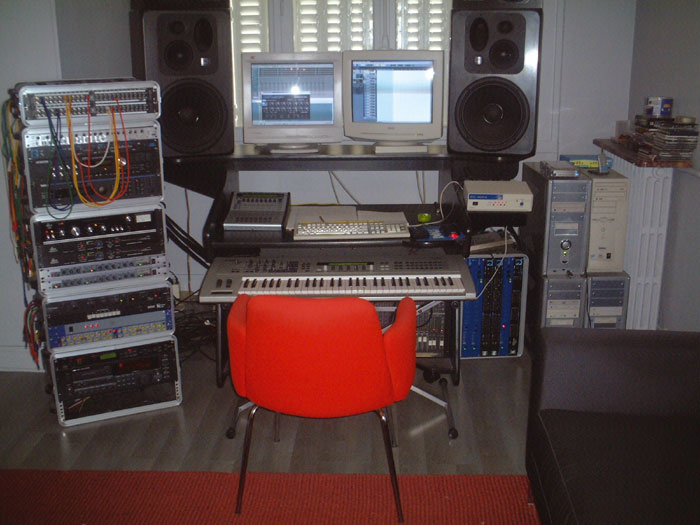 Walter Taieb's Paris studio is based around four PCs running Cubase, Sibelius and Gigastudio, with the Vienna Symphonic and Miroslav Virtous orchestral sample libraries.
"Of course people have been making pretty good orchestral demos for a while," Taieb concedes. "But they were using technology at its limits, and this affected the compositions. When I wrote The Alchemist and the Caroline Dale track I was still doing a lot with pen and paper, but for the Vanessa-Mae album I could for the first time input right away into my system, and hear something that's very close to the end result. In the past you could make things sound like an orchestra, but you couldn't compose like you normally would for an orchestra. It was also impossible to make very fast passages work, or to make the strings sing, and so people often simply had held chords in their demos. The VSL library has made a huge difference, even though the sounds themselves are sometimes better in other libraries. But the VSL actually contains played intervals, and so the passages from note to note sound a lot more realistic now."
For Taieb, the process of handling the computer screen like score paper has simplified and accelerated the process of writing for orchestra, and improved his sample-based demos as well. "I always begin composing playing my keyboard and using a piano sound," the Frenchman explains. "Then I sketch the general harmonic, arrangement and orchestration structures on paper. Once I have them I immediately enter the notes manually into Logic, using the Score and Matrix editors. I find that entering notes this way saves a huge amount of time when preparing the score. It may not be as listenable as when you're playing things in, but there are a lot less mistakes in the score — the notes are all the right length. Software programs have tremendous problems with things like triplets, and when you play things and then quantise, the score will look like a mess.
"I used Logic for Vanessa-Mae's album, but I've since switched to Cubase, which I think is better now; but at the time I didn't want to waste time learning a new program. From the first moment of working in Logic, or Cubase, I'm aware that the score will eventually end up in Sibelius, and so I make sure that it will be easy to export. First of all, I lay out the score on my screen just as an orchestral score, all the instruments exactly in the same order. The other thing I do is make extensive use of the MIDI channel splitter. I specify a musical articulation for different channels, so one channel is for legato, another for staccato, yet another vibrato, and others will be for long notes, short notes and so on. I have those different articulations in a very precise order in the splitter, so I can change the MIDI channel very quickly for each part on a note-by-note basis, and with that trigger the appropriate samples, making the demos sound more realistic.
"The moment I take the MIDI splitter out, it will look like one channel, and will be very easy to export to Sibelius. I'll then later write the musical expression comments and dynamics on the print-out from Sibelius. Another advantage of this way of working is that normally, you can put a lot of your time and imagination in making your sample-demo sound realistic, and yet you'll still expect the orchestra to improve on your demo a lot. This often leads to disappointments. But if it sounds good when you're basically playing it like a robot, you can only be pleasantly surprised later on in the recording studio."
Gathering Pace
Taieb's slightly unorthodox way of working appears to have made an impression, because he got the gig for Vanessa-Mae's album on the basis of the demos he made of his bolero and tango. "These demos were very elaborate," recalls Taieb," and I had written in every level change and expression, trying to make them sound as real as possible. If I want a more realistic-sounding demo, I will play the lead line in, or have someone overdub it.
"Later, when Vanessa came to rehearse these two compositions, we had three days to spare in Paris, and we came up with the idea of doing a kind of Santana track, with lots of percussion, some minimalist orchestration, and the violin on top. It was a strange concept, and I did a minute-long demo for it with some percussion loops and orchestral sounds played on my keyboards. It was sent to London, and I was told that if I finished the piece before the recording dates with the Royal Philharmonic Orchestra, which were a week later, it would make the album.
"This meant that I had to do the composing and orchestration in a couple of days. This is where the work with the computer was extremely useful. It was like using a word processor — I could copy and paste parts across and so on. When working on the track, which was called 'Tribal Gathering', I didn't bother with making the demo very realistic, since no-one would have time to listen to it, and it was only for my own reference. What's nice with my way of working is that after entering the notes, I just press Play and listen to it. I could test the orchestration really fast, and try different combinations in the orchestra, things you wouldn't attempt during a recording session with an entire orchestra waiting for you. This definitely helped me being more creative.
"In the past you learned orchestration from studying other people's work, and so you know that the combination of this instrument with that instrument will sound beautiful. Learning orchestration takes a lifetime, because there are always new tricks to consider. But when you work with computers you can experiment much more. I think that as long as you still have the same state of mind as when you were working with pencil and paper, computers are a great tool for orchestration. But if you do it without having a clue about orchestration, never have studied it, quality will go down. This is what happened with a lot of Hollywood scores, where composers have great sounds to work with and do MIDI versions of the orchestra, but end up creating a lot of middle-of-the-road music, without melody or real composing talent."
Transfer Troubles
After Taieb finished his composing work his copyist took over, double-checking the Sibelius score, extracting individual instrument parts and transposing some of them (Taieb prepares his conductor's score un-transposed), creating a conductor's score, and printing everything out. Armed with a suitcase full of paper and a Firewire drive with his Logic demos, Taieb travelled to Abbey Road Studios for rehearsals and recording with the Royal Philharmonic. Pro Tools was to be the recording medium for all the orchestral sessions, which necessitated transferring Taieb's Logic files via the dreaded OMF. "There were several reasons for the transfer. First I simply wanted to give the engineer an idea of the feel of the demos and the balance of the orchestra I had in mind. But we ended up not even listening to them! Then, all the orchestral percussion you hear on the final tracks came from my Gigasampler, so we needed these parts. Third, 'Tribal Gathering' was written for a 90-piece orchestra, and we only had 60 musicians, so I had to find a way of making it sound like 90. Obviously, the orchestra played to a click track, to be in sync with my material.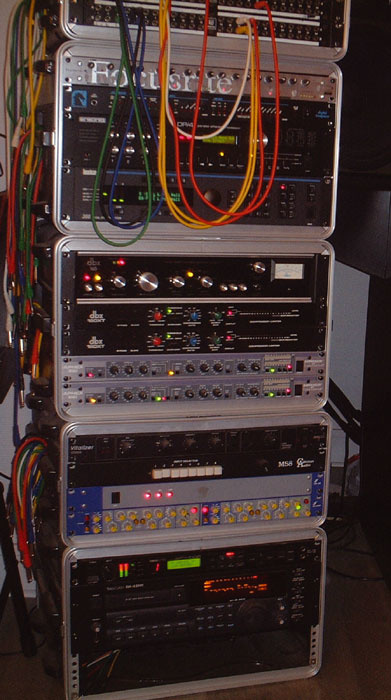 Walter Taieb's main outboard equipment racks. From top: MOTU Digital Timepiece synchroniser, Ensoniq DP4 effects, Lexicon 300L reverb, Dbx 165 and 160XT (x2) compressors, Aphex 661 compressors (x2), SPL Vitalizer enhancer, Focusrite ISA 115HD input channel, TC M5000 reverb and Tascam DA45 DAT recorder.
"With regards to the OMF format, I was surprised to hear at the three different top studios where the album was recorded, SARM, Metropolis and Abbey Road, that they all had problems with it. Somehow the audio tracks never end up in the right place. I found a way of transferring data from Logic to Pro Tools, which involved first transforming all my track files into one big audio file, and then transferring this from Logic to Nuendo, using OMF. They are compatible and so this was easy. In Nuendo I added an empty audio file to each track, starting all empty audio files at beat one of bar one, and then merging these empty tracks with the audio tracks. In this way all audio files begin at the same point and fill in all the blank spaces as well. If you export this from Nuendo as individual WAV files and then import them into Pro Tools, all the tracks are in sync."
Classical Sounds, Pop Mixing
Taieb conducted the orchestra himself for his three tracks, and was also involved in the overdubbing, first of Vanessa-Mae's parts at SARM West studios. "We had the luxury of a four-day lockout. After a few days she felt confident enough to improvise some cool violin parts on the 'Tango' and compose her lead part on 'Tribal Gathering'. I think we put about 10 microphones around her, and inserted all of them in the board so that we didn't know which microphone was on which channel. We gave all microphones marks out of 10, and ended up using a combination of a B&K 2006 and a Microtech Gefell UM92.1S, both placed about one metre above her."
Back in Paris, Taieb recorded some additional percussion in his studio, and a bandoneon at Mega Studios. The bandoneon turned out to be tuned slightly flat with respect to the orchestral recordings, so the entire orchestral recording was pitched down for monitoring while the overdubs were recorded, with the bandoneon pitched up again afterwards. Mixdown took place at Metropolis in London, where Vanessa-Mae's violin was, says Taieb, "treated as if it was the lead singer in a pop record. The engineer used a mixture of expensive vintage gear like Pultec EQs and cheaper equipment like the Focusrite Platinum Voicemaster, and plug-ins like the Sony GML emulation EQ. We also sent the violin through a quarter-inch analogue tape machine to make it sound warmer."
Anticipating that the record company would want to make the completed album sound as 'pop' as possible, Taieb had made sure he recorded all the sections of the orchestra together during the Abbey Road sessions. "On all the other tracks the orchestra was recorded in sections, but I wanted to have the sound of an orchestra playing together, so it would also sound good with just two overhead microphones, and so that the engineer would not be able to make it sound too rock & roll. As it turned out, the final mix still uses too much of the direct microphones for my taste. You need a mixture of room and direct mics in my opinion. Perhaps I'm just too much of a purist."
Taieb has since returned to club music, acting as DJ in Paris's largest dance clubs, and being DJ of choice for Marilyn Manson, Audioslave and Black Eyed Peas. Purist he may be, but he clearly still understands both sides of the classical/pop divide.