


Phil Tan, one of the leading mix engineers specialising in urban music, dissects his mixes for two worldwide hit singles from Rihanna: 'SOS' and 'Unfaithful'.
He may look almost unbecomingly young, but 37-year old Phil Tan is one of the most experienced and successful mixers in the American music scene. Talking from Jermaine Dupri's Southside studios in Atlanta, the Grammy award winner reveals details of his mixes of two tracks featuring Barbadian singer Rihanna, 'SOS' and 'Unfaithful', both UK No. 2 chart singles.
Malaysian-born Philip Tan graduated in 1990 from Florida's Full Sail Real World Education facility in the subject of Recording Arts. Moving to Atlanta, he embarked on a career as a recording engineer, first working at Soundscape Studios, and then at Babyface and Antonio 'LA' Reid's LaFace facility. His big break came in 1992 when he met 19-year old rapper/producer Jermaine Dupri, who'd just broken through with a huge hit for teenage rap duo Kris Kross.
Dupri invited Tan to work for him at his private facility, which was called Krosswire at the time (Southside Studios was built in 1999). "Between '93 and '98 I recorded and mixed everything Jermaine did," recalls Tan. "I was still independent, but I literally had no time to do anything, so I worked exclusively for Jermaine. I got a bit burnt out with the recording part of it, so in '98 I switched to mixing only. I still work for him and at Southside, but I do my other mixes mainly at a room I have at Soapbox Studios in Atlanta, with my own Pro Tools system and favourite Yamaha NS10 monitors."
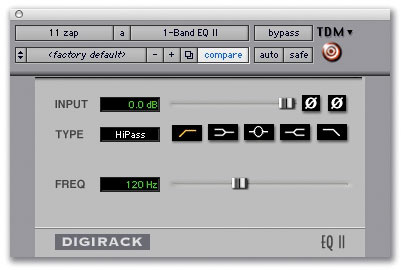 Phil Tan uses the standard Pro Tools EQ to filter out unwanted low-frequency rumbles.Phil Tan's work has appeared on albums and singles that have sold in excess of a staggering 150 million in the US alone. He specialises in R&B and hip-hop, and his credits include Usher, Snoop Dogg, the Neptunes, Fergie, Ne-Yo, Nelly, Ludacris, Destiny's Child, Gwen Stefani, Mariah Carey, Alicia Keys, Janet Jackson, Busta Rhymes, Aretha Franklin, Elton John, Cee-Lo, Toni Braxton, Run DMC and many, many more. In November 2006, when this interview took place, 16 songs mixed by him featured in the US Billboard Hot 100 & Hot R&B/Hip-Hop Songs chart, and 23 albums containing his mixes were in the Billboard 200 album chart
'SOS (Rescue Me)'
Writers: Jonathan 'JR' Rotem, Evan Bogart, Ed Cobb
Producer: 'JR' Rotem

 The backing vocals on 'SOS' were boosted above 5kHz and treated with small amounts of pitch-shift on either side to widen them.Phil Tan: "This song uses a stereo two-bar loop from Soft Cell's song 'Tainted Love' as its basis. JR played the additional parts with a combination of soft and hardware synths. There were probably 30 to 40 tracks in total. JR tends to give you [Pro Tools] Sessions that have a clear direction: there's not much guesswork. I didn't change or add much, just a bass drum and taking out the loop a couple of times for additional breaks. There was never any doubt that it was going to be a clubby song, so it had to be very immediate and hard-hitting. The song was sent to me by an A&R executive who knew of my work, I turned it in, and the next thing I knew it was on the radio.
"The screen shots show just a few of the plug-ins that are used. There are loads of them across the entire Session, I just selected some that I thought would be helpful in some way. I think a lot of times what mixers do is seen as a little bit of a mystery, but it really is not that complicated. We use the same stuff as everybody else, the only difference is that we're a little luckier in having our stuff show up in the charts."
'Zap!' sound & others: Digirack EQII high-pass filter
"This is just a simple high-pass filter which I use all the time on almost everything because, apart from the kick drum and the bass, there's generally not much going on below 120-150Hz. I have always found that filtering below this cleans up unnecessary muddy low-level things, like microphone rumblings and so on. The Digirack EQII is a very simple and helpful plug-in. It's seen working here [above] on a sound called 'Zap', which is a space raygun kind of synth sound that had a bottom end that got in the way a little bit. Incidentally, the 'Tainted Love' loop had a kick drum, and JR added another one for additional bottom end, and I added one to that to give his kick drum some more definition. Mine was not a big, thumpy kick drum, it had more of a point to it, and it was probably above 120Hz."
Backing vocals: McDSP Filterbank E2
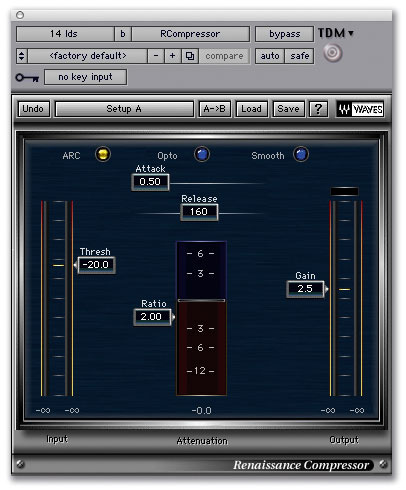
 Rihanna's lead vocal on 'SOS' was processed with Waves' Renaissance Compressor, while reverb came from the same company's Renaissance Reverb."I compressed the background vocals using the Waves Renaissance Compressor, and sometimes you lose a little bit of top end in the process. This filter [right] was just a shelf to bring it back a little bit and give it some sheen. Because this is a high-energy track, you want the vocals to match that energy. Basically I boost 3.5dB from 5k upwards. I have loads of different EQs, and this one is a two-band that's very easy to operate. It worked, so I stayed with it. I may choose other EQs because of different capacities but also because they'll sound different. Some are fairly clean and some impose a bit more personality."
Backing vocals: Digirack Pitch-shifter
"This is working on the background vocals, to fatten them up and apply a bit of a chorus effect. As you can see [top right], they're flattened slightly on the left and made sharp on the right, with varying degrees of delay. Like with most effects I use, it is sent to an auxiliary and blended in later, which is why the mix is set to 100 percent."
Lead vocal: Waves Renaissance Compressor
"'SOS' is a pounding type of song, and the lyrics are a cry for help, so the vocals need to be 'in your face', almost aggressive. I therefore wanted to make sure that the vocal is fairly constant. There's plenty of level automation with the vocals going on, riding the faders with the mouse — this song was done in-the-box at Silent Sound Studios, also in Atlanta. Ideally it would be nice if you didn't hear compression, but in some cases you do want to hear it. The compression ratio isn't that much, and I pressed the Opto button, which emulates the feel of older analogue compressors."
Lead vocal: Waves Renaissance Reverb
 DUY's Redspider plug-in was used to create a wider stereo image from a mono cymbal sound on 'Unfaithful'.
 Phil Tan used the Metric Halo Channel Strip EQ to round out the bass on 'Unfaithful'.
  The Waves SSL E-Channel plug-in was used to compress the backing vocals.
 TC's Mega Reverb was the main reverb on 'Unfaithful'.
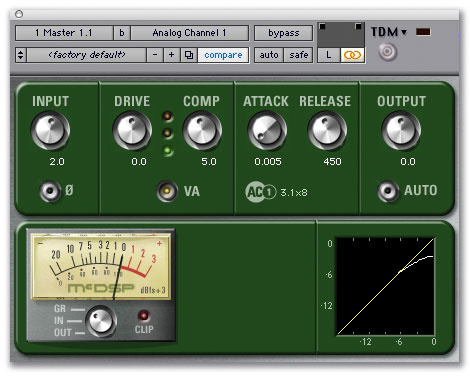 The mix of 'Unfaithful' was processed with McDSP's Analog Channel to provide additional warmth."There's not a lot of reverb in the song, because it's up-tempo and quite packed, so there's not a lot of space. The reverb here is a room with a short length, 1.68S — a longer time would have gotten in the way. Sometimes you have to carve out a space for a reverb with EQ and by shaping the reverb characteristics — attack, release time, length, and so on — so that it does not interfere with the other frequencies in the song. I don't normally pay a lot of attention to exact reverb time, it's only with delays or reverb pre-delays that you want them exactly in time. Finding the right reverb is a bit of an unconscious process for me. It's an ongoing process of trying things out throughout the mix, until I find the right combination of ingredients."
'Unfaithful'
Writers: Ne-Yo, Tor Erik Hermansen, Mikkel S Eriksen
Producers: Stargate
Phil Tan: "This is a ballad centred around vocals, piano and strings. It was co-written and produced by the Norwegian Stargate production duo. It had about 60 tracks, including a lot of strings. I treated those as one instrument. Lyrics will give you the direction of the song, and this song is very much about a vocal performance. So I started by working on the vocals, then the piano, and then fitted everything else in. Conversely, with 'SOS' I probably started with the drums and built up from there. When I first listen to a track I look at the Session, and at the individual tracks to see what they are doing. That first impression is important, and is usually the right one."
Cymbals: DUY Redspider
"DUY are from Spain and they make great stuff. All the Redspider does here is create space on the cymbal, which was mono. I wanted the cymbal to feel wider and more washed out."
Bass: Metric Halo Channel Strip
"This has dynamics and an EQ section. In the early days when plug-ins weren't so DSP efficient, it was handy to have all-in-one plug-ins. The Metric Halo was modelled after the SSL, and before the Waves SSL bundle came out I used it to imitate the sound of an SSL. Here it gives the bass more roundness; the EQ is the main part I used. I added a bit of 2.2kHz, 315Hz and 80Hz."
Backing vocals: Waves SSL E-Channel
"With backing vocals, once you have them blended, a lot of times you have to remove stuff you don't want and accentuate stuff you do want. Particularly with stacked backing vocals, clarity and definition are important, which is what I tried to achieve here. There's a decent amount of compression, with the ratio at 8, and I added some high end. I guess I'm drawn to the SSL sound, since I've worked on them for so many years, and the SSL bundle is essentially three different plug-ins: EQ, compressor and channel strip. There's an analogue switch that adds harmonic distortion to give it a certain SSL character."
Vocals & others: TC Mega Reverb
"This was the general reverb used on most of the song. The TC plug-ins are very good-sounding, and I use them quite a bit. I find the graphic representation of the reverbs very helpful; it allows me to sculpt things better. It's an older plug-in, so for its time it was great, but since then reverbs have improved: particularly the convolution reverbs are great. I used the TC reverb in this case because it sounds clean and I like its simplicity. I don't have the patience to figure out things that are complicated. 'Unfaithful' is not an intimate ballad; it's more a show tune kind of thing and that's why it needed a larger space."
Stereo mix: McDSP Analog Channel
"This went over the whole mix. The setting is supposed to emulate a Neve console. I used it for a little warmth and harmonic distortion. I have several plug-ins that emulate analogue gear, like DUY Valve, Cranesong Phoenix and McDSP Analog Channel. They all sound different. Which one I use depends on the song and the kind of sound I'm looking for. Basically a mix is the result of a decision-making process throughout a day. It's the way I felt about a particular song on a particular day. If you were to give me the same song on a different day, it would probably come out differently. There's no such thing as perfection, and I think music is more fun when things are a little bit inexact."
Mixing With Intuition
"Settings don't mean anything," insists Phil Tan. "A lot of the time, if you try to use the same setting on the same singer, or the same drums, but in a different song, it won't work. Of course, I have settings that over the years have worked fairly reliably, and I often reach for them, but in the end settings are simply whatever I felt was appropriate on a particular day on a particular song. Whatever works is whatever stays. I don't analyse what I do too much, it really is just what I felt at a particular time. A mix is therefore like a time capsule of sorts, and in all honesty, in the 16 or 17 years I've been doing this, I've never been able to listen to my own mixes after I finished them, because I hear all the stuff I could have done differently."
Getting In The Box
"For years I mixed on an SSL, until I went 'in-the-box' around the time Pro Tools went HD — 2001/2," says Phil Tan. "I work in Pro Tools because that's what everybody gives to me these days — no-one wants tape any more — and what really made the difference was when they included the built-in plug-in delay compensation.
"Mixing in the box has become a necessity because of the way the business works these days. I do about 200 mixes a year, and take on average one and a half days per mix. Very few artists and producers now attend the mix session, so on the first day I get things very close, and then I send a stereo audio file, often MP3, off for feedback. I have little or no control over when people get back to me, so it would be very costly for me to have to wait for that, or to set the whole mix up again on a mixing desk at a later stage. Instead, I can save everything in Pro Tools, including the plug-ins, which are the majority of my effects. I'll record any analogue effects I've used, like my favorite GML 8200 EQ or Tube Tech compressors, as audio on separate tracks. When I receive the feedback, I can simply load the Pro Tools file and put the finishing touch on the mix.
"I don't mind mixing in the box, but recently have had problems with carpal tunnel syndrome because of over-using the mouse, so at Southside we now have a Digidesign Icon control surface, which is much easier to use than having to type in numbers and click and drag with a mouse. I have no control surface at Soapbox. I used to have a Pro Control, but it wasn't precise enough so I was still typing in numbers and using the mouse, and I got rid of it. I'm now looking into getting something else, maybe the Jazz Mutant Lemur."