


Over the last decade, some extraordinary music has emerged from Tori Amos's Martian Engineering studio. A new box set collects together the highlights, while the studio itself is soon to open to paying customers.
Tori Amos had been called "the '90s' most essential musician besides Kurt Cobain", and her recent boxed set, A Piano: The Collection, illustrates why. Strikingly packaged, with a two-octave, full-size piano keyboard sitting on top of the box, it contains five CDs charting Amos's musical history from her international breakthrough, Little Earthquakes (1992), to her most recent album, The Beekeeper (2005), plus assorted B-sides, live, rare and previously unreleased tracks. It's a musical history dominated by Amos's long-standing fight for artistic freedom.
When she first signed to Atlantic in 1987, she caved in to record company pressure by modelling herself as a permed rock chick with a band called Y Can't Tori Read, which released an eponymously titled collection of guitar-led '80s rock in 1988. Afterwards, she faced an uphill struggle to get Atlantic to accept her on her own terms. Little Earthquakes established Amos's inimitable voice as a singer, songwriter and piano player, but she had to fight tooth and nail for four years to have this now-classic album released in a way that she could accept. It was initially rejected, an A-list producer — incredibly — suggested that all the pianos should be replaced by rock guitars, and the track listing was changed several times.
Even after that, Amos faced a constant struggle to trust her own judgement over the many outside voices whispering, or shouting, in her ears. She left songs off records against her own better judgement, and accepted a string arranger not of her own choice before ending up personally erasing the multi-thousand-dollar session tracks.
Small wonder that the American singer is combative whenever criticisms are levelled at her work. "I do not bend to the suits in the industry, or experts who supposedly know my music better than I do," she declares. "I do not bend to anyone. I serve the songs, and I will do anything in order to retain who they want to be. They are my children, I am their scribe, and they are entities, they are alive. I am a woman doing exactly what I want to do, and I am in a great position. There are very few women at my age who have put out a boxed set and are ready to put out a vital work in 2007 and getting ready for a world tour."
Going West
Amos, who is 43, has proven all the suits and quasi-experts wrong, and carved herself a niche as one of the most respected and successful female songwriters around. In achieving this, her quest for artistic independence has been, and continues to be, at the heart of almost everything she does. It was, for instance, the reason why she built her own studio, following advice from Peter Gabriel in 1995. At the time she was recording her third album, Boys For Pele, on location in Ireland, with the help of engineers Mark Hawley and Marcel van Limbeek.
 The control room at Martian Engineering is built around a Neve VR desk.Photo: Martin Philbey / Redferns
"Peter said to me: 'You've made some successful records, but I want to know where you're going to be in 10 years time. There will be good times and bad times with your record label, and to develop your music you need a workshop, a place to experiment.' I had no idea how right he was going to be. Had I not listened to him, I don't think I would have survived the war with Atlantic Records. But we were here in Martian Engineering, and we were in control and in command of the music and the record company only had access to the master tapes that I gave them. I've heard stories of artists standing outside and banging on doors, screaming 'Give me my fucking masters!'"
Amos, Van Limbeek and Hawley founded Martian Engineering in 1997, and Amos and Hawley were married the following year. Cornwall was Hawley's suggested location for the studio, and suited Amos very well. ("Like Real World, we are far away from the paranoia of London, LA and New York.") Far away from physical record company presence, Martian Engineering was from the beginning a top-flight studio, where Amos has recorded, mixed and/or mastered all her work since 1997.
Piano Music
The studio has helped to fuel an extremely productive phase in Amos's career which has seen her releasing music at a frightening rate. A studio album, The Beekeeper, a 45-track iTunes compilation and a 12-CD live boxed set, The Original Bootlegs, all saw the light in 2005. In 2006 there was a DVD called Fade To Red: Video Collection, and a new studio album is scheduled for release in the middle of 2007. In addition, the singer released another retrospective, Tales Of A Librarian, as recently as 2003. One could imagine that Amos might have regarded a boxed set at this stage in her career as too much of a good thing, but when Rhino Records approached her with the idea of presenting a DVD collection of almost all her music videos to date, plus a five-CD 'artistic vision' of her work, she jumped at the opportunity.
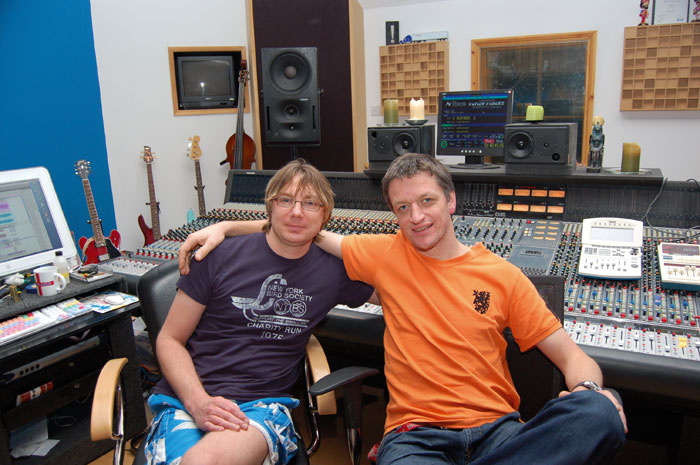 Martian engineers: Mark Hawley (left) and Marcel van Limbeek."A few people who have had boxed sets done said to me that I'd better do it myself, or else I'd feel like shooting myself," remembers Amos. "So I told Rhino that they would have to trust me, and they did. We remastered and remixed [in 5.1] the DVD video collection first, and because it's running many songs from different periods back-to-back, I learned that mixing sonic worlds together leads to a cut-and-paste effect. I did not want that for the boxed set. We needed to keep the songs within their time frames."
Amos aimed to 'chronicle time' with A Piano, providing a historical overview of her work over 15 years as a composer and performer. "You have to understand that this boxed set is not just about pleasing somebody today. This is about creating something that in 10 or 15 years time will be what you go to and that the digital radios will play, because I have been able to refurbish the tracks and make them valid for today, so they can hold up to the records that are being released now. When you do a historical perspective, you also need to think about what it will look like in the future."
In contrast to Tales, which was based on the concept of remixing selected songs from her back catalogue, the idea of remixing everything for the boxed set was ruled out, as it would cease to be a historical document. Moreover, songs from her 2001 covers album StrangeLittleGirls or any of the many other cover versions she's performed over the years (most memorably Nirvana's 'Smells Like Teen Spirit') were deemed inadmissible, because, says Amos, "Those songs are not my children, so I chose not to include them."
Instead, in selecting and sequencing the 86 tracks on A Piano, Amos decided that it was first and foremost a matter of choosing "the best of the best" from her studio albums. After this, a selection was made of the best of the best of rare and previously unreleased tracks. The next step was to sequence the material in such a way that, while the album tracks were roughly grouped together, and the B-sides and demos all ended up on the fifth CD, each of the CDs could stand on its own as a listening experience ("Chronological order can be a cop-out. It's an easy way to catalogue something, but it's not necessarily a narrative. And I really respond to a narrative.") She also decided not to record any new parts or tracks, apart from the vocal for 'Take Me With You', an unfinished song from the Little Earthquakes sessions.
"Picking the best of what I had was bittersweet," explains Amos, "because I had to be very careful whether I was in the artist or producer's chair. You can start judging yourself as an artist, whereas it was my job as a producer to present a history of my music. So I had to really discipline myself. Producing is a skill, and stepping into the producer's chair doesn't mean that you can do it. I had to learn a lot. I stepped into producing for Boys For Pele because I was fighting for my artistic life. Atlantic wanted another record like Under The Pink [Amos's 1994 second album]. But I knew that if I delivered that, it would be all over for me. You cannot repeat yourself exactly the same way. People move on."
Mastering The Piano
As well as Mark Hawley and Marcel van Limbeek, another crucial long-term collaborator in Tori Amos's career has been mastering engineer Jon Astley. The A Piano box set, unsurprisingly, involved a fair amount of work at the (re)mastering stage. "The box set's five CDs are made up of one for B-sides and rarities and the other four are the eight studio albums that she's done, four of which I originally mastered. The early albums were done before Tori and I met. Mark brought the mix masters and the mix reels with the alternate versions on them back from LA on magneto-optical drives in DSD format, and we played those on my Genex into the mastering chain so we could easily compare them without having to line up a tape machine between reels.
 Photo: Martin Philbey / Redferns"I think Tori planned these albums very well. They are almost chronological, but the running orders have been changed around, and where there were relevant tracks that were recorded during the sessions that didn't make it onto the album, they too have been included. The fact that her running orders work so well actually took a lot of the pressure off me to make things sit well together, although there wasn't a great need for me to polish the older material — the masters I was working from sounded so much better than the CDs. I only used a small amount of multi-band compression with a nice limiter with a soft-knee on it just to hold some of the peaks down, and balanced the bottom end of some tracks to make them sit well with the others, but I left the top end entirely alone.
"For EQ I used the mastering version of the Manley Massive Passive (it's the same as the studio version but with rotary switches rather than pots and more useful roll-off frequencies for mastering). And I used just a little bit of dynamic EQ on one or two songs where Tori's voice was popping out of the track a bit. She doesn't seem to do this any more, but early in her career her vocals could occasionally get a bit hard-sounding at around 2kHz, and by using the Weiss dynamic EQ I was able to push those down a little without affecting the rest of the vocal. I used a little de-essing, also from the Weiss, just to catch the 'esses' when they were very loud, without affecting the rest of the top end at all. I used the TC Electronic three-band compressor rather than the five-band, mainly because I am so used to it. I'm hardly using it, but it's still worth it, just to give me a dB or so of extra level. Then I go into the Brickwall Limiter in the TC MD4 dynamics package. I think that's a really nice-sounding limiter.
"There's no pressure working with Tori. There's always time to burn things to CD and just live with them for a few days, which is great on a project like this, as you'll always spot new things you want to tweak or have fresh ideas. All four of us have a say in the mastering and I don't always get my own way!" Dave Lockwood
Only The Best
One of Amos's production decisions for A Piano was to have far-reaching ramifications. She "wasn't going to accept 1630s", but instead wanted to "go back to the original, pre-mastering stereo mixes and remaster everything". So Mark Hawley went over to Capitol's Studio Library in Los Angeles to track down the original stereo masters for Amos's first two albums, Little Earthquakes and Under The Pink, which had been recorded and mixed to analogue tape. Hawley was shocked to find that many tapes had either disappeared or been damaged.
"When we discovered that some of the master tapes were not holding up well," recalls Amos, "Mark found alternate mixes made at the time that were not dramatically different. All through the years I've insisted on having several mixes with very slight variations. Once I knew we were almost there with the mix, I wanted alternate mix versions with the vocal point two or point four up or minus two down — I think in increments, not dBs. These mixes with very small variations retained the spirit of the original recordings and saved our lives."
In the end result, Disc A of A Piano is called Little Earthquakes Extended, and contains the entire album plus the songs that had been left off during the four-year struggle of its making, in an entirely different track order. Disc E contains 'B' sides plus three demo recordings made at Martian. Amos acknowledges that it was "very difficult" to whittle her 100 B-sides down to 19.
The Organic Musician
The decision to group tracks from From The Choirgirl Hotel (1998), Scarlet's Walk (2002) and The Beekeeper on Disc D was in part thematic (the first was influenced by "an undercurrent of miscarriages" and the latter two were made after she became a mother in 2000) and in part sonic. Having used mainly conventional pianos at the start of her career, Amos experimented greatly with music technology on Choirgirl, playing many electronic keyboards and working with samples and loops. The modern sound of that album sat well with that of her two most recent albums.
Amos decided to remix two Choirgirl songs, 'Iieee' and 'Cruel', because, she says, "These two tracks were such production numbers that I was comfortable retouching them, as we have access to so much more technology today. Choirgirl was about using technology as an instrument. When people listen to 'Cruel' in 20 years time, this is what I want them to hear, because it's better." When Amos is asked what exactly it is about today's studio technology that has improved so much that she feels warrants the remixes for A Piano, there's a long silence,
 A selection of amps miked up ready for recording, including a Leslie (centre). Photo: Martin Philbey / Redferns"We're pretty geared up in the studio," she says, finally, "and I think I have made friends with what's there now. I don't regard studio equipment as the destroyer of the organic musician any more. I've lived with all the boxes and knobs. I understand what Pro Tools does. I believe in using all these things as instruments, and have learned how to use them musically, instead of letting them homogenise my work. There's a way to apply technology without becoming robotic. And so it's a cop-out not to embrace it.
"Studio technology has been much harder to come to terms with for me than performance technology. I had to sit back to be able to see the subtleties and endless possibilities of studio technology. How effects are used, how compression is used, EQ, microphones and so on. Now what's happening for me is that I treat these elements as part of the arrangement. On the new record I use both production and performance technology, playing Fender Rhodes, Yamaha CS80 and the Bösendorfer."
Despite making her peace with studio technology, Amos still sticks to her Bösendorfer grand piano, a compact cassette recorder and a ghetto-blaster as her preferred writing aids. In her book, Piece By Piece, she also warns against what she calls "audio pornography": the use of effects for their own sake. "I think with Choirgirl we over-tweaked things frequency-wise. In working with Mark and Marcel I've had to learn a lot. I had to hear how certain frequencies will tear your head off. I don't want you to feel as if dogs are barking in your ears and sometimes I may have done that. Frequency is a really fierce and ferocious teacher. And what I do is about turning things up. I don't make records for little things in people's ears."
The latter is a reference to the whole phenomenon of the iPod and music downloading. Amos admits that "You have to make sure that what you do works on any system," but expresses her exasperation. "I don't know why you would not want music in its best form possible," she sighs. She adds, using a Dutch expression probably learned from van Limbeek, "but that's me, I'm an antfucker [nitpicker]. I make things to sound good and to put on loudly. As you hear the music in your body, every chakra is responding, and you feel satisfied."
Life On Mars
The Hawley-Amos residence is hidden at the end of a dirt road off a Cornish B-road deep in the middle of agricultural nowhere. Behind a home that's modest by rock-star standards, a former shed has been converted to form Martian Engineering. In addition to the spacious control room there are four live rooms, plus the other paraphernalia that's an intrinsic part of a modern studio: machine room, office, maintenance room, storage room and so on. Until not so long ago, this was the whole of Martian Engineering, and it was as private as Hawley and Amos's home on the other side of the courtyard. But recently a brand-new construction has arisen behind the shed, containing a large common room connected to an open kitchen, four bedrooms, a health spa containing a jacuzzi, steam room, sauna, gym and so on, plus Amos's piano writing room. Most areas enjoy panoramic views of the surrounding countryside. The complex has been built in preparation for Martian Engineering opening its doors to paying visitors at some stage in 2007.
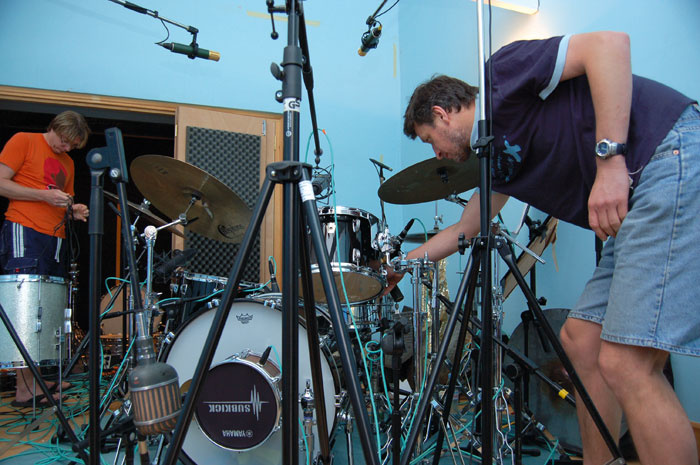 Hawley and van Limbeek put the finishing touches to a mic setup for a drum track.Photo: Martin Philbey / RedfernsSitting in the control room, Mark Hawley, Amos' engineer and husband, and engineer Marcel van Limbeek do their best to answer questions about their working methods and about Martian Engineering. Born in London, but growing up in the north of England, Hawley cut his teeth playing drums and guitars in local bands before he went into live engineering. Limbeek is Dutch and moved to London in 1991, where he met Hawley.
The two hit it off and began working together, with van Limbeek doing on-stage monitoring and Hawley front of house. Hawley happened to know John Witherspoon, Amos's manager, who in 1994 asked the duo to do the live engineering for four weeks of her Under The Pink tour. Hawley and Van Limbeek instantly clicked with Amos, and she invited them to do the entire tour, which spanned 181 concerts and took up most of 1994.
Hawley: "The tour was a simple setup, just her and a piano, and we offered to record it for her on ADAT. Some of these live performances got turned into B-sides, and she then asked us to help her with a new record, which became Boys For Pele. We recorded it in 1995 on location in Ireland, using gear we bought from the recording budget and some stuff from a little studio I had built."
Squash Courts
Most of 1996 was taken up with Amos's next tour, this time consisting of a whopping 187 concerts, and in 1997 Amos and her two engineers finally found the time and space to put Peter Gabriel's advice into practice. Hawley: "A week after we finished the tour, I went to Cornwall, looking for somewhere to build a studio. We didn't want to buy a studio in London, partly because of the cost, and I'd always loved coming to Cornwall as a kid. So I found this place and luckily Tori liked it, and then it was a matter of finding builders and stuff, while Marcel studied acoustics.
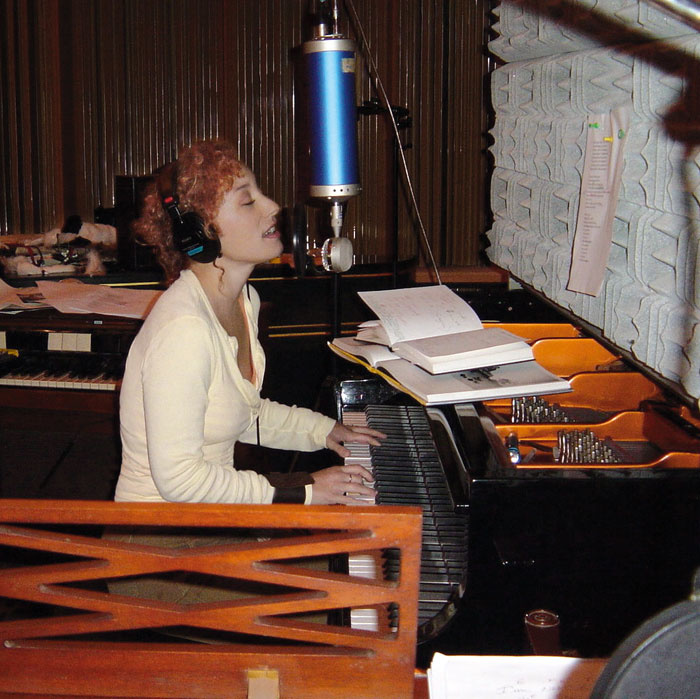 Marcel van Limbeek has recently begun using the Korby KAT5 'convertible' mic to record Tori Amos's vocals.Photo: Martin Philbey / Redferns"Initially we were just thinking of building a place where we could record From The Choirgirl Hotel. We had acquired enough equipment with Pele to record an album, but we'd mixed at Jacobs Studios, and we wanted to be able to mix the next record in our own facility. We got an architect in for the structural stuff, and to obtain the planning permission, and Marcel designed the studio's interior. As ever, we were up against time, and everything — from the building work to installing the Neve VR Legend VSP 7.1 desk, which has 68 channels and Flying Fader automation — was done in eight weeks."
Van Limbeek reports that the control room originally "sounded like a squash court". He designed and installed lots of diffusers to create a natural and consistent decay time throughout the room, rather than opting for more conventional live-end dead-end acoustics, which tend to result in a single sweet spot. In addition, all the studio spaces are 'floating', with floors, walls and ceiling isolated from the thick Cornish stone walls.
Hawley elaborates: "The basic studio is still how we put it together in early '97, but we have made of lots and lots of little improvements that made a huge difference to the place, and we've bought tons of outboard equipment over the years. Also, I've been to so many studios over the years where everything buzzes, and you wonder where people's desire is to make a great studio. I am really into making the studio technically as good as possible, lowering the noise floors wherever possible.
"We decided to upgrade all our old-fashioned microphone cabling to AES-EBU, and we changed all the cables from the Pro Tools to the desk, and the improvement was incredible. Of course, when you improve each of 48 channels by a tiny amount, then 48 channels together make a huge difference. We also connected all the valve gear without Pin 1 connected, to avoid any earth loop. So all our gear is earthed through the mains."
The Digital Revolution
Hawley and Van Limbeek were both very early converts to digital. "We always recorded on digital," says van Limbeek, "initially on a Sony 3324 [24-track tape recorder]. We liked that digital sound doesn't degrade after many playbacks and there was something really precise about digital sound. Now digital sounds even better and in some respects almost more like analogue, because it's so smooth."
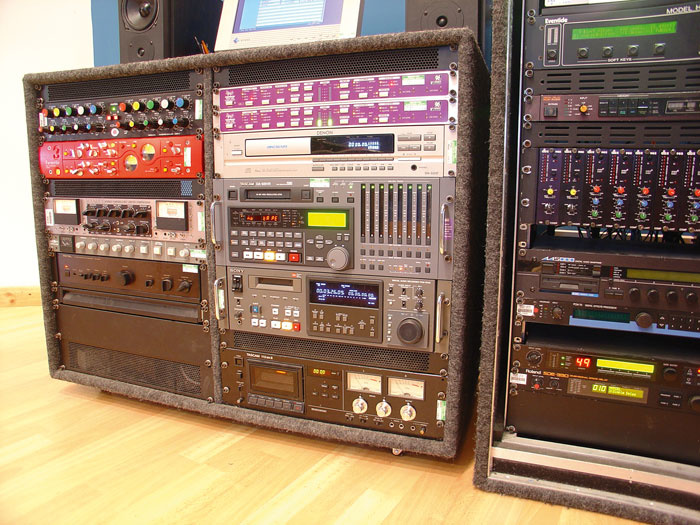 Photo: Martin Philbey / Redferns
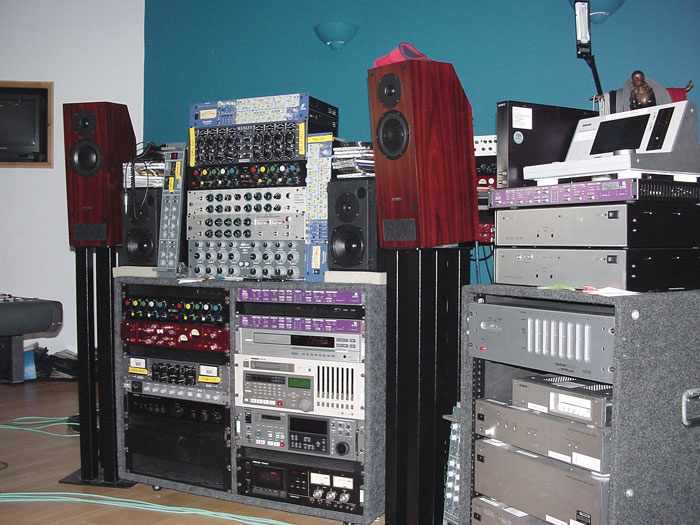 An extensive collection of outboard gear gives pride of place to a wide range of stand-alone preamps. Photo: Martin Philbey / RedfernsAccording to van Limbeek, the biggest change at Martian "has been the arrival of the Pro Tools rig". They started out with six Apogee AD8000 converters, and currently the studio has three Apogee AD16X and three DA16X converters, providing a total of 48 inputs and outputs to Pro Tools.
"For us it has always been about maximising sonic quality," states Hawley. "The AD8000s made all the difference. As for Pro Tools, we first encountered it when Andy Gray was using it programming for us during the recordings of Choirgirl Hotel in 1997. We'd record stuff on the Sony 3324, and sent it to him and he would do loops and stuff and we'd put that back into our tape machine. At one stage he offered to process Tori's vocals in his Pro Tools, and I was like 'I'm not having my wonderful audio in your stinking Pro Tools!'
"But gradually we began to use it, and the year afterwards we moved over to Pro Tools. The amazing thing was that it turned our whole way of working around. From Choirgirl Hotel onwards, Tori always tracks live with Matt [Chamberlain, her regular drummer] in a different room, and in the old DASH days they would do four or five takes of a song and then we'd edit it in the DA88, which could take half an hour. But with Pro Tools it's a matter of doing as many takes as they want and in a few seconds we can edit the best bits together. It's so creative, and because it's so quick, you can maintain the recording vibe much better."
Mark Hawley is also evangelical about the value of Pro Tools at the mix stage. Part of the reason why they chose to remix tracks on Tales Of A Librarian and A Piano was that "mixing with Pro Tools makes such a difference as far as keeping the noise floor down, and we thought we could make the music come across better. We restarted the mixes from scratch. For us it is all about being creative and you're never going to think the same about something, so even as we use the Flying Faders automation, we don't bother to recall or write down our mixes. If it is wrong, we do it again."
Hardware Heaven
Hawley and Van Limbeek now record to 24-bit at 96kHz ("We experimented with 192, but Pro Tools isn't ready for it yet"), but their quest for sonic excellence doesn't just stop at using HD and top-quality digital converters. They stress that the front end has always been equally important. "Our Neve VR here is an amazing desk," explains Hawley, "but apart from the occasional channel here and there, we never used it to record. Instead we always went through preamps. This began with Pele, when I bought a cheap Tascam desk just for monitoring and the Focusrite Red 1 to record. Since then we've kept buying more and more preamps."
Today, Martian Engineering's armoury includes models such as the Millennia STT1, Focusrite ISA430, GML 8304, Summit TPA 200B, Chandler TG1, DW Fearn VT2 and TL Audio PA1. These complement an equally impressive microphone collection, featuring 35 Neumanns and 16 AKGs, plus models from B&K, Shure, Sennheiser and Blue, and the multi-capsuled Korby KAT5. Hawley praises the latter as being part of "the new, low-noise-floor valve technology".
It's usually van Limbeek who records Amos herself, giving man-and-wife tandem a bit of space from each other. "For the new record, Tori's piano is recorded with two Neumann U87 mics, placed under the lid, in an M&S pattern, one set to omni or cardioid and the other to figure-of-eight, going through a GML 8304 preamp. Before that I'd use two U87 microphones with cardioid patterns, placed phase coherent, with a bit of space between them. In the past I always used the Focusrite Red 1. You have to change your setup at times: you can't have every record sound the same.
 For her forthcoming album, Marcel van Limbeek has recorded Tori Amos's Bosendorfer piano using a pair of Neumann U87s in an M&S configuration.
"Just like with The Beekeeper, we began recording Tori's vocals on the new album with the Blue Bottle, but one third into the recording we obtained the Korby, which is a fantastic microphone. You can change the capsules to get the characteristics of several classic microphones. It sounds amazing and the noise floor is so much better than with many of the old microphones. We used it for the remainder of the sessions, varying the microphone capsule and preamp per song, and sometimes inside of a song, but mostly we used the U47 capsule. She sometimes has very elaborate vocal arrangements, so it helps to have different vocal sounds inside of a song. The GML is one of our really clean preamps. The Focusrite is a super and very reliable all-round preamp. Lately we have been getting a bit more into crazy preamps, like the Neve 1084, which is fantastic, and the DW Fearn, which is a beautiful valve amp."
Hawley adds a little bit of context: "Generally what happens when we are making a record is that the three of us will get together after Tori has written songs with her piano and her cassette recorder. Unless we happen to be around, she doesn't normally play us these things. She will then go into the studio and demo the songs with us. The great thing about having our own studio is that even as we never intend to use those takes, they sonically are of good enough quality to get used if necessary. The recording of 'Gold Dust' on Scarlet's Walk was a demo run, and the three demos on A Piano were also recorded like this.
"When we record an album we have three to four weeks during which it's just the three of us here, and every day she demos songs and we all listen back. When Jon [Evans, Amos's bass player] and Matt arrive she'll usually play them the best demo recordings, or play the songs live, and they will then chart the songs out and start working together on them from there. These days they always track together, all three of them. Jon will sit here in the control room, Tori in one live room, and Matt in another. They may do eight or nine takes, and sometimes a few fixes to improve their parts. But usually what you hear is what they've played.
"We tend to use Pro Tools purely for editing and as a tape machine. Everything else we do outside of Pro Tools. For the new record we started to use some plug-ins, because a couple of them are now very good. We used the Massenburg Designworks digital EQ, for instance, which is brilliant. It's precise and smooth and extremely neutral — it doesn't change the colour of whatever you are treating. Other than that, I started using Sound Toys software for crazy effects, and that's it."
Hawley and van Limbeek certainly aren't short of outboard gear at Martian, with numerous EQs, compressors and effects units available. Mixdown is to a SADiE Series 5, which uses DSD technology — "a great format", according to Hawley. "A typical mix chain on the vocals may be Neve 1084 [preamp] first, then LA2A or 1176 [compressors], depending on what sound we want, then GML EQ."
Landing On Mars
The trio aim to turn in the mixes for Tori's new album by the end of January, after which they'll be busy preparing for her next world tour. While they are away on tour, Martian Engineering will open its doors to the outside world for the first time. In this time of ailing and closing studios, does Hawley really feel they'll be seeing plenty of customers? "Totally," he replies. "It's amazing that you can do everything at home now, but there will always be room for a great acoustic space of exceptional quality and without any technical problems. In order to survive, professional studios will simply have to be of really great quality."