

We discuss the merits of mics that feature a USB port and compare recent arrivals from Rode, MXL and SE.
Podcasting is one of the latest buzzwords for self-promotion on the Internet. It's easy to do: create your own radio-style programme, publish it on the Internet and make it available for anyone who wants to download it to their MP3 player or computer.

Not surprisingly, manufacturers have been quick to launch products designed for podcasting. This includes a range of USB microphones which can connect to any computer via a USB cable, enabling the user with a laptop to record without the need for mic preamps, regular microphone cables or other hardware. The concept itself is simple enough: put the preamp and A-D converter inside the microphone and power the whole thing from the USB buss. It's only when you look more closely at the concept that certain challenges arise, so it is interesting to see how the different manufacturers have met these challenges.
USB Mic Overview
I'll be having a look at a few of the new mics later in this article, but first I should address some of the issues that are generic to this type of mic.
One limitation of USB microphones seems to be that the only suitable converters currently available for this kind of product are 18-bit, rather than 24-bit. However, this is of little practical consequence, providing you send the converters a strong enough signal to make use of their available dynamic range. Not all USB microphones are fitted with gain controls, though, so while they may be optimised for close-up speech or singing, they will produce pitifully low signals if you try to use them to record a conversation between two people with the mic on a table-stand a couple of feet away. If such a recording results in a peak recorded level of, say, -36dB, you've effectively lost out on six bits of resolution, leaving you with what is, in fact, equivalent to a 10-bit signal. Although you can normalise the resulting recording, or use a digital gain control to get the level back, the percentage of noise and distortion will still be that of a 10-bit signal.
Another technical issue is that most DAW software expects to see an audio driver that handles both input and output signals, yet a traditional microphone is only an input device. Depending on your choice of operating system and computer hardware, you may have to jump through a few hoops to be able to record via the mic and play back through some other audio path, such as the computer's built-in sound circuitry or an external audio interface — and in my experience with Apple's Aggregate Device settings, the latency gets much worse when you do this. One way around that, which also offers some additional benefits, is to include a headphone output on the mic itself, so that the mic also acts as an audio output device. This means fitting a D-A converter and a little more electronics, but the standard USB buss can supply enough current if the job is done carefully. The other benefit of including the output converters in the mic is the ability to build in zero-latency monitoring by including a small control that lets you balance the computer's audio out with the direct sound from the microphone. As long as you turn off software monitoring or turn down the monitoring level of the track you're recording in software, you won't get to hear both the direct and delayed signals in your headphones.
So now we know what's important to look for, what mics are available in this category and how do they perform? The first USB mic we ever looked at was the Samson C01U (see review in SOS June 2006) and this came out so long before the others that the term 'podcasting' wasn't even in common usage at the time. This unashamedly budget mic uses a back-electret cardioid capsule in a side-address housing and includes electronic preamp gain control that can be adjusted via a software control panel to optimise the gain prior to A-D conversion. In principle, this is an excellent idea, but we found the mic to be rather noisy unless used close up, so the technical benefits of the remote gain adjustment were, to some extent, negated by the quality of the analogue circuitry. Nevertheless, it offered good value for close-up work and is still being sold today. Samson have also released the C03U, a USB version of their C03 microphone, using a similar AD converter as the C01U, and the Q1U dynamic USB mic.
Rode Podcaster
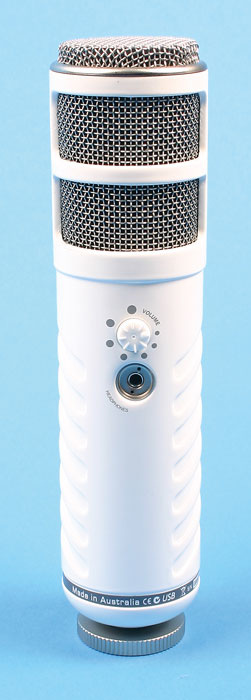 The Rode Podcaster, with its white body, looks very stylish and has no doubt been designed to fit aesthetically with certain other white 'pod' products!Rode's new 'Podcaster' USB mic is obviously targeted at podcasting applications. It uses a large-diameter, tight-cardioid dynamic capsule powered by a neodymium magnet, all housed in a seriously butch-looking end-address housing. The frequency range is optimised for speech, with a gentle roll-off below 100Hz, a presence peak at around 9kHz and a roll-off above 14kHz. There's no preamp gain control, but analogue headphone monitoring of the mic plus the DAW output signal is included, and the gain is set so that the maximum input SPL handling is 115dB SPL, making it suitable for close-miked speech and vocals. The headphone outlet is a mini-jack on the side of the body, where you'll also find a small headphone volume control, but note that this controls the summed level of the microphone and DAW output, so if you need to do any monitor balancing you have to adjust the DAW output level from within the DAW software itself. The mic comes with a mic-stand mounting clip, a USB cable and a conditional 10-year warranty, and there is an optional shockmount, which locks to a screw-collar at the bottom of the mic.
The Podcaster will work under Mac OS or Windows, without the need for further software, as it is a USB-compliant device, but additional software is available as a free download for both platforms, providing metering, a mute button and controls for adjusting recording level (this adds gain post-conversion, so it isn't the same thing as having adjustable preamp gain, as I discussed earlier). When the Podcaster is plugged into the computer, the LED glows red briefly, before turning green to show that a correct USB connection has been established.
MXL USB.006
 The MXL mic has three gain positions, which means you're more likely to be able to optimise the recording level than with the other mics.MXL's entry into the world of Podcasting is the USB.006 which, despite its low cost, is a true capacitor mic with a large-diaphragm cardioid capsule. It comes in a woven carry case, with lead, table tripod stand and a foam windscreen. MXL have not included headphone monitoring with this model, but they have taken the very sensible step of fitting it with a three-position gain switch, so that it is possible to get the gain in the right ballpark for most mid- and close-range applications involving either the spoken word or singing.
The housing for the mic is styled much like any other side-entry studio mic, and is finished in metallic silver-grey. The USB connector is at the base, where the XLR usually goes. A locking ring allows the mic to be fitted to a suitable shockmount. Unusually, I could find no technical spec for this microphone and looking inside reveals little other than that the design is transformerless and relies on surface-mount circuitry. When it's active, a red LED inside the mic basket tells you which side to speak into.
SE Electronics USB2200A
SE have added a USB interface to the capsule and electronics of their popular SE2200A cardioid capacitor microphone, and housed it in a charmingly squat, retro-looking housing, which also includes headphone monitoring of the mic's own signal plus the DAW output, with a rotary control adjusting the relative balance between the two (but not the overall level).
 The SE2200A is the only one of the bunch to include both a digital USB and a traditional analogue XLR output, which makes it more flexible in that you can use it with your regular preamps, as well as on its own via USB.
The mic has a built-in swivel mount and connects via a miniature camera-style USB cable to save space (the other mics use standard USB computer cables). The mic features pad and roll-off switches as well as a software gain-control application, but as with Rode's Podcaster, the mic itself has no gain adjustment prior to conversion other than the pad switch, so it must be used reasonably close up to achieve the optimum signal-to-noise ratio. Interestingly, the mic has a further switch, labelled 'P' or 'A', standing for PC or Apple. Apparently, the designers found that the signal level was different depending on which platform they recorded into; this is perhaps something to do with the way an 18-bit signal is converted into a 16-bit or 24-bit signal for recording on each platform.
The model I got to look at was a pre-production version, with no documentation or specification, so its performance had to be judged subjectively. I couldn't fail to notice one distinguishing feature, though: the mic had a conventional balanced XLR analogue output as well as the USB port, so the USB2200A is clearly designed to be dual-purpose. For this reason, they didn't stick the USB socket in the end of the mic like everyone else.
Testing
As there is no pre-conversion gain control, I decided to test all three mics by recording what I fondly believed to be plausible Podcast-level speech at a distance of six to seven inches from the microphone. In order to more easily compare the quality of all three mics on test, I normalised the results, as this would have more or less the same effect as using a software gain control and allowed me to judge three signals of a similar level.
Rode's Podcaster actually delivered a restrained -25dB on signal peaks with normal speech, though this came to -10dB or better for singing. Given that the mic has no gain switching, this seems like a sensible compromise. Once normalised, the sound was still pretty clean, though on closer inspection not quite as clean as from the MXL. Tonally, the mic had a punchy, dynamic quality quite different from the large-diaphragm capacitor sound, but seemed to let in a little more of the room sound than the MXL, so the sound wasn't so intimate. Working closer to the mic would fix this and also improve the signal-to-noise ratio.
Providing this mic is used close up, it is capable of excellent results but, as with the other USB mics I looked at, it is clearly not ideal for recording round-table discussions. Some digital whine was audible over headphones when monitoring from the socket on the mic body, though this didn't find its way onto the recording. As the level control on the mic body controls both the direct-monitored mic level and the DAW output, some level adjustment may have to be done in the DAW itself to achieve the correct monitor balance and level.
The MXL mic had plenty of gain, with signal peaks in the region of -10dB at the high gain setting, while the lower gain settings left adequate headroom for more spirited singing. The recorded result was pretty much as I'd have expected from MXL's conventionally wired, lower-cost mics used via a competent preamp, and the tonality was very warm, in-your-face and radio DJ friendly. Of the three mics, this suited my voice the best — but that doesn't mean to say you'll arrive at the same verdict.
Because there is a reasonable amount of level in the high-gain position, you could probably get away with setting up this mic at a slightly greater distance to record two speakers together, then normalise the result, but it doesn't have the gain needed for recording group discussions, where the distances involved are likely to be much greater.
SE's USB2200A initially produced a very low output, but when switched to the 'A' (Mac) setting and run into my Apple iBook, it peaked at around the same level as the MXL model — around -10 to -12dB. I like the idea of being able to balance the mic and DAW signals too, though for DAW level you need to use the software faders in the DAW itself, as the mic has no overall gain control. Maybe asking for gain and balance controls on the mic body is a bit too much, as nobody yet offers such a combination.
The SE's tone is not dissimilar to that of the MXL mic, exhibiting a rich, large-diaphragm character but perhaps not excluding quite as much of the room sound as the MXL. Again, you could work closer to eradicate any room tone, providing you use a pop shield between you and the mic. Overall the sound is big and flattering — ideal for radio style voice-overs.
Peas In A Podcast?
All of these USB mics are certainly viable for making radio-style recordings, or for recording pop and rock vocals, though in the studio a conventional mic will always win on quality, for you have the opportunity to optimise the gain structure by using the mic preamp gain control. That's where the SE model scores higher, as it has an analogue output for this purpose.
Because each of the mics reviewed here takes a slightly different approach — and because they differ somewhat in price — it is difficult to come up with a 'best buy' recommendation. Personally, I slightly preferred the sound of the MXL on my own voice. Though this mic has no monitoring facility, it does have three gain positions, so you're more likely to be able to optimise the recording level.
Rode's mic is simple and its end-address, dynamic format suits DJ-style work, while its built-in headphone monitor amp means you don't have to keep switching drivers so you can hear what you've recorded. At the stipulated six-inch working distance, its sound was the least flattering to my own voice, but, as mentioned earlier, you can move in closer to get more level and to invoke some proximity bass boost.
SE's mic has the benefit of a sensible amount of gain and a pad switch to knock back very loud sources. It also has that neat monitor balance control, and the ability to connect to a mic preamp. Also, it sounds very like a regular SE 2200A mic: a big, flattering sound. Although I preferred the MXL on my own voice, the USB2200A was tonally quite similar.
While there may be little or no advantage in USB connectivity in a studio setup, these mics do open up possibilities for recording location interviews, or for putting together podcasts in hotel bedrooms, but in some ways burdening them with the podcasting tag may be doing them a disservice: they are ideal for music recording on the move, providing the source is nearby and fairly loud. They also make it possible for those not into studio recording to get good-quality results without having to buy any extra gear such as audio interfaces, mixers or mic preamps.
Alternatives
As I mentioned at the outset, SOS reviewed the Samson C01U in June 2006, and Samson have also released USB versions of their C03 multi-pattern condenser and their Q1U dynamic microphone.
Some manufacturers have launched 'podcasting bundles', which are designed with the podcasting market in mind but rely on a separate interface to provide the USB connectivity. Behringer, for example, have rather cheekily bundled three of their existing products and priced them to compete with the dedicated podcasting mics already mentioned. Though not available for review at the time this article was written, their bundle comprises a conventional side-address, cardioid-pattern capacitor mic, a small mixer with two phantom-powered mic inputs and a separate Firewire-to-audio interface unit. Clearly, you lose the all-in-one portability of a dedicated USB mic, but in terms of flexibility and the ability to adjust the gain optimally, it is hard to argue with, and they've set the price to compete head-on with USB mics. Essentially, they give you a miniature version of what most of us are already using in our studios, so the mixer mic amps are used to determine the record gain, the mixer monitor section looks after playback, and modern computer systems have negligible latency anyway, as long as you set up buffer sizes of 256 samples or less. What you lose out on, other than simplicity (some cabling will be required), is the ability to power the whole setup from the USB or Firewire port, so this solution is less suitable for those who want to gather news using their laptops and a USB mic. It is, however, the least problematic option for those not needing portability. Alesis also announced recently that they were offering their own podcasting kit, based around one of their eight-channel Firewire equipped mixers with a dynamic microphone, cable and stand, headphones and a carry case. This system also includes Cubase LE, can stream up to eight channels of audio to the computer (Mac or PC) via Firewire and can monitor two channels back from the computer at the same time. The mixer includes four mic/line channels with phantom power, two further stereo line inputs and an on-board 28-bit effects processor with 100 preset effects. Again, this is an approach to solving the problem without actually offering a USB mic. The dynamic mic that's included in the kit is unlikely to be particularly esoteric, but for someone who wants to get into basic multitrack recording as well as Podcasting, it is a very attractive little package. A quick search around the internet also reveals that a number of enterprising dealers are creating their own podcasting bundles by combining existing mics with Firewire or USB interfaces that have inbuilt mic preamps.
Pros
- Easy to use.
- Plenty of headroom.
- Solid, dynamic sound.
- Monitoring headphone amp built in.
Cons
- No overall monitor level control.
Pros
- Easy to use.
- Plenty of headroom.
- Solid, dynamic sound.
- Monitoring headphone amp built in.
Cons
- No overall monitor level control.
Summary
A flexible and good-sounding mic optimised for fairly close operation.
Rode Podcaster £149
pros
- Easy to use.
- Plenty of headroom.
- Solid, dynamic sound.
- Monitoring headphone amp built in.
cons
- Can be noisy if the source isn't very close to the mic.
summary
- Perhaps the most radio-DJ friendly sound of the three.
- Three gain settings.
- Very affordable.
cons
- No inbuilt monitoring.
summary
- Classy, large-diaphragm sound quality.
- Analogue output for conventional use.
- Headphone monitor with balance control.
cons
- No overall monitor level control.
summary
A flexible and good-sounding mic optimised for fairly close operation.
£149 including VAT.
HHB Communications
+44 (0)20 8962 5080.
+44 (0)20 8962 5050.
sales@sourcedistribution.co.uk
£79 including VAT.
Sound Control +44 (0)870 067 2922.
£222 including VAT.
Sonic Distribution +44 (0)1582 470260.
+44 (0)1582 470269.