

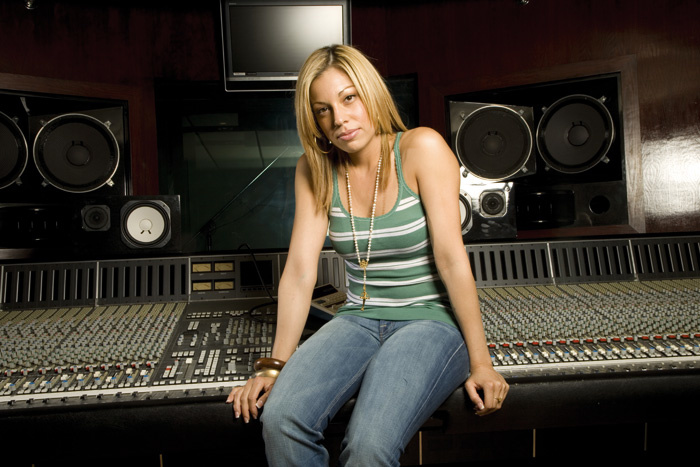
The unrivalled status of producer Timbaland is built on a hand–picked team of engineers, mixers and producers. For the mix of his hit single ‘The Way I Are’, he turned to Marcella Araica.
Indisputably the biggest hitmaker of the 21st century so far, producer Tim ‘Timbaland’ Moseley made a serious push for world domination as an artist in his own right, with his second solo album Shock Value. It featured, among many others, Justin Timberlake, Nelly Furtado, Missy Elliott, The Hives, Fall Out Boy and Elton John. Among the hit singles the album has spawned is ‘The Way I Are’. Featuring singer Keri Hilson and rapper DOE, it is driven by an arpeggiated synth line and Timbaland’s trademark heavy–but–spacious drums.
Like several other tracks on Shock Value, ‘The Way I Are’ was mixed by Marcella Araica, one of a small band of engineers, mixers and producers that Timbaland regularly employs. Others include mixer Jimmy Douglass (who featured in Inside Track in July 2007), engineer/mixer Demacio ‘Demo’ Castelleon, and producer, keyboardist and programmer Danjahandz, better known simply as Danja. Despite having had to overcome music industry resistance to women behind the mixing desk, Araica has worked with several notable artists as an engineer and a mixer, among them Missy Elliott, the Pussycat Dolls, Jamie Foxx, Nelly Furtado, Britney Spears and, of course, Timbaland.
“I’ve worked with Tim for five years now, and it’s probably the biggest gift I’ve ever encountered,” comments Araica, speaking from Danja’s room at Hit Factory Studios in Miami. “When I started, Demo basically took me under his wing, and I learned so much from him that I consider him one of my mentors. Right from the beginning I knew I wanted to mix, and I got my answers as to what mixing is from watching Jimmy when I was assisting him. As far as Shock Value is concerned, Tim said that he wanted Demo and I to mix half of it each. The recording and mixing was spread out over some time, and was creative and hilarious. Tim’s very comical, and all the funny voices that he does are spontaneous. They come out as part of a vibe, and he goes with it. That’s part of his genius. His suggestive talking at the end of ‘Scream’, for instance, was recorded while I was already mixing that track, and was completely improvised! I was on the floor laughing.”
Faster Than Lightning
In recognition of her idiosyncratic approach and her tendency to hit her Pro Tools keyboard and mouse very hard and at breakneck speed, and further inspired by her short name Marcy, Araica earned the nickname Murciélago, after Lamborghini’s supercar, which in turn has been adapted to ‘Ms Lago’.
“I’m like a mad scientist when I’m in the studio,” she says. “I love to experiment with everything. I’ll get creatively sicko from time to time, stretching sounds and making rhythms out of things that don’t yet exist in the file. Recording is an art in its own right, but mixing is where it’s at for me. When I was an intern I would sneak into the studios when they weren’t used and I’d put up anything I could bring in, and I’d just practise and practise and practise. Then I’d go back to my car and listen and I’d learn from that. Mixing is about making sure that all sounds work with each other, that certain moving parts, lead lines stand our more than other parts, and that the vocal is at the centre of it all. Tim is always going on about being able to hear the music, and he taught me that the vocals have to stand out too. It’s very challenging, and I love to be challenged.
“I also record, and I like to record and mix songs, because during recording I can go exactly for the sound that I’m looking for. I don’t believe in the fix–it–in–the–mix thing. Some mixers say that they don’t have the patience for recording, but a lot of patience also goes into mixing too, because it’s not just about the one or two days the mix takes, you’re also dealing with the clientele. When you’re recording, people usually are satisfied just hearing the sound come back from the monitor speakers, but when it comes to the mix it’s suddenly the real deal, and lots of people have opinions — artist, manager, A&R, label head and so on — so you get a lot of cooks in the kitchen, which can be frustrating. But it’s part of the whole mix thing. I find that I can learn a lot when people have comments. They may be hearing something that I don’t and even when the critique makes no sense, it may lead me to bring something out that I hadn’t heard before.”
The Vision Thing
Araica was set on mixing ‘The Way I Are’ from the beginning. “The song was recorded at Tim’s studio in Virginia, and from the moment I heard it in its raw form, I wanted to mix it. I didn’t care whether I mixed the whole album or part of the album, I just wanted to mix this song. I fell in love with the song, and just knew it would be a hit. I love every type of music, but I particularly love dance music. Every time I go nightclubbing it’s like ‘homework’. I listen to the way things sound on the sound system and watch the way it affects people on the dance floor.
“My vision for ‘The Way I Are’ came from a vacation I had in Ibiza in 2003. I was blown away by the sounds coming out from DJs mixing records. One producer and song that particularly inspired me was Benny Benassi’s ‘Satisfaction’. The first time I heard that song I almost lost it. The way that kick hits in that song, that’s what I was going for in my mix of ‘The Way I Are’. I wanted to mix ‘The Way I Are’ so that it would make me feel a similar way. Tim let me have a go at it, and he just said ‘Do what you want to do, and call me when it’s ready.’ I spent a full day mixing it on an SSL at Pacifique Studio B in Burbank, California. I mixed the other songs I did on Shock Value at our room here at The Hit Factory in Miami.
“I added a little intro, again inspired by my Ibiza experience. There was a big party on the beach, and the airport was right next to where it was happening, so you could hear these planes overhead, and every time one landed there was this huge burst of excitement about more people coming to join the party. I had Demo come in and play this sound, and I pitched it down to make it sound more like a machine. That sound is swirling before the beat drops in and helps to make everything sound totally crazy, like a state of emergency. I went back into the studio the next day to make sure that I had not gone mad the night before, and called Tim. He sat down and listened and it was probably the only time he’s ever listened to one of my mixes when he didn’t want to change anything. He just said ‘It sounds great, it’s perfect.’”
Organisation
 Three vocalists are featured on ‘The Way I Are’. Timbaland’s ad libs were EQ’ed using McDSP’s Channel G, while URS’s S–series EQ was used to sculpt Keri Hilson’s ‘computerised’ vocals. Her wordless backing vocal was treated with Waves Enigma, while her harmony and backing vocals were processed with Waves’ Renaissance Compressor and URS’s 1980 Compressor.“When I get a session for mixing, the first thing I do is organise it, from top to bottom. The music will come first, and then the lead vocals. I’ll clean the tracks up, making sure there are no pops, crackles, bad edits, and so on, and then I’ll start submixing. Pro Tools Sessions usually have too many tracks to be able to run them all individually through the desk — ‘The Way I Are’ had 94 tracks! After submixing I spread things out on the board and I’ll do a rough mix, just to see what’s there. I like mixing on SSLs, and my board of preference is the SSL 9000 J–series: it’s so versatile and I love the sound. What comes out of the stereo bus of the analogue boards of today sounds a little too crisp, too digital, too thin. But the 9000 J–series still gives you the warmth of analogue, and it adds character to the sound because you can push it. The headroom on that board is amazing. By contrast, digital boards are very temperamental and distort very easily. They also don’t sound very nice. Also, on SSLs you can mix in any mode, which is great, because when Tim comes in and wants to do a last minute overdub, like on ‘Scream’, I can just go into overdub mode and it’s not messing with my mix.
“With the analogue versus digital debate, I don’t have much experience of analogue tape machines, other than at the Full Sail school where I studied, when it was all we worked on. Analogue does have this warm thick sound. To me it’s very mid–range, but it’s a pleasant mid–range. A lot of peope say they can’t hear the difference between analogue and digital, and I don’t really understand that, it’s so obvious. But honestly, in practical terms you can’t beat the simplicity of digital. Winding tape back and forth is very time–consuming, and in this area of music with fairly restricted budgets, the digital thing just works better. For sonic reasons I will often print my mixes to half–inch tape, depending on the type of song, and I’ll also sometimes print my drums and bass to half–inch and then I’ll load them back into Pro Tools, just to get a punchier sound.
“After having done a rough mix, I’ll begin mixing in earnest by working on the vocals. The vocals are very delicate, and you have to treat them carefully. After that I’ll add the kick and the snare, so I can hear what they’re doing frequency–wise and how they relate to the vocal. The next thing I do is blend the various tracks of music in, one by one. I’ll add the bass last, because it wants to be the star of the show, and so I’m very particular about the bass. By this stage I’ll be tweaking whatever catches my attention, and I’ll be doing the automation.
“You’re listening the whole time, and a mix is never done. I’ll be mixing on NS10s almost until the end, and when I think the mix is in a really good place, I’ll then start referencing on KRK monitors, and I’ll be listening on my laptop, and so on. When I hear the kick drum almost breaking those poor little speakers on my computer, I know it’s good! Why is the bass the last thing I add to the mix? Things can become very tricky with the bass. It’s very easy to lose your kick drum when you add the bass. If things are not EQ’ed right, you get more of the bass than the actual thump of the kick. You need to treat the bass and the drums completely differently, otherwise you’ll get into trouble.”
‘The Way I Are’
Written by Timbaland, Danja, Keri Hilson, Balewa Muhammad, Candice Nelson, J Maultsby
Produced by Timbaland and Danja
- Vocals: Waves Renaissance Compressor, Enigma & Q8, Tube–Tech CL1B, SSL EQ, McDSP Channel G, Prosoniq Orange Vocoder, Lexicon 480 & PCM42, Antares Auto–Tune, Eventide DSP4500, URS S–Series EQ & 1980 Compressor.
“I started with Tim’s vocals. I wanted him to sound like a big, present person, but a little robotic. I applied a [Waves] Renaissance Compressor and a Waves Q8 EQ, just tweaking things a little bit here and there. I also used a Tube–Tech CL1B on his lead vocals and added a little bit of SSL EQ. This gave me my basic EQ settings, and later I added a Channel G EQ plug–in to some of his ad libs — TA stands for Tim Ads — to adjust the texture, cutting some lower frequencies and adding around 10k. If you add around 10k it opens everything up. “I tend to use outboard for dynamics and plug–ins for effects, because you can automate things right away and very precisely. On the board it’s a bit slower to set. The effects on Tim’s voice were basically just delays, blended underneath. I made a copy of his vocals and then ducked the delay, so it wasn’t prominent. You can hear the delay at the last lines of the verses. I also put an Orange Vocoder plug–in on two of Tim’s vocal stacks, and then put the ‘Whispering Reverb’ preset on the Lexicon 480 over that. It’s one of my favourite reverbs, and I used it on all the voices on the song.
“Kerry’s voice was interesting, because I used a bunch of different effects on it. I did some tweaking with Auto–Tune, not to correct her pitch, but to give her vocals a computer–like sound. I basically wanted her to sound like a fantasy, something that wasn’t real, kind of disembodied. When I did her vocals I was thinking of the movie S1m0ne, in which Al Pacino is making up this computerised woman. That became the concept for the character I wanted to bring out in Keri’s vocal. So I rolled off low end and some mid from her lead vocal using a URS plug–in, and I messed with Auto–Tune, going into graph mode and drawing the sound, until I got what I wanted. Finally, I added the ‘Raspberry Sparkle’ preset on an Enigma plug–in. I also had a Lexicon PCM42, for very short delays. They’re in time, and work like slapback delays. I love the PCM42, it sounds so much more natural than Pro Tools delays. In addition there was an Eventide DSP4500 for reverb, and a Lexicon PCM70 for a flanging effect. My assistant usually rigs up 10 to 12 outboard effects to the board, so I don’t get tempted to just stay in the box.
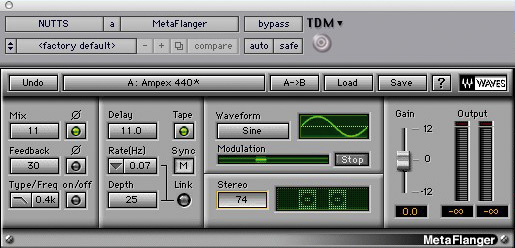 The track’s main keyboard sound was processed using Waves’ Metaflanger and Enigma, to make it ‘spaced out’, while MondoMod was used to add movement to the synth pad. “Keri did quite a few vocal overdubs, and she did a wordless lead background vocal that went through the whole track, singing something that’s based on the Salt ’n Pepa song ‘Push It’ — there were no samples in the track. I added another Enigma plug–in to this background vocal [‘TunaKeriHa2’], using the ‘Harmonic Swept Rezonance’ preset, just to add something weird. I just play around until I get something that goes with the track. I put the effect directly on the track, and when I do this, once I have a sound that works with the track, I push the effect back a little bit, using the Mix parameter. I also did some EQ on this vocal, adding around 2.2k and 7.5k. I also used two compressors on some of her other backing vocals: the RCompressor went on her harmonies just before you hear the hook (‘KH’), and the URS compressor went on a submix of her backing vocals in the B–section (‘KBS’), just before the hook.
“Finally, I kept DOE fairly straight, his voice brought the reality back into the song. I just used some reverbs and delays, to make him bounce in the track. I doubled up his lead vocals on certain words and I did a submix of that and compressed that with URS compression.”
- Drums: Urei 1176, Focusrite D6, Waves SuperTap, SSL EQ, Lexicon 480 & 960
“I printed them to half–inch analogue and back into Pro Tools to make them sound punchier. I wanted them to hit, and to hit hard. The kick was a stereo track, and I EQ’ed that and ran it through two black–face 1176 compressors. I didn’t add any effects on the snare, I just put it through a Focusrite D6 EQ, adding some high mids, because I wanted to make it sound fat but still make sure it cut through. There’s also a percussion–like instrument that goes through the whole track. I called it ‘block’ and used the SuperTap [delay] to make it bounce more, as well as some board EQ and reverb, probably hall settings on the Lexicon 480 and 960.”
- Keyboards: Waves MondoMod, Enigma & Metaflanger, Eventide DSP4500, Sony DPS V77, Lexicon PCM42
“I called the main synth line ‘Nutts’ because it’s such a crazy sound. I made it sound more spaced-out with two flangers, using the Enigma and MetaFlanger plugins. I also rolled off some low end on the desk, and that was all. There’s also a pad running through the whole track, which I called ‘Coolio’ — I sometimes get silly in the way I name tracks. I wanted to give it a little bit more movement, so I stuck it through a MondoMod on a preset called ‘Medium Chorus’. The intro to the track I made up of a sound I took somewhere in the track; I stretched and pitched it, and threw a million effects on it, like the Eventide DSP4500, the Sony V77 [multi–effects], and the PCM42. Demo added the words ‘state of emergency’.”
- Bass: Waves Renaissance Compressor
“As always, this was the last thing I messed with. Normally I find it quite a challenge to fit the bass with the kick, but not in this track, because the kick played such a tight rhythm, and it was such a big–sounding kick with a fairly round attack and no decay. It was just a punch and this worked well with the bass. I put an RCompressor over the bass, using it as an expander or a limiter rather than a compressor, to make it sound stronger, so it sat better in the track.
“The biggest challenge for me in mixing this track was to make the vocals sit well with the rest of the track. I remember getting a little frustrated because I could not get it to work, something in the balance wasn’t right. I scrapped the mix, taking all the faders back to zero but keeping the EQ and the effects, because they were fine. In bringing everything back up I found that I needed to compress Tim’s vocals a lot more to get the sound I needed. I don’t normally do heavy-duty vocal compression, but in this case I had to push the threshold on the Tube–Tech back a lot more to make sure you could hear his vocals. At the end of the day it all worked out really well.”
In addition to Timbaland, quite a few people would second that.
Moving Up The Ladder
Marcella Araica began her musical career “playing around with music, doing keyboards, guitar, whatever. I realised I wasn’t really good at being a musician, so I did some research to find out how I could still be in the music business, and that’s when I found the school that I went to, Full Sail Real World Education in Orlando, Florida. I chose to do Audio Engineering, because I always loved tweaking sounds. I was at the school for a year, graduated and from there did an internship at the Hit Factory in Miami, and basically moved up the ladder to Assistant Engineer. At that time, five years ago, I met Missy Elliott and Timbaland, and I’ve been with him ever since.
“Being a woman in this industry is I won’t say it wasn’t a challenge, because it was, in many different ways. The music world is male–dominated, and when they see a woman sitting in the chair behind the mixing desk, it can be quite tricky. There would be a lot of talk that wasn’t really cool. My way of dealing with that was not to focus on what they may be thinking or saying, but simply do my work and be the best. In the beginning, when I first started to mix, it wasn’t always accepted. It was a challenge to get people to believe in me. As a female I had more to prove. I saw men being thrown in there and people automatically try to make them feel comfortable, and when it’s a woman, it’s like ‘Hold on, this is different!’ But as I said, I love challenges! Now that I have been with Tim for five years and with Danja for three, worked with several big–name artists, and made a name for myself, it has become a lot easier.”