

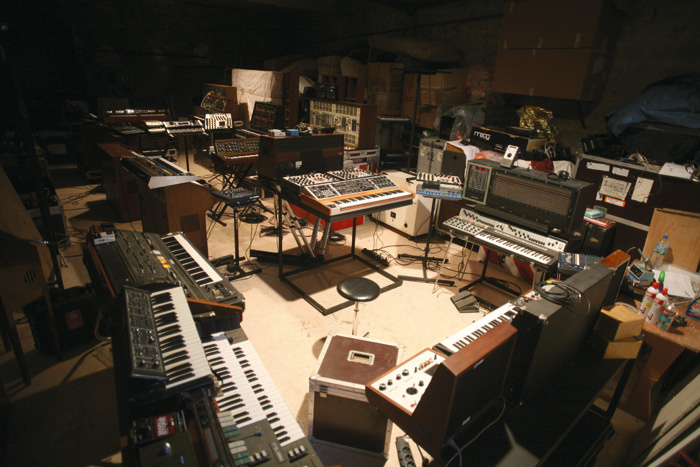
 The massive live area–cum–store–room in Jarre’s Paris studio, with synths set up as they were for the performance of Oxygene on the Live In Your Living Room DVD.
To celebrate the 30th anniversary of his hugely influential hit album Oxygene, Jean-Michel Jarre has produced an audacious DVD performance of the entire piece in a manner never before attempted.
If anyone can lay claim to having raised the popularity of instrumental electronic music to the level of stadium rock it is Jean-Michel Jarre, renowned for spectacular live shows featuring lasers, fireworks and other unforgettable visuals. As well as selling more than 60 million records worldwide over the last 30 years, the Frenchman has made it into the Guinness Book Of World Records, on three separate occasions, by attracting huge concert audiences, the most recent comprising 3.5 million people.
There have been many other historic milestones in Jarre’s career. He was, for example, the first composer to introduce electro–acoustic music into the Paris Opera House and the first Western musician to tour China. From a technological perspective, he has also been at the forefront of new developments. He was among the first to embrace the 5.1 medium with his album Aero, and his latest DVD, Live In Your Living Room, is the first release to use a new breed of 3D technology developed for the latest home–theatre cinema systems.
Small Beginnings
JMJ is undoubtedly a great showman, entertaining millions with state–of–the–art stage theatrics, but before becoming a household name, he spent many years creating experimental electronic music using tape–loop effects and some of the first analogue synthesizers, for a time under the guidance of the visionary French composer Pierre Schaeffer. By 1977, Jarre already had a couple of albums and a film soundtrack under his belt, but it was the reception received that year by Oxygene that was responsible for his ascent to international stardom. The LP’s success was remarkable, given that it is a fairly minimal instrumental concept album recorded on a tiny budget in not much more than a well–equipped home studio.
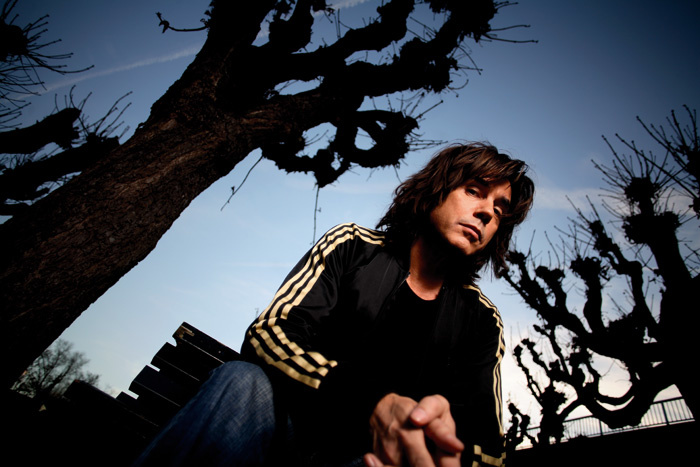 Photo: Richard Ecclestone
“I really did it in a kind of home way using what, I think, was one of the first home studios,” Jarre reflects. “I just had three or four synthesizers and was using a Scully eight–track and a mixture of Ampex 256 and 3M tape. The whole album was done on just one eight–track and you can hear that in the piece — it’s quite minimalist and I think that contributes to its timelessness.” Remarkably, the album went on to sell an estimated 12 million copies and produced the instantly memorable ‘Oxygene IV’, one of electronic instrumental music’s most iconic themes.
So why re–record the classic, rather than simply re–release it for its anniversary? Surprisingly, the idea has been on Jean-Michel’s mind almost since day one. “Actually, I got this idea to re–record the album very early after I recorded it because, although I was OK with the music, I always thought that I could have had better conditions for the recording process. It has nothing to do with analogue versus digital: even analogue–wise I thought that I could have better preamps and things like that. When the digital era exploded at the beginning of the ’80s I said ‘OK, I’ll do that one day,’ but for me digital was, for quite a while, not as good as the analogue processing by a long way, and it’s only quite recently — I would say in the last five years — that with 96kHz, 192kHz, and 24–bit, we’ve entered what we can call the high–definition era. And only since then I decided to take the opportunity of the 30th anniversary to do a better recording.”

Jean-Michel’s plan was to follow as closely as possible the original recording process, using the same synths and effects wherever possible, but replacing the Scully eight–track with a Mac–based Pro Tools HD3 system, recording at 24–bit, 96KHz via a Summit Audio TPA 200B Dual Tube preamp and Neve and API processors. “I put almost everything through the Summit,” he says, “and I got this good, fat, analogue sound. I also used an old Neve preamp and an API, just to put it on Pro Tools, basically. When I mixed, I used only digital processing because I realised that having analogue sources is what really counts. When you have all analogue synthesizers and you put that in Pro Tools at 96KHz, 24–bit, it is almost transparent. The main difference is when you are using virtual instruments — when everything in the chain is digital — that’s definitely totally different.”
The original was also recorded without the aid of a sync track or timecode, and pre–dated MIDI sequencing, so Jean-Michel elected not to use these tools for the remake either. “I played and triggered all the sequences by hand,” he continues. “With sequencers you are working with patterns and blocks, so it was very interesting revisiting songs and realising that the process of not working with patterns is a totally different journey — a totally different trip, really. I remembered that when I started to do electronic music I was obsessed — I more or less forgot that obsession along the way — about not having anything being repeated in exactly the same way. For me it was exactly the opposite attitude to that of Kraftwerk, Tangerine Dream and all those electronic bands who were doing something more robotic. I considered electronic music in a much more sensual, organic way, where nothing should be repeated.
“So, on Oxygene nothing is repeated the same way. Each sound, even if appears to be the same, has a slightly different attack and release, and, as the sequences are being made by hand, by definition they are not exactly the same. Even the sounds of the drum machines were filtered in a very subtle way to give life inside the patterns.
 Two Revox B77 tape machines used for delays were, says Jarre, responsible for “40 to 50 percent” of the sound of the re–recorded Oxygene.“I used a lot of pedals like the Electro–Harmonix Small Stone phase shifter to create the modulations and delays, and for the remake I had a pair of Revox B77s for tape delays. Actually, I would say that 40 or 50 percent of the music is coming from the Revox machines, because I was quite extreme, by having a signal direct on one side and delay on the other, almost at the same percentage.”
Making It Live
Through the process of making the new Oxygene recording, which involved dusting down many of his old vintage synthesizers, Jean-Michel began to consider the idea of actually performing the whole album live from start to finish, something he had never done before for logistical reasons. The idea led eventually to the production of the Live In Your Living Room DVD, which is actually a studio recording, but performed live in front of cameras instead of an audience. The performance will be of great interest to all synth enthusiasts, not only Jarre fans, for it acts as a fabulous demonstration of the world’s most sought–after analogue synthesizers being played in a genuine live situation.
Jean-Michel explains how the idea evolved. “I have often played excerpts from Oxygene, but never the entire piece. These days, as we know, so many concerts are pre–recorded or pre–produced to diminish the risk of mistakes and optimise the result, but I decided to perform the whole piece in a real, live situation with no computers. So we put everything in a big warehouse and filmed the performance without any stops. The DVD is not made up of a few takes — it’s like a concert film, except the idea is the audience is the people watching on their plasma–screen TV or whatever.”
One thing Jean-Michel really wanted to do was make sure that the same instruments were used as on the original album, even though there was the possibility of using more reliable modern equivalents. To complicate matters, Oxygene was an eight–track recording, featuring as many independent synth lines playing together. Having just two hands and no multitimbrality or sequencers meant that a live performance required three other musicians and extra banks of vintage synthesizers. Drafted in to provide the other six hands were Jarre’s long–time collaborators Dominique Perrier, Claude Samard and Francis Rimbert.
“Sometimes there are two or three layers of the same sound, each with different phasing and processing,” explains Jean-Michel. “For example, there are several Eminent String Machines that make up one of the main Oxygene string sounds. Having four of us meant I had to multiply the number of instruments, and finding the equipment was quite a headache, especially as I tried, as much as I could, to avoid using instruments produced after Oxygene. There are one or two exceptions but 95 percent of the instruments are of that time. For me it was really important for the radicalism of the process.”
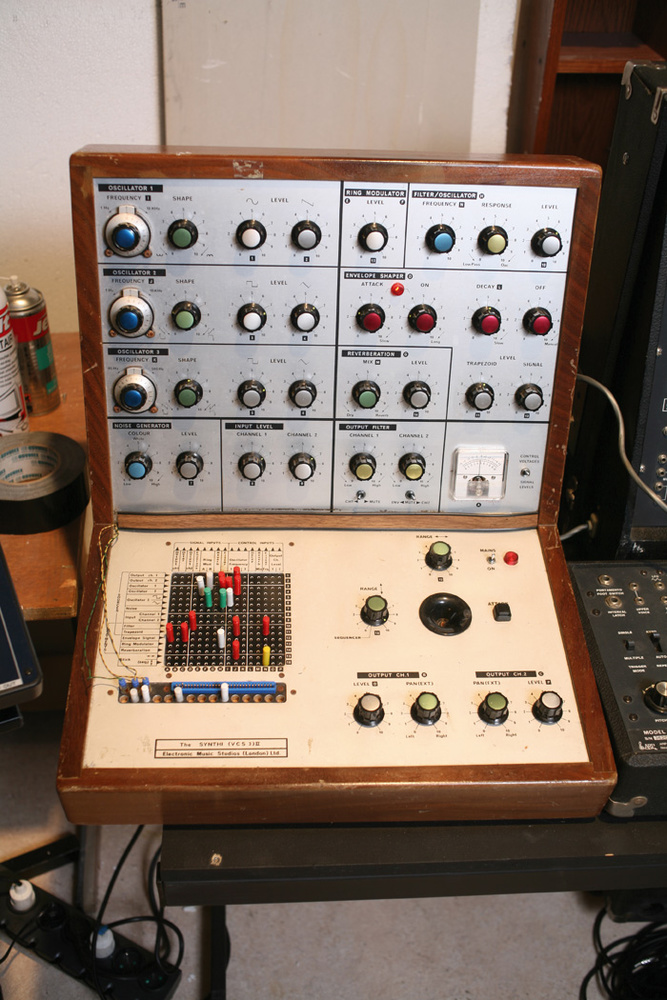 EMS VCS3 and Synthi AKS pin–matrix modular synths were central to the recreation of Oxygene; no fewer than five are visible in the pictures of Jarre’s studio.Most abundant in the setup are the EMS Synthi AKS and VCS3 synthesizers, each one set up with a certain variety of patch, as Jean-Michel explains. “During the piece you have the VCS3 or AKS being used for lots of different sounds, but because they have no presets it takes too long to change between numbers, so we have four or five on stage and each synth is used for one family, style or range of sounds.”
Having so recently re–recorded the album, Jean-Michel was well aware of what he’d used for each part, but he still needed to plan the setup in a way that would enable four people to perform the piece together. “At first I had to see who was doing what per song,” he explains. “It was more or less like a band situation where someone says ‘OK, I have a good feeling for that part, I’ll take care of it.’ That’s also a reason why we have some repetition in terms of gear. Then I could say ‘OK, for this number this person will need this, this and this, for the second, this, this and this.’ I planned it by drawing it on paper and then everything went together like Lego!”
Remarkably, Jean-Michel reckons that rehearsing the album to a point where it was ready to perform in one take only took about two weeks, although he was under a little bit of pressure to meet the important anniversary deadline. “Everything went so fast because I changed record companies this year, partly for this type of project. After that everything has had to be done with a kind of emergency feeling, but that seems to fit the project so I love that.”
Camera Action
For the filming, the four musician were arranged in a ‘T’ shape (Perrier far left, Rimbert on the right, Jarre out in front and Samard in the middle) within the warehouse, so that each person was surrounded on four sides by his bank of instruments. On stands facing the four, and fed by the Mackie FOH desk, were two large Genelec PA monitors, ensuring everyone was listening to the same thing. Two microphones were placed pointing outwards from the front of the setup to capture the ambience of the warehouse. The synthesizer outputs were recorded into Pro Tools on separate tracks.
Finally, a large corridor of space was left around the perimeter of the setup for the camera operators, enabling them to capture the action from all angles. Antwerp–based Alfacam, specialists in high–definition TV filming, were hired to shoot the DVD, having previously worked on Jean-Michel’s Beijing concert in 2004. “They are really nice people who are technically very precise,” comments Jarre. “We rehearsed the performance choreographically, to avoid a situation where one camera man would get in the way of the lens of the other.
 One of the most unusual synths in Jarre’s collection is the RMI Harmonic Synthesizer, an early additive synth. On top of it is an even rarer device: the Digisequencer matrix sequencer custom–built by Michel Geiss to Jarre’s specification.“On top of that, I decided to produce a 3D Stereoscopic version. I thought the idea was quite interesting because 3D is retro–futuristic stuff; it reminds us of the 1950s when you have these guys wearing white glasses and all that. I’m quite familiar with the idea because about 10 years ago I worked with Apple filming a concert in 3D. It’s going to be the next step in the entertainment world. James Cameron has developed a new Stereoscopic movie camera and 3D projectors have been installed in 1000 theatres in the US. Actually, the 3D version is going to be released in 50 theatres in Germany and the US.
“For filming you have two lenses for each camera, so you produce separate HD masters for each eye. The lenses are spaced the width of the eyes, and you have to do some pretty precise, boring stuff to get the right angles depending on where you want the focus, but the result is spectacular. With standard home DVD players and screens, the only way to get 3D at the moment is by using the old red and blue glasses, but Phillips is developing a new screen you can use without glasses. Our film is ready for that but it’s still a prototype. I think it’s very interesting, because until now music was the only mode of expression invading the space around us.”
Of course, the Stereoscopic visuals go hand in hand with surround sound, and JMJ is no stranger to the format. “I’ve worked a lot on 5.1 since Aero,” he adds. “That was really the first album, I think, conceived and produced especially for 5.1. It’s got the THX label and George Lucas is using it for THX demonstrations.
“I’m not looking for realism; I’m looking for musical results, and I think what’s great about electronic music is that you don’t care if you are in the middle of this orchestra. You don’t know which instrument is doing what, so having them in front of you and the audience behind seems, to me, a bit irrelevant in that case. It’s much more fun and exciting to be in the middle of all these sounds going around. In that aspect, electronic music is made for 5.1 more than anything else.”
The Performance
 Some of the desirable modular and semi–modular synths used on both the original and the recreated Oxygene. From top left, clockwise: Korg PS3200, ARP 2500, ARP 2600 (two were used) and Moog modular. Although Live In Your Living Room runs through the Oxygene tracks chronologically, it also offers listeners three extra tracks not found on either the original or remake. As the performance is a continuous piece of music, the new sections form links between the main movements. Jean-Michel explains how the transition parts came about. “I suddenly realised that to get from one part to another in a more live situation it would be nice for the other musicians to be in a freer, improvised thinking pattern. So we’ve either improvised variations between different songs, or lengthened the existing parts. When I started feeling that it was the right time to change, I began introducing the next part and everybody followed. It happened in a rather natural way but we also used eye contact to communicate.”
In contrast to the free–form transitional parts, a notated orchestral score was used by all the musicians to help them with the rest of the material. “It’s one thing when you are all by yourself, overdubbing one bit at a time because you know what you’ve just played,” explains Jean-Michel, “but when you’re playing all the parts at the same time, particularly when you don’t have a drum machine, you need to have a method of counting the measures to be able to play together. So, it was strange, but fun, using this kind of retro–futuristic system that mixed a quite serious orchestral score with a performance on analogue electronic instruments!”
Although the performance was undertaken without any click, MIDI or time reference, there were still some electronic drum parts, emanating from two Keio Mini Pops drum machines, which occasionally had to be started so that they fell in time with the pre–established tempo. Claude Samard, positioned in the middle of the other three musicians, was the official musical director of the project, given the task of operating the Mini Pops and other critical rhythmical parts. To help him start the drum machine in the right place, Jean-Michel, or one of the other musicians, would introduce a sound that acted as a signal for everyone. “For ‘Oxygene IV’ he was getting this kind of crescendo of noise,” explains Jean-Michel, “and was just counting one, two, three, four, hitting Play and we were all right in time, hopefully well, almost! The Mini Pops has no in or output sync, so you have to play everything around it, even the song’s bass sequence. It’s a bit of a problem playing like a human sequencer.”
 Two Keio Mini Pops drum machines provided an authentically retro rhythm track.Although separate feeds were taken into the Pro Tools system from all the synthesizers, so that they could be mixed at a later date, it was always the intention not to change much afterwards. “We all know that for a lot of live releases you end up redoing everything in the studio,” says Jarre, “but for this particular experience that would have been silly, so the idea was to keep all the accidents — even if you have the wrong note being played, or something not really in tune — to keep the whole thing and therefore the truth and authenticity of the performance.
“The only thing I changed is the delays, and that was only because I didn’t want to carry my Revox machines to the warehouse. I was just in the middle of finishing the mix of the studio version; I didn’t want to change anything, and when you are travelling with those kinds of things, you never know if something will happen. So, just to be sure, I used some regular delays for the performance and later exchanged them for the Revox machines. But what has been played has been kept.
 Multiple Eminent 310 string machines were central to the Oxygene string sound. Here, a Moog Liberation monosynth is also ready to go. “For both the album and live recording I didn’t work with stereo sources at all apart from mono–to–stereo reverb, just to give it a sense of space. Otherwise, all delays and sources are mono. Obviously, when you work in 5.1, stereo is a headache, so you have to be in mono.”
In terms of processing, the Summit Audio preamps favoured for the album recording were not used live, only the direct feeds routed via the front of house desk. However, Jean-Michel is insistent that the raw synthesizer outputs were perfectly good enough. “I was totally amazed, as were the sound engineers, by the warmth and depth of the sound when you have all this analogue stuff on stage playing together. Nothing is harsh, so you can push up the volume and you have no aggressiveness; it’s amazing how very round, warm, solid and fat the sound can be. And all these sounds mix, so you never get those kind of digital phase problems or foggy type of effect. With all those instruments playing on stage it’s like a symphonic orchestra, where you have violins mixing with trumpets and they all really work together. I’ve never experienced that before, so it was really amazing to mix a Mellotron with a modular Moog, analogue drum machines, Eminent strings, AKSs and all that.”
Happy Accidents
One of Jean-Michel’s main reasons for using the old analogue gear, despite its quirks and issues of reliability, was to engineer a situation in which the band were forced to react in a musical way to any random mistakes or accidents that occurred. One issue thrown up by the relative tuning of the Eminent String Ensembles proved to be particularly beneficial.
 A Moog Taurus bass synth, stand–mounted for playing by hand rather than foot!“The Eminents were not tuned to exactly the same pitch, and we had an instrument where the pitch was blocked so we couldn’t change it. It made us realise that nowadays everything is automatically at 440, 442. We detune, but we do big important detuning as an effect. The sort of subtle detunes that you have in acoustic instruments are found less and less with electronic instruments, where the tuning is done somewhere in a digital patch. The stuck pitch was around 443 or something like that, so it gave us something strange. It was one of those scary, silent movie soundtrack–type sounds that reinforced the atmosphere.
“Also, in the keyboard of the ARP 2600 there are two notes that make the synth go berserk each time you play them. That created some interesting things when we did a chorus or improvised. We had a few accidents with that so we built everything around the accidents, making other instruments respond with strange sounds.
“Obviously it’s a risky situation to go on stage with those instruments because they are not reliable like a Mac, but at the same time it is also that kind of risk when suddenly you have an accident that can give you something else. In electronic music these days, where everything is so pre–produced and clean to optimise the result, we are killing the effect of surprise. We have rock bands with just guitar, drums and bass coming back instead of keyboards and synthesizers, because of this reason. People are bored of being behind their computer and want to express themselves with a rawer attitude, and with those analogue instruments you are in exactly the situation of a rock band, where you just plug and play.”
The Future Now
Now that Jean-Michel has revived his love of old synths, he is adamant that he will continue using them on future projects, and he has some strong views on the pros and cons of today’s music technology. “By playing with real analogue stuff, you realise how unique these instruments are. All the musicians and engineers working with me said the same thing. Those instruments are incredibly rich — no one can beat that. We have fantastic virtual synthesizers and emulations of vintage instruments, and you can do lots of interesting music with the technology, but they are so different you cannot compare them — just forget it! You can’t compare a 400–kilo Mellotron with a virtual synth that’s imitating the look of it. It has almost nothing in common. Oxygene could only have been done with the old analogue instruments; that was part of the experience, and now I want to experiment more with them.
 Classic polysynths such as the Memorymoog (top) and Yamaha CS80 were also used in the performance of Oxygene. “New bands today want Fender Stratocasters or Les Paul Gibsons from the early ’60s because they have a different sound, but it’s not a retro attitude, because if you take, for instance, a symphony orchestra violin player, his dream is to play a Stradivarius, made in the 17th century. It shows that with all the technology we have, no one has been able to make an instrument of that quality. It proves that building great instruments it is not just based on how technologically advanced or sophisticated you are.
“What’s really interesting is that we haven’t invented many new instruments. We have much more sophisticated ways of processing sounds or emulating frequencies, but the irony is that virtual instruments are all about recreating the past, right down to the look of the interface. But then you find yourself playing in a rather awkward way with your mouse or remote control! This is instead of getting back to the real instruments, which is a totally different approach, where you have a large facade with knobs that you can instantly grab and alter and you can be constantly processing the sounds and getting instant feedback from the machine.
“In principle you can do all that with a computer — but you don’t, because you memorise everything. But with these instruments, aside from the Memorymoog, you have no presets. These ephemeral situations, in which you are all the time, put you in a totally different frame of mind. It’s like when you are in front of a guitar — you don’t preset your chords or sounds, it’s a dialogue with your instrument. That physical response is something we have forgotten, and yet it’s the foundation of rock & roll. It is based on intuition and doing music with your instinct, not only with your brain.
“Looking back, the 1980s was a really dark time for me. The ’90s were better and this decade is definitely far better, but back in the ’80s we were at the beginning of the digital age. Even if it was a revolution, it broke an old poetic attitude towards electronic music. Suddenly everything worked in terms of patterns and presets, and we all became archivists for quite a while, instead of having this kind of artisan, craftsperson attitude and an intuitive relationship with our instruments. I think we all fall into that trap. It’s not better or worse, it’s just something different.
“And the designers even stopped producing those instruments. Tom Oberheim, Bob Moog — they all more or less stopped. And crazy guys like Mike Matthews, doing all the Electro–Harmonix Electric Mistress flanger and Small Stone phaser pedals. They are absolutely amazing; you can’t get those sounds with virtual effects. Those instruments are part of the mythology of electronic music at the same level as the Stradivarius, Steinway, Gibson Les Paul or Fender Telecaster. A lot of people have only seen these synthesizers in photos so it’s a good opportunity to show everybody in the world of music — and the audience in general — that they should be considered at the same level as Stradivarius. You have this mythology in rock & roll, obviously you have it in classical music and jazz, but, apart from Moog who more or less everybody has heard about, the other synthesizers are relatively unknown.
“This whole thing is a tribute to all those guys who created these instruments, without whom I wouldn’t be there, you wouldn’t be there and most of the people wouldn’t be there!”
Inside The Studio
Jean-Michel Jarre’s studio, on the outskirts of Paris, is pretty much under construction at the moment, but is all the more interesting for that, as it reveals so much about where he has come from and where he is going. The control room is the one completed area so far, and is suitably soundproofed, decorated and furnished. Here there is a Mackie Control 24 desk acting as the front end for the Pro Tools HD3 rig, running on a Mac G5, a large screen for monitoring DVD images and viewing the Pro Tools interface, plus a few racks of processors housing, amongst other things, his prized Revox B77 tape machines.
The massive live area–cum–store–room in Jarre’s Paris studio, with synths set up as they were for the performance of Oxygene on the Live In Your Living Room DVD.Elsewhere in the building is a larger performance/store room which can only be described as extremely rustic, with patched–up walls and a vaulted brick ceiling shored up by steel girders. Although some plasterboard has been thrown up here and there, the room is still very much the store area it no doubt was 150 years ago, and, as such, is packed to the vaults with flightcases, boxes and shelves containing miscellaneous gear gathered throughout Jean-Michel’s career. Squeezed in the middle of all this, however, wired into a makeshift PA system and ready to play, is one of the most impressive vintage synthesizer collections anyone is likely to see. These are no museum pieces, however: they are fully functional, complete with custom modifications and surrounded by soldering irons and torches so that quick repairs can be undertaken.
The setup, as seen in our photographs, is exactly what Jean-Michel used for his Live In Your Living Room DVD, and, by the time you read this, it will have already been used for a series of live shows, performed without synchronisation of any kind. “We are doing the first live performances in a very chic theatre in Paris and I’m going to put all these instruments on stage. I’ve been fighting to just use a PA rather than specific monitoring, but everybody is telling me ‘Don’t push too hard, because with the feedback on stage it’s a bit difficult.’ So we’ll probably have either wedges or ear monitors just to be sure to arrive in sync, otherwise it might not be precise enough. But for the DVD filming we had a big PA in the warehouse and everybody, including the sound engineer, was listening to the same thing. I very much like this kind of thing.”
Big Influences: Pierre Schaeffer
Jean-Michel is quick to name Pierre Schaeffer, inventor of the idea of musique concrète and founder of Groupe de Recherches Musicales (GRM), as his mentor. He explains why Schaeffer was such an important influence on his musical career.
“I started being involved in electronic music when I was a student aged about 16 in the 1960s, and started studying under Pierre Schaeffer in Paris. In my opinion, this guy is the father of all of us. He created absolutely everything. He was the first saying that music is not made of notes, but of sounds and noise, and back in the 1940s he invented everything. He was making loops with records even before tape recorders, and he was the first to use delays and reverse sounds. When I was a student of his we were doing all these kind of looping things, re–injecting one tape recorder into another and creating huge delays.
“At that time I remember going into studios where you had maybe 20 speakers around and above, like multiple mono channels. That was something I experienced a lot, but when I left art school and went into these sophisticated pop–music studios I was in front of just two speakers and always felt frustrated with that situation. But because of the cinema industry, we can now get a decent sound system at home and I’m really happy to exploit that again.”