

Six albums into their career, Glaswegian instrumental band Mogwai decided to take the producer's chair themselves.
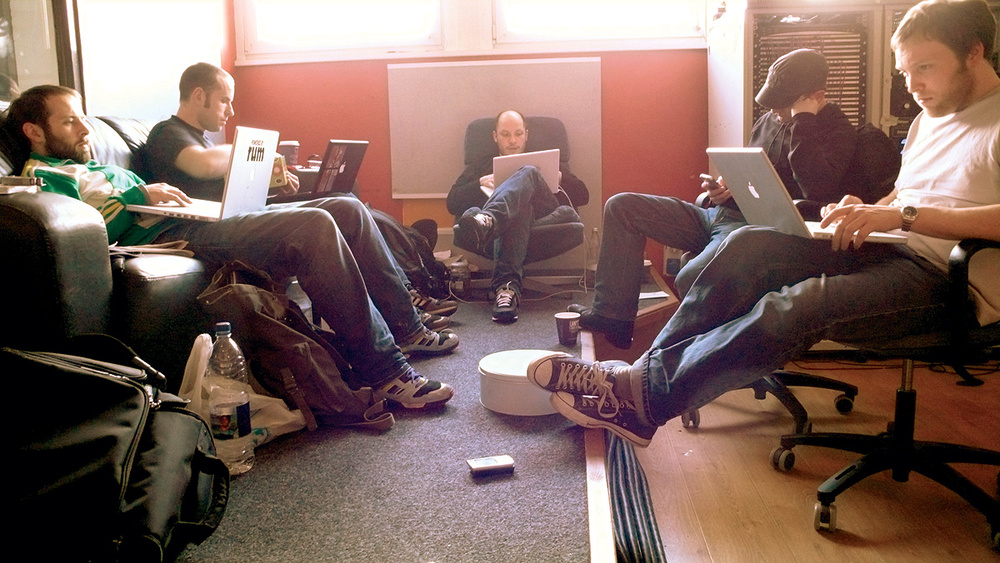 The art of conversation, 21st-Century style: Mogwai at work on The Hawk Is Howling.Photo: Gareth Jones
Since Stuart Braithwaite and Dominic Aitchison formed Mogwai in 1995, their largely instrumental music has come to define the 'post-rock' genre. A mixture of brutal guitars, plaintive piano and electronics, it has been extensively licensed for television, films, commercials and video game soundtracks. Last year's LP The Hawk Is Howling is the band's sixth studio album.
Mogwai guitarist and recording engineer John Cummings was behind the desk, and also contributes piano and programming to the band's rich sound palette. As one would expect with a working band whose line-up hasn't changed in a decade, Mogwai have an established creative process, as John outlines. "The tracks tend to start off as individual rough ideas or recorded sequences that we have individually, and then we'll do a quick demo of them at home so everyone's got something to work from. We've all got laptops, so it tends to be Garageband, Ableton Live or Pro Tools, depending on which band member is doing it. Then it will be circulated amongst us as MP3s — and these will range from the most basic sketches to other pieces that are more structurally complete.
"The ideas are guitar, keyboard or bass‑driven, generally, and we'll often put down some rubbish drum machine or a click track. There are a lot of these pieces that don't get any further work done, as people don't see any promise in them, so it takes a while to get them worked up into songs. I think it took about six months this time to get an album's worth of stuff. The songs tend to get only properly finished in our heads after we've been touring them for a couple of months — there's only so far you can go without playing them in front of people. The tracks grow into themselves — pushing and shoving, squashing and squeezing until the things fit better.”
Chem 19
 Chem 19 in Glasgow, where The Hawk Is Howling was recorded, is based around an Amek Einstein desk.
Recording took place during February 2008 at Chem 19, a studio run by Glasgow record label Chemikal Underground. "Our first album [Mogwai Young Team] was recorded completely on tape machines,” recalls Cummings, "but I have an aversion to them, and as a result the last two albums have had no tape involved at all. The studio is a place where I have recorded bands before. It's a wee bit out of the way, on an industrial estate in a Glasgow suburb — it's not the easiest to get to. But it's just got a really nice big live room and a nice selection of microphones.”
As with the demo-writing stage, recording involves a structured but particular building‑block approach, rarely involving the full band at any one time. "Recording tends to start with whoever has written the song,” reveals Cummings. "Say if it's one of my songs, I will record the guitar part with the drums and the bass first, try to get a pretty good one of them, and then Stuart and Barry will go in separately to add other guitars or keyboards.”
Cummings was happy to involve others in the engineering side of things, and the project was overseen by Chem 19's respected in-house studio engineer Andy Miller. "For fear of attempting to badly micro-manage everything, I kept out and was happy for other people to be in charge for the whole recording and mixing process. If I had been doing it, I might have done it in a slightly different way, but it's best to leave overall charge of the project in somebody else's hands. As much as it's difficult to tell somebody how to exactly play the guitar, or a particular guitar part, it's the same trying to tell someone how to engineer a record in particular way. It's better to let them do it the way they do best.”
Super Bass, Clean Guitar
 The live room at Chem 19.
As such, the recording process was open‑minded, with approaches ranging from a fully miked drum kit to a simple single room microphone. Mogwai's distinctive multi‑layered guitar sounds are achieved through a mixture of old-school and new technology. Their backline is predominantly Fender or Marshall amplifiers, but specifically Marshall bass heads.
"It was what I bought when I got my first student loan!” confesses Cummings. "A friend of ours had a Marshall Super Bass Mk2 head and cabinet for sale. So I bought that and I wasn't even thinking that it would be a stupid idea to get a bass head. I was 17 when I got that — but it's still the type I use and I've bought more of them over the years. It's super-full and really clean, and it can take really large amounts of distortion going into it without adding any more of its own.”
Guitarist Barry Burns also uses a Matamp stack, described by Cummings as "a bit like a gritty Orange, but more awesome.” However, to achieve the complex sounds, acoustic recording is augmented by an array of software for guitar, keyboards and synthesis. "Guitar Rig is a pretty good effects rack, but it's the Waves GTR3 that we would go to for usable amp sounds,” expounds Cummings. "We have used real pianos quite a lot when we've had access to them, but with laptops, we have access to the VST ones as well. I'm a huge fan of [NI's] FM8 — really impressed with the range of sounds you can get out of that. We use Akoustik Piano a lot as well, and Barry uses Ohm Force [plug-ins]. We've got the Korg Legacy Collection, which is pretty good, and I think Barry's using the [Arturia] Minimoog stuff quite a lot. But the FM8 is definitely my favourite keyboard. I've used Battery quite a lot for rhythm sampling, plus Reaktor, SuperCollider and Melodyne.
"We've also got a great wee Philips organ as well — a 1960s Philicorda from a car boot sale. I had to cobble together the wiring because it was one of those old flat and round pin speaker connections.” The band were tempted to take this out on the road, but generally Barry's VST keyboard instruments are coming off a rackmounted Muse Receptor controlled from an Edirol PCR50 keyboard.
One of the new album's stand-out tracks is 'Scotland's Shame', which has a fantastic mutating bass texture, evolving from the opening organ chords. "That one was recorded live with everyone,” recalls Cummings, "apart from me doing an overdub as I didn't have a guitar part — but one magically appeared to me. Barry wrote the song on the organ. The bass would have been a Travis Bean through an Ampeg SVT Classic. That's what Dominic [Aitchison] does tend to prefer. He also runs a Mesa Boogie 400 Plus, although he doesn't tend to enjoy it as much as the Ampeg. I think it would have been using an Electro-Harmonix Bass Microsynth pedal as well — that's where all the goodness was coming from.”
The Castle Of Doom
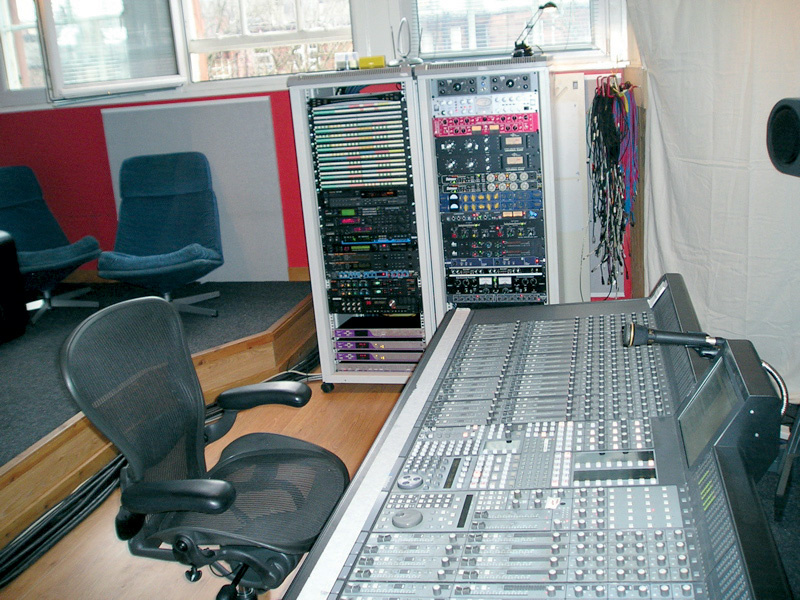 Castle of Doom, where Gareth Jones mixed the album on a Euphonix CS2000.
Gareth Jones, best known for his work with Depeche Mode, was brought in to mix The Hawk Is Howling at the Castle of Doom, a studio in Glasgow co-owned by Mogwai and producer Tony Doogan. Outfitted for tracking, overdubs and mixing, it was built according to Tony's specifications, including a Euphonix CS2000 board, and equipped to mix for 5.1 surround sound and sync to picture for film work. "It's without a permanent home at the moment,” reports Cummings. "It used to be a in a lovely detached house in Glasgow's leafy West End, but the owners wanted to sell the house and the Fratellis ended up buying it. We're still looking for a more permanent home for it. At the moment it's a kind of mobile mixing room based around the Euphonix desk, although I've never really taken the time to get my head around all the fantastic joys of complete automation for everything.”
Jones was given the simplest of briefs: Keep it big. "Obviously, the band needed to be involved,” says Jones, "and I needed their input, so it made budgetary sense for me and my assistant [James Aparicio] to go to Glasgow. I took my eight‑core Mac up to Scotland, loaded with plug-ins, and DSP — two UAD cards, TC Powercore X8, Waves APA 44M and Focusrite Liquid Mix — so apart from the nice analogue gear at the studio, I had my own arsenal of plug-ins. The Waves Studio Classic bundle and my UAD plug‑ins, together with the Liquid Mix, were all used all over the place for colour and dynamic control. I am also a big fan of the PSP plug‑ins. There were some big Linn speakers in the studio that I was not familiar with, but they seemed very useful. As always, I also took my trusty powered Dynaudio BM6As and Sennheiser HD650 headphones.
 Gareth Jones.Photo: Daniel Miller"I have been mixing a lot 'in the box' recently, but when I saw the equipment at the Castle of Doom I made the decision to buy an Apogee Symphony PCI card for my Mac and a couple of X-Symphony cards to hook up to their Apogee DA16 converters. I also got an X-Symphony for the AD16, which allowed me to come 'out of the box', and I thoroughly enjoyed the experience. Summing was through the Euphonix board in the studio, and I set up a few compressors on aux sends so I could get some additional tones going. Two Distressors, two Urei 1176s, two Chandler Germaniums and two Dbx 160As were on eight auxes most of the time. I also used the API 2500 as a buss compressor. I found the Euphonix EQ quite useful as well.”
Tracks that had been recorded using Pro Tools were subsequently transferred to Logic for mixing within Jones' comfort zone. "I am a Logic fan, and I am not good with Pro Tools at all, so it is always good for me to work in Logic. I feel at home there, and I am comfortable mixing 'in my own studio'. James also set up a small Pro Tools room in the live room so that track preparation and pre-mix editing could take place in there as necessary. James was also running Pro Tools LE on his laptop, preparing tracks for me as I mixed.”
Mogwai tracks often start with a plaintive piano motif or phrase. Guitar, bass, drums and all manner of unworldly noises are added whilst the piece builds, twists and turns, then shifts and builds again. Once you have got over the expectation of hearing vocals, you don't miss them — in fact, the purity of their music is in the absence of the human voice. "I guess mixing instrumentals is just different,” says Jones, "perhaps easier in the sense that you don't have to make room for vocals, but harder in the sense that you do not have the anchor that is the vocal.
"We allocated about a track a day, with a few days for tweaks and redos, so all in all about 17 days. Basically we used the old method of leaving every mix up overnight, loading mixes up to an FTP site, everyone downloading and listening at home, in the car, on the iPod, whatever. Then we reconvened every morning about 11 and made adjustments. Then onto the next mix.”
Capturing Versus Creating

Previous Mogwai albums have been recorded with a producer, whereas The Hawk Is Howling was self-produced by the band. Summing up, John Cummings admits that the old approach has its merits. "I think next time it would be good to go back to recording and mixing with the same person — it's what we've done before with people like Paul Savage. I think the way we did things this time, when recording, was to try to keep it a bit open-ended so that there were more possibilities in the mixing. If it's not you doing the mixing, you don't want to leave whoever it is with a set sound that doesn't work, so it was kind of recorded in a neutral way and that can set your view. You end up with more extreme results when you have a consistency of vision from recording through to mixing. There's more of a blank, neutral assessment of what the band are like, rather than using the studio as an instrument. It's more of a method of capturing rather than creating. That's a perfectly fine way to make a record — but I slightly prefer the other way! Less Steve Albini and more Phil Spector!”
Step On It: Mogwai Pedals
Guitar foot pedals are an important element of Mogwai's sound, both in the studio and live — so much so that Electro-Harmonix even produced a limited issue 'Mogwai Big Muff' with a slightly more extreme sound. "Distortion and delay have always been the ones that we've used the most,” recalls Cummings. "Stuart uses a Fab Tone and Rat pedals. The past few years I've been using a lot more EQ and reverb pedals, which help live from song to song. And a bit of tremolo — I like a bit of tremolo. The Boss ones are pretty good and we've had amazing Fab Tone ones, and there's a really good Frantone Electronics Vibutron — that's outrageous. Wah is always a hit, and the coolest pedal that I've got at the moment is the Electro‑Harmonix Hog.
"For delays we use quite a lot of Boss — DD3, DD5, DD6 — and the new Electro-Harmonix Stereo Memory Man. We've had a really great relationship with the people from Electro-Harmonix over the years, and the new pedals that they're coming out with are a lot more robust. I'm a bit more confident about taking the new Memory Man out on tour than the old Memory Man.
"I think we try to keep it pretty simple. Stuart and me have got between 12 and 13 pedals and run a couple of amps at once. We've never gone the way of getting those MIDI switching devices for different loops. Like most people, we are limited by practicality. It's so annoying when you've got a perfect, but expensive, pedal that disappears or breaks. So we tend to go more for ones that aren't so expensive and fancy, 'cause then you end up relying on unique tones to play concerts. And if a pedal bag goes missing it's easier to replace.”
However, not every guitar effect gets the Mogwai thumbs-up. "We tend to avoid chorus effects in everything we do — that's the only stipulation we have,” states Cummings. "We've certainly got no problem using good digital stuff — flange and phase are funny in their own way and they can be used to fantastic effect, but I've never been able to find a positive home for chorus — it's just never made sense to any of us. I also don't find tape echo works too well for guitars — it seems to make it muddy rather than making it glorious and soaring, which tends to be what delays sound best doing.”