

As frontman with Queens Of The Stone Age, Josh Homme is arguably the biggest name in rock music. So how would he tackle a move into the producer's chair with British indie superstars Arctic Monkeys?
 Arctic Monkeys frontman Alex Turner (left) and producer Josh Homme (right) share an uncomfortable‑looking cuppa during the sessions for Humbug.Photo: Justin Smith
Josh Homme and the Arctic Monkeys share a love of distorted guitars and rocking out, but other than that they come from completely different musical universes. Homme and his music are as American as they come. He's a man of the desert, having been born in Joshua Tree and grown up in Palm Springs, California; but while his formative musical experiences, with the band Kyuss and early Queens of the Stone Age, were heavy metal, he has since developed an impressively wide‑ranging array of talents and activities. Homme has collaborated with numerous people, among them Foo Fighters and Trent Reznor, and made a splash recently when he appeared on stage with John Paul Jones and David Grohl under the name Them Crooked Vultures. In the course of all this, Homme has been credited with performing on guitar, vocals, bass, drums, keyboards and xylophone, and as an engineer, mixer, and producer.
Arctic Monkeys, meanwhile, are the archetypal northern English, rain‑drenched, working‑class Britpop band, complete with heavy Sheffield accents and lyrics dripping with humdrum details of daily life. Their first album, Whatever People Say I Am, That's What I'm Not (2006), is still the fastest‑selling debut album in UK history, and like 2007's follow‑up, Favourite Worst Nightmare, was packed with frantic, double‑time post‑punk music. More recently, singer Alex Turner and fellow band members Miles Kane and James Ford pursued their love of '70s orchestral pop as The Last Shadow Puppets.
Throwing Homme and the Arctic Monkeys together was always going to result in something unusual, but few people will have been prepared for the Monkeys' third album, Humbug. The frenetic rhythms have been greatly slowed down, with the band instead doing a lot of slow, low‑down riffing, and often striding waist‑deep into prog‑rock territory. Whereas frontman Alex Turner frequently half‑spoke or half‑spat his lyrics, he now positively croons, following in the footsteps of fellow northern singers such as Bryan Ferry and Morrissey.
Opening Doors
"The Arctic Monkeys were unlocking doors in the house that they live in,” recalls Homme, "which was great to be around and watch. From the first note that I heard for this record, which was a demo for the track 'Dance Little Liar,' I thought: 'I'll be damned, these motherf**kers want to paint landscapes.' Which is right dead in the centre of where I live musically. I reckoned that it was going to be fantastic, because we would be able to go down this path together and really enjoy it. I am also always on the search to try to do something that will be classic and will last forever. And the staging point for something classic is to find a weird chemistry, so that just the meeting in itself is a story to be told.
"For as long as I've known the Monkeys, they've always wanted to play that most dangerous of games, which is to grow and change with each record that they made, while retaining their sense of themselves at the centre of it. It's the most dangerous thing a band can do, and also the most necessary. If you're lucky enough to be a musician, you have to take risks. If you risk nothing, you get nothing.
"You're constantly enticed by labels and fans to sort of mimic yourself. But you have to shut that out. Certainly, after his album with the Last Shadow Puppets, Alex was ready to grow in metres instead of in centimetres. The Arctic Monkeys were on a search for themselves, and nobody who attempts mimicry can understand that. They needed to be with someone who had pursued that, and I have always thrown myself into the fire. I also have a lot of experience blowing it, which is the key to getting things right! [he laughs] So we were of absolute like mind and of similar taste. When we started, we already had more in common philosophically than we understood consciously. And that understanding made for quick friends.”
In The Desert
The choice of Homme as producer didn't come entirely out of the blue: the band and the American had met a number of times when on tour and shared a mutual appreciation, while drummer Matt Helders has named QOTSA as an influence.
Initially, band and producer took, says Homme, an attitude of "Let's go and record a couple of tracks with no particular purpose in mind,” to lessen pressure and expectations. However, it soon became clear that the collaboration struck gold, and two sets of sessions were booked in September 2008 at Homme's favourite Rancho de la Luna studio, near Joshua Tree in the middle of the Mojave desert, with help from Homme's friend and collaborator, musician and engineer Alain Johannes Engineer Alain Johannes at Rancho de la Luna in the Mojave desert, where much of the album was tracked.. As the sessions unfolded, Homme was at pains to avoid imposing his own musical perspective.
"Before we started, the band had demos of eight or 10 songs in various stages of completion. During a first conversation I asked them what they wanted me to do. Did they want me to push them? Fine, I can do that. Or did they just want me to hit record? I can do that as well, but you'd better be a good band! What I love about the Monkeys is that they just need to be told: 'Yes, the direction you are going in is awesome. I know it feels scary, but that means that it's right, so let's go.' Those prog‑rock elements — like in 'Crying Lightning', all those weird passages tucked right in the middle of a pop single — I love the guts of that, because it is very sexy and it paints a dark and imposing picture without alienating anybody. I love how much of an infiltration that stuff is.”
So what, then, about the apparent QOTSA influences in various songs? "When we discussed what they wanted me to do early on,” replies Homme, "I asked: 'If I have an idea, do you want me to tell you or not?' And I would ask the same question each time for each song. That was part of my job. Once everybody had done their thing, I would say: 'I have this idea, would you like to listen to it?' Some of these ideas they used, and some they did not. So I played and sang a thing or two here and there on the record, but it was not really for me to do. This was their record to make. I told them that I would probably get credit for the things that had come from the Monkeys themselves.
"Much of the slowing down and the expanse came directly from the band itself. In fact, there are three songs that are so good that I could not believe that they are not on the record, and they were also the fastest songs. I called and begged and pleaded, but they did not make the record. They are three songs that could easily be singles. If they don't get released one day, I'm going to storm the building at Domino Records to demand that they be released! One is called 'Catapult', which to me is the pinwheel between their last two records and this record, because it has a foot in each territory musically, and it has more hooks than a bait shop. The other ones are 'Steepest Little Secret', which kicks ass with a giant groove, and 'The Desert's Only Costume Shop', which would make Reading jump straight up and down. So I said: 'You bastards, you are going to make it seem as if I was the one that got you to slow down.'
"While working in Joshua Tree they were able to gain a confidence to experiment with things that they had always wondered about. For example, it seemed that both Jamie and Alex, in fact the whole band, thought that playing lots of guitar leads sucks. But there's a way to do all things. You don't know anything if you have not tried it or are just too scared to do it. So they had a chance to trip and fall and get up and find their own style, and it turns out that they both have a very odd style of playing lead, which is great. I also truly enjoyed working with Alex on continuing the crooning work he begun with the Last Shadow Puppets. Alex started to find places in his voice that he had never used before. He naturally has that swagger, so it is not forced or contrived. A lot of his earlier stuff had been almost talked through, so I was like: 'It's time to sing, especially since you can, so let's really work on these melodies.' Another area we worked on that they hadn't tried was in applying the kitchen sink idea to a track like 'The Jeweller's Hands'. In the past the band had always recorded themselves live in the studio, and that was it. As a young band you have pride in being able to do that, but by your third record you naturally want to start crafting things in the studio. Once again, it was great to watch and we ended up with quite a few critical overdubs on the album.”
The Lack Of Anything Else
The way the Arctic Monkeys are developing arguably recalls the Beatles, who went from recording themselves live in the studio to the studio‑based, kitchen‑sink approach of Sgt Pepper's. Homme agrees that there is a parallel. "That process was perfectly done by the Beatles, but is difficult to let yourself grow like that and not disappear up your own ass. The thing is, the explosion that the Arctic Monkeys went through cannot be explained easily. It's also something that often rips people apart, but these guys are still best friends, and they managed to create a bubble for themselves and they still have some naiveté after all they have been going through about wanting to discover new things. Plus they're ready to do the work. I'm always baffled by musicians that don't want to put in the work, because what we do is such a luxury thing, and it's fucking awesome. So being around them while they were working intensely was great.”
The band's intense and quick development led to a second round of sessions at Rancho de la Luna, followed by a third set of sessions at Homme's Pink Duck studio in Los Angeles in December The Arctic Monkeys lay down a take at Rancho de la Luna. and a fourth at Mission Sound Studios in Brooklyn, New York, this time with James Ford producing. In addition to the band's own input and Homme's production approach, a number of other elements contributed to the final outcome, most importantly Rancho de la Luna itself and the engineering approach of Alain Johannes, with help from Homme, which incorporated some unusual methods and pieces of kit. Homme explains why he chooses to record many of the projects he works on at Rancho de la Luna: "One of the greatest catalysts for making music is the lack of anything else. Rancho is a normal house, located in the desert, with the nearest neighbour half a mile away, and it is everything that a studio should not be. I like the restrictions, because I think that any good studio does not have everything. A studio that has everything has twice as much as it needs, because your mind should do most of the work, and you need some restrictions so that you can stretch yourself. It is good to be forced into working with stuff that you might not normally work with and would, in fact, rather avoid. There's something in the amalgam of the wrong location, the wrong house, and the wrong equipment that makes everything all right, so it has always been an easy choice for me to go there. Magic happens there, and it does not take long to get great tones. I love that enigma.”
Maths Problems
With regard to the "wrong equipment”, Homme admits that he and Johannes in fact took quite a bit of what presumably was the right equipment to Rancho. Homme: "The studio's gear is esoteric, with a Soundcraft desk and a Fostex 16‑track tape recorder. I brought my Eventide 2016 to Rancho, which is a great, versatile, variable reverb. I also took my Eventide H8000FW multi‑channel effects processor, because Rancho is quite small, and it allowed me to add four different effects at once. Other goodies that I took with me included Neve 1084 pres, API stuff, a Pultec EQ1A, some Tube‑Tech stuff, and some of my own compressors, like my Federal, my Department Of Commerce compressor, my Gates, and my Collins 26U.
"We also brought a Pro Tools rig out to the Rancho. I struggled for a long time with Pro Tools, because in a blind test with analogue I could pick it out as worse every time. But now I can't tell the difference. I still miss some things about analogue, though, most of all the restriction to 24 tracks and the tape saturation. When you hit zero on digital, things will start to crackle, but tape will try to hug you first. I have a bunch of reel‑to‑reel tape recorders at Pink Duck, and often will rent a Studer half‑inch on which I'll put a four‑track head, to record stuff on, typically drums, percussion and bass, and dump that into Pro Tools. We do that a lot with Queens.”
Homme discusses these details with enthusiasm, and it's no surprise to hear him say "I love engineering. Carving sound, hearing it and knowing which microphone and microphone preamp combination is such a fun math problem solved.” It also becomes clear that, while Homme was credited as producer on Humbug and Johannes as engineer, in reality the labour division between the two was much less clear‑cut. "When Alan and I start working, we become so tangled and intertwined that we start looking like conjoined twins,” observes Homme.
"Josh and I are really into engineering,” agrees Johannes, "and over the years we have worked together on many projects, from the Desert Sessions to QOTSA's album Era Vulgaris. We both choose mics and mic preamps and so on and are always searching for the unknown, something that has a very particular character, and we then see how it fits into the puzzle. There's no repetition every time we do something. Our idea is that we like every sound to have its own character and its own space in the spectrum. If you have 48 tracks going through the same gear, it will all have the same tonal quality, so instead we try to mix and match our gear as much as possible. We brought some API 550s and eight channels of Neve 1073. I brought my Decca mastering limiter, and a Neve 33609, and some of the Thermionic Culture stuff, like the Culture Vulture and the Rooster. I also occasionally ran some stuff via a tape recorder, for the tape compression, especially bass and drums. With vocals and guitars I prefer the hardness of digital, because the transience is so quick.”
Where Most Bands Stop
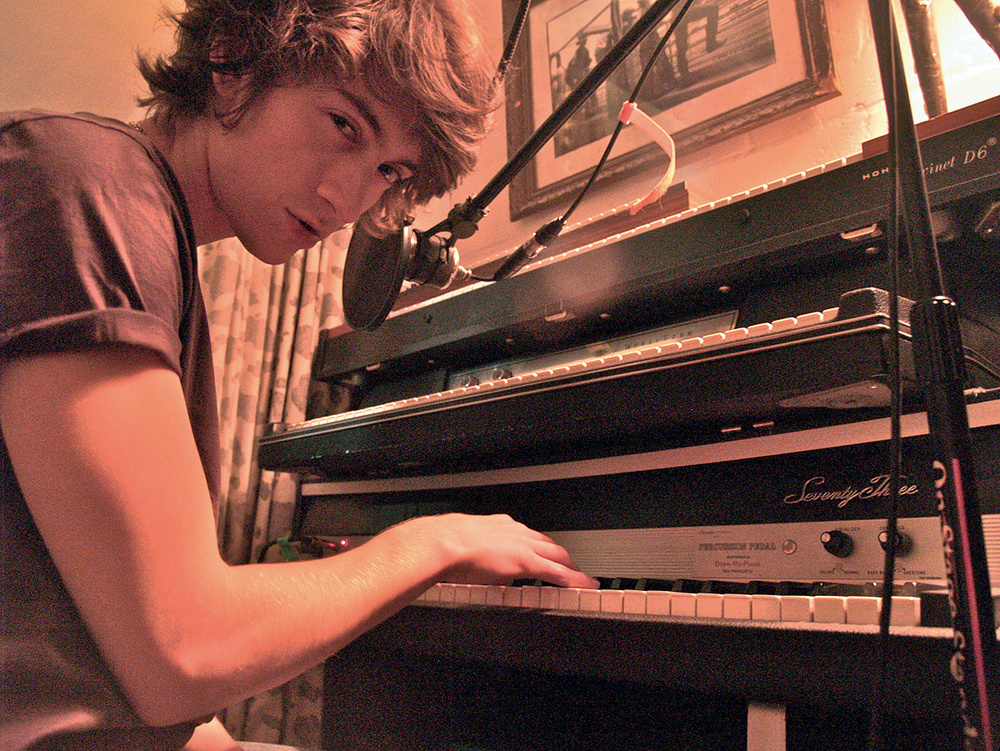 Humbug expanded the Monkeys' sound palette in numerous ways, among them the use of vintage keyboards.
With their mix‑and‑match equipment at hand, Homme and Johannes set about capturing the wildly experimenting Arctic Monkeys in all their glory. Johannes: "The band had demos, but there also was a lot of arranging things in the studio going on, with Josh going in there and running through the different possibilities of playing a song and trying different beats, different feels, and so on. I documented everything, and while Josh was in the live room with the band working on the arrangements, I had the opportunity to maximise the sound. As the shapes of the songs kept shifting, we kept adjusting the mics and mic preamps and so on. Once the arrangement locked in, it was usually a matter of two or three takes and that would be it for the basic tracks. The band are really astute and quick. The first fully realised take allowed me to make some final adjustments and then we went for one or two more takes. We didn't edit between takes very much. Matt and Nick are such a strong rhythm section, when they nail it, they nail it. Afterwards there was more exploration and carving of the many textures and layers that the guitars and other instruments could offer.”
Homme: "For the Monkeys, the best thing in the studio is to play together as a quartet. It's uncanny how much that focuses them. They laid down the basic tracks live, with Alex singing guide vocals that could often have been keepers. We almost always replaced the vocals, anyway, because they really deserved that focus and attention. But if the guide vocal beats the overdubbed vocal, then you know what to do. It does not need to be laboured. With each take you peel away some of your excitement. If you don't have a good take by take 10, you should move on and come back to it later. Also, we have this saying in the Queens which goes: 'This is where most bands stop, and this is where we start.' This refers to the details that go into a song, like an accent shot in verse two for no reason, and so on. What really excited me was that the Monkeys were also really into doing this detail work on the music. I respect that eagerness to craft songs.
"The keys in 'The Jeweller's Hands', for example, were all played on pianos and organs and the strange keyboards in Rancho like Optigans, Crumars and non‑professional‑style home organs from the '50s and the '60s. Alex played all the keyboards. He is one of those guys who doesn't tell you that he plays the piano until the sixth day. He is sneaky that way. On a number of songs there was also a xylophone. A good reason for these unusual sounds is to avoid doubling, unless it's for a deliberate desire for something special. Doubling can really trample nuance. I want to hear you, and not you twice, necessarily. And so in lieu of adding more guitars, it is a great idea to switch your same idea to some other instrument. That way each thing gets heard. Playing an instrument that you normally don't takes you out of your comfort zone, and it was great to see them do this!”
All Sorts Of Microphones

Johannes: "We used a lot of different microphones, often changing them for each song. We leaned a lot on the Rode NT4 stereo mic, which is an easy way to get a nice stereo picture as if you are standing in front of something. We used it mostly for the drums. We also used a Neumann 49 for the centre of the room, and the kick and snare mics would vary all the time. For the other instruments we had quite a bit of separation, with the two guitar cabinets located in two bedrooms, and the bass cabinet in a closet. I used the Heil PR30 on the electric guitars, because it has a nice crunch to it, or again the Sigma, sometimes a Coles ribbon, sometimes the Violet Designs Amethyst. Acoustic guitars I recorded with an AKG condenser pointing two inches from the bridge, plus an Oktava condenser at the 14th fret.”
Homme: "One of the most successful vocal combinations for the Joshua Tree sessions was a Neumann [TLM]149 close up, going through APIs or Neves. We created a great John Lennon‑style single slap delay with my Marantz cassette recorder, which added warmth, clarity and drama that sounded great on Alex's vocals. You usually need to roll off the cassette hiss with a Neve EQ or something. The bass distortion in 'Crying Lightning' was the result of a Webcor reel‑to‑reel machine that we used as a bass amp.”
Johannes: "We also used some ribbon microphones on Alex's voice, for instance the Sontronics Sigma, or an old Sony. In a few cases we used an old Fender mic for a crap‑out distorted vocal sound. The distorted vocal sound in 'Dance Little Liar' was recorded with an old ribbon through the Thermionic Rooster and the Neumann through a Neve 1080 into a Neve 33609 compressor. I very often had two or three microphones on the vocals. We were not always using all of them, it was more a matter of having a choice, if we wanted the vocal sound to open up for the chorus or something.
"I had all sorts of microphones sitting around. The group vocals at the beginning of 'Dangerous Animals' were done with everyone in a Rancho bedroom, recorded from a distance with an old Sony ribbon, through a Neve 1080 and 33609. Again, the basic idea was just mixing and matching different microphones and other equipment for coloration and for tone. The preamps were mostly Neves and APIs, but I sometimes ran the mics through the Soundcraft desk. Everything went straight into Pro Tools. I didn't use many plug‑ins in Pro Tools. I kept it pretty clean. Occasionally I used a quick gate or something like that, just for playback. A few plug‑ins were really useful, like the Izotope Vinyl plug‑in, which changes the frequencies to emulate old records. Waves' Restoration plug‑in was also helpful for cleaning up the sound. Because some of the gear we were using was five centuries old, while the tone was great and the musicality awesome, it sometimes was bloody noisy. So that was really useful for cleaning up the sound here and there.”
Engineering Continuity
Homme's Pink Duck studio looks, according its owner, like a "bordello from the cowboy days” on the inside.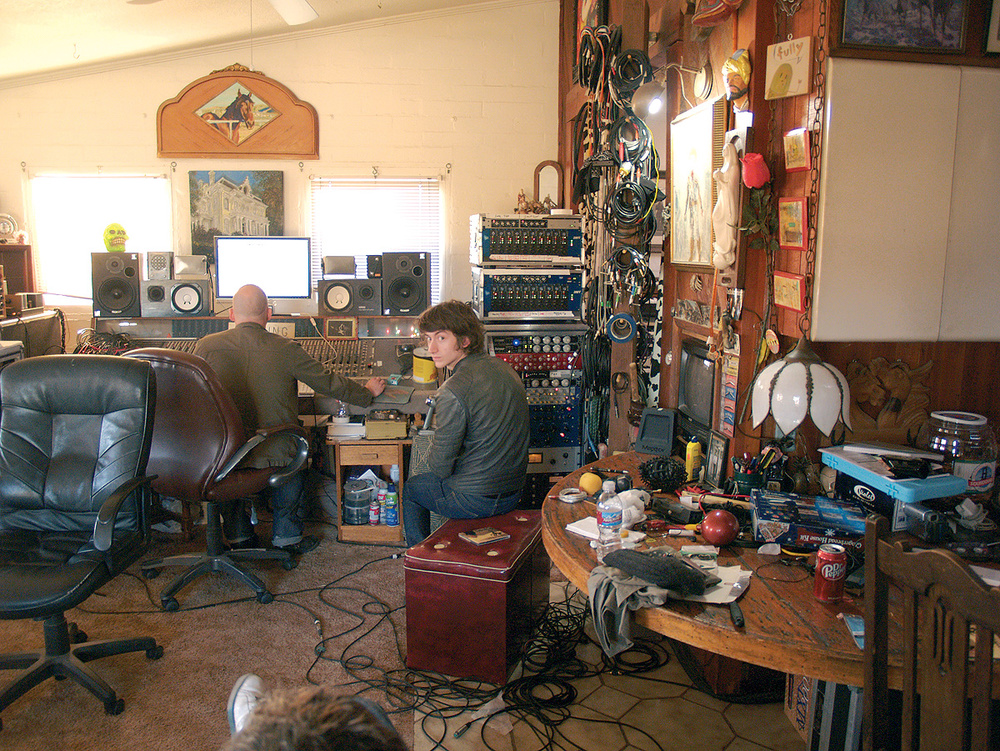 The Rancho control room. The producer explains that the move from Rancho to Pink Duck was planned all along just in case the desert didn't pan out as a helpful catalyst for the band. Ultimately, however, they wanted more Rancho, more desert and more isolation. Several songs, among them 'Pretty Visitors', 'Dangerous Animals', and 'Dance Little Liar', were recorded from scratch at Pink Duck. The equipment used at Pink Duck was as similar and varied as that in Rancho, the only major difference being Homme's SSL 4048 desk with G+ computer and E‑series EQ, which is, remarks its owner proudly, "the rock EQ”.
Homme signed off at this stage, as his presence was demanded for other projects, which is why James Ford produced the band during the Mission Sound sessions. This meant a return to a more familiar team, as Ford had produced the band's second album and the Last Shadow Puppets' The Age Of The Understatement. The three tracks on the album produced by Ford are in the same vein as the Homme‑produced material, both musically and sonically. The latter aspect may have to do with the presence of Johannes, who also travelled to New York, at the request of the band, for the sake of continuity.
Johannes: "I couldn't really bring a lot of gear to New York, so I kind of interpreted the aesthetic with whatever gear was there in the studio. The continuity was in my engineering approach, rather than the equipment. It was not really like there was a measurable difference between the different approaches, it was more a matter of recording the vibe. The Mission Sound studio had a nice Neve desk, and I used their [Rode] NT4 mic and the [Shure] SM7 and some nice Neumanns. The studio also had a nice 24‑track tape machine, and I tracked the rhythm section — bass, guitars, drums — live to tape, and loaded it into Pro Tools, comped takes together or kept the whole take. We then did the overdubs in Pro Tools. I used a couple of tape reels over and over again for this.”
 Like a "bordello from the cowboy days”: the live room at Pink Duck, with a few of Josh Homme's guitar amps.Again, in part, for the sake of continuity, Rich Costey (Foo Fighters, Muse, Mars Volta, Fiona Apple, Franz Ferdinand) mixed the entire record. It was a prospect that filled Homme with dread: "Putting the project in somebody else's hands was scary. But Rich sent me his mixes every day and we spoke every day, and I was really pleased with what he did. He got things really close to what we wanted to do, even before speaking with him. Of course, from the files Rich picked up on what direction the mixes needed to take. The notion of taking a million microphones and recording without effects and then sorting it out in the mix is not my style. I prefer to sonically commit to tape. I think we should all know now whether we like how something sounds or not. So we recorded everything with effects, which means you're building up a sonic quality.”
 The Pink Duck control room, with its SSL desk.Costey nonetheless managed to put his own stamp on a number of songs, for instance using his Binson Sound City Echomaster 2 echo unit to add a spectacular swirling reverb wash behind Turner's voice in 'Secret Door' when he sings 'The secret door swings behind us'. Homme: "Much is made of having continuity when you are doing an album, but in my mind it is not worth fussing over. Alain engineering all sessions helped, and Rich managed to unite both mine and James's tracks. But if your direction is clear, there's always continuity, and that was very much the case with this project. These guys have grown as people, and musically, during the making of this record, and I did too. This meant that it was a success for all involved — even before the music was released.”
From Musician To Engineer
Unlike most musicians, Josh Homme doesn't just dabble in a bit of engineering when necessary, but has a genuine love for the métier. "I love engineering. The creation of music in the studio really has always been my favourite part. That should be the most beautiful process, but I actually had a bad experience my first time in a studio, and I vowed that I would never have one again. I found ways of eliminating intrusions and outside influences, so that when you have a problem it is yours, and it is fun to solve it. I feel the most free in the studio. I always hear instruments in terms of their coloration and how they are positioned in the sound picture, and so having my own studio, Pink Duck, is really fantastic. It's a great place to actualise the sounds that are in my head. It's filled with gear that I have been collecting for a long time. It's a mixture of old and new; I don't have rules that are based on age. There is great stuff made now, and there was certainly great stuff made then. I would say that the gear collection is esoteric. I found over the years that if everyone is using something, it can't be that good!”
Likewise, Alain Johannes was a multi‑instrumentalist first, and is still active in his first successful band, Eleven. He too found himself thrown into engineering because he wanted to have more creative control of his work. "Unfortunately the production and engineering of the albums I did with Eleven always came up short, and then one day it dawned on me that the aesthetic carries through right from composing, playing and recording to mixing and mastering. With Eleven we'd made an album for $150,000 and one for $175,000, and somehow something kept getting lost in translation. I became very frustrated. So I decided to engineer and mix things myself and set up my own studio, When we left Hollywood Records and went to A&M, they agreed to hand me the $200,000 budget to go out and buy equipment where we recorded our fourth record, Avantgardedog [2000]. The technical side of things seemed daunting at first. but I always recorded myself as a kid, using reel‑to‑reel tape recorders, sound‑on‑sound techniques, early Portastudios, and so on, and I always managed to catch an amazing vibe and feeling and spontaneity in the process. I wasn't confident initially that I could cut it, but I just went for it, and picked the microphones and the microphone preamps and instruments, and before I knew it I was engineering and mixing.”