

The fruit of the union between synth and drum machine legends Dave Smith and Roger Linn ought to be something very special indeed. Is the Tempest set to take the world by storm?
Over the last four years, tales of a new drum machine from the industry dream-team of Roger Linn and Dave Smith have circulated wildly. Teasing images of prototypes bearing exotic names such as 'BoomChik' came and went. Now, finally, the long gestation period is almost over. I say "almost”, because the Tempest (a much better name!) is still a work in progress. Although its hardware is complete, much of this review was conducted using a beta version of the OS. It's quite an advanced beta, though, stable and functional in most areas and therefore sufficient for a preview of the Tempest's sound and interface — and a hint at the performances it could inspire.
To anyone wary of becoming an early adopter, the following statement on Dave Smith's web site might offer reassurance: "Going forward we'll be releasing periodic free software updates that can be downloaded and installed over MIDI, and we'll be maintaining a list of what is remaining to implement. If you wish to wait until all features are done, we understand. If you wish to try it out first, then decide to wait, that's OK, too — we will maintain a liberal, no-questions-asked return policy while we're finishing up the remaining features.”
Clearly, this has been a huge project for the two companies, and as it reaches fruition, now's our chance to take the first look at a drum machine hoping to take the world by storm...
Tempest Fugit
The production model Tempest is described simply as an 'Analog Drum Machine', but it's actually far more than that. Classic analogue drum boxes were based on dedicated circuits and, if you were lucky, a few choice controls to tweak the main drums. The Tempest's six voices are based on a multitimbral synthesizer architecture that's not a million miles from DSI's Evolver range of synths. Each voice has two analogue oscillators, a sub-oscillator and two digital oscillators eager to spit out percussion samples or other waveforms. These sources (plus an internal feedback loop from the main output) are processed by analogue low-pass and high-pass filters, aided and abetted by fast LFOs and snappy envelopes, and further honed by the modulation matrix. All of this adds up to an extraordinarily deep engine for a mere 'drum machine'!
The challenge was to blend the skills and experience of both companies to produce a unique and well-balanced entity. It goes without saying that any drum machine bearing the name of Roger Linn is going to trigger high expectations — and they're expectations that won't be diminished when you glance at the bottom line!
Hit Me!
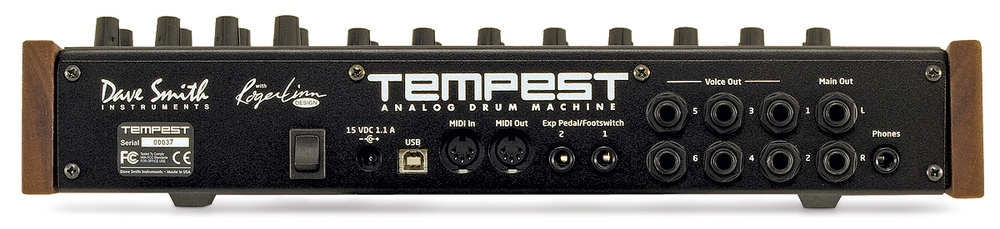 The Tempest's back panel includes an input for an external 15V power supply, a USB port, MIDI I/O, a pair of footswitch inputs, six individual voice outputs, a pair of stereo outputs and a headphone socket.
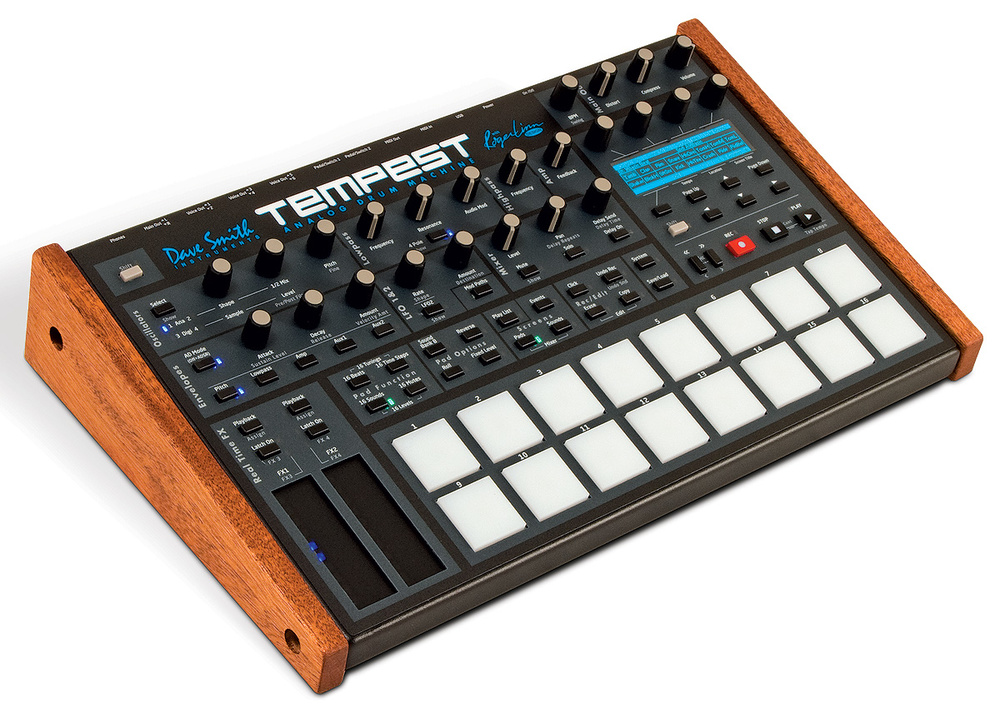
Weighty and compact, at just 39cm x 22.5cm, the Tempest is a quantum leap in style past the earlier prototypes. Although well supplied with knobs, encoders and buttons, it's the small, clear OLED display that instantly catches the eye. Its resolution of 256 x 64 pixels permits graphics where necessary and text that is tiny but readable. It's a credit to the programmers that so much information is delivered squint-free from a rectangle measuring just 8cm by 2cm.
Most of the buttons are small and slightly wobbly but with a positive click; only the three transport controls suggest non-Lilliputian manufacture. The panel text is printed onto an overlay with all functions and shifted functions clearly marked, but the overlay background is a bit darker than many of the online photos, and the buttons don't exactly stand out in low light. Fortunately, LEDs point the way to the various pad functions, screen buttons and other options.
Ergonomically, it's a delight; a mixture of knobs and encoders is used for voice editing and these, especially the knobs, feel smoothly reassuring. Most of the main synthesis parameters have dedicated controls, with those of less immediate importance packed into menus. Above the display, four encoders adopt new roles as you navigate around, resulting in a user interface that's nippy enough whether you're programming from scratch or editing one of the factory sounds. Even if you've never touched one of Dave Smith's recent synths, it shouldn't be long before you feel at home.
Turning to the drum pads, the Tempest's main performance area is divided into two rows of eight pads, plus two ribbons with adjacent LED runways. The pad configuration feels ideal — far better than the commonly-seen 4x4 grid for laying down 'finger and thumb' beats. Backlit in blue, the pads are velocity and pressure sensitive, while the ribbons also respond in two planes: position and pressure. The ribbons both offer alternate assignments, further boosting the ways to seriously mess with your beats. Before we start doing that, let's end the initial once-over with an I/O inventory. After all, the design concept specifies an entirely analogue signal path, ruling out such joys as onboard reverb or delay, so you're going to crave a few individual outputs.
Fortunately, the rear panel is awash with outputs: the main pair is supplemented by a stereo jack for every voice, so there are six in all. Thus, even when you redirect a voice for external processing, it maintains its position in the stereo field. Handling all six voices in that way would rapidly gobble up your mixer channels, but it's equally easy to connect a mono lead if you like. Plugging into any individual socket disconnects that voice from the main outputs.
It's disappointing that the power supply on such a high-end machine is external, but at least the supplied wall-wart is very light and unobtrusive. The remaining connections are: two assignable pedal inputs, a (currently unused) USB port, MIDI In and Out and, finally, a headphone socket. Rounding things off, a pair of wooden end‑cheeks add a traditional touch of class, while chunky rubber feet and the slightly sloping front panel invite you to a session of finger pounding.
Projects & Beats
 The Tempest is all about hands-on control — as you can tell from its busy front panel.
On power-up, the Tempest instantly loads into RAM the project you were last working on. Only one project is directly accessible, but there's onboard flash storage for more, plus individual sounds and beats. DSI estimate there's room for at least 50 to 60 projects, although loading a fresh one currently involves a bit too much button pushing and encoder spinning for my tastes. A feature under consideration for a future update is the background loading of projects, which should help.
A project contains 16 different beats — drum patterns — which isn't a whole lot to have on tap. In fact, it's quite stingy! The user can opt to give each beat its own tempo or tie the whole project to a common BPM. There's no project-wide concept of a kit; instead a selection of individual sounds is available to get you started, or you can extract the sounds from other beats and projects. Selecting a new sound is one of a minority of actions that halts the music but once you've created your first beat, little else is going to stop you. At the time of writing, a beat may be one to four bars in length and is restricted to 4/4 time.
Operating the Tempest at speed is all about training your fingers to instantly swap between the various modes. Primary targets are the four Pad Function buttons; with these you exchange conventional finger drum performance with beat triggering, or they enable pad muting or even old‑school step-based programming. Further modes are accessed by holding buttons in combination, the most interesting being '16 Tunings' in which the pads are tuned to a choice of preset scales. This is good news: with a Dave Smith synth at your fingertips it would have been criminal if there hadn't been a way to weave melodies around those percussion patterns, or produce completely melodic beats when the occasion demanded it. Actually, if you connect up a MIDI keyboard, you can play one pad's sound remotely. Hit record and the sequencer will even capture this performance, monophonically for now. This aspect of the OS is still incomplete, but already it offers a tantalising glimpse of the Tempest's other identity — that of a six‑voice polyphonic synthesizer!
To create a new beat, first switch into '16 Sounds' mode. Here the pads trigger — yes, you've guessed it — 16 different sounds. You might not expect six voices to spread too well across so many pads but the Tempest is jolly slick at juggling its resources. In practice, they stretch quite a long way, plus I suppose it's rare for drummers to have more than four limbs anyway. Even so, it's often desirable to allow a long note to fade away naturally or be sure that the kick or hi-hat is not interrupted in a busy pattern. For such occasions, you can reserve voices explicitly. Another way to conserve resources is to have a pad cut others off, as you typically would with open and closed hi-hats.
Tweaking a sound is as simple as touching its pad and then heading for the controls. Assuming the sequencer is running, you can simply hit 'record' and start playing. If you make a mistake, you can erase the contents of each and every pad with the dedicated Erase button. Simple, uncluttered and exactly what's needed.
In traditional drum-machine style, all recordings are quantised, with 32T (triplets) the highest resolution offered. Be aware that you need to set this prior to recording; you can't re-quantise to a different resolution afterwards, although you can add swing non-destructively at any time. Also, only notes are recorded; none of the panel tweaks can be captured. Note repeats (rolls), reverses and ribbon motions are recordable, though, the last as snapshots for each note rather than as continuous values. As the ribbons can be freely assigned to most sound parameters, they quickly become the de facto means of instilling life into patterns, — not that you'd expect any Tempest pattern to be static or boring with so much synth muscle available.
Switching into '16 Beats' mode, the ribbons gain jurisdiction over all sounds at once. They form part of a powerful performance system that also includes eight of the main panel controls. These beat-wide parameters offer joys such as filter-sweeping the whole pattern and applying masses of squeaky VCA feedback to multiple voices, plus global envelope chopping and extravagant, multiplexed pitch shifts. To hop smartly back to the pre-tweaked beat, simply take the 'revert' option — wonderful stuff! Beat-wide parameter changes are neither stored nor carried across to other beats, unless you want them to be. In this mode, the ribbons offer a total of eight Beat FX assignments, although (unlike in sound mode) they are purely for performance and cannot be recorded.
It's in performance that the Tempest shines. Naturally, you are free to copy beats from one pad to another during playback but one of the coolest tricks is to switch from one beat to another, either at the end of the pattern, dynamically on the next beat, or at various clock divisions, right up to instantaneous. The fact that you can do this without audible glitches demonstrates just how effective the voice-stealing algorithms are. Even though there's no Fill function, the simple act of switching from beat to beat can generate fill-like phrases and more. I predict that the era of the drum machine solo could be dawning, especially as you can repeat/stutter sections of a beat using the Roll button (or a footpedal) too. Similarly, the whole beat can be reversed, which is an excellent effect considering that there's no audio recording going on here — it's achieved entirely with envelopes and programming cleverness!
The sequencer is direct and uncomplicated, but if you need to make fine adjustments, detailed editing of individual events is possible via a familiar grid. The screen only has room to show the events of four pads at once, but I was impressed by how the rows can be rearranged to group any four together visually. Individual notes can be shifted forwards or backwards, and new values such as ribbon or reverse effects may be inserted or adjusted at will.
Drumbox Evolution
It's worth taking a deeper look at the synthesizer lurking beneath the panel to get a feel for the kind of sounds to expect. I did find it odd that no analogue noise source was included, although in compensation there's a selection of noise samples — essential raw material for synth percussion. Tonally, the DCO-based oscillators sound great, offering stability when needed but loosening up nicely if a little 'analogue slop' is applied. The oscillator sync is as rich as in Dave's other synths but there's no Evolver-like FM or ring modulation between the digital oscillators, which would have added desirable extra dirt.
It's the digital oscillators that deliver instant percussive gratification. Although analogue synthesis can yield crazy electronic blips, zaps and thwacks, sometimes a groove needs the hard reality of samples as its backbone. With over 400 16-bit samples and digital waveforms supplied, it's your task to balance hard reality and analogue malleability. The selection of kicks, snares, hi-hats and so on is more than good enough to make countless standard kits. Some samples are clearly sourced from classic Linn drum machines, others have a distinctly Roland-ish sound (the 808 and 909 are well represented). While there are probably more toms and cowbells than I'd ever need, it's a well-rounded collection, prime fodder for filtering, modulation and transposition. A few more ethnic drums wouldn't have gone amiss, but I enjoyed those that did make it, such as the tabla samples with which I assembled a very playable kit, complete with pitch-bend from the pads' aftertouch. The inclusion of less traditional samples, such as broken toys, lasers, quarks and solar explosions, might go some way towards easing the pain of those who hoped for import of user samples.
It's not all percussion, either. Unsurprisingly, some of the digital waves are sourced from the Prophet VS, but there's a small but welcome selection of others that, when layered with the analogue oscillators, are capable of creating some monstrously bloated synth sounds.
The resonant two- or four-pole filter has been a regular in all the latest generation of DSI synths and it's equally at home processing individual voices or an entire beat, especially as it can be further refined by the high-pass filter. Audio-level filter modulation adds much-needed bite, and as the digital oscillators can bypass the filters completely, this presents interesting exclusion possibilities for spicing up those beat-wide filter sweeps.
With a modulation matrix, five envelopes and two LFOs (their range from around 30 seconds up to audio rates in excess of 500Hz), the Tempest can produce sounds that are highly responsive to velocity, aftertouch and other performance controls. After the howling VCA feedback stage, there's one last layer of analogue processing, in the form of a stereo compressor and distortion processor. For extra weight and filth (always worthy ingredients for grooves) these can be set on a per-beat basis or can remain project-wide. Although rather noisy, they'll be the controls you reach for every time you need to cut through in live performance. There's a MIDI-based delay, too, which puts a further strain on those six voices, but that's it as far as effects go — no reverb or real delay.
Conclusion
I have to admit that the Tempest didn't blow me away at first. I rifled through the example projects, guessed at suitable external effects and caught definite glimpses of potential, but it was only when I built a project from scratch, programmed a series of synth and percussion sounds, then created a set of variations to perform with that I got it. One of the Tempest's greatest strengths is that it doesn't flood you with so many features that you can't get where you need to be, fast. The pads respond beautifully to finger drumming, and as I learned to smoothly switch between beats and appreciate the scope of beat-wide parameter changes via ribbons, buttons and knobs, my initial lukewarm reaction became a dim memory.
Other than the Tempest's unfinished status, my only operational concern involves the longish process required to load new projects. It's a bit late to get my requests in, but I would have loved instant access to more than 16 beats, and some basic effects would have made a big difference. It could be that I'm greedy or simply not purist enough, but with digital oscillators allowed, I wouldn't personally have complained at a digital delay too.
At this price, the Tempest cannot be regarded as a casual purchase, nor does it offer a great deal to the casual user. If you're the sort of person who snatches the occasional hour in your home studio or if you already have a pile of gear you're planning to get to grips with, the Tempest probably isn't the drum machine for you. If, however, you are prepared to invest some quality time programming and practising, the potential payback can exceed any derived from classic analogue favourites. As a live, organic sequencer for electronic percussion and synthesis, there's nothing else quite like it.
Alternatives
There's no obvious alternative that comes to mind in pure hardware, certainly nothing that combines overkill levels of synthesis with the responsive pads and other controls Tempest provides. There are smaller, far simpler analogue drum machines from companies such as MFB in Germany and powerful digital machines such as Elektron's Machinedrum, with Korg's Electribes sitting somewhere in between. But none have a polyphonic synth inside, nor are they aimed quite so squarely at dynamic performance.
Things To Come
As stated elsewhere, the Tempest is still a work in progress. The plan is to get all the remaining unimplemented features complete before the NAMM show, perhaps even before you read this. Although import of user waveforms hasn't been ruled out, this isn't currently on the list of priorities, which include:
- MIDI control of parameters: CCs and NRPNs will be sent and received from the panel.
- Play List Switch enabled: this will allow basic song creation via a list of beats that play in sequence.
- Time Signatures other than 4/4.
- USB: will be used for MIDI-over-USB (no audio will be available).
- Sound Bank B Switch enabled: right now you can play 16 sounds in a beat. This switch will toggle to a second bank of sounds for a total of 32 per beat.
The version reviewed here was 1.0.2 (beta).
Pros
- A drum machine with a colossal synth engine.
- Has analogue and digital waveforms, including many real percussion samples.
- Can double as a six-voice polyphonic synth.
- An instrument for hands-on performance and sonic exploration.
Cons
- Not for the impoverished or uncommitted.
- Not yet finished.
- Only 16 beats in memory at once.
- Analogue signal path means no reverb or (real) delay.
Summary
As the offspring of two industry giants, the description 'drum machine' seems inadequate for the Tempest. I see it as a new breed of beat-oriented instrument awaiting its first virtuoso. Harnessing the synthesis of Dave Smith's most advanced instruments and the percussive know-how of Roger Linn, the Tempest may not be complete yet, but already offers a professional-level feature set — at an equally professional price.
information
Dave Smith Instruments +1 707 963 7006.
Dave Smith Instruments +1 (707) 963 7006.