

Tony Bennett's continuing success showcases the value of old-school recording techniques — and the talents of his engineer son Dae.
 Tony Bennett recording his first number one album, at the age of 85!Photo: Josh Cheuse
It is never too late to have a first number one. Tony Bennett recently managed the feat at the tender age of 85, when his album Duets II topped the US Billboard album charts in the Autumn of 2011. Even more impressively, the album also made it to the top five in almost every other Anglo-Saxon nation, including the UK, and reached the higher regions of the charts in two dozen other countries.
Not only is Bennett the oldest living artist to have a number one album, but he's achieved it with a style of music — the pre-WW2 popular song crooned in jazz band, big band and/or orchestral settings — that was, for several decades considered a relic of the past. Bennett first achieved success during the '50s and early '60s, before undergoing a resurgence in the late '80s, flanked by his sons Danny and Dae, respectively his manager and recording engineer. His career has been on an upward curve ever since, as has classic big-band and orchestral vocal music, so the success of Bennett's Duets, An American Classic, released in 2006 to celebrate his 80th birthday, was not altogether surprising. Produced by the legendary Phil Ramone, it featured an A-list cast of guest singers, including Barbra Streisand, Paul McCartney, Celine Dion, Elton John, Michael Bublé, Sting, Bono, Stevie Wonder, Diana Krall and more.
Duets II has proved even more successful, and features another cast of top guest singers, among them Lady Gaga, Amy Winehouse, John Mayer, Aretha Franklin, Michael Bublé, Willie Nelson, Norah Jones, KD Lang and many more. Duets II was co-produced by Ramone and Dae Bennett, and the latter also recorded and mixed both Duets albums. The 56-year old describes how the two Duets albums came into being: "When my brother called me in 2005 saying that my Dad and he were thinking of doing a duets album, I wasn't into it, because these type of records can sound so canned and artificial. I thought about it for a bit, and called him back and suggested that we make a feature out of doing it live. The hardest thing to happen on a recording is something spontaneous, but if you can get something spontaneous to happen, it always is the best stuff. Plus my Dad always records live. He hates headphones, and if you put these on him, and/or put him in a booth, you'd be taking him out of his element and you wouldn't get the best out of him. We have always recorded him live in the studio. So we decided to make the duet albums in such a way that they cannot be but spontaneous and exciting.”
Studio Surprise
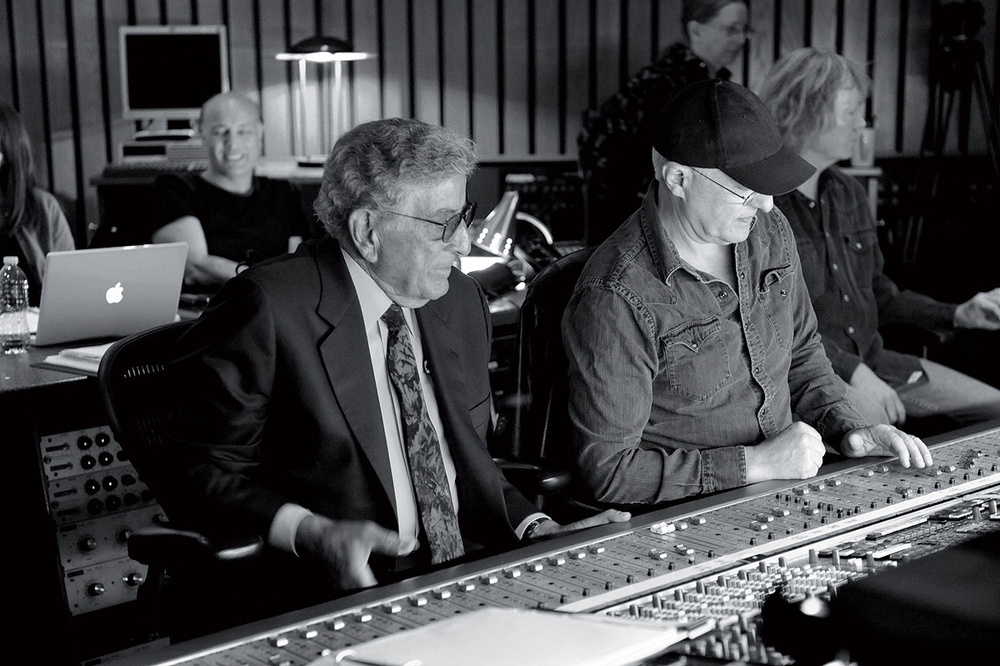 Like its predecessor, Duets II was recorded and mixed by Tony Bennett's son Dae Bennett (right).
Dae Bennett and Phil Ramone's method was to record Tony Bennett and each of the guest singers with a jazz quartet — drums, double bass, piano and guitar — in that most old-fashioned of ways: live in the studio, with no separation or click track. The other trick that appeared to have worked well for the first Duets album was not to tell the guest singers that this was the modus operandi (by the time the second album came round, most stars had presumably wised up to the ploy!). Dae Bennett: "With the first album, many of the artists arrived at the studio thinking they were going to sing to a backing track, and when they came in and saw Tony and the quartet and all the mics set up, they were like, 'Jeez!' We always had a headphone station set up, ready to go, if they really wanted it, but everyone settled for not using them. So instead we had two Red monitors on either side of them, with the quartet semi-circular in front of the singers. The Red monitors are very directional, and more like sidefills than floor wedges. My Dad also uses them in live performances.
"When the Dixie Chicks came in [during the recordings of the first album], one of them, Emily Robison, sat down next to me at the console and through the side of her mouth whispered to me: 'You know what? We never record this way! We're really nervous about doing this.' They were doing 'Lullaby Of Broadway' with an Andrews Sisters-type vocal arrangement, and I said to them: 'Don't worry about it.' My Dad is also very good at putting people at ease, and of course, they are really talented. By the end of the session, they were all very happy and doing high fives and so on. Almost all the sessions turned out that way, with artists coming in nervous and by the end being very happy. Michael Bublé sang on the first Duets album, and when he came in for his session for the second album he said: 'I do all my sessions like this now.' John Mayer was probably the most nervous of the artists who participated in the making of Duets II, and said that he really wasn't sure about the phrasing and stuff. Many artists think that they have to phrase like Tony, but I explained to him that we just wanted him to do his thing, that our idea was for everyone to be themselves. I said to him: 'It's a blues tune, and you play blues guitar, don't you?' And he was like 'Oh, yeah,' and he got it. After that, everything started to flow. We got that a lot during the sessions. I always do my best to keep everything relaxed, and my Dad is a very mellow guy, so we made sure everyone was feeling comfortable. That's how you get the best takes.”
A Spare Half Hour
 Tony Bennett in discussion with the album's co-producer, Phil Ramone.Photo: Kelsey Bennett
Most of the recordings of the quartet and the vocalists for the first Duets album had taken place at Capitol Studios in Los Angeles and at Dae's own Bennett Music Studios (see box). It was the same for Duets II, with the addition of Ben Folds' studio in Nashville and Avatar Studios in New York. Bennett: "Ben's studio is the old RCA room, and we recorded Willie Nelson, Carrie Underwood, Faith Hill, Alejandro Sanz and John Mayer there. The main problem with a project like this, with many big-name acts, is scheduling, which was my brother's job as executive producer. What worked well with the first record, so we also did this for the second, was to book Capitol Studios during the Grammy week, when a lot of artists are in town anyway. There were also two groupings of sessions at Bennett Studios, but some artists' schedules were so tight that we also did a day of sessions at Avatar, where we recorded Lady Gaga, Sheryl Crow and Aretha Franklin. We had Lady Gaga for two hours, and Aretha Franklin for maybe 90 minutes, and Bennett Studios, being as close to Manhattan as it is, still adds another half-hour travel time, so it was easier for everyone to grab a cab and go to Avatar. It was hairy at times!
"In addition, we flew to London to record Paul McCartney for the first album, and Amy Winehouse for the second one, which was apparently her last-ever session before she died. The video of her and Tony singing that you can see on the Internet shows the actual vocal recordings! We also went to Italy to record Andrea Bocelli at his house, and we recorded Mariah Carey in her bedroom: she was pregnant with twins and wasn't going anywhere! The sessions at Capitol, Bennett Studios and Ben Folds' studio were with the live quartet, and we also took the quartet with us to London when recording Paul McCartney, but for the other sessions we had recorded the quartet in advance, and Tony and the guest singer were singing to a two-track mix of the quartet. I then edited the quartet and vocal recordings, and I gave what I call the 'locked edits' to the video people — the whole thing was being filmed at the same time — as well as the big-band and string arrangers. The big-band recordings took place on one day at Bennett Studios, while the orchestra was recorded over two days on the seventh floor of the Manhattan Centre, in the Hammerstein Ballroom. I later mixed everything at Bennett Studios.”
Spilling The Beans
 John Mayer with Tony Bennett.Photo: Josh Cheuse
In view of how the recording sessions were handled, it's no surprise that Dae Bennett's screen shots from the Amy Winehouse duet, 'Body And Soul' and the John Mayer duet, 'One For My Baby (And One More For The Road)' look highly unusual by today's standards. Just seven drum tracks and a total of five tracks for the bass, guitar and piano is positively minimal in an era when 100-plus tracks in a session are not unusual.
The lack of separation is also apparent from simply looking at the waveforms, which show significant amounts of spill when the singer isn't singing, and an enormous dynamic range. Given how much Tony Bennett moves around on the session videos — in the clip with Lady Gaga, both of them seem practically oblivious to the existence of the mics — it's amazing that there's level at all in some places. Yet the wealth of vertical lines on the screenshots indicates that a significant amount of editing took place. Taken altogether, the screens suggest a very unusual marriage of 21st Century and old-school approaches. So what exactly was going on? Dae Bennett takes things from the beginning, starting with the mics and signal chains he used.
"My vocal setup for the recordings with the quartet consisted of two Audio-Technica AT4047 mics, going into a Neve 1073 and then a [Urei] 1176. I normally like to use the classic Neumann U47 for recording vocals, but they would have picked up too much of the room. The AT4047s have a tighter cardioid pattern and also sound very good. In the sessions when the vocalists sang to the locked two-track edits, I did use two Neumann U47 mics. My drum mics were pretty standard: a Neumann FET 47 on the kick, Shure SM57 on the snare, [Audio-Technica] AT4080s for the overheads, [Neumann] KM184 on the hi-hat and Sennheiser 421 on the toms. All the mics were placed very close. Most of the album tracks were recorded with a jazz quartet playing in the same room as Tony Bennett and the guest singers, so mics were positioned fairly close to the sources to cut down spill. This photo shows part of Dae Bennett's drum miking setup, with two Audio-Technica AT4080s as overheads; also visible is the Neumann KM184 on hi-hat. The double bass was recorded with a DI and a Neumann U47, which I may have run through an [Teletronix] LA2A to add some presence, the guitar with an AEA R84 ribbon, right on the speaker, and the piano with two AKG C414s, placed close to the strings, with the lid closed. All the mics went through Neve 1073 mic pres — I'm a big fan of them.
"Before coming into the studio, the band had worked out an arrangement for each track, while Tony, Phil and I had worked out the duet distribution, ie. who sings what, and where harmonies would be sung, and where we wanted improvising. Tony and Dae Bennett and Phil Ramone created lyric sheets showing the distribution of lines between Tony and his guests (right); these were used by Dae and Phil Ramone to 'score' individual phrases, which could then be edited together to make master vocal recordings. Some people sing harmonies better than others, and we didn't go for a lot of harmony singing, because it makes the sessions more complex. We also didn't do any pre-recording rehearsals, because we wanted to keep everything simple and spontaneous. The singers would come in, we'd work through the vocal parts and harmonies with them, and then we'd do takes. We recorded four to six takes of each song on average. Phil and I each had a lyric sheet with a grid, and we made notes as things went down of what was great, or just good, and what was not so good. Over the years I've found that these notes have become surprisingly accurate, and they certainly saved us hours and hours of time during editing, because you know where the things are that you want to use.
"I did the editing based on the vocal performances, so I began editing by compiling the best vocal performances and making a rough cut of them. For the most part, because of the spill, when I cut the vocal tracks, I had to cut the quartet with them. On the screenshots you can see vertical lines going all the way through the quartet and vocal tracks, which was me cutting the takes as if I was cutting two-inch tape with a razor blade. I would then also cut inside of these takes and tracks, so you get thinner lines, and because of the way Pro Tools names these regions or snippets, the numbering may not line up vertically. Sometimes the edit lines are staggered, ie. they don't line up vertically. One of my favourite things with Pro Tools is that you can stagger crossing points. I may have done this, for example, because Tony sang a brief pickup just before an edit point, so I have to open the new edit sooner than the band. In other cases I may need to let the vocal hang over a little bit longer, going into the incoming quartet edit. With his phrasing, Tony may come in early or later, or there may be other surprises. We always say that Tony never sings something the same way once! [laughs] The complete Pro Tools Edit window for the duet between Tony Bennett and John Mayer, 'One For My Baby (And One More For The Road)'. The two large, edited tracks in the centre are the vocal comps; above them are the tracks for the jazz quartet, and below them the big band that was added later. Note how many of the edits were made across both the quartet and the vocal tracks. Spill from the other instruments is clearly visible on the vocal parts.
"The main issue with the edits was that you can't lose the sound of the room, so there was not a lot of space to move tracks around or drop in individual words. Also, doing global edits required a lot of attention, because we hadn't recorded to click track. It's all in-space editing, just musical. This would, of course, not have been possible if my father wasn't working with this incredible quartet. I'm a drummer, and I had a little flashing metronome with me in the control room, to make sure the tempos didn't go crazy. The musicians are pretty much playing the same thing every take, as there was an arrangement, but they are jazz guys, so there were variations. You can see some mutes in some tracks, and this was where I had some leakage issue at a particular moment. If I muted the vocals at some points, something may have happened in the quartet that I wanted to edit out. Of course, you want to keep the room tone consistent, and muting one mic can affect this, but if I could get away with it, I would do it. I've done a lot of on-location recording, and I guess I'm used to working with spill. Leakage simply is part of the sound. It may come across as a nightmare, but I think it greatly adds to the live sound of this record.
"Once I'd edited the quartet and vocal recordings, I'd send these edits out for approval. Everybody involved might have some comments, and I'd make adjustment to incorporate those, and then I'd send out the next version for final approval. When I had that, I bounced that edit to a stereo file. As I mentioned before, I called that the locked edit, and I'd send it with the timecode EDL [edit decision list] and take numbers to the video guys, so they knew what to use, as well as to the arrangers.
"For the big-band sessions after that, we had five saxes, recorded with [Neumann] U87 mics, four trombones, recorded with [Neumann] TLM103s, and four trumpets recorded with two Coles 4038 mics and two AT4080 mics.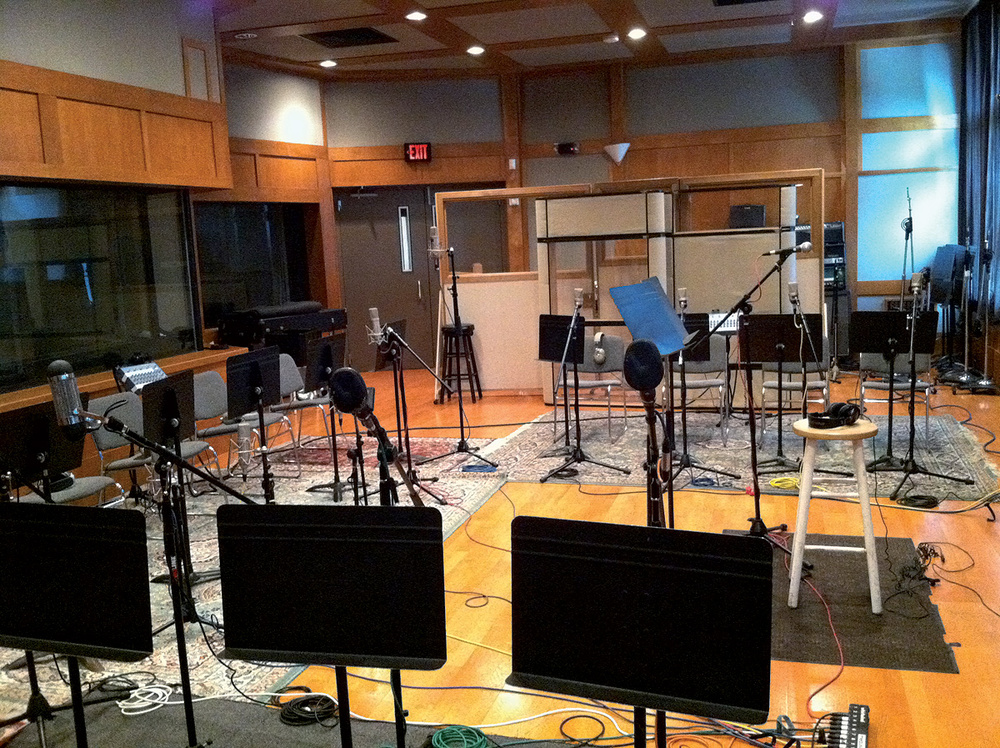 The setup for big-band recording, with Coles 4038s for trumpets (front), Neumann TLM103s for trombones (rear) and Neumann U87s for saxophones (left). Mic pres were again the 1073s, or Focusrite ISAs. We had a 60-piece orchestra at the Hammerstein Ballroom, recorded over two days. I had extensive miking on the orchestra, with stereo pairs on each string section, so there was a stereo pair on the first violins, a stereo pair on the second violins, a stereo pair on the violas; cellos, brass and woodwinds were recorded with individual mics, and for percussion I had overheads with some additional spot mics. But 90 percent of the sound you're hearing comes from the two overhead mics, which were two AT4080s. The original studio arrangement of the orchestra was done before there was electricity, so the orchestral setup is the mix, and if you have a good-sounding space and a couple of good overhead mics, you get a pretty good balance.”
'One For My Baby (And One More For The Road)'

- Written by Harold Arlen & Johnny Mercer.
- Produced by Phil Ramone & Dae Bennett.
The Mix
"I did all the mixes at Bennett Studios, on the SSL G+ series desk. After I was done, Phil [Ramone] came in and we finalised the mixes together. The mixes were mainly a question of balancing and EQ and adding some AMS reverb and occasionally some chamber reverb from a Lexicon 480. I used hardly any plug-ins or effects. All the compression I intended to use was added during recording, and in any case, I was not creating a sonic fantasy, but simply trying to make real live recordings sound as good as possible. I'm not some kind of audiophile minimalist or something, I just think that keeping it simple is what sounds best. If I think it needs a plug-in or some outboard processing, I'll go for that. I've worked with all kinds of music and I like different types of music, so the perspective I have from that is not to have any rules. I keep an open mind.
"Because everything on these sessions was close-miked, there wasn't a lot of variation between the sound, in terms of in what place we had recorded the quartet and the vocals. So I spent the first two, maybe three, days of the mix sessions creating templates for the mixes of all the songs, for the quartet, and for the big band, and for the orchestra. This meant laying everything out on the desk, and patching things in, and creating EQ and reverb settings. The main thing with a project like this is to attain consistency throughout the whole album. There may have been some tweaking here and there because of a U47 in one place sounding different than one we used somewhere else, but once the console was set up, I tried to maintain continuity over the mix of 18 songs. On finishing a mix, I A/B'ed it with a previous mix to check for consistency.
"So after I had spent these two or three days creating templates, it was mainly a matter of using desk volume automation to get the balance right for each song. I added some AMS reverb to the vocals, and very occasionally a plug-in or real 1176 to keep things in check, and to get some more presence. On some tracks, Tony was more sure of the lyrics than on others, and I also had to compensate for him moving around while singing. I did that by riding the automation. I'm a real believer in A/B'ing things, and so I also would listen to CDs of each of the guest artists, to hear how they like their voice to sound — assuming that that is the way they like to hear themselves! I tried to get them as close as possible, while at the same time keeping the continuity of the album. Normally it was very straightforward to make them sound very close to their own records. If I was running a dozen patch cables it was a lot.
"The whole Session was done in 48kHz/24-bit, and I mixed back into the same Session. I ran the mixes through the compressor in the centre section of the SSL desk and then through a Manley Massive Passive EQ and then back into Pro Tools. Towards the end of the mix sessions, I A/B'ed later mixes with earlier ones, again to make sure that there was consistency throughout the whole album. In short, the mixes were very straightforward. As I said before, the real interesting stuff happened during the recordings, and particularly in the dynamics between Tony and the different guest singers!”
Dae Bennett & Bennett Studios
Tony Bennett's 56-year old son Daegal began his musical career many years ago as a rock drummer, with an early interest in recording. He recalls, "Our family grew up in here in Englewood [New Jersey, close to northern Manhattan], and one reason why so many jazz musicians were out here was because Rudy van Gelder had his studio here. When my parents had a house built, they asked Rudy to set up a small studio in the basement, which had an old Ampex two-track tape machine. Of course, with my father being on the road all the time, my brother and I were in there a lot of the time! So my brother and I grew up with gear, and it's something that was always in the background for me, even when I was working as a musician.”
Still in his teenager years, Dae and his older brother D'Andrea (Danny), a bassist, founded the country-rock band Quacky Duck and His Barnyard Friends in the early 1970s, which also featured the now well-known guitarist/violist David Mansfield. The group recorded one big-budget album, Media Push (1974) — says Dae, "I celebrated my 18th birthday in a studio in Boston” — but was otherwise short-lived. Dae Bennett continued to work as a drummer, but "woke up one morning and realised that I was trying to be a rock drummer in a disco era, and so I decided to switch to Plan B”, which involved exploiting his skills as an engineer. He began building his own studio in 1980, and opened it as Hillside Studios in Englewood in 1982. He ended up experimenting with the emerging new music technologies, like computers, sequencing, and MIDI, and the corresponding new music styles, mostly hip-hop, in part due to the influence of Sugarhill Records, which was also based in Englewood, and which recorded a lot of its artists at Hillside. Dae Bennett worked, for example, on Rob Base's pioneering 'It Takes Two' ("one of the first records to use an entirely sampled rhythm section”) and with Naughty By Nature and Teddy Riley.
In 2000 he started Bennett Music Studios, also in Englewood, in part to cater for the recording needs of his father. Until its closure in September last year, it had become one of the most successful studio facilities on the American East Coast, with 18 albums recorded there that won Grammy Awards. Yet despite its success, Bennett — like so many other top studios — was recently forced to close its doors.
Bennett: "My previous studio, Hillside, was a small place where we could at most record trios and quartets, but if we wanted to record a big band we had to go to another studio. So I set up Bennett Studios, which was located in an old train station in the centre of town and had several huge recording spaces. All the acoustics were done by Andy Munro, and they were perfect: not too live, not too dead. Moreover, there was a 1400-seat theatre down the road and we literally dug a trench down the street from the studio to the theatre, and put a pipe in it for fibre-optic cables with a 64-input splitter at the back of the theatre stage. This made it possible for us to record a lot of TV and live shows, and we also used the theatre as a big surround or echo chamber.
"Bennett Music Studios was a great space with many facilities, and if someone had told me at the beginning that we'd record 18 albums there during the next 10 years that had won 18 Grammy Awards and an Emmy Award, I would have signed up for that. So we did really well and I'm really proud of what we did.
"But it came to a crossroads recently, with me needing to invest in the studio, and I felt that there was just too much uncertainty to justify doing that. The Neve VR needed refurbishing, the Digidesign and other computer stuff needed updating, the SSL G+ also needed work, and it would have cost half a million bucks or so! I'd rather have a root canal than maintain a Neve VR! Maintaining them is like painting the Washington Bridge: by the time you've finished one end, you have to start at the other end again. I did not see this as a worthwhile investment, given the state of the music industry. But the studio is still there, and there are some people looking into buying the gear, and some people interested in buying the entire business, because it's a beautiful place. It'd be a shame to see it go, but I'm not holding my breath.
"I'm now working again as a freelance engineer. I have always done a lot of on-location and posting work, and I really enjoy live recording, as well as mixing. I've just finished creating a setup at my home, where I now have a nice small editing suite with a DAW.”
Amy Winehouse's Final Session
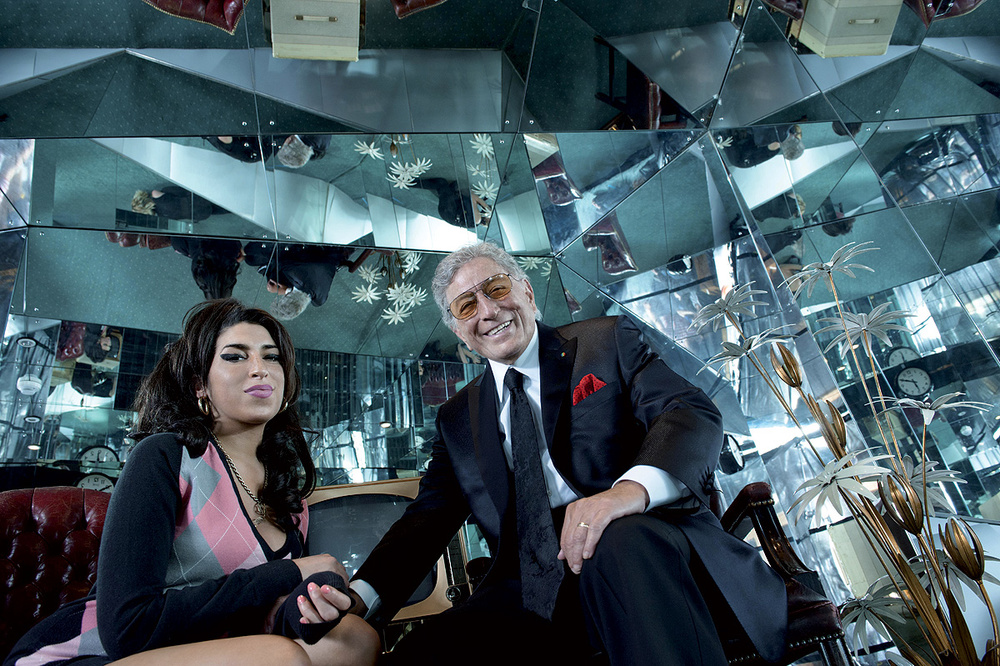 Tony Bennett with Amy Winehouse.Photo: Kelsey Bennett
On March 23rd 2011, Tony and Dae Bennett met with Amy Winehouse at Abbey Road Studio 3 for what was to be the British singer's last recording session, exactly four months before her death on July 23rd. They recorded the classic song 'Body And Soul', which had been written in 1930, was performed by legends like Ella Fitzgerald, Billie Holiday and Frank Sinatra, and became a jazz standard following saxophonist Coleman Hawkins' timeless 1939 version. Dae Bennett recounts the history of the Winehouse-Bennett version:
"We had already recorded the quartet at Bennett Studios. We had done a few takes, but I liked one take all the way through, so we used that. It's the reason why the quartet recordings in the Edit window don't have any edit lines. We set Tony and Amy up with playback speakers and two [Neumann] U47 mics, and what you see in the video are the actual vocal takes that I selected for my edit. The signal chains were the same: Neve 1073 and then an 1176 and then going into Pro Tools. I recall that they did about five or six takes. You can see some mutes in the vocal takes, which is where there may have been too much leakage or too much of the sound of the room. But in general I left the spill. The string arrangement was added later.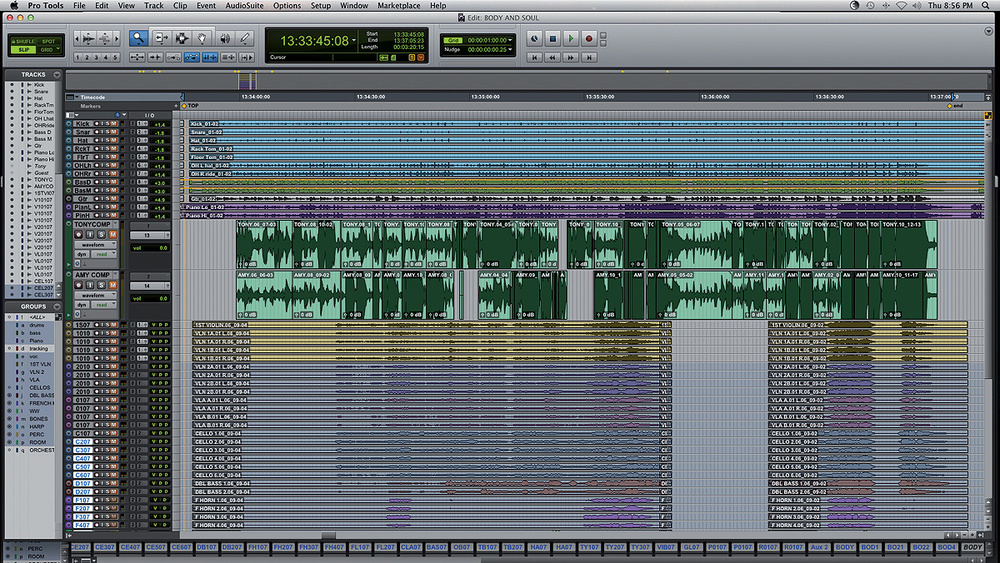 Amy Winehouse's last recorded performance, as captured in Pro Tools. Here, the two singers were performing to 'locked' backing tracks, so there are no edits to the quartet recordings.
"The most interesting stuff always happens in the dynamics between the artists. Amy was another person who was very nervous when she came in. She seemed a little awestruck. But as soon as my father said that she reminded him of Dinah Washington, the floodgates opened. She relaxed and she was off. It was a great session, and the result was everyone's favourite track on the album. We were really devastated when we heard she had died, because we were really impressed with her and the depth of her talent.”
Bennett and Winehouse's version of 'Body And Soul' was released on September 14, to commemorate what would have been Winehouse's 28th birthday. The day also marked the launch of the Amy Winehouse Foundation, which was set up to support organisations that help young adults with problems such as ill health, disability, financial disadvantage or addiction. Proceeds from 'Body And Soul' go to the foundation. For their work on the recording, Bennett and Winehouse were nominated for a Grammy Award in the Best Pop Duo/Group Performance category.