

In working to perfect a Bollywood mix, our engineer found that there were plenty of lessons that could be drawn from it and applied to mixes in most genres.
A
 Guest vocals on this month's Mix Rescue mix were provided by Gowtham Bharadwaj (above) and Vandana Srinivasan (below).
 Photo: Madhana Gopallthough some UK/US musicians still think of 'Bollywood' as a typo, it's actually one of the world's most popular and commercially lucrative genres — and it demands extremely high production values to achieve its typically slick, glossy sonics. This was an ongoing source of frustration to SOS reader Sambasevam Shanmugam, who'd been told by contacts in the South Indian music industry that even though his self-produced songs were well on target compositionally, his mixes weren't cutting the mustard. Unsure of how to up his standards, he sent in the song 'Kaathaadi' to SOS for some advice. He'd already identified the main problems: a lack of contrast between sections; unreliable translation to headphones and laptop speakers; and instability in the vocal levels. He'd also struggled to achieve a warm bass sound without overcrowding the mix, and had undercooked the delay and reverb effects overall for fear of washing things out. Plenty to be getting on with... especially since he had a number of productions by Oscar-winning composer A.R Rahman (of Slumdog Millionaire fame) in his sights for referencing purposes!
Vocal Processing
 Because the mix was built around the two lead vocals, and they were both nicely recorded, they required only very gentle processing, as you can see from these screenshots: the male vocal processing is shown on the left, the female vocal processing on the right.

Whenever I receive a new multitrack to work on, I take time to organise, name and colour all the tracks in my DAW so that I can navigate around them instinctively. Listening through the tracks one at a time at the outset of this process frequently helps decide my overall plan of attack for the mix. This project was a case in point, because the moment I heard the quality and expressiveness of the vocal recordings, I was convinced that no effort should be spared in making them the stars of the show, as they really were a pleasure to listen to! I decided to start with the vocals and then build everything else around them, thereby maximising the space for the singers in the mix, and this meant that the vocals themselves received very little processing at all.
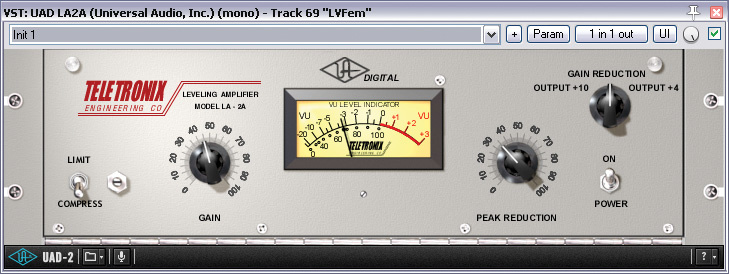
Comparing the vocal tones to Sambasevam's reference tracks, I cut 2.5dB from the male vocal at 170Hz, and gave the female vocal a narrow 3dB cut at 380Hz and a 1dB lift above about 2kHz. As far as dynamics were concerned, the female vocal received 3-5dB of understated opto-compression from Universal Audio's LA2A plug-in, while the male vocal was treated with a subtle four-band compression patch from Cockos ReaXcomp.
I don't often use multi-band compression on vocals, but where they're absolutely in the spotlight it can help bring out details and even out frequency-response variations that otherwise make it difficult to balance the singer against other tracks. The settings involved low (1.2:1) ratios across the board, low thresholds for 1-2dB of gain reduction per band, and crossovers adjusted to suit the characteristics of the vocal tone: the low band up to 350Hz caught the note fundamentals and chest resonances; the 350Hz-3.3kHz low mid-band handled the main pitched harmonics; the 3.3kHz-8.8kHz high mid-band controlled the sibilance region; and the high band dealt with the 'air' frequencies (which I couldn't resist driving a little harder for increased intimacy).
Ring-fencing The Singers
 High-frequency EQ on many channels helped to avoid conflicts with the vocals, either by cutting the upper octave (as on the percussion channels with Sonimus SonEQ) to keep the vocal 'air' band clear, or by cutting in the 2-6kHz region to push sounds behind the vocals in the mix (as on the cymbal-channel Cockos ReaEQ instance shown).
Despite their very light processing, these vocals by no means mixed themselves. Far from it, in fact, because the big job was protecting their timbre as much as possible from being compromised by other tracks. In the first instance, this involved a number of high-frequency EQ cuts across various parts in the arrangement, either rolling off the upper octaves in a general way to keep the vocal 'air' unmasked (as in the case of many of the drum/percussion parts, as well as the piano, acoustic guitar, solo violin/viola and ensemble strings) or targeting the forward-sounding 2-6kHz region with deep peaking cuts to soften and distance sounds (such as the brush kit and many of the cymbal samples) that were dulling each singer's tone or pushing ahead of them on the front-back axis.
Some such cuts had to be automated to reflect the changing roles of certain instruments. For example, the acoustic guitar could afford to have brighter, more forward sonics during the instrumental sections at 1:29-1:50 and 2:49-3:09, as could the piano at 1:30-1:50 and 3:09-3:29. Against the vocal at 1:50-2:49, however, they both had to be reined in — quite aggressively in the case of the piano, although it's not something that most people will notice consciously because of the way the singer demands the attention there.
Another important consideration was keeping a firm hand on each track's transients, minimising sources of distraction during vocal passages and smoothing the overall production sound in line with the references. I called on a variety of tools for this. SPL's Transient Designer de-emphasised the acoustic-guitar pick transients throughout, although I automated its attack control to target certain spikes more severely and adapt the action to different song sections. Cockos ReaXcomp toned down the sharp, high-frequency finger-click transient in the main programmed loop, while a good dose of fast 3:1 compression from DDMF's gutsy NYComp compressor smoothed the edges off some of the other drum and percussion sounds (most notably the brush-kit loop), and a savage 10:1-ratio treatment from Tone Boosters TB_Compressor hammered the wrinkles out of some vinyl noise, which I'd added at Sambasevam's request.
Premium Vocal Automation
 Restraining over-spiky transients: HF compression from Cockos ReaXcomp on the main drum loop, fast 3:1 compression with DDMF NYCompressor on the brush kit, and fast limiting from Tone Boosters TB_Compressor on some added vinyl noise.

The crucial final ingredient in achieving the remixed vocal presentation was a good deal of detailed automation. Regular readers will be well aware that extensive vocal rides form part of pretty much every mix I do, but this month's remix was one of those special cases that justified me going the extra mile, and applying additional EQ automation as well. I discussed this approach while critiquing Alison Krauss's 'Paper Airplane' in SOS October 2011's 'The Mix Review' column, and mentioned that it seems to suit some productions more than others. One situation where it really reaps rewards is where you want a super-solid vocal balance without the audible artifacts of pushing a compressor into warp drive. It felt tailor-made for this particular remix.
I still didn't go to quite the lengths that Krauss's producer Mike Shipley did (judging by SOS April 2011's 'Inside Track' feature), because the only EQ I automated was a very broad, three-octave, high peaking filter, centred at 7.6kHz and 5.7kHz for the male and female vocals respectively. This peak covered a gain range of around 6dB in each case, and worked in conjunction with the level automation to really lock the vocal's subjective position in the balance. It isn't necessarily that easy to appreciate on typical home-studio stereo nearfields, but if you switch to a point-source mono speaker (such as the Auratone 5C), the effect is much clearer, and that means significantly better translation across different listening systems — certainly enough to justify the few hours of painstaking automation work involved, in my view.
Anchoring The Mix
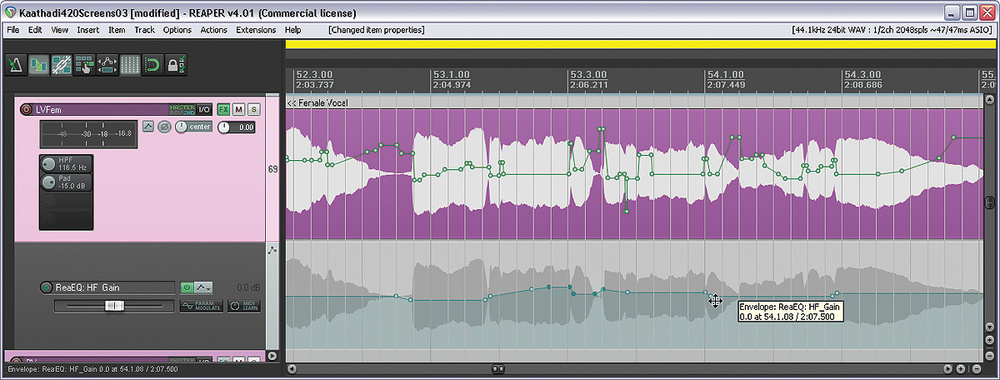 Locking down the vocal levels in the balance required not just fader automation (the green automation envelope) but also EQ automation (the blue envelope). A Cockos ReaEQ plug-in was used for the EQ automation, and you can see that for the female vocal it was set for a very broad peak centred around 5.7kHz.
Another thing that really stood out was the sensitive intricacy of the programmed upright bass. However, it presented several technical difficulties that made it challenging to balance in the mix, especially when comparing the results on different listening systems. The first issue was a time-varying phase mismatch between the left and right channels of the stereo track at low frequencies, something that can cause unreliable low-end reproduction on stereo systems. An instance of GVST's freeware GStereo plug-in swiftly scotched that, by summing to mono below 90Hz, after which I used low-frequency 4:1 compression from Cockos ReaXcomp to strictly regulate LF levels.
My next concern was a low mid-range scoop in the tone, which meant that it didn't really deliver the same fullness on smaller speakers as it did on larger systems. Universal Audio's Precision Hz bass enhancer provided the main remedy, fortifying this frequency region with enough vitamins to satisfy the budget listener, but without bloating out the hi-fi experience. Some credit is also due to the saturation circuit of Variety Of Sound's freeware Nasty VCS, which I inserted to emphasise the note sustains with compression and dip some 1.5kHz 'nasality' with EQ. Most remaining tweaks were in the form of level automation to even out some balance inconsistencies.
One other plug-in was applied quite late in the mixing process: Platinumears' IQ4 dynamic EQ. This was because a couple of bass resonances (around 150 and 270 Hz) were preventing me from finalising the bass balance on smaller speakers. When either resonance kicked in, it skewed the frequency response towards large-system audibility, so that the apparent level on small speakers suffered. Compressing those regions with a pair of dynamic EQ bands allowed me to reach a better compromise, and therefore improved the mix's ability to translate into different listening environments.
Fitting the main drum loop's kick around the processed bass tone wasn't too tricky, as there was plenty of it in the sub-50Hz region below the bass part. That said, the kick was trespassing on the bass a little around 100Hz, where a couple of decibels' cut helped avoid any kind of build-up of woolliness. The loop's snare backbeat, on the other hand, presented an unusual problem, in that it provided a nice wide image in stereo, but the tone and level dropped considerably when the channels were summed to mono, making a bit of a nonsense of the mix balance — a considerable worry from the perspective of achieving good cross-system mix translation.
My first step for tackling this was to obtain some independent control over the snare hits by slicing them out of the loop and placing them on a separate track. That done, I experimented with various polarity, phase and timing adjustments on the left channel, to see if I could achieve a better compromise between the mono and stereo presentations, Having met with little success, I used an instance of Voxengo MSED to narrow it almost to mono instead, and then reinstated some of the missing width using a super-short gated reverb patch, created from first principles using Togu Audio Line's TAL-Reverb III and instances of Cockos ReaComp and ReaGate. Liberal sends to some of my global reverb effects also helped spread it out (more about that later).
Acoustic Overdubs
 Processing the main bass part involved several troubleshooting stages. For example, GVST GStereo (left) and Cockos ReaXcomp (


This balance processing notwithstanding, Sambasevam's arrangement and choice of programmed sounds were pretty good on the whole, and mostly required only a bit of high-pass filtering and a dusting of general-purpose compression, the latter frequently courtesy of Tone Boosters one-knob EZ Compressor. However, one aspect of the arrangement wasn't quite delivering: he'd often been content to use some interesting sound only once or twice, which seemed a bit of a waste, as well as doing little to improve the cohesion of the production. I did quite a lot of copying and pasting of these little snippets, airing the sounds in different contexts and with different processing or effects to showcase more of their facets and bind the song's structure together slightly more tightly. I also felt that the idea of cymbal rolls — which had only really been touched on in the original mix — could be developed to enhance the section dynamics (especially given the widespread use of such sounds in Bollywood mixes), so I imported cymbal samples from my own collection and spent a half hour or so experimenting with different placements and EQ to create something to more strongly support the flow of the music.
The other main problem Sambasevam had was that his live instrument recordings didn't live up to the performance or recording quality of his programmed parts. In the case of the acoustic guitar, the musical part was very well suited to the song but the playing was somewhat erratic, and although Sambasevam had attended to some timing corrections using audio editing, I took the editing quite a lot further, as well as nudging the levels of slices of audio to enhance the phrasing. The down side was that because the recording was also rather noisy, any low-level notes that I wanted to drag up brought quite a lot of hiss with them. In fact, it was only the good fortune of having the prominent brushed snare part set against the guitar in the arrangement that disguised the noise-level variations sufficiently to render the part usable.
With the violin part, on the other hand, I eventually waved the white flag and retreated to the mix engineer's bastion of last resort: overdubbing! Although there were aspects of the performance I liked, I just couldn't find any way to salvage something sonically appealing from the dead, boxy, scratchy raw signal. Whether the culprit was over-close mic positioning or an unsuitable instrument (or both!), I couldn't say, but after an hour of cooking up ever more outlandish plug-in chains, I threw in the towel and began looking around for someone to overdub the part.
By sheer coincidence, very shortly after coming to this conclusion, I happened upon a viola-recording question in the Recording Techniques section of the SOS online forum, posted by SOS reader Simon Lyn. I surfed to his web site, which featured some wonderful music he'd produced by multitracking his own viola playing, and I was extremely impressed by his creativity and musicianship. It occurred to me that a viola's warmer timbre might suit Sambasevam's remix better than the original violin, so I emailed Simon to ask if he'd consider getting involved. He replied enthusiastically, and in a week or so he'd sent over a new set of tracks, which proved much more suitable. There was still a little work for me to do to fit the viola's tone into the mix — mostly just a question of rounding off the frequencies above 3kHz with some EQ and a touch of limiting — but within 10 minutes the show was back on the road.
Layered Effects
 Mike created a stereo gated reverb patch from first principles to widen the snare's image in the mix. The raw reverb was generated by Togu Audio Line's TAL-Reverb III, but this was heavily processed with Cockos ReaComp and ReaGate to reach the required short dense burst of reflections.

Once all the main tracks were sitting comfortably alongside each other dry, I began exploring what various send effects might offer. Bollywood songs, especially ballads, are notable for their lush effect-laden backdrops, and in this context some of the techniques of the late '80s and early '90s still have much to offer. In particular, the practice of layering and cross-feeding a number of delays and reverbs can be very effective, creating a smooth and complex wash, even if you're relying on less-than-stellar algorithmic reverbs. This is a technique I learnt first hand from A-Ha's engineer Gerry Kitchingham, many years ago. I certainly didn't bat an eyelid to find five reverbs and four delays in action by the end of the mix process.
The main all-purpose reverb was a wide, open-sounding algorithmic hall, which was primarily responsible for creating a sense of common acoustic space, so I fed it from most of the mix channels to some extent. The strings, piano, viola, and cymbals benefited from higher feed levels, though, to give them a bit more concert-hall expansiveness, while the vocals used very little, so that they would stay well up-front. For convenience, I almost always start from a preset when setting up reverb send effects, but normally I find myself significantly tweaking parameters and adding EQ, because a lot of presets sound too overstated for drier-sounding contemporary UK/US styles. In this instance, though, the preset I chose worked almost perfectly straight out of the box. All I added was a couple of decibels of extra width from an instance of Voxengo MSED.
 Many of the tracks in Sambasevam's arrangement were well chosen and well programmed, such that they only required a bit of filtering and general-purpose dynamics control to fit into the mix, as you can see here from the Cockos ReaEQ and Tone Boosters TB_EZCompressor settings for one of the arpeggiated synth tracks.
 The only other long reverb that I used was a rich plate patch, convolved from a sample of Universal Audio's EMT 140 emulation (freeing up processing power on my UAD Solo card), and that too performed its intended purpose (of widening and sustaining the vocal parts) with only one small alteration — 25ms of added pre-delay to reduce the possibility that comb-filtering between the dry and wet sounds would undermine the vocal tone I already had. This reverb worked well in the same role for the cut-out snare hits and the added viola parts and I also fed it from some of the other delay/reverb returns to generally add complexity to the reverb picture.
 Editing the acoustic guitar parts into slices served not only to deal with timing problems, but also helped adjust some lumpy musical phrasing, using the individual region gain settings.Another convolved plate sample was used in a more specialised role to fill out the mid-range of both the acoustic guitar and piano sounds, and was therefore more heavily processed to isolate exactly the extra resonance I wanted, while minimising any audible 'reverb' signature: the decay time was shortened to roughly 0.25 seconds, the stereo image was narrowed, the reverb frequencies were funnelled into the 500Hz-8kHz region, and the transients in the feed signal were ducked out with an instance of Reaper's Jesusonic Transient Controller plug-in. The Redline Reverb plug-in from 112dB provided my main blending patch, a preset with a short 180ms reverb tail, which I post-processed with Cockos ReaEQ to recess the mid-range at around 1.4kHz and gently roll off the low end below that. This proved most useful for pushing the drums, guitar and viola back into the picture, by way of contrast with the upfront vocals.
 SOS reader Simon Lyn helped with this month's remix, providing new viola lines to replace some unsuitable violin recordings that had been submitted as part of Sambasevam's original multitracks.My final reverb was what I call a 'fizzverb', a plate patch shortened to about 50ms or so in length and then aggressively high-pass filtered, such that it operates as a cross between a psychoacoustic enhancer and a stereo widener. This was dedicated to the male lead vocal, which didn't feel as if it had quite the breathiness of the female lead. For the female vocal, additional width was added by my normal Harmonizer-style pitch-shifted delay patch instead, and the same patch provided some extra spread for the solo acoustic guitar, viola and backing vocals too.
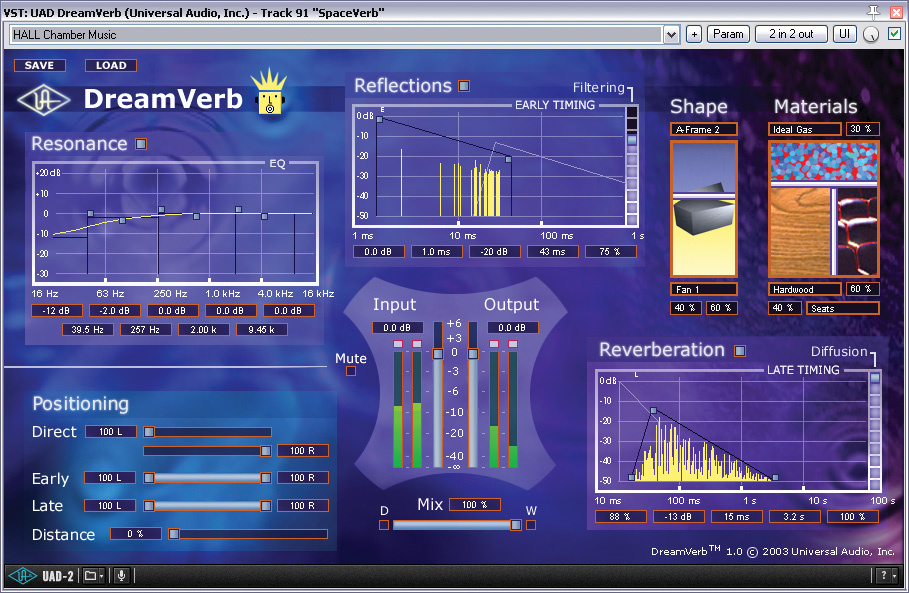 To draw all the backing parts into a communal space, Mike used a concert-hall preset from Universal Audio's Dream Verb, as shown in this screenshot.What I think of as the 'technical' delays in this mix were a pair of simple tempo-sync'ed patches, one twice as fast as the other, which simply encouraged the vocals, guitars and viola to ring on more luxuriantly, not least because I fed some of the delay return signals onwards to the main long plate. More creative (and audible) were the pair of wider panned delays which added stereo interest to the lead vocal parts, as well as various synth and cymbal fills: the first a simple, four-tap, 3/16, ping-pong patch that I keep in my mix template as standard, and the other the 'Journey Man' preset from Voxengo's Analogflux Delay.
 112dB's algorithmic Redline Reverb provided the main ambience reverb for the remix, blending and distancing backing parts to move them behind the lead lines.With so many send effects going on, there was inevitably some multing and automation work to do to make sure their levels responded appropriately to changes in the song's overall texture through the timeline, although the lion's share of this work was carried out on the lead vocal parts, so that they could open out during fuller sections without losing the sense of closeness required for more stripped-back moments.
Beyond Bollywood
 A 'fizzverb' — a very short, wide, and bright reverb patch designed as much for high-frequency enhancement as for additional stereo width. In this production this process was used to add a dose of additional breathiness to the mail lead vocal.
This remix features a number of techniques that can be applied across many different styles — particularly the vocal-focused balancing/automation methods and the tactic of using multiple layered delay/reverb effects. So even if Bollywood music doesn't yet figure on your own musical radar, do still check out this month's on-line audio examples at /sos/feb12/articles/mixrescuemedia.htm to evaluate whether similar approaches might also benefit your own work.
Many thanks to Simon Lyn for supplying the great viola overdubs for this remix. You can check out some of his own music at http://music.simonlyn.com.
Rescued This Month
This month's Mix Rescuee is SOS reader Sambasevam Shanmugam, who is based in California. He was raised in Chennai in southern India and trained in both the western classical and carnatic musical traditions, before getting into electronic music at the age of 14. He wrote 'Kaathaadi' with the help of lyricist Bharath Kumar, carrying out all the programming himself. Vocals were provided by two professional Indian singers, Gowtham Bharadwaj (a former finalist from Airtel Super Singer, a kind of Indian Pop Idol) and Vandana Srinivasan, while Rich Prewett provided acoustic guitar parts and Mithun Srinivas played the violin. Some studio sessions in Chennai were engineered by Satyaprasad, but all the rest of the recording and production was done by Sambasevam himself.
www.facebook.com/sambasevam.shanmugam
soundcloud.com/sambasevam-shanmugam
Remix Reactions
 This month's Rescuee: Sambasevam Shanmugam
Sambasevam Shanmugam: "Wow! Where do I begin? This is a GREAT mix — I almost didn't believe I was listening to my own song! The new mix has exactly the kind of contrast I was looking for. I remember my jaw dropping when I listened to the chorus (1:06) the first time. The guy is talking about how he struggles to contain his emotions and the remix really reflects that feeling of turmoil and tension. Then at 1:50 the emotions are reversed as the girl merely whispers to the guy what she feels, and again the mix reflects just that. My favourite part is the new buildup at 3:30-3:49, which is brought to a fitting climax at 3:50 by re-using the strings. Throughout the track, Mike's created various 'points of interest' that grab my attention instantly. In addition to all this, the song feels much more cohesive and musical now. I'd expected to hear a well-balanced mix, but this goes above and beyond that. Thanks a lot Mike and SOS!”