


In-ear monitoring is becoming a practical option for musicians and engineers at all levels. Is it time you made the switch?
In-ear monitors (IEMs) have only been around for a relatively short time. Introduced in the late '80s, they only really became affordable about 15 years ago, and it's fair to say that they've revolutionised the touring industry. Many live acts have adopted them now, and for some tours they are seen as indispensable, mainly due to the freedom they can give the performer — particularly singers. The ability to have a consistent sound wherever you go on stage has enabled uncluttered set designs, increased freedom of movement, and enhanced performances. The combination of a wireless microphone and in-ear wireless monitors is now a common sight on many tours.
For those who have never seen or used in-ear monitors, they are two-part systems. There's a transmitter, usually a half-rack unit, which transmits the monitor mix wirelessly (via radio) to a receiver, a belt pack around the size of a mobile phone that the performer wears. This picks up the monitor signal and amplifies it through a pair of earpieces. The transmitter and receiver operate in the UHF band, between 606 and 614 MHz. Other bands are available, but some require a special licence: the wireless frequency spectrum is regulated by the Joint Frequency Management Group (JMFG), and their web site, www.jfmg.co.uk, has the latest information — although, as spectrums are currently being reassigned, that info is always changing!
Risky Business?
Anyone who has used radio equipment before will know that interference and dropouts are always a potential issue, and the increasingly busy wavebands are making finding clear frequencies a difficult task. However, modern systems tend to use carrier signals, which lock the belt pack onto the transmitter's frequency, and this has done much to alleviate interference problems.
 A typical in-ear monitoring system, comprising a half-width rack radio transmitter, a belt-pack receiver and a set of earbuds.As with any radio signal, dynamic-range compression and reduced bandwidth compromise audio quality, but the technology has become increasingly sophisticated and can deliver high-fidelity sound with reasonable consistency. Modern systems are very stable and produce a good-quality signal, and though the sound is not quite up to hi-fi standards, due to the restrictions of broadcasting, the advantages of being wireless, and the freedom this provides, usually outweigh any minor sound-quality concerns.
The earphone side of in-ear systems can vary greatly in price and quality, however. Most systems are provided with generic buds — the kind of headphones you would normally associate with MP3 players. The next step up from there is a generic mould; these are more ear-canal shaped and fit a bit more snugly, making them less likely to come out. The best option is to have a mould taken of your ear, and a custom monitor made for you. These vary in price depending on the model, and can range from £100 to over £600. Custom moulds have the advantage of being a snug and usually comfortable fit, and they also cut out a lot of external noise, so can be great on loud stages. They can, however, lead to a feeling of detachment, and you can become a lot more reliant on your sound engineer to provide you with a balance mix.
The Band
While writing this article, I was on tour doing sound for British band Bombay Bicycle Club. Although still young, they have three albums under their belt, and have gigged around the world. I took the opportunity to poll them for their opinions on in-ear monitors, which they have all been using exclusively for several tours now. All the band sing, including the drummer, so good monitoring is essential.
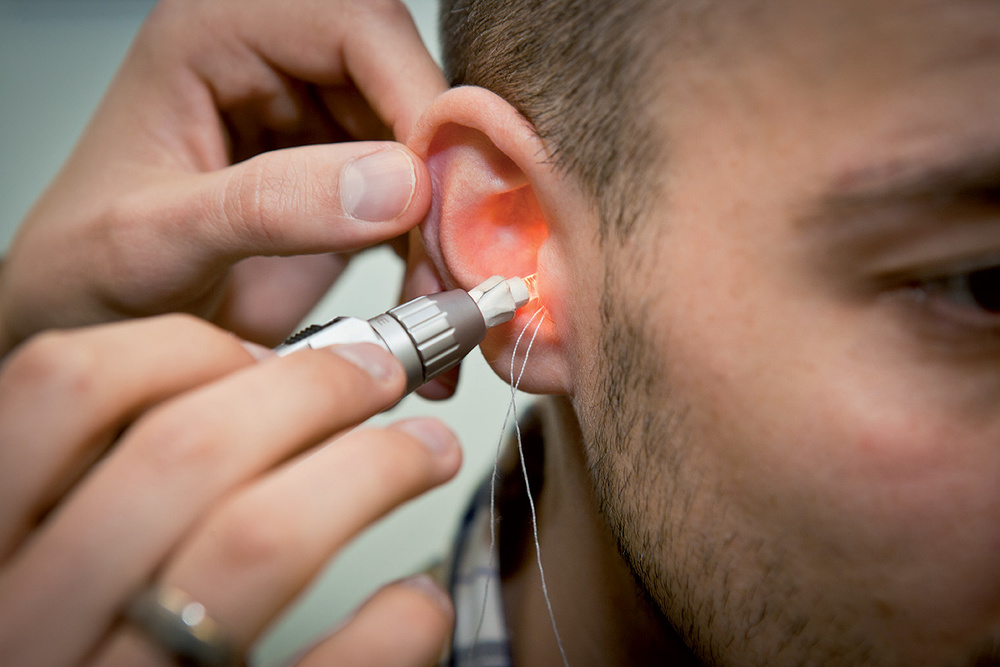 Getting custom-moulded earpieces made can be quite expensive, but they offer the most comfortable and secure fit, while blocking out much more external noise than 'generic' earbuds.Jack Steadman, the band's guitarist and singer, said: "I find them helpful but don't enjoy them. They can be inconsistent and you need a good engineer to run them. I also feel alienated from the gig. Without IEMs in, I can just walk closer to something on stage to hear it louder; if I'm on in-ears, I feel a loss of control. On the other hand, as a band we have never sung better, so for the sake of the show they are the best option and I am willing to put up with the minor irritations of using them.”
Ed Nash, Bombay Bicycle Club's bassist, adds: "I feel much the same, and I tend to take one or both earpieces out on some stages. They are great for clicks though, especially if you are using backing tracks, and again for vocals.”
Jack: "I also find that low to mid frequencies can become overbearing in my ear, and that can actually make singing more difficult. But, once again, it comes down to the monitor engineer. I have had lots of good gigs [on IEMs] that have been fun.”
Vocalist Lucy Rose also seems in two minds about in-ears. "For singing with loud bands, I understand why you would use them,” she says, "but for quieter music I prefer using monitors. On this tour I don't think I'd be able to sing in tune without them, but at the same time I hate them because my voice feels isolated and the music never blends together like it does in a room; they're a bit of a vibe killer. My ears have also grown so I've had to change my moulds, which is annoying.”
Louis Bhose, who plays keys and banjo for Bombay Bicycle Club, sums them up as "a necessary evil,” but concedes that they have their benefits. "We all wear them on flights, as they are great for the noise cancellation and are reasonably comfortable to wear. They sound considerably better than normal earbuds, but as we all have either T2 or Ultimate ears, you would expect them to, at the price.”
 Bombay Bicycle Club's Jamie MacColl (left) and Jack Steadman during a soundcheck. Although IEMs can create a sense of isolation for the performer, the band now use them exclusively.Photo: Jesse Wild/Getty ImagesSuren de Saram offers a drummer's perspective: "As we use backing tracks for a portion of the set, I don't really have much choice but to use in-ears. At first, when we started using [backing] tracks for some of the songs off the new album, I would just use some cheap generic in-ears for the songs with backing and then use wedges for the rest of the set, but that wasn't really a practical long-term solution, so we bought some proper moulded in-ears and I now use them for the entire set.
"Sitting behind a drum kit, it's important to block out some of the stage noise, whether that's with in-ears or ear plugs, to save your hearing, more than anything. In that sense, in-ears are great, as you can then set your volume to a safe level, and with a good monitor engineer you get a very clear mix. In-ears aren't good as far as bottom end is concerned, so to get the bottom end of my kick drum and the bass, I always use a sub as well. One other negative point I would mention is that you do tend to feel quite isolated from the crowd with in-ears, particularly on bigger stages. Obviously, you can use ambient mics to help with this, but that then changes your whole mix, and having ambient mics turned up loud with a crowd clapping out of time when you're trying to keep in with a click can be difficult!”
Problem Solvers
The final word has to go to Steve Down, Bombay Bicycle Club's tour manager, who was running the monitor system on this tour. "One huge benefit of using IEMs is consistency from show to show. With wedges, you have to deal with the acoustics of the room a lot more, and difficult rooms can make it hard for musicians to pitch,” says Steve. "The acoustics do still play a small part with IEMs, as the room sound will inevitably work its way into vocal mics, but it's much easier to deal with. You certainly don't have to worry about our old friend Mr Feedback, which can be a huge problem when dealing with quiet vocalists on stage.
"We use the same mics and the same IEM systems every day — the only thing that changes (on this tour, at least) is the monitor console, so the signal path from sound source to ear is essentially the same. I can walk up to pretty much any desk and dial the show in without hearing a sound, and each mix will be 90-percent right when the band walk on stage for sound check. And if I'm using a digital desk that I have a show file for, the whole setup process is very quick and consistent from the previous show — almost plug in and go.
"I would say that it's much harder to mix in-ears if you don't know the band. Bombay have had some tough gigs with house monitor engineers, and this isn't necessarily because they don't know what they are doing, but the tiniest change on a fader can really throw a musician — you really need to be quite subtle. With wedges, you can be more brutal, as the musician might have just four or five signals in their mix and they can get the rest of the sound from the stage, but with IEMs the engineer is in complete control of everything the musicians are hearing, so it's important to be sensitive to their needs. You really need to add in a bit of every channel for a well-balanced and pleasing mix.”
The Engineer
Joe Campbell has been mixing monitors for over 20 years. Recently, this has seen him tour with artists as varied as the Prodigy, Chris Rea and Adele. He was just starting a world tour with Placebo when we spoke.
 Monitor engineer Joe Campbell has worked with IEMs since the mid '90s. His monitor mixes now run to 50 inputs, including ambient mics, and are distributed to up to 20 IEM packs."I first encountered IEMs in the mid '90s, and they were quite a revelation, both for myself and for the artists. Initially, it made some aspects of the job easier; it made it possible for the singer to move all over the stage and still be able to hear his mix. It also meant I could turn the wedges down and reduce the chance of feedback.
"For a while, it was only the singer that used in-ears, but soon everyone was at it, crew as well. Now I'm using a digital console with dozens of mix outputs, with 20 IEM packs, several sub-bass mixes, and 50 inputs, including two pairs of ambient mics set up to make it sound like you're not wearing in-ears.”
But what, I asked Joe, are the down sides? "When I'm using wedges and side fills on tour, I know exactly how loud the mixes are. When everyone is on in-ears, there is a volume control on the body packs and it's very difficult to get all the band members to set the volume controls at the same level, resulting in the PFL output of the monitor desk potentially bearing no relation to the volume of the mixes in their ears.
"Often, band and crew members, will have different models of in-ear monitors that do not all sound the same, and this complicates things further. The monitor engineer has to have some control, and the best way is to keep it as simple as possible at the start.”
The Specialist
I took the opportunity to talk to one of the most established figures in the wireless rental business. Nick Bruce Smith was a respected sound engineer in his own right before forming the rental company Hand Held Audio about 20 years ago. "Mick Shepherd (my business partner) and I were on a Thompson Twins tour back in 1984 to 85,” he says. "They had purchased the latest Samson VHF radio systems for the tour, and incredibly they worked at almost all of their gigs around the world! But then the band announced they were no longer going to tour, and all their equipment was to be sold. So Mick and I purchased the Samson kit and I took it straight onto a Depeche Mode tour I had been selected to mix monitors on. Once again, they worked, with little failure.”
But the going hasn't always been so easy: "The Radio Station was the first IEM system, designed and built primarily by Chris Lindopp and Martin Noare,” says Nick. "In 1991 I was asked to do monitors for the Pet Shop Boys' first ever tour, and due to the set design we had to use the Radio Station IEM system. Although the concept was perfect for the act, the technology wasn't quite there: the RF performance of the VHF system was quite erratic, and trying to run four VHF radio mics and four channnels of in-ear monitors was very challenging. The Radio Station operated without any companding [the process of compressing a signal in the transmitter and expanding it in the receiver, to get around the limited dynamic range of radio signals], and this did give it a very dynamic sound, but it also gave a lot of RF noise. On a number of occasions, notably in Tokyo and Chicago, I could only get one transmitter to work, so everyone ended up with the same mix. Not a happy band!
"Halfway through the tour, I took delivery of a beta system that was in the UHF band and used a die-cast body pack. I thought I had gone to the moon — things were about to change!
"Today, we regularly run 20 channels of IEM, alongside guitar and vocal systems, and a typical major event uses 100 channels for IEMs, radio mic and comms. Its almost unthinkable!”
I asked Nick what had been the greatest advances in the technology, and what he thought the the next steps would be: "I haven't touched on the earpieces themselves yet! In those early days you had two choices: a custom acrylic mould with a Sony Walkman driver pressed in, or, if you had loads of money, then you could buy the Future Sonics Ear Monitor, which used a 16mm speaker properly mounted into a flesh-coloured shell with detachable cable. The advance that has taken place since then has been quite substantial, and developments still go on. JH Audio and Ultimate Ears have both developed three-way earpieces that contain six or eight armatures inside the shell, giving much greater dynamic range. ACS have developed an active ambient earpiece, which has miniature microphones in the earpiece, allowing the user to mix in some ambient sound.”
And it seems that the systems themselves have also come a long way. Newer models, according to Nick, benefit from "much lower noise floor, the ability to run multiple systems, improved RF range and, very importantly, system pricing, which has made it affordable to more musicians. The Radio Station back in the '90s was £2500, but you can now buy lower-cost systems for £500.
"Every now and then, I will be at a band rehearsal and the engineer will allow me to plug into a spare pack, and that enables me to see the huge improvements that all manufacturers have achieved in the 20-odd years that IEMs have been around.”
Caveats?
I asked Nick what he thought musicians' experiences had been like when switching to using IEMs. "They have varied, but overall I think it has been more positive than negative. Over the years, we have experienced some artists that could just not get on with them — quite often the front men/women, who felt too detached from the audience. But engineers started to use ambient microphones to try and get round this issue, and sometimes it helps.
"Making sure your vocalist did not back off the mic too much was always a challenge too, but it could be managed with some gentle persuasion — or just slowly dropping the vocal level in the monitor mix as the show progressed!
"Guitarists can sometimes feel that they can't get the sound they hear from a wall of Marshalls, and the drum & bass boys say they sometimes lack that air movement they get from 15- or 18-inch speakers — but I have to say that I've had so many artists in the last 20 or so years who now can't imagine doing another show on wedges and side fills!”
Final Thoughts
Finally, I asked Nick what he would say to someone first starting out. "Stick to your budget. There are some very good universal-fit earpieces on the market at relatively competitive prices. Try to pick a dual-driver earpiece if you can, as a single driver can often struggle with the dynamic range of a busy live mix. Obviously getting a custom fit does mean you don't have to fight with the insertion of the earpiece, and should guarantee you consistent isolation levels, providing the impression has been taken correctly. The range available to you in a custom format is much better than for off-the-shelf designs, and you can now get an extremely high-quality audio experience, but you do pay for that.
"I'm sure that for some musicians starting out, in-ear monitors are not a viable option — not least because you often arrive at a small venue where FOH and monitors are done from the same desk and having your own IEM mix is not on the cards! But as soon as you find yourself doing shows where the tech spec allows it, I would definitely recommend the IEM route over wedges.”
In The Beginning...
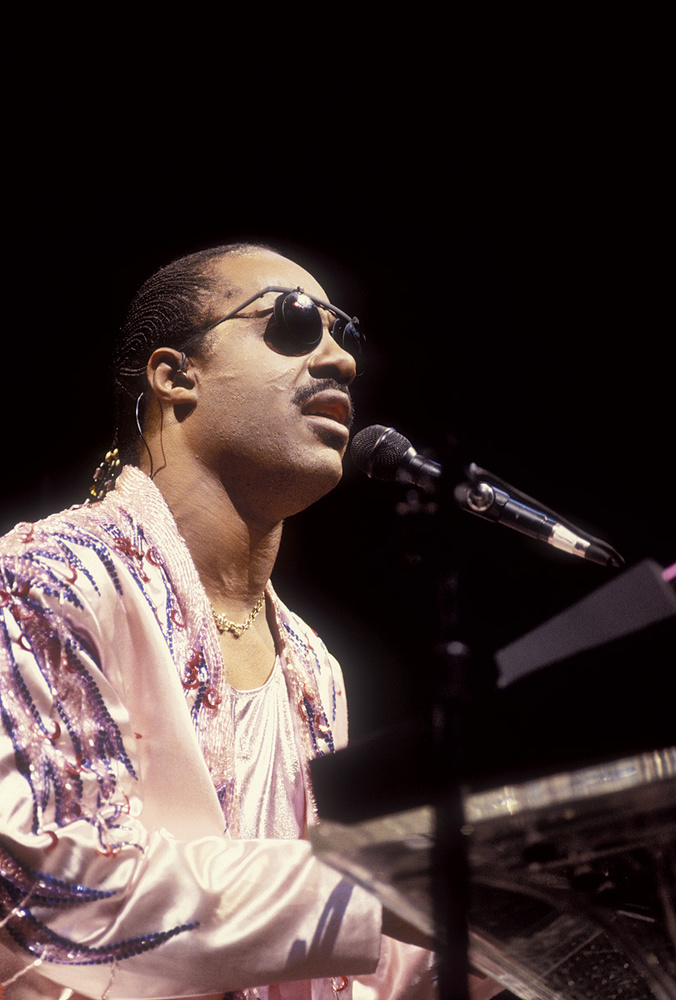 Stevie Wonder first started using in-ear monitors in 1987, when he used a mobile FM broadcast truck to transmit his monitor mix to the stage!Photo: Ebet Roberts/Redferns
There are many claims about who invented in-ear monitors, but it is generally considered to be sound engineer Chris Lindop. He was working with Stevie Wonder in 1987, and on that tour Stevie had a a full-blown, broadcast-standard FM mobile radio station, Wonderland Radio. On stage, Wonder used a standard Walkman FM radio receiver tuned to Wonderland Radio, which broadcast his mix to him via a pair of earbuds.
Effectively a pirate radio station, the legality of the setup was very questionable. When he played London's Wembley Arena, his private monitor mix could reportedly be picked up in Hampstead, around six miles away!
However, using this system, Stevie was able to walk freely around the stage listening to his mix. From this, Chris went on to develop smaller systems for many artists, and, with the help of others, developed the Radio Station, which was later manufactured by Garwood Communications. These early systems were rather hit and miss, but they soon gained popularity with major performers.
A mention must also go to Marty Garcia of Future Sonics, who began developing custom-fit earphones in the early '80s in the States. Working with high-profile acts such as Todd Rundgren and the Grateful Dead, he pushed the design of earbuds forward with the use of custom moulds and drivers.