

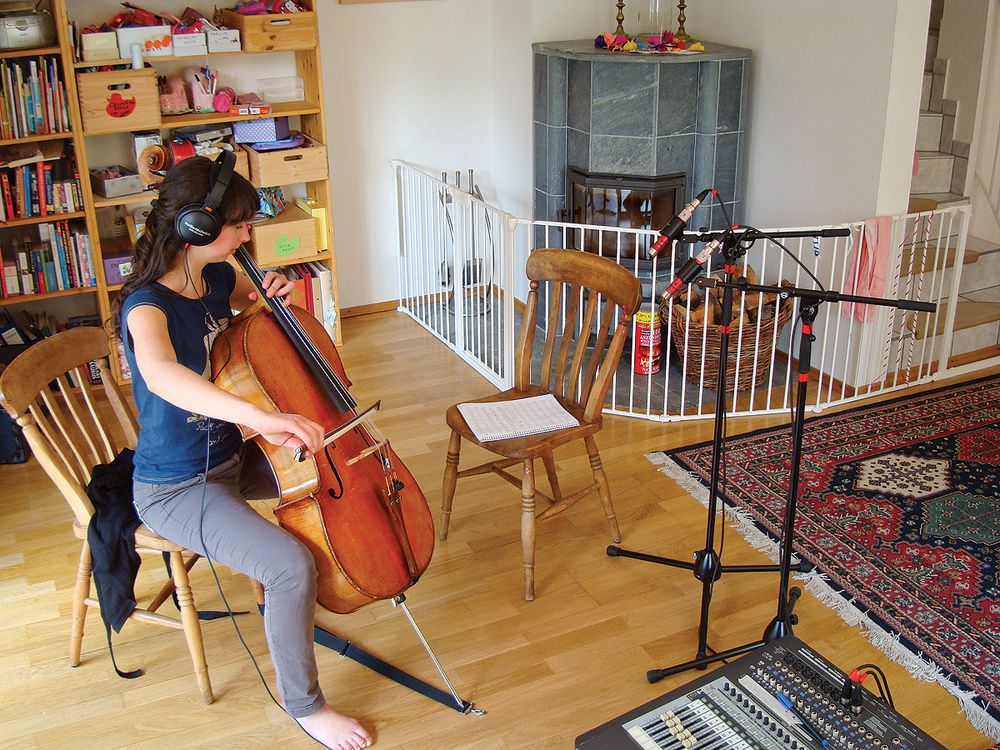
 Following a series of test recordings, here's the dual-mic setup Mike settled on to capture some cello overdubs in a medium-sized domestic living room. The mics are Avantone Pro's small-diaphragm CK1 condensers, with their cardioid capsules fitted.
This month, our engineer gets roped into the writing and arrangement process as he tracks cello parts in a living room.
Back in this column in SOS October 2012 (/sos/oct12/articles/session-notes-1012.htm), I described the tracking of indie-rock group Dunning Kruger's three-song EP. On a later date, I helped them with some overdubs, including a selection of different cello parts for the track 'Japan Song'. Although I'd expected my role in this to extend no further than pushing some mics around and hitting 'record', I also became involved with the arrangement and musical direction — as many project-studio producers find they have to — so I thought it'd be worth revisiting this project here, to pass on some more tips.
Before The Session
The venue was a 7 x 5-metre living-room with laminate wood flooring, and I brought along my Roland VS2480 for recording duties, just to keep things simple. To give us a good trade-off between monitoring flexibility and having plenty of spare tracks, I imported sub-mixed stems of the full band sessions (stereo drums, bass, two guitars, and two vocals) onto the first seven tracks of a fresh 16-track VS2480 project. Back in the tape days, this process was called 'making a slave reel', and although it's less commonplace on modern digital systems, it can still come in handy, for making best use of a limited track count, or to minimise disk-access and CPU demands on a laptop-based system.
With everyone in the same room, I decided that all monitoring would be done via headphones. I was confident that the VS2480's fan noise and any spill from my open-backed Beyerdynamic DT880 headphones wouldn't prove troublesome, as long as I positioned myself at least a couple of metres from the mics, but I also took closed-back Audio-Technica ATH910s for the cellist, Anna Zimre, to minimise foldback bleed.
I decided to set up my cue monitoring through the VS2480, because although monitoring latency can cause problems with some digital systems, this multitracker's throughput delay is pretty low. I also knew that Anna would have the option of slipping one of the ATH910's ear-cups backwards a little to listen to her instrument acoustically, if necessary — which is precisely what she ended up doing!
Time-saving In Advance
 To avoid any technical confusion while repositioning the two identical mics, they were labelled 'L' and 'R' with masking tape, and these labels were duplicated for the respective preamps and input channels.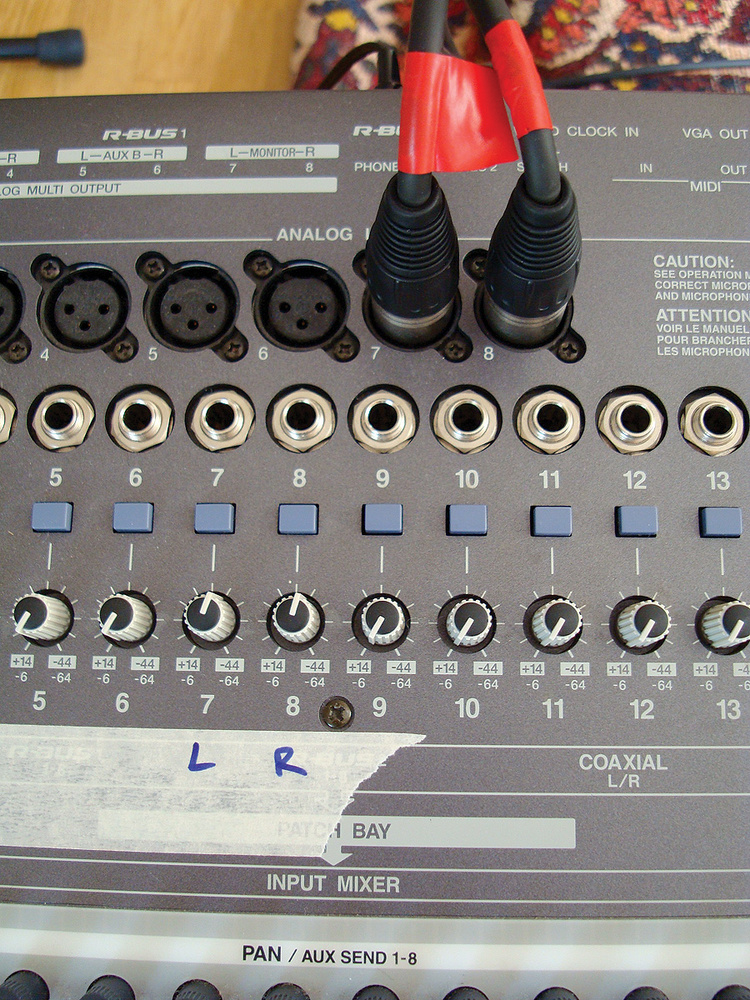
I hate keeping musicians waiting around, so I chose and line-checked my mics in advance of their arrival. My plan was to mic from a few feet away, to achieve a fairly natural timbre without spotlighting any single region of the instrument. I selected cardioid polar patterns for the mics, to reduce the amount of room sound picked up, but I knew that early room reflections would nonetheless form an important part of the recorded sound, so I instinctively favoured the typically tidier off-axis frequency response of small-diaphragm condensers. The pair of Avantone Pro CK1 pencil mics I had with me were a bit of an unknown, as I'd only recently acquired them, so I also brought my trusty AKG C414B XLS as a backup option.
A few strips of marked-up masking tape here and there helped to avoid any operational confusion later on. The two CK1s were labelled 'L' and 'R', and these letters also appeared just below their respective preamp controls, so that I'd always know which mic I was adjusting. Another strip of masking tape below the faders identified the contents of each recorder track and the fader of its respective monitor channel — the VS2480's built-in mixer features an in-line design with an assignable moving-fader control surface, and it's very easy to forget which channel's doing what when you're under pressure!
Finally, I put on the ATH910s to check the foldback mix, and then pulled down the headphone volume control, ready for Anna to set her own comfortable level. It amazes me how often project-studio engineers miss out this simple check, and then find themselves sacrificing 15 crucial minutes to technical gremlins right at the moment when the musician's primed to record. While you may have to tweak the balance a bit later on, it saves so much time if you start from a balance you'd personally find acceptable — and it also overcomes the problem of less confident musicians (who often feel uncomfortable with the idea of 'wasting time' — as they see it — building a headphone mix) soldiering on out of misguided politesse.
On With The Session!
Just as I'd managed to locate a suitably sturdy wooden chair (comfy recliners and office-style swivel chairs aren't conducive to most cellists), Anna arrived, along with her brother, Dunning Kruger's drummer Peter Zimre, who wanted to be on hand to bring the band's perspective to any creative decisions. While the kettle was boiling, Anna unpacked and tuned her cello, allowing me to quickly set a rough preamp level for the mics.
She then ran through a few warm-ups, during which I took the opportunity to ask her to move her chair to a couple of different locations in the room. The first actually worked best, especially in the lower mid-range, and I also found that removing the floor rug enhanced the upper mid-range early reflections, which I felt might help the instrument better survive the masking effects of the band's drums and electric guitars.
One tip that I frequently read for miking acoustic instruments is to adjust the microphone position while listening to the signal through closed-back headphones. Eminently sensible as this approach seems in principle, I've never really had much luck with it: some of the sound coming directly from the instrument always seems to break through to skew my perception, and if I turn up the headphone level far enough to minimise this, loudness-related psychoacoustic effects make it almost impossible for me to trust what my ears are telling me, especially when they are compounded by the additional tonal colorations that are typical of many closed-back headphone designs.
But that's not all. I've always felt that the most appropriate recorded sound for a given instrument depends a great deal on its arrangement context, and you need to balance the sound at a reasonable level against the backing to make that judgment call. This is rarely practical while waving a microphone around, as it's so tough to compare different mic positions without falling foul of loudness bias: the louder microphone position will almost always seem to sound better.
Tag-team Mic Positioning
 Mains came from a counter-level socket in an adjacent kitchenette, and the extension cable was coiled around a drawer handle to reduce the risk of it being unplugged accidentally.
The upshot of all this is that I now take a different approach when deprived of the luxury of a separate control-room: I use two mics in a kind of tag-team. In this instance, I set up the Avantone Pro CK1s following the noble tradition of educated guesswork, walking around the room while Anna was playing and eventually placing them about six feet from the instrument and three feet from the ground, the height proving surprisingly important. However, I differentiated the two mics by having one on-axis to the instrument and the other at about 30 degrees off-axis.
I then recorded Anna playing 10 seconds of one of the band's suggested parts. Explaining to the others that I needed a moment to listen back, I balanced the tracks at suitable (and comparable) levels against the backing and switched between them with my Mute buttons. Within about a minute I'd decided that the on-axis mic sounded less well balanced — and a bit boxy and nasal — so I moved it to match the off-axis mic's angle, but about 18 inches closer to the cello. Another test recording convinced me that the closer position gave the instrument more solidity and presence, so I moved the more distant mic to match the closer mic's distance, but a foot further off-axis. The third test recording revealed that I now had two microphone signals which, while still subtly different, both felt eminently usable, so I cracked on with the overdubbing.
Could I have achieved the same ends with just one mic? Again, yes in principle; but in reality I find it trickier to stay objective about which of the test recordings is the best when they're from different performances. Furthermore, using both mics for the actual recordings brought its own set of benefits: I could mix and match the two timbral shades at leisure while listening more critically in my own studio after the session; I could use different mics for different harmony layers, to get a richer multitracked ensemble sound; and I had the option to widen the stereo image of any solo lines by panning the mics, if that proved beneficial at mixdown. You don't have to use identical mics for this mic positioning method, though; choosing different mics introduces a little more trial and error into the process, but I'd still expect to reach a workable sound on at least one of the mics in under 10 minutes.
Working Up Parts
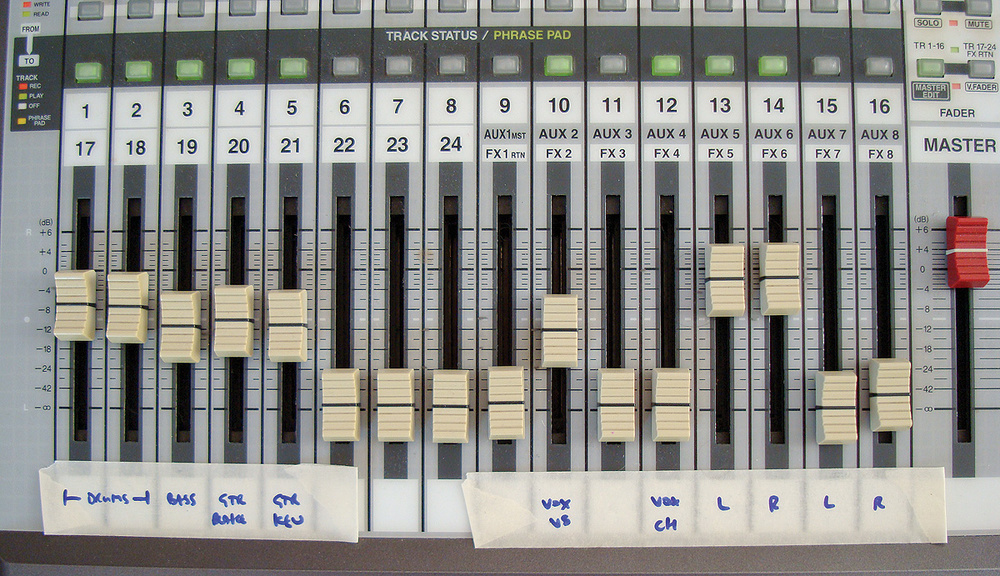 Here you can see the layout of the 'slave reel' project Mike created specifically for this overdubbing session. Submixed stems from the live band-tracking sessions occupy seven tracks, and four tracks have already been assigned for two sets of cello overdubs.
With the sound in the bag and refreshments in hand, talk turned to the nitty-gritty of the exact arrangement required. The band were keen to try cello parts on two main song sections: some layered ensemble textures to enliven the climactic outro (a 45-second full-band workout); and some sort of solo melodic line to sustain interest during the middle section. Anna had sensibly brought a manuscript pad detailing a couple of basic ideas, so we listened to those against the track to see how they fit.
What struck me quickly was that neither idea in its raw form really seemed to perform the required role. For a start, the outro part was slated to double the main bass line, but I was pretty certain that'd never make it past the heavy frequency-masking effects of the bass and full-force electric guitars at mixdown, even if we doubled it at the octave. (If we only required subliminal harmonic padding, we might as well have used samples.) I was also concerned that neither part developed much over time. Although the cello sound initially supplied a subjective arrangement 'lift', as any newly introduced timbre will, it didn't contribute much to the musical momentum once the novelty wore off. After a few bars, we'd have been pretty much back to square one from a production perspective, but with less mix headroom to play with. Luckily, both Anna and Peter could see some sense in my reservations, so we set to work on building a more effective outro arrangement together.
My initial objective was to make the strings as audible as possible in their own right, because I knew that I wouldn't be able to fade them up very high in the mix without making the rest of the band sound small by comparison. To this end, I suggested shifting out of the instrument's lower register onto its top two strings, to give a more cutting tone, as well as favouring the fifths and thirds of the chord pattern over the root notes, to reduce the degree of bass/guitar masking. Changing notes mid-bar, rather than in tandem with the bass/guitars on every downbeat, also helped to draw more attention to the cello, and introducing some harmonic suspensions by holding the previous bar's note through until the mid-bar change improved matters further — as dissonances blend into a mix much less well than consonances do.
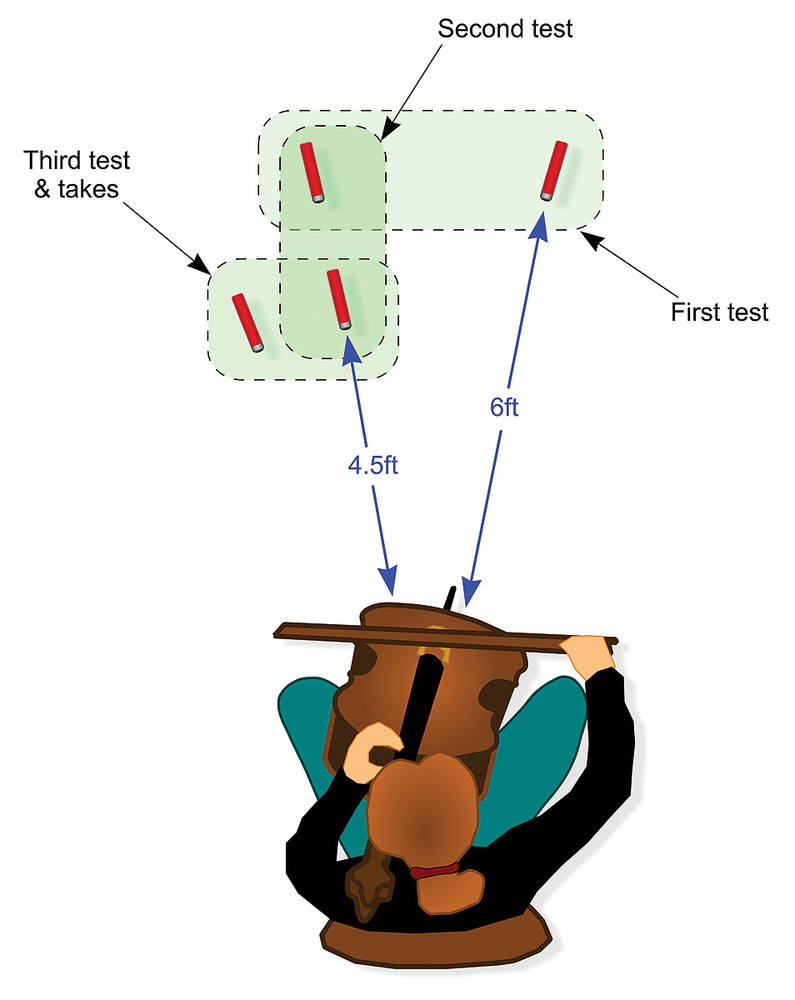 This diagram illustrates the dual-mic 'tag-team' approach used to home in on a suitable miking position. Best-guess on-axis and off-axis positions were compared first, and the preferred off-axis location was then compared with a closer positioning. Finally, an alternate version of the closer position was set up further off-axis, providing two mic positions that, while subtly different, were equally appealing.Planning for some arrangement build-up involved overdubbing a small selection of alternative harmonic layers in different registers, to leave the option of introducing them progressively for each of the outro's three sub-sections. However, I also tried to introduce a more melodic top line for the last sub-section, and even went to the trouble of redoing one of the earlier overdubs to fit better with this once it was finalised. For the recording, I encouraged Anna to use some of the natural pitch slides that are so characteristic of expressive string playing to intensify the top line's melodic nature. This isn't necessarily that easy for string players to do 'on the fly', so I spent a little time rehearsing where these might best appear, allowing her to get comfortable with the necessary left-hand fingering adjustments before being called on to perform them in earnest. Again, these slides had the welcome side-effect of generating fleeting dissonances that better defeated the bass/guitar masking, to grab the listener's ear.
The outcome was four different lines, all double-tracked to allow for a layered texture at mixdown: the original root-note line and an octave-up double (in case the band decided to return to that idea), a new main harmony line, and an additional melodic part. At the mix, I decided to use the higher root-note line to start with, adding the main harmony and melodic lines in the second and final sub-sections respectively.
Collaborative Composition
 This is the final manuscript sketch for the two new lines in the outro section. Notice the harmonic suspensions with their mid-bar note-changes during the last line, which were deliberately inserted to help make the part more audible in its own right.
Now that everyone was accustomed to the team dynamic, the stage was set for the more challenging task of coming up with a compelling solo line for the song's middle section. Although band musicians are usually comfortable improvising solos on the hoof, this skill is rarely cultivated in the classical tradition, so expecting orchestral players to operate in the same way often proves to be a recipe for awkward, unadventurous lines and tentative delivery. I almost always recommend working out and rehearsing a part on paper before thinking about hitting record — whether that means getting involved in that side of things yourself (as I did on this session) or just giving the instrumentalist the time and headspace to sketch something for themselves.
Even with manuscript, though, Anna initially struggled to conjure up a new line that went much beyond the scope of a keyboard part, as many young orchestral musicians do, simply because their training so often focuses almost exclusively on the interpretation of pre-existing compositions. So I tried a few little tricks to try to help her arrive at a more musical result that reflected the unique qualities of her instrument and performance style.
The first thing was to take the pressure out of the situation, so I set up loop points around the section in question and left it running. Anna could then experiment comparatively unscrutinised while I rustled up more drinks and snacks. I still kept my ears pricked, and made a point of complimenting any particularly characterful-sounding licks and noting down some of them on paper for future reference. Talking over some features of the section's bass line also proved helpful, as this inspired Anna to arrive at one riff based around a similar rhythmic contour, while a brief sketch of the chord sequence provided suggestions as to which notes were the most obvious resting points in each bar, harmonically speaking.
However, the biggest breakthrough came when I suggested that she take off the headphones and play me some favourite passages from her classical repertoire. Suddenly, no end of stylish performance nuances were on display, many eminently adaptable to our current ends: the sweeping arpeggiations of some unaccompanied Bach, for example, or a few of Vivaldi's ornamental end-of-phrase fall-offs. It also became clearer that this cello shone on certain notes, such as its low D and E-flat, while others had less to recommend them: both the open G string and its octave harmonic came across as rather bland, for example, so we tried to avoid those.
Refinement & Rehearsal
 The top and bottom lines of this manuscript sketch show the final cello solo line, which was developed collaboratively during the session — notice the detailed bowing and fingering indications in particular, which played a vital part in getting the best phrasing and performance. In the middle of the page is an outline of the solo section's harmonic backdrop, which provided the cellist with a useful point of reference while toying with different ideas.
This whole process effectively left us with a box of puzzle pieces, from which we constructed a 'first draft' solo, shuffling our favourite snippets about and 'joining the dots' between them. Once this was on paper, our emphasis could shift towards developing the musicality of the performance and refining the draft part as necessary.
As with the outro melody, finalising a left-hand fingering scheme helped put evocative pitch glides before selected notes, but the bowing also demanded special attention. One important consideration was which notes to slur together into one bow, because slurring can really help solo lines to sing, as well as defining the boundaries between phrases. There were also practicalities to bear in mind, such as the difficulties of matching the tone and volume of fast and slow bow-strokes, or the tendency for up-bows to favour crescendos and down-bows diminuendos.
I realise that it's easy to get bogged down in these kinds of details, but they make a big difference. My biggest tip for retaining your production perspective is to just sing the solo to yourself from time to time, because it's often much easier to decide on the most natural-sounding phrasing when you're not distracted by the fingering/bowing mechanics. I also think it's important to let classical instrumentalists have a little time to themselves to practice the final line so that they can really 'inhabit' it, rather than having to concentrate too hard on sight-reading from note to note. (Any excuse for another coffee break...)
Compared with the arrangement process, recording the part was lemon-squeezy! Anna's sitting position had drifted around towards the sofa while we were hammering out the part, so I first had to reposition her, but after that it was just a case of banging down a few good takes to allow me some comping opportunities later on.
Cello Recording At Home
Despite the misgivings of many SOS readers, catching a respectable-sounding cello sound in a domestic environment isn't too tricky, as long as the recording room isn't too small. But even a spectacular recording won't help you much if your arrangement doesn't support the goals of the music, so be careful of just adding lines for the sake of adding 'a string sound'. On top of that, you can't treat most classical players like band musicians in the studio — so try to put yourself into their shoes if you want them to give of their best.
Hear The Results For Yourself!
Accompanying this month's column is a dedicated resources page. In addition to some links to further reading from the SOS archives, you'll find a variety of captioned audio demonstration files from this session, including: the three test recordings I made while positioning the microphones; a complete raw take of the solo section (through both mics); the isolated cello channels for both song sections in the final mix, without any send effects; and excerpts from the final mix, showing the strings in context. There's also a link on that page to where you can download the final multitrack sessions for 'Japan Song' as unprocessed 24-bit/44.1kHz WAV files, if you'd like to examine the edited cello parts further or try remixing them yourself.
Regrets, I've Had A Few...
Although I was pretty happy with this session overall, there were a few things I'd prefer to have done differently, as usual. The main thing I should have sorted out was an additional pair of headphones for Peter. Although it wasn't a big deal — it was easy to pass my own cans back and forth between us — I reckon it would still have made our three-way communication a bit easier if I'd sorted out another headphone feed.
The other mistake I made was leaving one of the living room windows open while we were recording the solo-line takes. I'd wanted to let in some air after the outro-section takes — it was a hot day in mid-May — but then forgot to close it again! Fortunately, however, Tuesday mornings are fairly quiet in that neck of the woods, so it was no disaster in practice — I got the faintest hint of birdsong in there, but nothing that remained audible in the context of the mix.
Tuning & Varispeed
One unusual tuning issue arose early in this session — according to Anna's instrument (and tuning fork!), the whole backing track was about 65 cents sharp! I'm guessing that the tuner the band used on the live sessions must have had its internal pitch-reference at some non-standard setting, but whatever the reason, the mismatch presented something of a quandary.
With electric and electronic instruments, you can retune over a useful range without significant side-effects, but it's not nearly as easy with acoustic instruments. For a start, the acoustic resonances of the instrument don't move if you change its tuning, so all the notes will sound slightly different and, more pertinently, will feel significantly different to a sensitive performer. You also have to bear in mind that string instruments, in particular, actually 'learn' their tuning to some extent, because the wooden structure becomes conditioned to resonate in certain ways after hours of playing certain frequencies. The upshot of this was that I was loath to ask Anna to retune.
What I did instead was to engage the VS2480's varispeed function, reducing the project sample rate from 44.1kHz to 42.37kHz to align the backing track's tuning with the cello. Of course, the theoretical problem with tracking to a varispeed-flattened backing track is that your recordings are then 'munchkinised' by the upward shift in their formants when you return the project to its original playback speed. However, in practice the degree of formant shift you get with such a small varispeed change is pretty negligible, so I didn't lose any sleep over it here.