

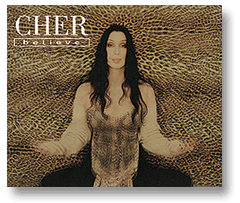
It was the best-selling single of 1998 and signalled a radical change of musical direction for Cher — complete with bizarre vocal processing. Yet, surprisingly, it was produced in a small studio in West London. Sue Sillitoe relates the astonishing tale of 'Believe'.
 For most of last year, it looked as though Celine Dion's track 'My Heart Will Go On' was going to be the best-selling single of 1998 — but this accolade was snatched from the Canadian Queen of AOR at the 11th hour by another female vocalist who not only launched a successful challenge for the title, but did so with a song that was massively different from anything she had ever done before.
For those of you who've been stuck on a radio-less desert island for the last two months, the single in question is Cher's dance hit, 'Believe', which spent seven weeks at the top of the UK charts and — at the time of going to press — had already achieved sales of 1.5 million and rising. What's less well-known is that it was produced by two London-based producers Mark Taylor and Brian Rawling, in their own studio.
Striking It Lucky
Together, Mark and Brian run Metro Productions, a production and publishing company which operates from Dreamhouse, a three-studio complex in Kingston, Surrey. According to Mark, despite the track's mainstream commercial success, the story behind the creation of 'Believe' is a strange one. As released, the single incorporates the work of six different songwriters, two producers and executive producer Rob Dickins (the erstwhile chairman of Warner Brothers, who has now left the company for pastures new).
Mark, whose previous production credits include Gina G and Danni Minogue, says the fact that the single happened at all is down to a series of lucky breaks, which began when Metro's songwriters were asked by Rob Dickins to submit a song for possible inclusion on Cher's new album.
He explains: "Thanks to the work we had done with Gina and Danni for Warners, we had a good relationship with Rob, and that's why we got the opportunity to work with Cher. Rob asked us to write a song and we came up with the song 'Dov'é L'Amore' [now a track on Cher's new album, also entitled Believe]. Initially, he wanted Junior Vasquez to produce it, which we were delighted about, because it was quite a coup to have the song accepted in the first place."
'Dov'é L'Amore' was duly sent over to Vasquez in New York, but when he sent back his version, it was rejected by Rob, who decided instead to give the production of the track to Taylor and Rawling as well.
"It was one of those scenarios where lucky breaks, chance and other people's bad luck come into play," says Mark. "We were only meant to do one song, but in the end we were responsible for the bulk of the Believe album — six tracks in total including 'Believe' itself. Vasquez did another and producer Todd Terry did three."
The 'Believe' Balancing Act
The starting point for 'Believe' was a song by Brian Higgins, Matt Gray, Stuart McLennen and Tim Powell, which had been knocking around the Warner offices in demo form for months. "Everyone loved the chorus but not the rest of the song," says Mark. "As we were already writing other songs for Cher, Rob asked us if we could sort it out. Two of our writers, Steve Torch and Paul Barry, got involved and eventually came up with a complete song that Rob and Cher were happy with."
Mark says Torch and Barry were given a DAT with a programmed demo in a firmly eurobeat style, which they weren't too keen on, so they sat down with guitars and began to rewrite it. In the end, they kept only the chorus, which went through some minor chord changes but basically remained intact. "The lyrics for the chorus were already there, but our guys added the lyrics, melody and chords for the verses and middle eight, then put the whole thing back together again. We sent it over to Rob Dickins and he highlighted a few changes. Then Cher heard it and she liked it straight away."
 Once the demo version was agreed, Mark and Brian took over for the actual production, working at Dreamhouse, which has Mackie consoles in every room. Mark says, "We knew the rough direction to take, because Rob had said he wanted to make a Cher dance record. The hard part was trying to make one that wouldn't alienate Cher's existing fans. We couldn't afford to have anyone say 'I hate this because it's dance' — then we would have turned off loads of people who are used to hearing Cher do rock ballads and MOR songs. I think we can safely say we succeeded in maintaining the balance, because kids on their own will buy a certain type of record, and adults on their own will buy another. The only way you can achieve sales of 1.5 million is to appeal to both camps. Getting that right was the most difficult part — and was the reason why I ended up doing the track twice!"
Mark got halfway through the first version before consigning it to the bin without having played it to anyone else. "It was just too hardcore dance — it wasn't happening," he says. "I scrapped it and started again, because I realised it needed a sound that was unusual, but not in a typical dance record sort of way. This was tricky, because dance music is very specific. To get what I was after I had to think about each sound very carefully, so that the sound itself was dance-based but not obviously so.
"It was really a question of finding, say, a kick drum that didn't sound like a typical TR909 dance kick drum — and instead, using something that had the right sound but wasn't so clichéd. I ended up using all kinds of sounds mixed together. The drums are all samples, but samples that have been mutated, EQ'd and compressed. The kick drums in particular were heavily compressed to give them a weird, pumping, smacky sound."
Instrumentation
Mark believes one doesn't need expensive technology in order to make a hit record, and adds that 'Believe' exemplifies this philosophy. "Don't forget I was only using a Mackie desk, and the rest of the equipment involved was the sort of thing any Sound On Sound reader could aspire to. Having a really expensive piece of kit doesn't mean you'll make hit records. My view is that the end result is what matters — not how you get there."
 Co-producer Mark Taylor.With this attitude, it's not so surprising that Mark used nothing fancier than Cubase VST on a Mac G3 to assemble the entire track, including the vocals (although these were initially recorded to Tascam DA88s — see later). The G3 contains a Korg 1212 I/O card, but in fact a stand-alone Soundscape converter unit provides the main audio interfacing with the rest of the Metro kit, particularly their DA88s (via TDIF).
"The sampler was an Akai S3000, and for other sounds we used several of our synths, including the Clavia Nord Rack, Oberheim Matrix 1000 — for the white-noise wind effect at the very beginning of the track — and the Moog Progidy for some sub-bass. A lot of the time I was just fiddling around to see what came out! The samples were a combination of sample CDs and ones I've collected myself over the years. As I've said, I wanted the samples to sound different, so that the track didn't sound like any old dance hit. We did this by using the EQ in the Akai sampler, from our little ART Tube EQ and on the desk to really crunch things up, and compressing and squashing sounds to give them an unusual edge. The great thing about the S3000 is that you can put four different samples on each note in a keygroup — so for the kick drum, for example, I used four different kick samples from my own collection playing together. One was just a noise, one was a splat, one had all the bottom end and so on. By mixing everything together I was able to create something unique."
Cher's vocals were recorded onto three Tascam DA88s with a Neumann U67, at her suggestion, as she had just finished a recording with George Martin using that mic and was particularly pleased with the results. From the DA88, the vocals were loaded straight into Cubase VST on the Mac, and nearly everything else was then done on the computer's hard disk.
Mark: "There's also some guitar in the chorus, which we ran through a Sessionette amp miked with an AKG C414. Then we put it through a Zoom to add tremolo and severely EQ'd it to make it sound a bit odd. For the piano we used an Emu Vintage Keys sound which I really like. It's based on a Yamaha CP80 electric piano which we slightly modified to make it cut through the track better. Then we compressed it quite hard to give it a definite ringing sound. We also added lots of delay using a Roland SDE330, which sounds really spacious and adds ambience without cluttering the track — although the really obvious delay on the vocal phrase 'after love, after love' at the very beginning wasn't done using that — we just sampled that phrase and repeated it with the S3000's internal filter on it, so that it fades in very dull and brightens up."
Mark explains that the main synth pad remained the same throughout the recording of the track, and was the only element that survived from his first version. "It's a very distinctive, core part of the record — the song hinges on it. I combined two sounds to get that — one from my old Roland Juno 106 and another from the Korg TR-Rack. There is something about the way the pad and melody work together that gives the whole track a sort of hanging feeling. When I started putting the song together for the second time, I had the pad running, and I rebuilt the drums to make the pad and the drums sound like they were driving everything along. Then I added the other instrumentation — the guitar and the piano."
STOP PRESS! Historical Footnote
Cher's 'Believe' (December 1998) was the first commercial recording to feature the audible side-effects of Antares Auto‑Tune software used as a deliberate creative effect. The (now) highly recognisable tonal mangling occurs when the pitch correction speed is set too fast for the audio that it is processing and it became one of the most over-used production effects of the following years.
In February 1999, when this Sound On Sound article was published, the producers of this recording were apparently so keen to maintain their 'trade secret' process that they were willing to attribute the effect to the (then) recently-released Digitech Talker vocoder pedal. As most people are now all‑too familiar with the 'Cher effect', as it has become known, we have maintained the article in its original form as an interesting historical footnote. Matt Bell
That Vocal Trick In Full
Everyone who hears 'Believe' immediately comments on the vocals, which are unusual, to say the least. Mark says that for him, this was the most nerve-racking part of the project, because he wasn't sure what Cher would say when she heard what he'd done to her voice. For those who've been wondering, yes — it's basically down to vocoding and filtering (for more on vocoders and the theory behind them, see the 'Power Vocoding' workshop in SOS January 1994).
Mark: "It all began with a Korg VC10, which is a very rare, very groovy-looking analogue vocoder from the '70s, with a built-in synth, a little keyboard and a microphone stuck on top", he enthuses. "You must mention this, because SOS readers will love it — and I know, because I've been reading the mag for years!
"Anyway, the Korg VC10 looks bizarre, but it's great to use if you want to get vocoder effects up and running straight away. You just play the keyboard to provide a vocoder carrier signal, sing into the microphone to produce the modulator signal, and off you go. The only drawback is the synth — you can't do anything to change the sound, so the effects you can produce are rather limited.
"I played around with the vocals and realised that the vocoder effect could work, but not with the Korg — the results just weren't clear enough. So instead, I used a Digitech Talker — a reasonably new piece of kit that looks like an old guitar foot pedal, which I suspect is what it was originally designed for [see review in SOS April 1998]. You plug your mic straight into it, and it gives you a vocoder-like effect, but with clarity; it almost sounds like you've got the original voice coming out the other end. I used a tone from the Nord Rack as a carrier signal and sequenced the notes the Nord was playing from Cubase to follow Cher's vocal melody. That gave the vocals that 'stepped' quality that you can hear prominently throughout the track — but only when I shifted the Nord's notes back a bit. For some reason, if you track the vocal melody exactly, with the same notes and timing, you hardly get any audible vocoded effect. But I was messing about with the Nord melody sequence in Cubase and shifted all the notes back a fraction with respect to the vocal. Then you really started to hear it, although even then it was a bit hit-and-miss — I had to experiment with the timing of each of the notes in the Nord melody sequence to get the best effect. You couldn't hear an effect on all the vocals by any means — and on others it made the words completely impossible to understand!
"In the end, we only used vocoded sections where they had the most striking effect and didn't make the lyrics unintelligible. To do that, I had to keep the vocoded bits very short. So for example, when Cher sang 'Do you believe in life after love?', I think I only cut the processed vocals into the phrase on just the syllables 'belie‑' from 'believe' and 'lo‑' from 'love' — but that was enough to make the whole phrase sound really arresting. I made sure throughout that the last word of each vocal phrase was unprocessed, because again, I found it sounded too bubbly and hard to understand when it was vocoded."
Mark spent time alone in the studio painstakingly processing Cher's vocals in this way, and by the following morning, he was convinced he didn't have the nerve to play her what he'd done. "It was a bit radical," he laughs. "Basically, it was the destruction of her voice, so I was really nervous about playing it to her! In the end, I just thought it sounded so good, I had to at least let her hear it — so I hit Play. She was fantastic — she just said 'it sounds great!', so the effect stayed. I was amazed by her reaction, and so excited, because I knew it was good."
Although the vocoder effect was Mark's idea, the other obvious vocal effect in 'Believe' is the 'telephoney' quality of Cher's vocal throughout. This idea came from the lady herself — she'd identified something similar on a Roachford record and asked Mark if he could reproduce it.
He explains, "Roachford uses a restricted bandwidth, and filters the vocals heavily so that the top and bottom ends are wound off and the whole vocal is slightly distorted. It took a while to work out exactly what it was that Cher liked about this particular Roachford song, but in the end we realised it was the 'telephoney' sound. I used the filter section on my Drawmer DS404 gate on the vocal before it went into the Talker to get that effect."
Better 'Believe' It...
'Believe' took approximately 10 days to record. Once it was completed, Mark ran a monitor mix onto DAT and sent it to Rob Dickins for clearance. To Mark's surprise, Rob was so pleased with the sound that the monitor mix basically became the final version, with only the most minor of tweaks. "The vocals were much too loud, because I was trying to clear the track," he laughs. "But apart from that, it worked fine, and everyone was really happy with it. It just goes to show that you don't need to spend days mixing in order to get a hit. With 'Believe', I was adjusting things as I went along and running everything live on the computer, which meant I could save just about everything, apart from the effects and EQ hooked up to the desk. All the level changes in the mix were already recorded in the sequencer, so the finished mix just kind of grew in an organic way as we worked on the track."
The single was mastered at Townhouse, although very little was actually changed at this stage. "It was very straightforward," says Mark. "Just the fades and the odd dB of cut and boost here and there — standard mastering stuff."
Looking back, Mark says the most satisfying part of the project was getting to know Cher who spent six weeks at the studio working on the album. "The first day was incredibly nerve-racking," he admits. "I thought she might think our setup was a bit small, and that she would turn out to be a bit 'Hollywood'. But she was really great and easy to get on with. These days, artists like Cher are used to working with producers who have their own studios — and these are not necessarily big, just well equipped."
With such a massive hit to their credit, it's not surprising that the eight-man team at Metro is now in great demand. They are currently finishing a Gypsy Kings album (which was started after the group guested on the 'Dov'é L'Amore' track), and other high-profile projects are in the pipeline, such as the first single from Gary Barlow's new solo album, and the next Tamperer release. Whether they will continue their relationship with Cher, however, remains to be seen.
"She's said she wants to work with us again, but you know how record company politics can be," says Mark. "I hope it does happen, because it was a great project and one we all thoroughly enjoyed. We certainly never expected the single to do so well — let alone seven weeks at number one. But when I listen to it now I can see why it worked. It's a great song with a fantastic chorus, and the weird vocoder effect on the vocals makes it special."