

Super Furry Animals' recent album Rings Around The World is one of the first to be released in a custom‑mixed 5.1 surround version for DVD as well as on stereo CD. Keyboard player Cian Ciárán explains how and why they embarked on this groundbreaking project.
 In today's fickle world of rock music, it's increasingly common for newly signed bands to make ham‑fisted attempts at stamping themselves on our collective memories as quickly as possible, even at the risk of their absurd proclamations or outré activities appearing cringingly embarrassing later on. With hindsight, it's difficult to regard, say, the attempts by Suede's Brett Anderson to pass himself off as bisexual, or the clumsy efforts of Jamiroquai's Jay Kay to present himself as some kind of environmental activist, as anything other than desperate tactics to provide the music press with something to talk about. And these are cases we can still call to mind — remember Thousand Yard Stare or Sheep On Drugs? Apart from their names, nor do I.
Today Wales, Tomorrow The World
Back in the mid‑'90s, you could have been forgiven for assuming that psychedelic Welsh five‑piece Super Furry Animals would live a short, bright life, like Rutger Hauer in Blade Runner, and then vanish from our cultural radar quicker than World Of Twist. The Furries were signed to a Cardiff‑based label and sang in Welsh, but before it became trendy; they showed up to rock festivals in an armoured techno‑broadcasting tank, and they loftily forecast colossal future success for themselves. They claimed to be influenced by a bewildering, seemingly musically incompatible range of genres and bands, whilst still making themselves out to be utterly different from anyone who'd preceded them.
In 1996, they explained simply, "We're not mods or rockers, or punks, or ravers, or romos — we're Super Furry Animals."
 Keyboard player Cian Ciárán.Romo, Britpop, and trip‑hop have come and gone, but as 2002 dawns Super Furry Animals are still here (although they've sold the tank). They've been part of the now‑defunct indie giant Creation Records and lived to tell the tale, they've put out an entirely self‑funded record sung in Welsh and watched it become their most successful release, and they're now signed to the Sony label worldwide. Their most recent album Rings Around The World is a dizzying distillation of country rock, bubblegum pop, acid house, and death metal, to say nothing of the work of The Stooges, The Beach Boys, Ennio Morricone, Suicide, Status Quo, and Burt Bacharach. As if that weren't enough, the album was not merely released on an ordinary stereo CD, but also on a DVD featuring 18 tracks in custom‑mixed 5.1 surround sound, with a video for each song. For all the bluster of their early years, they turned out to be quite right. They are Super Furry Animals, and despite all their influences, there is no‑one else quite like them anywhere.
How To Spend An Advance
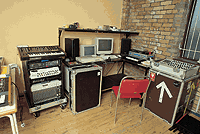
Within minutes of my arrival at his Welsh studio, SFA's hirsute keyboard player and programmer, Cian Ciárán, is examining the SOS interview Walkman's tiny built‑in mic and talking about recording some drums with it, just to see what the results would be like, exhibiting a willingness to experiment that is absolutely typical of his band. The studio, a recent acquisition, is located in an industrial unit and will eventually allow Cian to develop ideas, pre‑program sequences, and make demos. At the time of SOS's visit, however, much of the gear has yet to be connected up. There's still no computer capable of recording audio, only Cian's trusty Atari ST — although he does have a Carillon PC system on order. Despite this, there is already an extraordinary variety of keyboard and processing gear in the one‑room unit, ranging from Cian's original DX7 and Korg Poly 800 (two of his earliest synths) to his highly prized Fender Rhodes Suitcase 88 electric piano. Grinning, Cian explains that most of it has been funded by record company advances for each of the band's albums (Rings Around The World is their fifth).
 The Super Furry Animals' new record deal with Sony (Epic in the UK) has allowed them a great deal of creative freedom with the Rings Around The World project — none of the ambitious surround or video plans would have been possible without the major label's financial involvement. Indeed, even ignoring the surround aspects of the album, the group have made it their most lavish production to date, with real string and brass sections being used on several tracks, notably the lush 'Presidential Suite', the bombastic 'Shoot Doris Day', and the summery hit single 'Juxtapozed With U'.
Why Surround?
But why make a 5.1 version of an album? Well, although DVD film releases with a surround soundtrack have been commonplace for several years, the opposite concept — a DVD containing audio as the focus of the package, with video films as the supporting material — was virtually unheard of when the band began planning Rings Around The World. Surround‑compatible remasters of old pop material previously released in stereo or quad were beginning to appear, but the idea of a modern album being finished in both stereo and surround formats was something hardly anyone has tried before or since. The idea of breaking new ground proved too interesting for the band to ignore once the Sony money was on the table. What's more, they have a long history of pushing themselves, ever since their first album for Creation, which was recorded in Anglesey on a miniscule budget.
Cian explains: "We really went for it on that first album — because we thought it might be our last! And we've treated every album we've done since then with the same respect. You've got to really go for it, because it might be the last thing you get to do! Also, we all liked the idea of doing stuff that you know has never been done before — that's really the interesting aspect of surround. You can go down to much lower frequencies because of the subwoofer channel, and you can make things pan around you.
"We were a little worried at first that doing a DVD might seem elitist, because only certain people have DVD players and systems, even now. But hopefully, most people will have DVD playback systems at home within five years. Even if it doesn't take off, the stereo version of the album will always be there — and we treated that just like making any ordinary record."
Recording For Stereo & Surround
The band began recording in Monnow Valley studio, Wales, in April 2000, with co‑producer Chris Shaw and engineer Eric Tew, and concluded there some months later after an interval recording in Bearsville Studios, New York. Much of the gear now in Cian's unit was shipped across Wales for use in the studio, including the Fender Rhodes that can be heard all over the album.
One of the earliest tracks to be recorded arose from a jam between Cian and guitarist Huw Bunford, the basics of which were recorded in the most rudimentary fashion. "We looped one bar of [drummer] Daf playing the kick and snare through an SM57 plugged straight into my Akai S2000, just to give us something to play to. There was a baby grand piano in the studio, and I started playing on that. Then we set the mics up to record the piano and Bunf's guitar into the sampler. Later, we chopped the playing up a bit, and put some Sherman filter on to the drums and guitar to give them a bit more movement. They're still the samples on the actual record."
Eventually entitled 'Alternate Route To Vulcan Street', the moody, piano‑led track eventually opened the finished album. "It was just something that started as a laugh, but Daf added more drum passes on brushes, we ended up getting a string arrangement for it, Gruff wrote some lyrics, and finally it was a song!"
Even as 'Alternate Route To Vulcan Street' was being readied to receive its string overdubs (with a mournful arrangement by Sean O'Hagan of The High Llamas), the band, Chris Shaw and Eric Tew were considering how they'd need to record the basic tracks to enable an interesting 5.1 mix to be made later on, as well as the standard stereo version. Cian: "There's no real standard setup yet for how to record in 5.1. Chris and Eric had never worked with it either, so it was a learning curve for them as well.
"Obviously, it influenced how we recorded in some respects. We were adding more mics than we would normally use for stereo, with loads more ambient mics. This sounds anal, but one of the reasons we went to Bearsville was because of the drum and live room there — we did a lot of drum tracks there. Of course, we then omitted most of the signals from the ambient mics in the stereo mix, but used them in the surround version. And when we recorded the strings, we had an eight‑piece string section at one point, and we used four mics in an arc, and we tried to recreate those mic signals in the same positions in the surround mix, so that the listener would feel like they were in the conductor's position. It's stuff like that you try — things you could never do in stereo."
Another luxury the band explored while recording was the use of sub‑bass, destined only for reproduction in the low‑frequency subwoofer channel in the surround mix. "We used frequencies as low as 20Hz on the sub channel, which would blow ordinary speakers. That was a sound that I'd never worked with before, because normally people just put a shelving EQ to cut out anything as low as that. On one song on the album, 'A Touch Sensitive', which contains a Stooges sample, we made a bass line out of a TR808 bass drum, a real bass drum, and a 20Hz synth tone. You can't hear it on an ordinary stereo — you can only hear a 'splat' sound at the start of the note, not the sustained sub‑bass tone — but if you're running it through a PA or a 5.1 system with a subwoofer, you'll hear the full thing. We did a similar thing on 'Juxtapozed With U', layering the 808 bass drum with Simmons electronic percussion."
Enter Pro Tools...
Most of Rings Around The World ended up on analogue tape, but rarely without passing through a Digidesign Pro Tools system on the way, operated by the faithful Eric Tew. Though the Super Furries experimented with Pro Tools on their last album for Creation, Guerilla, this was their first complete project with it. "We could see the benefits of using it back then, and it was something we really wanted to try out properly. We'd lay tracks down to two‑inch tape first, until we had a decent take, and then we'd dump that into Pro Tools, work on it there, editing and overdubbing, and then put the results back on to two‑inch analogue when we were happy. This meant we could edit some beats very precisely in Pro Tools, like the gated kicks at the end of the track 'Sidewalk Serfer Girl', but still do the final stereo mix from tape, so you get the tape sound — we like that."
Pro Tools also proved its worth on the multi‑part track 'Receptacle For The Respectable', which, in true schizophrenic Furry style, undergoes a complete personality change over the course of four minutes, beginning as an acoustic guitar‑driven pop song, passing through a brief intermediate phase as a Bacharach‑influenced 'Raindrops Keep Falling On My Head' soundalike, before concluding as a tribute to death metal, complete with distorted, bellowed vocals. According to Cian, the song started life at Monnow Valley comprising just the first two parts, but by the time the group got to Bearsville, singer Gruff had written and added the third section. "We recorded it there as a three‑part song played through from start to finish. The fourth part, the death metal part, came from just pissing about with Pro Tools. We looped a bass part from the last bar of the third bit by accident and that became the bass line to the fourth bit. It was still essentially a song that you could play on an acoustic guitar, but in the studio, it became one of those things that evolved. The only bit that wasn't 'played' as such was the last part.
"At one point, there was even going to be a fifth part based around the delayed siren sample and delay you hear right at the end of the track as it is now — that's my Boss RSD10 sampler/delay on there. We were going to chop that up in Pro Tools and stick a hip‑hop beat over it to create another bit, but we thought 'enough's enough'. If you're going to do a fifth bit, you'd probably do a sixth, and before you know where you are, you're doing a concept album made up of nothing but bits!"
Off To Metropolis
After completing tracking in Monnow Valley in September 2000, the band booked time the following month to commence mixing in Metropolis Studios, London. Here they were aided by, amongst others, Assistant Mix Engineer Richard Wilkinson, who takes up the story. "We initially approached this album as though we were mixing an ordinary stereo release. The stereo mix was mainly done from two‑inch analogue tape, with a few things in Pro Tools which it hadn't been easily possible to create directly to tape. We mixed in Metropolis Studio C on the 72‑channel Neve VR console there, and spent the first couple of months finishing the stereo mix. The band were quite particular about maintaining the sound of the Neve, which they really liked — they felt it was warmer than that of SSL desks. However, when the time came to do the 5.1 mix, we had to move to Studio E, a surround‑equipped control room, where the desk is an SSL — a J‑series. Fortunately, we knew this was coming, and managed to get around it by forward planning."
 When creating the stereo mix on Studio C's Neve VR, the team hit upon the idea of running the individual Neve‑EQ'd and compressed channels back into Pro Tools. As Richard Wilkinson explains, "We then had compressed and EQ'd channels on separate tracks in a new Pro Tools Session, ready for mixing. The idea was to ensure that the surround mix and stereo sounded very similar, down to the EQ and compression settings. We also took copies of the more prominent effects in the stereo mix when putting the stems into Pro Tools. For example, on the track 'Miniature', an EMT 244 digital reverb was used, with quite a definite sound. We didn't want to get into recreating that, so we put that into Pro Tools as well."
The Pro Tools setup containing the multitrack mix was then connected to the Studio E SSL, whose EQ was bypassed for most of the time, so as to alter the 'Neve'd' tracks as little as possible.
This resolved the sonic issues, but there was another complication. Richard Wilkinson explains: "Obviously, when using for 5.1 mixing what is essentially a desk designed for stereo output, even one with four busses like the SSL J‑series, there are limitations. Firstly, what do you use for your six master channels? [For more on this question, see this month's instalment of SOS's series on surround sound, in SOS January 2002 — Ed.]
"For the centre and sub channels we used auxes. We used the ordinary left and right channels, obviously, for left and right, and I think the two surrounds came off the A buss. On the J‑series, you can automate the feed to the A buss for the backs and the front left and right, but the auxes are only on/off automatable, not for level changes, so we just had on/off automation on the centre and sub. As there are no surround panners on the J‑series to smoothly alter the extent by which a channel is assigned to each of the master busses, you certainly couldn't achieve sweeps or circular pans — the automation was either too complex or simply not possible. We had to conclude that if we wanted to do anything complex involving panning, something like the SSL J‑series wasn't really designed for that in its factory state. That's where Pro Tools really came into its own again."
After the niggles with the desk, the surround monitoring and mastering arrangements must have seemed delightfully simple to the band. "Studio E has a set of Genelec 1031s for stereo monitoring, a set of Yamaha NS10s in a surround configuration, and some 5.1 PMC monitors too. The NS10s are there because it gives you something close to a consumer‑type loudspeaker situation — exactly as in stereo monitoring, really."
Surround 5.1 master recording facilities at Metropolis comprise either eight‑track Tascam DA98HR DTRS recorders, or eight‑track Genex MX8000s recording to hard disk. For Rings Around The World, the team elected to go with the Genex, recording at 24‑bit, 48kHz. Six tracks were taken up by the completed 5.1 mix, while the remaining two tracks contained the finished stereo mix for reference and later use on the finished DVD. "The way the monitoring works is that you monitor the master mix coming back off the Genex, so you always hear the master mix exactly as it is," explains Richard.
Surround Mixing Techniques
The logistical problems largely surmounted, the Furries and their team began mixing. No‑one was short of ideas for testing the concept of surround to its limit. Richard: "Generally speaking, we'd spend the first half an hour or so checking that everything had all transferred across correctly. We'd then spend maybe a day getting the surround aspects of the mix going, essentially deciding what was going to move and what was going to be stationary. Actually, most of the songs retained a basic stereo image, with the odd bit of movement around that. One of the things we learned quite early on, this being the first time that we'd worked on a dedicated surround album project, was that too much movement just confuses people. You have to retain something solid for the listener to focus on, and then have movement based around that.
"There was also a lot of use of the centre speaker to allow the lead vocal to cut through, although we always balanced that with putting the signal in the 'phantom centre' via the left and right speakers [see last month's instalment of SOS's ongoing series on surround for more on the distinction between phantom and real centre signals — Ed]. This was to avoid the vocal dropping out on systems with the centre speaker set up incorrectly. In fact, we made sure you could remove the centre speaker and still leave it sounding fine."
When it came to mixing 'Alternate Route To Vulcan Street' the team decided to take a radical approach, creating something that could never have been achieved in stereo — the slow rotation of the entire soundfield around the listener throughout the course of the song. It was here that Pro Tools was again used to good effect to get around the routing and control restrictions of the J‑series, as Richard explains: "To do this, we left the channels in Pro Tools and used Kind Of Loud's Smart Pan Pro plug‑in. We'd complete the mix we wanted with no movement in it, print that to the Genex, then copy it back into Pro Tools, so we had a six‑channel mix. Then, omitting the sub channel, we took the other five channels and put them through the plug‑in. We had to write quite a lot of automation level change data to achieve the moves, as you can probably imagine, timing it so that it matched the lengths of the bars. It helps that you can watch the movement. You can can watch the listener location move on the Smart Pan Pro control panel, and watch an automated blob representing the signal position moving around."
Mastering & Authoring
Once mixing to the Genex, track selection, and ordering (itself no mean feat with a final total of 18 tracks) was complete, the lengthy task of authoring the DVD began. This process, which was handled in‑house by Metropolis, involved putting the various audio files together with the videos that the band had commissioned to accompany their music, creating a software framework and graphical user interface around them, and producing the result as a finished DVD. The band were deeply involved in this part of the process, with Cian producing all the ambient noise beds and sound effects for the user menus himself. A friend of the band's dealt with compiling and editing the videos to go with the audio, and the files were all brought together by the Metropolis DVD production department, including versions of the soundtrack in the three most popular audio formats: Dolby Digital 5.1 (AC3), DTS 5.1, and Dolby Stereo (the last of these derived from the stereo mix, for those with a DVD player but only two speakers).
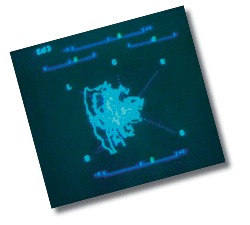
Cian now comments with some pride, "We all wanted that DVD to be absolutely right." Once again, the band ethic of maximum commitment to a project is evident. They even found time to include a hidden bonus, filming the Surround Mastering Phase meter from the Metropolis DVD authoring suite while the finished disc was created. They then assigned this constant visual feedback about the surround mix to the Alternative Angle data stream. Even without a multi‑speaker surround array, you can get some idea of how the surround mix is being panned by hitting the Angle button and watching — a nice touch (see photo above).
The New Pioneers?
After all the effort, was it worth it? Well, the Rings Around The World DVD is fascinating and also fun on many levels — a true multimedia experience, to use a much‑abused phrase. But is it the way of the future? Will all albums one day be made this way? Richard Wilkinson thinks so: "This band have always liked to push the limits of what's possible, and cover new ground. Projects like this are going to set the standard, but I do think a few of these groundbreaking projects are needed before other people have the confidence to try it themselves."
And what of Super Furry Animals? Will there be more surround DVDs? Cian, like the rest of the band, is reluctant to commit the Super Furry Animals to repeating themselves when they could be exploring the next big thing: "I don't know... Someone asked me recently, 'Will you go back now, and remix all your other albums for surround?'... but I think, 'nahh!' They weren't ever supposed to be in 5.1. Plus, we've got enough new ideas to use on new albums without using 'em up on old ones."
Super Furry Sampling
Cian has mixed feelings on the use of sampled instruments, despite his band's widespread use of samples in many contexts. "We try to use real instruments where we can, especially if the budget's not too tight, which was more the case with this album. But it depends what the song needs — like the muted trumpet on the third part of 'Receptacle For The Respectable', or on 'Presidential Suite'. They're real. But then, if you used a sampled trumpet on the start of 'Presidential Suite', it would sound terrible! You can spot a sampled brass instrument a mile off in an arrangement like that.
"In other songs, though, you don't have to do that. Bunf used to play French Horn years ago. He can only manage about four notes now, but he played those for me once and I sampled him. I spread those four notes over the keyboard, and got about two octaves' worth out of those notes before it started sounding stupid. Then I doubled that with a French Horn sound from an Emu Proteus and you get a nice sound that you can play a decent tune with. Sometimes using false instruments is a good thing. We're not purists, in that sense."
Furry Vox
Super Furry Animals make no secret of their admiration for the vocal arrangements of The Beach Boys and ELO, and the harmonies on Rings Around The World, for example on 'No Sympathy', 'Receptacle For The Respectable' and recent single '(Drawing) Rings Around The World' seem to be their most complex yet. Is this deliberate? Cian confesses: "This is the first time we've been really meticulous about arrangements, particularly vocals — it's a lot to do with working with Chris Shaw. Usually, we'd just go in the booth one after the other, and keep singing until we came up with harmonies that worked. But this time, although we did a bit of that as well, we worked it out more; we'd say, 'Look, you're doubling up on that note, there's no point in that; you sing something different there...'
"We also tried working things out on the piano, or a keyboard, or whatever was available that could give us a starting note. All five of us were involved, and the two engineers, too, trying things out. Sometimes we used Auto‑Tune, but not on the finished recording, just to re‑pitch existing lines to see if different versions of them would counterpoint correctly. Then when we'd worked them out like that, we'd learn the new lines and then go out and re‑sing them properly. Auto‑Tune is a good tool for that kind of thing, because sometimes when you try working out vocal arrangements for four‑ or five‑part harmonies on a piano — especially when they're close harmonies — you can't quite grasp whether something's going to work or not. You need to hear a proper voice singing it to be sure."