

Introducing the world's smallest transmission-line speaker.
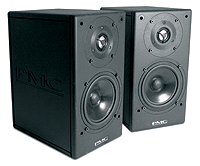 The product nomenclatures of the PMC range are nothing if not descriptive. The biggest speaker, the BB5, was the fifth iteration of a 'big box'. This was followed by a little box (LB1), then an average box (AB1, but recently enhanced to the AB2). A larger, medium box three-way was derived from the BB5 and called the MB1 (now upgraded to the MB2), and was followed by a tiny box (all things being relative, you understand) in the form of the TB1, again recently upgraded to the TB2. A further modification of the TB2 lead to the floor-standing box, the FB1. Having gone through almost the entire product range, you will hopefully have grasped the highly sophisticated and technical approach to product identifications, so have a stab at what the newly launched DB1 stands for.
Move straight to the front of the class if you guessed 'diddy box'! No, I didn't guess it either, but the newest and smallest product in the PMC range is, indeed, diddy, measuring a compact 290 x 155 x 240mm (hwd). However, despite its relatively diminutive size, this is still a proper transmission-line design, just like all its bigger brothers, and is claimed to be the world's smallest. It wasn't easy though — Pete Thomas, the owner and technical guru of PMC, spent almost a year designing and fine-tuning the line dimensions and damping to achieve the results required of a professional product carrying the PMC badge.
|

The Goods
The DB1 is a passive two-way miniature monitor with four 4mm binding posts to facilitate bi-wiring or bi-amping. The one-inch aluminium-alloy, ferrofluid-cooled tweeter is the same as that used in the TB2 and FB1, while the 140mm doped bass/mid-range unit is supported in a cast magnesium chassis. The two units are integrated with a crossover tuned to 3kHz. The transmission line is created from four internal folds and vents to the top of the rear panel. One of the mechanical advantages of the transmission-line design is that the MDF cabinet becomes extremely solid and well damped — a useful side-effect of all that internal woodwork to make the line folds. It is also quite heavy, with each DB1 weighing 4.5kg.
The review models were the DB1S variant, a painted black studio version with the PMC logo engraved on the side panels. However, a range of wood veneers is also available, as are magnetically shielded versions (DB1M) and a dedicated centre channel unit (DB1MC). Although not fitted to the review models, all production speakers have bolts fitted to facilitate mounting onto PMC's own design of cost-effective wall brackets, and matching floor stands are also available.
The sonic advantages of the transmission line concept are claimed to include accurate dynamics, very low distortion, and phenomenal bass extension (for a given cabinet size) without compromising linearity. The industry likes to debate the merits of different speaker designs and there are those who argue vehemently against transmission lines. It is certainly true that it is difficult to design a good transmission-line monitor speaker, and they are expensive to manufacture — hence PMC being the only manufacturer of professional transmission-line monitors at present. However, a large number of esteemed mastering engineers, recording studios, and film dubbing theatres are all repeat PMC customers, and an increasing number of well-heeled hi-fi buffs also rate the PMC designs very highly — as I do myself, it should be said.
Listening
So, what does the DB1 have to offer? Obviously we are talking about a very compact speaker, roughly the same size as that venerable old classic monitor, the BBC's LS3/5A. However, the frequency response of the DB1 is substantially flat between 50Hz and 25kHz. With a sensitivity of 87dB/W at one metre, the DB1 is also easy to drive, although PMC recommend amplifiers of around 100-150W on the grounds that a powerful amp under-used is far better than an under-powered amp over-used into clipping.
 The transmission line vents at the top of the rear panel, so placement of the speaker near walls should be avoided. Four binding posts allow bi-wiring and bi-amping.Driving the DB1s from a massively over-rated Bryston 4B, the first thing that struck me was the remarkable similarity to the sonic characteristics of the TB2 monitors. Hardly surprising, given the same tweeter, but the mid-range also sounded very open and neutral, with supportive but well-controlled and dynamic bass. The stereo imaging was also found to be much as the TB2s — very wide, with good depth, precise positioning and a broad, stable sweet spot. The mid-range and high end are detailed and revealing, and appear tonally accurate on voices, but the speaker isn't fatiguing at all, even after prolonged listening. With sensible positioning, the bass is smooth and extended without any hint of that 80Hz peak, characteristic of many reflex ported designs.
Some people find it takes a while to re-educate themselves to the accuracy of a transmission line design after years of reflex port abuse — but the cold turkey is well worth it for the much greater clarity around the low mids and that musically important bottom octave which so many people seem content to live without. The DB1 doesn't have the ultimate extension of bigger boxes, obviously, but the bass it produces is certainly very natural, fast, dynamic, and tuneful — and is far deeper than any comparably sized box. Essentially, the DB1s sound far bigger than they physically are, and will fare well in comparison with more conventional monitors of twice their size.
With its rear vent, the DB1 has to be positioned carefully, and needs to be kept away from walls. In fact, the console meter bridge is ideal — but don't be tempted to put these on their sides. The imaging works far better with them in the correct vertical orientation (as it does with most nearfield speakers, actually).
 Here you can see how PMC have managed to squeeze a 1.5m transmission line into such a small cabinet.The DB1 is intended to satisfy the requirements of small editing suites and DVD authoring rooms, OB vehicles, machine rooms and project studios, as well as the high-end domestic hi-fi market. It also offers the advantage of forming the first step on a clear upgrade path through the PMC product line, which avoids having to discard this starter model as your requirements grow. For example, adding the passive XB1P or the active TLE1 subwoofer will increase the system's bass extension and dynamics. Further upgrades might see the DB1s becoming the rear speakers in a surround system based on TB2s or FB1s — an attractive idea to anyone already addicted to the PMC mantra. If money is tight and space is limited, the DB1 should certainly be added to your auditioning list in the UK — this is a quality miniature monitor, worthy of the name.
PMC +44 (0)870 444 1044.
Pricing
- DB1S £500 per pair.
- DB1 (wood veneer) £555 per pair.
- DB5.1S 5.1 surround set including TLE1 active subwoofer £2350.
- DB5.1 surround set (wood veneer) including TLE1 active subwoofer £2599.
- DB1SMC centre-channel speaker £300 each.
- DB1MC centre-channel speaker (wood veneer) £327.50 each.
- For magnetic shielding, add £50 per stereo system or £100 per surround system.
- Prices include UK VAT.