

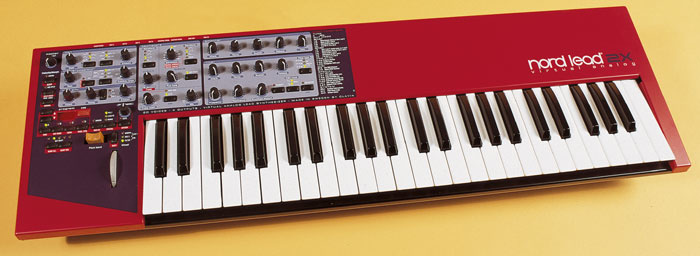
 Photo: Mark Ewing
The follow-up to Clavia's Nord Lead 3 is not the Nord Lead 4 (well, not yet, anyway), but a beefed-up version of the Nord Lead 2! We find out why, and how it improves on the original.
With their Nord Lead 3 (reviewed SOS July 2001), Swedish virtual-analogue pioneers Clavia produced an instrument with a remarkable user interface. The continuous knobs ringed with LEDs were an absolute delight, and the inclusion of an aftertouch-enabled keyboard and a real display for patch names seemed a significant (and overdue) advance over the earlier Nord Leads. With these things in mind, you'd hardly expect the next Clavia synthesizer to be a reworked version of the six-year-old Nord Lead 2. Of course you've spotted the title of this review already, so you know that's exactly what Clavia have done. If your first question (as mine was) is 'Why?', check out the box at the end. If that takes care of 'Why?', then read on for more on exactly what the Nord Lead 2X — and its rack counterpart the Nord Rack 2X — have to offer.
Red Again
The Nord Lead established itself in the mid-'90s as the classic design for virtual-analogue synths. I reviewed the Nord Lead 2 back in September 1997, so it was something of a surprise to meet it afresh in 2003. Especially because, with the exception of a detachable power cord and an 'X' in its name, I couldn't immediately spot the enhancements. Rather than rehash its spec or re-twiddle its knobs, why not check out the 'At A Glance' box below and the pics for a refresher of what's what.
For convenience here, I'll sum up the Nord Lead 2 as a twin-oscillator analogue-modelling synth with four-part multitimbrality, each part being referred to as a 'Slot'. This structure allows for layering of patches, split keyboards or control via four separate MIDI channels. As there are no onboard effects to play with (unless you count the MIDI delay and distortion in the filter section), the 2X's four audio outputs are welcome, and may be used to process each slot individually if you wish. Perhaps my favourite Nord feature is its 'morphing', which is cleverly implemented to extract the maximum sonic diversity from the minimum knob count (more on this in that box below).
For traditional analogue tones, the oscillators sound fine, the filter recreations are pleasing, the envelopes are snappy and the modulation options are well-chosen. And with no menu-hopping required to program patches, you know pretty much where you are at all times with this intuitive red metal synth.
Time gives a chap the opportunity to reflect, and it was interesting to revisit the sounds and operation of an instrument that I quite enjoyed, but never truly embraced, and view it in the context of the competition six years on. Perhaps surprisingly, the new model holds its own rather well, although the competition has thinned out somewhat lately. In the UK, it slots into the 'around £1000' price bracket, nestling below the various Virus keyboard versions but well above the (recently discounted) Novation K-Series and the much cheaper (but only eight-note polyphonic) Alesis Ion.
The Nord Lead 2X At A Glance
- Four-octave velocity-sensitive keyboard with no aftertouch.
- Octave Shift buttons (±2 octaves).
- Keyboard-split function.
- Wooden pitch stick that changes the pitch continuously, offering pitch-bend or natural vibrato in one controller.
- Modulation wheel offering control over several destinations or over the morphing feature.
- One pedal input for sustain and one for the expression pedal.
- Four unbalanced audio outputs — each slot may have its own output or a variety of mono and stereo configurations.
- Three-digit LED display, 26 knobs and 27 buttons for program editing.
The two oscillators generate sine, triangle, sawtooth or pulse waves with adjustable width. Additionally, Oscillator 2 has variable coloured noise with a unique sync option producing decidedly digital-sounding waveforms; it also features hard sync and may frequency-modulate Oscillator 1. The ring modulator produces atonal effects as the two oscillators are cross-processed, and when ring modulation is active, the FM Amount knob controls the modulated signal's timbre and pitch. A little trick to regain control of FM amount when the ring modulation is active involves using the mod wheel and setting its destination to FM.
Clavia's distinctive filters include 12dB-per-octave low-pass and 24dB-per-octave low-pass, band-pass and high-pass types, as well as a combination notch and low-pass filter. Envelope amount is controllable via velocity and keyboard tracking may set to full, two-thirds, one-third or off. A Filter Distortion button adds a preset amount of distortion.
Modulation is catered for by two LFOs with a variety of waveforms and destinations, although you can select only one destination per LFO. LFO2 also controls the rate for the simple (but effective) arpeggiator. A MIDI Echo function is present, and can be set between one and eight repeats (as this generates new MIDI notes, it can eat into polyphony if used gratuitously). A modulation envelope (attack, decay) for Osc 2 pitch, FM amount and pulse width is included too.
Each knob may be programmed for velocity control or may be 'morphed' by the modulation wheel (or pedal) to continuously fade between two sets of values. Some of the Nord's most complex sounds are created this way, the knobs controlling multiple value changes simultaneously.
Up to four program Slots (A-D) may be active at once for layered or split keyboard effects. There are dedicated buttons to select the Play mode from the following options: poly, legato, mono, unison mono, and unison poly. Finally, there's a Portamento control.
All the Nord 2X's control knobs and switches for program editing transmit and receive MIDI Control Change messages. Other MIDI goodies include synchronisation of the LFOs, and remote triggering of the filter and amplifier envelopes or velocity control from separate MIDI channels for some fascinating sequencing possibilities.
So, What's New?
Basically, the Nord 2X offers more patch storage, increased polyphony and better D-A converters. The Nord Lead 2 had a respectable 16 notes of polyphony — four times the amount of the original Nord Lead. The new model sees a further increase, cranking the total up to 20 notes. An extra four notes may not seem too radical, but they really count when using layered patches.
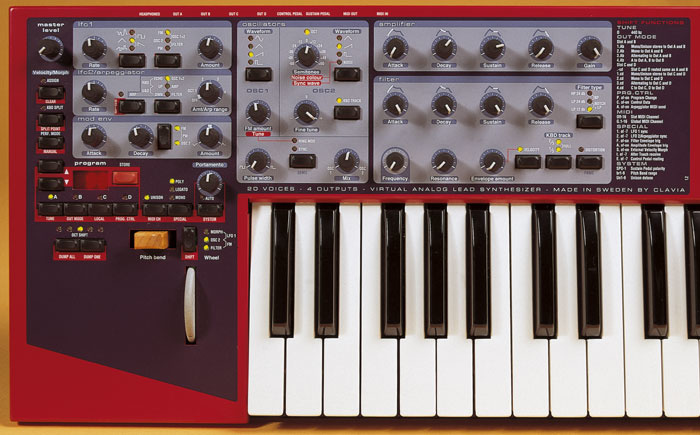 Photo: Mark Ewing
The biggest change of all is in the amount of memory available. A limitation of the original Nord Lead 2 was its meagre internal storage — just 40 user Programs and, worse, user Performances (multitimbral or layered collections of up to four patches) could not be stored internally at all — you needed to purchase an additional battery-backed SRAM card. Happily, things are far better in the 2X model (which has no card slot), as internal memory now consists of 990 single sounds — 396 of these user-programmable, 594 ROM factory sounds. Furthermore, there are 400 Performances; annoyingly, 300 of these are still fixed in ROM, but there are 100 RAM Performances in which to store original creations. Finally, where the Nord Lead 2 had 10 analogue drumkits, the 2X has 40, and all of them are user-programmable. Each percussion kit features eight drums, configured in eight zones across the keyboard. See the 'Sounds' box over the page for more on these.
Having so many sounds on board is both a blessing and a curse. If it sounds as though I'm never satisfied, let me explain; the curse part boils down to issues surrounding navigation. The Nord Lead series (prior to the Nord Lead 3) relied on a three-character display and pretty much got away with it. Now, though, with almost 1000 single sounds to call upon, locating a particular patch amongst the throng is a challenge — and that's even before you tackle the problem of remembering the patch number you want. For a start, you cannot leap directly to a particular bank. Instead, you must scroll through the onboard patches until you reach your destination. Holding down the shift key increments patches in steps of 10 but, even so, getting around is fairly laborious.
Programs are divided into Banks, each containing 100 patches. Banks are represented numerically on the display by their first digit and a dot. The two remaining characters represent the patch number from 0-99. Thus Bank 1, program 21 is shown as '1.21' (bank number zero is represented as a blank, for greater clarity). Percussion kits are located at the end of each bank and are preceded by a 'P' so '3.P0' is not an affectionate nickname for the cheerful Star Wars robot, but the first kit in Bank 3.
Performances are organised into four banks of 100. They are named according to the convention 'A0' to 'L9' (the letters 'I' and 'K' are excluded, as these characters don't work terribly well in the display), so '4.B1' refers to Bank 4, Performance 12. When you create a Performance, it automatically takes copies of each Program it uses. This means you can tweak each in turn with no fear of overwriting the Program upon which it is based, although you can store your work in a standard Program bank if you wish. Holding down multiple slot buttons at any time is a quick and easy way to try out new layers. All this adds up to a simple, flexible system.
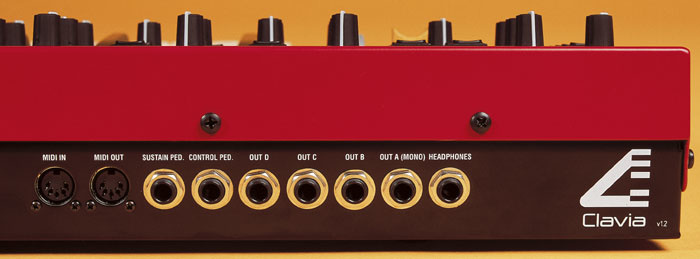 The rear panel is almost identical to that of the original Nord Lead 2, with individual audio outs for each of the synth's four 'slots', sustain and expression pedal inputs, and a headphone socket. Shame there's still no MIDI Thru, though.Photo: Mark Ewing
If this all seems familiar, you're forgiven, as this synth is architecturally identical to the original Nord Lead 2; indeed, all patches are 100-percent compatible with it. The most significant enhancement left to mention is one you may not instantly notice: improved digital-to-analogue converters. The Nord Lead 2X contains high-resolution, low-noise 24-bit DACs running at 96kHz (the Nord Lead 2 had 18-bit converters). The end result is a clean-sounding synth with a nice sizzle and bite, although the original was no wallowing hippo itself. For more on the sounds in the 2X, see the 'Sounds' box below.
Sounds: Hear For Yourself
With so many patches on board, auditioning them all took me several days; I hope you'll accept my description of a small cross-section of my favourites. Note that the names are retrieved from the manual due to the display limitations mentioned elsewhere in this article. For a chance to hear these sounds, download the ZIP file of MP3 examples from the Media sidebar of this article.
PERFORMANCES
- C4: 'Split Flute Echo' — this Performance splits the keyboard, placing an analogue bass in the left hand. It uses the built-in MIDI delay effect to liven up a sweet right-hand solo.
- D0: 'Cave Pad' — this isn't so much a pad as a tuned resonant percussive patch based on the noise waveform of Oscillator 2. Place this in a cathedral-type reverb for an awesome, atmospheric sound.
- G4: 'ARP Erasure' — two layered parts feature here, with their arpeggiators set to randomly emit a lively, bright series of patterns. I warrant they'd bring a smile to the impassive face of Vince Clarke himself.
- G7 (and also 2.G7): 'Synth Brass Section' — analogue brass sounds that sound classy even when compared to those in my Oberheim Xpander. I can't think of higher praise than that.
- H6: 'Hybrid WurliRhodes'— One of several highly useable electric pianos.
- L2: 'Plastic Bass' — there are many chunky, powerful basses. This is a rather Jarre-ish example.
- 2.L1: 'Short Wave Opera' — vocal textures with added noise making for an evocative pad.
There is also a range of specifically programmed organ performances, such as the excellent 'All Even Harmonics' located at 1.H1. Clavia hint at a rotary speaker using simple vibrato and morphing capabilities. Throughout the organ performances, slot D contains a 'click' and, of course, individual slots can be turned on or off for variations. It's not quite the simplicity afforded by drawbars, but it's not bad either.
PROGRAMS
There are literally hundreds of these, encompassing the whole range for which analogue is justly famous — and there are even a few successes where, traditionally, analogue struggled to convince. Naturally, the synth is packed with basses, solos, pads, brass, strings, electric pianos, bells, sound effects, arpeggios and more. Mostly, they are of high quality, and it seems unfair to single out any for special praise. Nevertheless, I must mention at least a couple of favourites, such as 2.99, entitled 'Rain'. Add reverb to produce a realistic downpour, or raise the mod wheel to transform the sound into something reminiscent of frying bacon. For more conventional uses, check out 4.73, 'ScoopPad', which uses velocity morphing and the mod envelope sweeping the pitch of Oscillator 2 to produce a warm pad with a marvellous initial glitch. I could (and did) noodle on that one for ages. Naturally, Clavia have the whole gamut of squidgy analogue sounds covered (eg. 2.77, 'HighPass 303') and even 'realistic' sounds, such as acoustic guitar (5.22, 'The Thumb') and solo strings (8.26, 'Solo Cello') are bundled in too.
PERCUSSION KITS
The percussion kits offer no less than eight simultaneously playable virtual-analogue sounds in a single slot, with only one limitation (each voice in a kit has to share LFO settings with its fellow drums). Each sound is mapped over a fixed area of the keyboard known as a zone. The eight zones are divided between notes 'C'-'E' and 'F'-'B' in each of the Nord Lead 2X's four octaves. An ingenious method of selecting the voice to edit involves simply hitting any black note within that zone. Having fixed zones means you can't work with General MIDI drum maps, but I suspect few potential Nord customers will be unduly worried by this! The analogue percussion voices supplied include zappy bass drums, noise-blast snares and toms, and metallic percussion, but you can tailor them all to taste using the Nord's synthesis options. They sound pleasantly Kraftwerk-like to me, especially when layered and arpeggiated in a Performance.
Conclusion
The Nord Lead 2X is a means of continuing production of the Nord Lead 2, whilst along the way exploiting updated components. However, many of the reservations I expressed in my original review remain. The keyboard has no aftertouch, there is no MIDI Thru port and there are no onboard effects. Mind you, neither these niggles nor a relatively high price have prevented the Nords from gaining a strong following, and the extra improvements are worthwhile. Four more notes of polyphony proved very handy when using the 2X multitimbrally, and the massive increase in onboard storage is also welcome. Perversely, having so many patches now makes the display more of a liability — identifying and locating favourite patches requires some method of your own, such as the famous 'writing on bits of paper' technique or the use of patch lists in a computer-based sequencer (if you use one). Those 24-bit DACs sound good too.
In terms of sound and performance, you know what you're getting with the 2X — namely a synth that delivers plenty from a (largely) intuitive interface and which has a character all of its own (indeed, some people are happy to admit that they prefer it over the Nord Lead 3). Ultimately, it makes perfect sense to improve any instrument for which demand remains high, and the fact that Clavia have breathed new life into this range suggests that they see no reason to abandon their classic line just yet.
Why 2X?
Clavia tell me that the Nord Lead 2 remains very much in demand due to its distinctive sound and the higher cost of the Nord Lead 3. However, some of the original components were becoming hard to source, and hence a redesign was necessary. I hope there are still spares for owners of the earlier model!
The result is a synthesizer that exceeds the original specifications of the Nord Lead 2 and hence has earned the 2X moniker — simple as that. And if you think this could affect the sales of the Nord Lead 3, the two synths actually sound (and perform) very differently, perhaps because the two instruments were created by different programming teams.
Pros
- 20-note polyphony.
- Greatly improved onboard storage and loads of stunning new patches.
- Simplicity of operation.
Cons
- Keyboard lacks aftertouch.
- No effects.
- Finding a particular sound amongst the multitude can be a drag due to the display and navigation system employed.
Summary
Clavia don't make cheap gear, but they do make it to last. For a synthesizer to have such a prolonged lifespan in these times of frenzied technological acceleration suggests it must offer something worthwhile. And while simplicity is the key factor, don't overlook the fact that powerful, complex sounds can be obtained courtesy of layering and the delightful morphing implementation.
information
Clavia Nord Lead 2X, £995; Nord Rack 2X, £749. Prices include VAT.
Hand In Hand +44 (0)1579 326155.