


Max Richter combines chamber music with ambient recordings, spoken-word pieces and experimental electronica, creating a distinctive and beautiful blend of the traditional and the futuristic.
Max Richter's latest album, The Blue Notebooks, has been praised to the skies all over the world, mainly by classical music critics; and given the ear-catching melodic lushness of Richter's orchestral and string writing, he's often pigeonholed as one of those contemporary classical composers who have rediscovered melody and tonality, such as Arvo Pärt, John Taverner, Henryk Górecki and Michael Nyman. Yet Richter's elaborate use of samples and electronics, applied in ways that are reminiscent of electronic acts like Future Sound Of London, Autechre and Boards Of Canada, places his music well outside the classical music genre.
"My string writing is indeed very traditional," muses Richter. "I listen to a lot of Purcell. And if there's a model for the big string piece on The Blue Notebooks, which is 'On The Nature Of Daylight', it's late Beethoven. I'm looking for that incredible intensity and clarity, using the minimum amount of notes possible. It's a case of less is more, definitely: getting things really concentrated. I'm a minimalist in that sense. At the same time, for someone living in 2004, it would be odd not to use electronics, because they are the instruments of our age. If I didn't use electronics, I'd be like an 18th-century classical composer not using the piano. It just wouldn't make sense.
"I have these two influences in my life," continues Richter, "the whole classical background, and all the other stuff that was around in the world when I was younger: electronica, early dance music, punk, psychedelia. I went through a whole musical journey, coming from my classical education, having a music degree, postgraduate stuff, having studied composition in Italy with Luciano Berio — which was amazing, incredible — to this place in the middle where I am now. One part of my music has the notes written down, it's about pitch and structure, it has a kind of classicism. Another part is about sound. That's where it gets really interesting. From working with people like the Future Sound Of London, I know that for them music is about colour, sound, and feel. And I'm trying to bring all these strands together."
The Direct Approach
Max Richter began his long march through musical genres in Germany, where he was born in 1966. Moving to Great Britain as a young child, he studied piano and composition at Edinburgh University, the Royal Academy of Music in London, and with the aforementioned Luciano Berio, the great modernistic 20th-century composer. Richter initially followed in Berio's footsteps, composing music in the hardcore atonal and serialist traditions that were the penultimate development in late 20th-century classical music. After graduating, he co-founded Piano Circus, a highly successful classical performance ensemble featuring six pianists. It was his performance experience with this group that guided him back towards tonality, as well as towards incorporating electronics.
"When we were playing music by people like Terry Riley, Steve Reich, Philip Glass and Arvo Pärt," Richter recalled, "I noticed that this music is very direct, and that audiences get off on it. They love it. One of my formative musical experiences had been listening to Kraftwerk's Autobahn, and later Brian Eno's Discreet Music. I made a live version of the latter for Piano Circus that also used electronics, and the audience response was incredible. By contrast, a lot of avant garde music is very head-orientated. The modernistic thing is often about a composer giving a lecture, casting down the pearls of wisdom, whereas tonal music lets people in, it's more inviting. I noticed that I preferred music with a sense of narrative, that you want to listen to more than once, that gives aesthetic pleasure and that's more intuitive. So I decided to write what I wanted to hear."
The pendulum of Richter's career swung entirely the other way in 1996, when he began collaborating with Future Sound Of London, working on their albums Dead Cities (1996) and The Isness (2002) as a piano player, co-writer, programmer, arranger and co-producer. He also did some orchestral arrangements on drum & bass pioneer Roni Size's 2002 album In The Mode. Having left Piano Circus, by the turn of the century Richter's focus was more and more on his own compositions, writing music for commercials, television and film, working with director Ridley Scott on his 'Future Thoughts' ad for Orange, and gradually establishing himself as a serious independent composer.
Richter's first full-length release under his own name was Memoryhouse (2002), released on the BBC's Late Junction label and featuring the BBC Philharmonic as well as his trademark electronic experimentation. Two years later there was The Blue Notebooks, released on the Fat Cat label, performed with the string quintet Richter now performs with on the live stage. On his last work, the instrumental string-samples-electronics pieces are interspersed with tracks featuring actress Tilda Swinton reading a number of selected texts by Czeslaw Milosz and Franz Kafka over musical backings that include environmental sounds and the clicking of a typewriter.
"I suppose the texts are about reclaiming beauty," ponders Richter, "the central line being the one by Milosz at the end of 'The Trees' about trees that had been cut down in childhood having regrown to become even taller than before. The Blue Notebooks is like telling a story. It's emotional but also a place to think. I believe music needs to have something to convey that you care about, that makes me want to run into the studio and say 'I have to get this down because I want people to hear it.' It's an hour of somebody's time when they listen to it, and I don't want to be wasting anyone's time."
On A Technical Point
The heart of Max Richter's current system is formed by his Apple Mac G5, with dual 2GHz processors and 4GB of RAM. "I dislike OS X, because it's much less stable than OS 9," says Richter, "but in order to run the VSL library, I have to run OS X. Logic is sequencer-wise the way to go. It's really very evolved. You can set it up any way you want, it's very quick and very easy to use, and it's pretty stable. Melodyne is by far the best pitch and time tool out there — massively better than, er, the one everybody uses, which sounds phasey and nasty. I don't really like messing with people's pitch and timing — I'd rather get good takes — so I don't use it for that, more for abstract type stuff like changing the tempo of audio from say 80bpm to 0.003bpm.
 Max Richter's studio is now based around an Apple Mac G5 with a 16-channel Logic Control controller.
"I don't have many plug-ins in my new system, because I've only just migrated to it, but one that I use a lot is Altiverb, which is an amazing-sounding convolution reverb. Another great plug-in is the TC Master X5, which is fantastic for doing things for film and TV, because it makes everything sound huge, and TV and film people love things to sound huge. Also, [Camel Audio's] Supercamel Phat is a lovely compressor/EQ/band-pass filter plug-in that is cheap and sounds great on everything, especially bass and kick drums. I love the GRM Tools band-pass filter, and the Camel complements it nicely.
"My audio interface is provided by a MOTU 24I/O, and I have a 16-fader Mackie Logic Control and the Samson C-control, which is just a monitor controller and talkback. The Mackie is fantastic for orchestral mixing, when you need to move lots of faders at once. If I had more space, I'd have more of these, because they're brilliant. My master clock is a Rosendahl Nanosyncs, which makes a huge difference for digital playback. I used to have a Yamaha 02R, and it made it sound like a desk five times the price, because the clocking got so much better, all the jitter was gone, and imaging was razor-sharp.
 More of Richter's gear (from top): his favourite Electro-Harmonix Hot Tubes pedal, Rosendahl Nanosyncs master clock, TLA Indigo stereo EQ, SPL Vitalizer enhancer and Transient Designer.
"Outboard gear is a TLA Indigo EQ2012 parametric EQ, which is very nice, SPL Vitalizer and Transient Designer, which is fantastic for shaping the front of the note; if you want things to sound a little further away you just make the attack a bit softer. The TC Gold Channel is a nice mic preamp; my TC M3000 is a beautiful reverb, very true. The FAT PCP330 vocoder is something I use all the time, and I like the FAT Resonator. The Electro-Harmonix Hot Tubes is very cool, as well as my Bob Moog Moogerfooger. I use the Hot Tubes as a kind of mastering box, for pianos, anything digital that sounds a bit plasticky goes through it. It's a fuzzbox, it adds a bit of grit. If you listen to the final track on Memoryhouse, 'Quartet Fragment', you'll hear it on a 60-piece string section. The drums on the track 'Arboretum' on the Notebooks also went through this.
"More outboard boxes: the Emagic AMT interface, Sony VHS player — short films are sent to me via broadband, but longer films on VHS — Tascam DA45 HR DAT machine, HHB compact disc player. The Kawai K5000R is a wonderful additive synth that can be very analogue-sounding — you can tune every bit of the sound, so you can build up partials and move them around, and get it to be slightly out of tune, so that it drifts, just like the Moogs and ARP synths, giving it more of a perceived analogue feel. My three Emu E4 samplers are in storage at the moment. My main keyboard is the Yamaha P300 MIDI keyboard."
Shadowy Sounds
So how exactly does Richter arrive at the point where he wants to run into a studio to get his ideas down? He explains that his music emerges from experimentation in his writing room, with electronic programming, piano noodling, or manual scorewriting all possible starting points. "There's a constant reservoir of stuff that I write, and the albums are a slice of that. An idea may turn into 50 ideas, and only one of them ends up on the record. A lot of my writing process is about trying to uncover surprises. It's like fooling my mind into delivering new things. The track 'Shadow Journal', for instance, came out of a shredded viola loop and a very unusual low sound. I think that bass sound was originally an 808 patch on a Roland 1080 module. It had a delay by accident, it was a glitch. When I heard it, it was like 'Quick, run the DAT machine.' That was quite a while ago, and then I stuck it into a computer, built some harmony and a pulse around it, and the piece came into being like that."
 The mix for 'Shadow Journal': the string recordings made to analogue tape at Eastcote are imported into Pro Tools (with Logic as a front end) for editing and combined with the other elements of the track, such as the electronica and spoken-word recordings.
A lot of the synth-like sounds on The Blue Notebooks have a soft, warm analogue quality to them, although there are no analogue synths visible in Richter's work room. "Some people have told me that they didn't think that The Blue Notebooks was very electronic," states Richter. "But it is very electronic. It's just that the electronics aren't shiny. People associate electronic sounds with shiny and sparkly colours, but I'm not interested in that. I built analogue keyboards as a kid, these synth kits that you could buy on mail order. Unfortunately I don't have any of that stuff any more, but it obviously had a strong effect on me. I now tend to roll off a lot of the high end in the electronics in my music, and this makes them sound very vintage-like.
"Reaktor and the Virus Pro Tools plug-in are my main synths, and particularly Reaktor 3 is my synth of choice. It's grittier than Reaktor 4. The washy sound you hear on 'Shadow Journal' is the shredded viola loop I spoke about. It's a viola player playing the chord sequence in arpeggios, and I've treated it, cutting off the low end below 400Hz and the top end above 1500Hz, using a GRM band-pass filter plug-in that's very dirty and very brutal. This left only the inner harmonics of the viola part, so it gets this nice whooshy, rather mysterious analogue feel."
Not Quite Knowing Where You Are
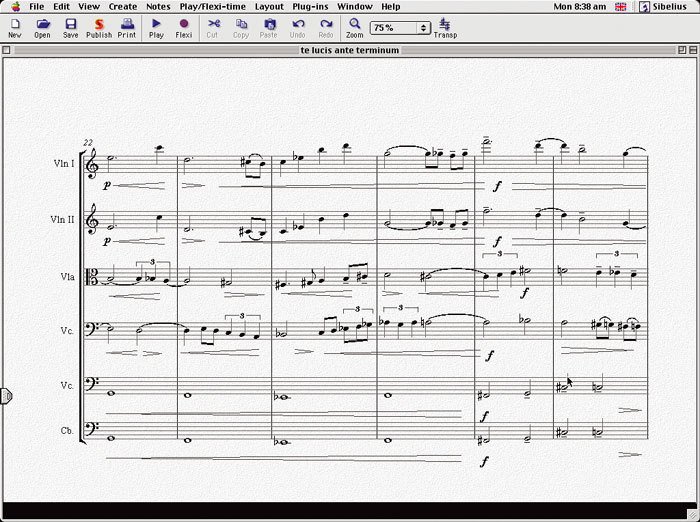
Richter explains that he has just changed his recording system, substituting a Mac G5 with 4GB RAM for his old Pro Tools Mix Cubed system, mainly because of the VSL orchestral library, "which is amazing. I regularly do orchestral mock-ups of the pieces I write for TV and film, and they are now good enough to fool the layman. Before I had this system I also used a load of Emu E4 samplers, but my current system, with Reaktor 3 and 4, Logic Platinum, EXS24, Melodyne and Sibelius as my main software, is fantastic. When I open the session, all the samples are there. This saves so much time. And Sibelius is a fantastic scoring program. There's no contest. When writing for orchestra I scribble on paper first, and then input things into the computer."

The composer calls the VSL library "a huge leap forward sound-wise, even though I still can't get it to work properly." He also uses the orchestral libraries of Peter Siedlaczek and of Miroslav Vitous ("great all-rounder, but a little too clean sometimes"), as well as Kirk Hunter's string library ("great sound, but very scrappy programming"). While these libraries are good enough for string and orchestral mock-ups in demos and for most film and TV work, Richter prefers to use real instruments on his albums. Similarly, few of the samples that make it onto his albums are canned. All outdoor environmental recordings on The Blue Notebooks are the real thing, recorded by him using DACS in-ear binaural mics.
"I love binaural stuff," remarked Richter. "It sounds perfect. The opening [and title] track of the album has four or five things happening at once. There's a recording of a windy day with a window rattling, which I processed with a nice exterior reverb from my TC M3000 to make it indistinct. It now sounds like a beach or a railway track. You don't quite know where you are, but it's a place. There's also a typewriter and a clock ticking, and there's Tilda talking, all very close by. And there's a piano playing off to one side, in a very big space.
 Richter uses Sibelius for conventional, score-based classical writing (above), but also writes by playing directly into Logic and using its programming tools.
"On 'Shadow Journal', there's a recording I made of a forest, mixed in with a recording of some crows, which takes over when the bass drops out. The stereo percussion in 'Old Song' comes from a very cheesy, 1960s cha-cha-cha Eko drum box, treated with my favorite box, the Electro-harmonix Hot Tubes guitar pedal, and then put through Reaktor. On 'Iconography' I did use some canned samples, from an organ and a choir, which I treated with three different reverbs, from the TC and Altiverb, all shuffled together. Also, 'Horizon Variations' borrows a little bit of harmony that you often find in Bach, and that was also used by Boards Of Canada on their track 'Over The Horizon Radar'."
Old And Amazing
Once Richter had completed the demos of the tracks for The Blue Notebooks in his work room, usually with finished electronic tracks and mock-ups of the strings and piano, he went into Eastcote recording studios to record the strings. Some of the live piano was captured at Hear No Evil Studios and some again at Eastcote. Despite the digital nature of Richter's own setup, these studios were chosen because of their analogue recording credentials. "I like vinyl, I like old tape, I like old synths and instruments, and I like people that play and stuff," explains Richter. "We recorded most of the live material on old analogue equipment that Eastcote owner Philip Bagenal once bought from the old Decca studios and Paul McCartney. We used an MCI desk, recorded with ribbon microphones and without noise reduction to 16-track two-inch tape, I believe it was also an MCI tape recorder, and used plate reverbs. It was very important for me that we had a really beautiful sound. Eastcote also had a high-definition Pro Tools system, which we A/B'd with the analogue. The digital wasn't bad, and if we'd used it, you would have said 'Oh, that sounds OK.' But that's not what we were aiming for. We were aiming for 'That sounds amazing, I want to hear that again!'"
All strings were recorded in one three-hour session at Eastcote, mostly without the players hearing the electronics or playing to a click track. Only on 'Shadow Journal' did they play to a click track and Richter's Reaktor-made loop. While the string players performed, the composer played the bass on 'Nature Of Daylight', which came from the EXS24 sampler plug-in, "the sound you get when you don't load any samples into it manually". Plate reverb returns were recorded to the 16-track tape, and the material from the multitrack tapes was then transferred to Pro Tools at 44.1/24-bit so that Richter could take it to his workroom to bring together the electronics, strings and piano.
"I did the premixing and editing for The Blue Notebooks on my Pro Tools system," explains Richter, "and mixed using the Yamaha 02R desk which I had at the time. I don't really like the sound of the Yamaha, so I basically used it as a monitor controller and effects send, and didn't touch the faders. As soon as you moved the faders on the Yamaha and start messing with the sound, it sounded awful. In any case, because the string players control the dynamics themselves, I didn't need to do much to the levels. It was more an assembly process. The plate reverbs sounded fantastic on the strings, but I also added some reverb from the TC M3000.
"In the end I mixed 44.1/24 to my 24-bit Tascam DA45HR DAT machine, from which it was mastered by Mandy Parnell at The Exchange. She's an analogue nut as well. She's a bit like a mad genius, approaching the mastering process as real art, in a very tortured, Beethoven-like way. All she used was a [Tim de Paravicini] EAR compressor on 'Shadow Journal', for the sub-bass, and a pre-World War II Pye EQ, with big Bakelite switches and buttons. Incredible!"
It seemed an apt way to finish work on an album that takes as much from the past as from the present. As Czeslaw Milosz's poem goes in 'Shadow Journal': "How enduring, how we need durability... I cast a spell on the city asking it to last." And in combining the very old with the very new, Max Richter is doing his best to cast a spell on the world...