


The likes of Depeche Mode, Cocteau Twins and Nine Inch Nails all owe a sonic debt to engineer/producer John Fryer.
For over 25 years, John Fryer has managed to sustain a career working as a producer in such diverse fields as proto-electronic pop, ethereal mood music and alternative rock. His discography runs to dozens of albums, singles and remixes, involving everyone from Depeche Mode to the Cocteau Twins to Nine Inch Nails, and most recently, Finnish multi-platinum goth rockers HIM. But now, after a quarter of a century spent in darkened studios, Fryer has largely turned his back on the world of commercial recording facilities, particularly since 2003 when he set up his label Something To Listen To Records. Instead, he prefers to run his operation from his Ladbroke Grove flat, where he works on an Apple Mac G5/Logic Pro 7 setup.
"I'm not a gear snob," he states. "If I think something's got a good sound, I'll use it, I don't care. I know from talking to record companies that sometimes when they employ a producer, he wants this studio and this desk and he's got to have these preamps and so on. Whereas I'll work anywhere, through anything, and I'll still get a good sound. I've made records through Peavey desks, Mackie desks, Harrison desks, SSL desks, Amek desks. I don't care about numbers and what they are. The sound is all I care about."
Having first started working as an assistant engineer at Blackwing Studios in London's Southwark at the beginning of the 1980s, John Fryer has witnessed the rapid technological developments of the last 25 years first-hand. "I've been through a lot of changes, from pre-MIDI, pre-SMPTE to total computers."
From his perspective, he argues that the low point of audio advances came in the 1990s when he feels that equipment began to get in the way of the actual process of making music. "It got too technical," Fryer says. "And to be honest with you, I think the less technical stuff you have in the way, the better the songwriting is. The first Depeche Mode album was made on eight-track. Just because you've got 48 tracks doesn't make a better song. And with a computer, just because you've got 164 tracks, it doesn't make a better song."
Taking Wing
Back in 1980, John Fryer more or less stumbled into the recording industry when some friends of his in a long-forgotten band booked into a London studio to record some demos. That studio happened to be Blackwing, the facility where Fryer would cut his teeth as an engineer and carve his reputation as a producer over the next nine years.
"It was a total accident," he remembers. "The guy who ran the studio, Eric [Radcliffe] was looking for an assistant and a few weeks later I was made redundant. And so he gave me a job. It's where I grew up in the music world. I had a very good education because it was the alternative indie world, working for Mute and 4AD and Beggars Banquet. There wasn't so much major work, it was all independent work and so it was very artistic, working with Ivo [Watts-Russell, 4AD] and Daniel [Miller, Mute]."
Fryer admits that when he first entered Blackwing, his knowledge of recording technology was incredibly basic. "I knew what most people knew which was recording onto a cassette or a reel-to-reel and playing it back. That was about it."
But at Blackwing, the technical rulebook had pretty much been thrown out of the window anyway. "The bands I was working with at the time, it was like the rules were there to be broken. If it made a noise, it was an instrument. It was a sound to be used."
Blackwing, he recalls, was a hive of hyper-productivity, with lack of cash forcing bands to make their records at a breakneck rate. "Back then you'd make an album within about five days," Fryer says. "The turnover was quick. Exciting but exhausting. Every record was totally different, the styles of music were totally different. The average day then was probably about 14 hours. You had to work very fast if you had a week to make an album, or two if you were lucky."
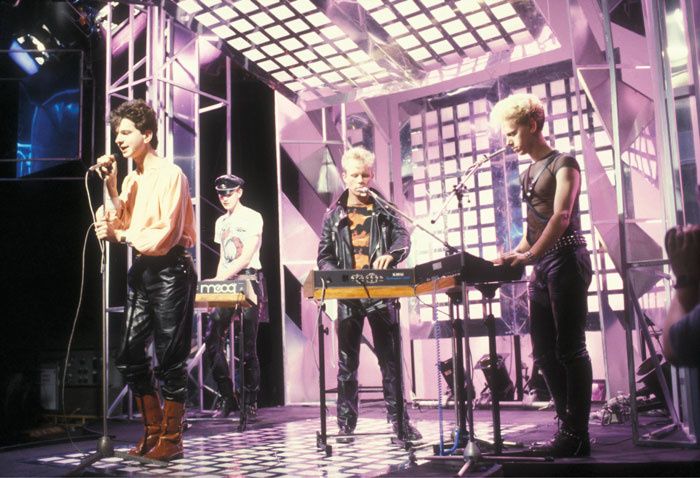 John Fryer made his name as an engineer on the first two albums by Essex synth-pop innovators Depeche Mode.Photo: BBC archive / Redferns
Can Fryer confirm or deny the long-standing rumours that Blackwing, situated in a church, was haunted? "Well, there were stories, yeah. I didn't actually see or hear anything, but people said they did. You'd make noises and within the noise you could hear other noises and odd voices."
Home to spooks or not, for a period of time in the early '80s, chiefly thanks to Depeche Mode, Blackwing became the home of the hits. The Basildon quartet recorded their first two albums there, 1981's Speak & Spell and 1982's A Broken Frame, with Fryer engineering using a Tascam eight-track and rudimentary sequencing. Favoured synths of the day included the Kawai 100F, Korg Minikorg 700s, Moog Prodigy, Roland Jupiter and SH1, Yamaha CS5, and perhaps most importantly, the ARP 2600.
"Back then the equipment was so limited, you had to work out ways of getting the most out of everything," Fryer recalls. "There were no
sync tones, so we were using the ARP and its analogue sequencer, and because it worked on CV and Gate, we devised a way of recording the click from that and feeding it back on itself, so you'd get a couple of chances of running sequences in time with the tape. You'd record a kick and snare on it and everything was played live over the top. The drums were the ARP and then it was Moog bass and so on. We used whatever was available. If it wasn't there, it was hired in."
Soon, Fryer had moved up from engineering and was becoming more involved in production. "As was quoted somewhere on the Internet, someone said that as an engineer I couldn't keep my mouth shut. But people liked working with me and then they'd come back and say would I co-produce or produce their records."
Among Fryer's first clients were the Cocteau Twins. The fledgling producer helped give birth to a sound that was utterly unique, built around Robin Guthrie's cavernous, echoing guitar work and Liz Fraser's otherworldly, if often indecipherable, vocals. He worked on their first two albums, Garlands in 1982 and Head Over Heels in 1983.
"The first one we did at Blackwing and the second we did at Palladium in Edinburgh. On the first album they were very shy — I don't know if they'd even been out of Scotland before. But, yeah, it was a unique sound and obviously Robin developed it the more they went on. A lot of it back then was done with Boss pedals — particularly the delay and the chorus. And we used the old AMS for chorus and delays and, of course, Lexicon reverbs. All the good stuff that's still in studios today, like the MXR Harmoniser and the Roland Space Echo.
"The second album we experimented with putting the guitar through anything and everything. At one stage we fed a guitar through a Yamaha electric grand piano and miked it up. That's the way I've always been with the bands I've worked with — you put anything through anything and see what sound you get."
Working with 4AD's Ivo Watts-Russell as part of the label boss's This Mortal Coil offshoot, Fryer helped create a classic with Guthrie and Fraser's atmospheric take on Tim Buckley's 'Song To The Siren', originally the 'B' side to 1983 single 'Sixteen Days (Gathering Dust)'.
"It still stands up today," the producer rightly points out. "But it wasn't something that we consciously put a lot of effort into. As you can hear it's very simple and it was done, like a lot of classic tracks, as a throwaway 'B' side, so there was no pressure. It wasn't overproduced or over-mixed. We always used Neumanns on Liz's voice and we didn't normally have to do much — add a bit of top, take some bottom out and the vocal usually sounded brilliant.
"It's funny when you record things — a lot of the time you think everything's special and when you stand back from it some time later, you realise that sometimes it wasn't as good as you thought it was or sometimes it's better than you thought it was. But that one just always sounded beautiful."
 Among the acts on Fryer's STLT label is his own band Esoterica.
Love-hate Relationships
Come 1989, John Fryer decided to leave Blackwing after a prolific nine-year run and went freelance. In the first year of going it alone, his clients included Lush ("It was down to me that they had distortion on their guitars") and Nine Inch Nails. Trent Reznor, confessing to being an unlikely fan of some of Fryer's more ambient works, asked him to produce the ground-breaking industrial rock of Pretty Hate Machine.
"A lot of bands like records that I've made and get in contact," Fryer explains, "and a lot of the industrial scene in America liked all the This Mortal Coil ethereal side and the electronic records I made for Mute. Pretty Hate Machine was sequenced using a Mac — the little one with the built-in screen — though I can't remember which software he was using at the time. The guitars were recorded using the Yamaha SPX50, just straight into there and out to the desk.
"We were trying to make the hardest record we could make. It was very strange because we made it, we thought it sounded brilliant, we had it on the big speakers just blowing us away. Then someone from the record company came in — and because the demos were more synthy and not as industrial as the album, he listened to it and his mouth dropped open and he said 'You've ruined this record.' But of course it's gone on to be a classic. It was done in 20 days. I think it was a good thing that we made records so quickly back then because there's a lot of energy in there and mistakes are left in, so it sounds human and it's not blanded out over time."
Travellin' Man
For most of the '90s and into the current decade, John Fryer spent much of his time in America, working in various locations with the likes of Stabbing Westward, Raging Speedhorn and Cradle Of Filth. He says that, particularly after years of working in the same studio, this itinerant lifestyle suited him fine. "Normally it was easier for me to fly to a place than it was to fly the band. But I always tried to end up back in Battery Studios in New York to mix 'cause they had my favourite Boxer speakers there. They're just big, true speakers. You could have them loud all day and they didn't tire you out.
"The thing I find with working in studios is that every studio you go to sounds completely different, and so Battery was like having a reference point. When I worked in Blackwing all the time, I knew the sound that I could get. We had an Amek 2500 desk which I really enjoyed, the EQ was very good, you could kind of alter everything. But when you go to different studios every week and they all sound completely different, you don't know what you're doing. You think you're doing one thing that sounds good on that speaker and then you take it away and it sounds like shit."
In Fryer's experience, US recording studios also vary wildly in terms of quality. "They have a funny attitude to A Rooms and B Rooms in the States," he says. "The A Room is like a million dollars a day and the B Room is like five bucks a day — and it sounds like five bucks a day. It's usually just a desk and speakers and you have to rent in other gear. In England, when you rent a studio, you get everything in the studio."
One of the reasons why Fryer says he enjoys working at home, especially when it comes to mixing, is because he's incredibly pernickety — an expensive business when working in top-flight facilities. "I like to mix at home rather than the studio because you're not pressurised for time. Also, when I used to work in Battery on the SSL, you'd do a mix and then you'd listen to it and want to change something, so you'd have to come back a week later and do a total recall. And remember, a total recall on SSL was only the desk — you couldn't recall all the outboard. It was close but never the same.
"Now it's easy because if I mix something at home and send it to the artist on CD and then they ask for changes, I'll just open the file, lift the vocal or whatever and send it back to them. I love the fact that I can come back to a mix a day later or a week later, open the folder and it's exactly how I left it."
Logical Progressions
Fryer is a devout Apple Mac and Logic man and says he can trace his loyalty to the latter back to his days using its Atari-based predecessor, Creator. "The thing about Logic is that as they've developed it, they've just enhanced the program, they haven't completely changed it. So it still functions as well as the first version and still has a lot of the same commands. Even though we've progressed 15 years or whatever, the MIDI side of it is still the same, just as good as it ever was. I was talking to someone the other day who only gave up using Creator four years ago, 'cause it was rock solid. I just find it easy to use, I find it totally logical. Even when they bring out a new version, it only takes probably an hour or so, then you're up and running again and everything makes sense."
 The outboard rack in John Fryer's home studio, with (from top) ART Pro MPA preamp and Pro VLA compressor, three guitar processors — Line 6 Pod XT Pro, Sansamp PSA1 and Washburn WSR42 — and MOTU 896 recording interface.
Anything he doesn't like about it? "Well, I think some of the old functions were a lot more user-friendly than the things they've got now. In the mixer page, you used to be able to drag across a few channels, select them all and move the faders up and down. Now you can't and you have to go in and select them all individually or go into your groups, which is time-consuming. It was something that I found totally useful when you'd pushed your mix too high."
Over recent years, Fryer has purposely got rid of a lot of his software effects. "This is the thing I was talking about with technology being distracting," he says. "When I had the earlier versions, I'd sit there all day and have a sound and try this plug-in and that plug-in. So now I just use all the Logic stuff because they all sound brilliant and you don't have to spend all day going through banks and banks of plug-ins to find something to manipulate the sound. Everything that's in there will get used, whether you multi-layer the plug-ins or record it and then manipulate it again. It depends on what kind of music I'm working on — if it's just straight acoustic stuff, I want to make it sound as pretty as possible and if it's power noise stuff, I distort the hell out of everything."
Fryer's setup is built around his dual-2.3GHz G5 and MOTU 896 Firewire interface. Monitor-wise, he uses the Mackie HR824s. "They just have a beautiful sound, it's very clear. You can hear the EQ, you can hear the frequency changes. With some speakers, you can sit there twiddling the knob and not hear a thing. They've got a lot of bottom end and they do seem true to the outside world. Before I had a pair of Fostex speakers, the ones with the orange cone [NF Series]. They were more like the NS10s, but they sounded a bit grey. You couldn't really hear all that well, they were a bit too middly and I don't think they were that true and that flat."
Like many producers, Fryer has an ambivalent attitude towards the once-ubiquitous NS10s. "They became the norm, the standard reference and you'll find a point somewhere in the late '80s to '90s where every record had the same sound. Then when everyone started using different speakers, records sounded different from each other. You obviously mix to the speaker. If it's not giving you a lot of mid, you overdo the mids. So now I think it's much better."
For a second pair of speakers, Fryer relies on a pair of Harman Kardon Soundsticks. "They're a good reference. They used to be USB powered but now they're on a jack and you can plug them into anything. They're a great reference point."
A Mackie fan through and through, Fryer finds he can mix everything using his 1202 VLZ Pro. "I just like the sound it makes. I used to have a little Soundcraft Folio and then when I was over in Germany, Tom from [Something To Listen To band] Sundealers owns a music shop. I'd mixed some stuff through the Mackie over there and it broke, so we got in the Soundcraft and it was very smooth-sounding and clean. The Mackie seemed to add a bit of edge, a bit of dirt. I think this is the one [the Prodigy's] The Fat Of The Land was mixed through... you get those kind of drum sounds with it. I separate the channels out and don't mix totally internally because the single stereo channels compress and change the sound too much. So I split the signal down to four stereo channels and then put it back into itself. If I had a bigger desk, I'd probably split it up a bit more."
While the producer admits that "there's not much left in my rack these days", he sings the praises of his ART Pro MPA preamp and Pro VLA compressor. "They're just very clear-sounding and inexpensive. My favourite compressor is the Dbx 160. You can make them subtle or you can have them quite extreme. I think the Logic compressors have a kind of similar sound to them. You can really over-compress stuff and it doesn't really damage the sound."
The rest is made up of guitar processors, including the Washburn WSR42 ("I used that back in the day with the Cocteau Twins — graphic EQ plus double distortion"), Sansamp PSA1 ("Great for a certain heavy guitar sound which I do believe Rammstein were using for a while") and Line 6 Pod XT ("A great selection of amp simulators").
But even with his stripped-down setup, Fryer admits that he can still get lost in a mix for days on end. Such, it seems, is the lot of the perfectionist record producer. "I'll be mixing something and I'll come back to it again and again," he grins. "In a studio, a mix might take a couple of days. The assistant will be saying 'OK, let's run the mix down,' and as we're halfway through, I'll be saying 'One more change, one more change.' We can go on all day doing that. Now of course at home I can almost go on forever. That's the problem with producing records. There always seems to be one more change you can make..."