


If you're ever going to make it in this game, you need a calling card, a way of impressing potential clients with your musical ability. You need a showreel. We explain what to do to create one...

If I failed to scare you off last month — and if you're reading this, that must be true — you've obviously accepted the idea that a career in music for picture is no picnic, but want to know more about how to get one going nevertheless. The first thing you'll need is a showreel, and it's these that we'll be considering this month, along with how best to use one to capture the attention of the production executives that commission music-for-picture work. In Part 3, we'll be looking at the kind of equipment you need to create your music. The month after that, we'll look more closely at the process of pitching for work, the people you need to target and what they all do, and finally, we'll demystify some of the jargon associated with this business — what exactly are 'underscore', 'beds' and 'stings'? After that, we'll start to consider how you go about conducting yourself once you've actually got a commission.
Reeling Around
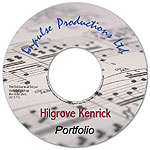
First things first — what is a showreel, and why is it important? Simply put it's a display of what you are musically capable of, a noisy CV/business card, if you like. Much like a CV, it will change over time, sometimes several times a week, and at other times you may not need to fiddle with it for a few months (see below for a few of my attempts to get it right over the years).
The ever-changing face of the author's showreel (from top-to-bottom): in 1998, as a fresh-faced hopeful with, clearly, no idea of what would make a good cover; in 2000, with at least some idea of what would fit on a CD label, but still no idea about font selection; in 2003, having discovered the Font menu and gone rather overboard with the knowledge; and the current, older, wiser, stripped-back model, which is designed for printing on a business-card-shaped CD blank.
The first question is how to deliver this information about yourself, and the answer is: on a CD. Not so long ago, the wisdom was that your showreel had to be on cassette, so that interested executives could listen to it in the car. The same principle still applies — but you try finding an executive who still has a cassette player in their car! So it has to be a CD, and it has to contain a little bit of everything you're capable of. 'Little' is the operative word here. You need to keep this disc really short — five or six minutes are enough. The people you're hoping will listen to this have neither the time nor the inclination to plough through lengthy symphonies. What's more, you'll need to include several different tracks on there, so that the disc showcases a variety of styles.
Whilst this requirement may at first appear restrictive, it's actually a godsend. No longer are you plagued by worries of how to start or finish a track; you simply pick your best ones, extract the very best bits from them, and crossfade them together (not fading to silence between tracks will help to keep the disc short, too). You should still leave track IDs in there, though — that way, if you're demonstrating something using your own reel, you can easily flick back and forth. And, if you do get lucky and the showreel elicits a return call, the interested parties can say they liked Track 8, for example.
Inspire Me!
One of the best sources of musical inspiration (or desperation) is the Internet. Let's face it, you're not the only composer out there, so go hunting and find some others. Like you, they're trying to attract producers, so you can use them and their web sites for research. Does their work sound better than yours, and if so, why? Is it their production values, or the musical quality of what they have composed?
Go for it — tear their work apart, and remind yourself why you're better than them. Then try doing the same with your own work — and be just as harsh. Perhaps someone has a extra style or two under their belt. Have you put some Tongan Neck Blues on your showreel? If not (and if you can find out what it is), get to it! If you think you can do better, then do it, and make sure it's on the reel.
If you're brutally honest with yourself, you'll find composers who utterly out-class you. When that happens, don't be despondent — work out why, and what you can do to catch up. You should never stop learning new musical tricks and skills, and you won't suddenly be able to out-do Poulenc or The Prodigy — these things take time. Learn from them, and then one day it might be you.
Don't forget that you can also obtain feedback by posting compositions to the multitudes of forums on the Internet. Of course, everyone has a different opinion, and you should brace yourself for an assault of contradictory comments, but the feedback can be useful nonetheless, if only to gauge general opinion on your direction. Choose your forums carefully depending on the input you want; some will only cover the technical side, while others will have little to say about the audio quality and more about the composition. A blend of both types might be to your advantage.
Pretty In Pink
Spare a thought for how the CD will be presented. Is it something you're only ever going to send, or might you hand it around in person? Either way, you don't want a generic-looking branded CD-R with hastily scribbled details across the top — your disc should stand out!
If you can get access to a CD printer and printable blanks, that's great. Failing that, there are hundreds of packages available for creating CD labels which can be stuck over the top of a generic CD-R. Either way, you can put your crucial contact details on the CD itself, so that even if your business card or covering letter are mislaid, execs will know how to get hold of you if they still have the CD. Your mobile number and email will do; you can squeeze in more if you want, but try to keep it clean. In the same vein, don't fuss over fancy graphics and pretty colours — no one is taking you on for your art skills!
On the other hand, anything you can do to make your disc stand out (a nice case, or a decent, simply designed inlay with perhaps a few credits) is a good idea. And as showreels are just a few minutes long, you're not restricted to full-sized CD blanks — you can now get half-size, multi-coloured, unusually shaped, and even (my personal favourite) business-card-sized blank CDs. However, there's a drawback to these — they're unusable in slot-loading CD players, like those in most cars! Will this make your disc the one that's left behind in the office, while your rivals' efforts get the full in-car treatment?
What's Going On?
So, you know what to make it look like, and how long to make the contents — but what do you put on it? Firstly, if it isn't up to scratch, forget it. Initial impressions count, and you need to be ruthlessly self-critical. Remember, most of the executives you're targeting will be getting piles of these discs across their desk every week. What they're listening out for is the sound of someone who can deliver, and that goes for technical and technological ability as well as the musical goods. Unlike a band demo, it's important that your showreel sounds at least like a competent recording. It's no good hoping that your prospective clients will be prepared to ignore the quality of a poorly recorded Portastudio hiss-fest and appreciate the musical genius beneath — it's far more likely that they simply won't bother to listen to it. Photo: Mr Bonzai
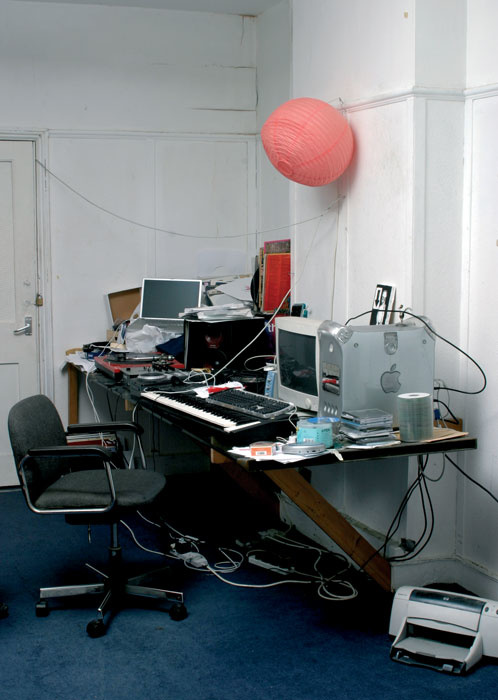 You don't have to have a recording studio with a grand piano, five Yamaha 02Rs, and clocks on the wall showing different time zones like film composer Harry Gregson-Williams (whose amazing setup is shown above) to make music — as chart topper Mylo's humble East London studio shows beautifully. Highly successful music comes from both types of rooms — it's a question of finding out what works for you.Photo: Richard Ecclestone
But how good does your kit have to be to produce something convincing? This is one of those debates that keeps the SOS forum going late into the night: does better kit make for better music? We'll look at this issue again next month, but as regards showreels, well, it can, but it's not essential. Yes, recording at 24/192 on some monster console with a shed-load of vintage outboard can make for a great-sounding recording. But conversely, it's perfectly possible to create a fabulous showreel with a few free software synths and plug-ins, plus a two-quid MIDI keyboard from a car-boot sale. A compositional genius with one black box will get better results than an SSL-owning creative dunce.
The crucial difference, as in any artistic field, is made by talent and skill. In this area of endeavour, talent is being able to compose. You either can or you can't. Skill, however, is being able to use whatever kit you have at your disposal, and use it well. Having said that, when you're starting out, if you can improve your chances by borrowing a better synth to use for your showreel, or make it on a friend's PC or digital multitracker in favour of your ailing cassette-based four-track, so much the better. Don't get carried away, but do your best to get the most out of what you have access to.
Unfortunately, when you're starting out, you have no idea what the people you're pitching to are looking for — musical ability, technological brilliance, both, or even neither (they might not care what it sounds like, so long as you're cheap to hire). Many of the people you'll end up working for will know very little about music — but not all of them! On the other hand, most of them will be able to tell when something sounds badly recorded. The only answer is to polish everything — practice until your fingers and ears bleed, and make sure you know your recording kit inside out. That way, you can create the best recordings of the best work you've done — and that's what goes on your showreel.
Structure, Mood & Variety
As hinted earlier, your showreel should contain a variety of styles. You should also be acquainted with the various types of score that will be used with moving pictures, such as stings, phrases, underscore, themes, and beds, and know which of these to include on your reel, and where. We'll say more about these later in this series, but if this is gibberish to you, just try watching TV or films for a few days. Whether it's a drama, documentary or a game show, listen out for the music. Look for repeated themes, altering styles, when emotions are evoked and where they've used underscore. The latter is musical wallpaper, designed for sections where music is needed, but where it literally has to sit under what's going on and not get in the way. No one is going to listen to a minute of underscore, let alone five, so by all means practice it in your own time, but for sake don't put it on your showreel — it has no place there.
What you're aiming for is a collection of emotive moments and styles (fast and slow pieces containing crescendos and diminuendos), and transitions (major to minor, fast to slow, and so on). I'm not going to tell you to have three orchestral, three electronic and three ethnic tracks, or whatever, as that's up to you and what you consider to be your style. But in the early days, you'll need to prove clients that you can do whatever they ask, so try to cover as much ground as possible. By all means have more wind-quintet pieces than happy hardcore if that's your home turf, but remember that if the recipient is looking for drum and bass and you give them brass band, the showreel will go in the bin, and that will be the end of you.
You could hedge your bets, and blend styles. This is not as daft as it might sound; in the current climate, musical crossover is becoming increasingly popular. We've moved away from the stark electronic scores of the '70s and '80s, and now the orchestra is back in a big way — but with electronic rhythms and pulsing synth atmospheres. It's never been so exciting, but to do it well, you need to be on intimate terms with two or more genres.
When you're happy with your selected styles, and everything's crossfaded and ready to burn to disc, my advice is that you compress the living daylights out of it. I know this isn't the done thing for an SOS writer to suggest, and rightly so! However, you need your showreel to jump out of the CD player and grab the listener by the throat, and nothing aids that in quite the same way as sheer volume.
How Much Theory Do You Need?
As Tom Stoppard would have it, "Imagination without skill gives us modern art." I'm not suggesting you create a performance art piece comprising a synthesizer engraved with the names of all the people you snogged behind the bike sheds — only that some musical grounding is better than none. The old guard will tell you that unless you stick to The Rules of composition, and studiously avoid consecutive fifths, for example, you'll never be a 'proper' composer. What utter rubbish. If you want to silence such doubters, you can try pointing out that Mozart or Beethoven were geniuses because they broke The Rules — or at least, The Rules as they were back then.
 Oscar-winning film composer Hans Zimmer.Photo: Mr Bonzai
Who says there are any rules, anyway? To impose rules is to stifle creativity or worse, emotion. One failed composer I know, very highly trained, can write you a perfect score in almost any style. The trouble is, all the 'T's are crossed, the 'I's are dotted, and all the emotion has been stripped clean out, leaving a soulless noise.
Pull apart an Oscar winner or two: Hans Zimmer uses consecutive fifths and octaves all over the shop, John Williams continually reprises Johann Strauss when he gets excited, and on the stage, Andrew Lloyd-Webber has a nasty habit of sounding disturbingly like Puccini reincarnated. The thing is, we can sneer at them all we want, but they've each been hugely successful in their chosen fields of work.
There are plenty of cyclical arguments about musical training, but clearly some is better than none. You're going to be called upon to write in so many disparate styles it'll make your head spin. Sure, once you're further up the ladder, you'll be hired for your own unique sound, but until that day, you need to be capable of coming up with whatever is musically required of you, be it Westlife or a waltz. A basic understanding of harmony, rhythm, meter and scales will get you a long way in deciphering an unfamiliar style. Practice and determination will handle the rest.
And what if you don't have that basic understanding? Well, the sole purpose of music in TV and film is to amplify emotion, so if it lacks soul, it'll detract from what's on screen. Thus even though you may not have your scales and modes the right way up, if you can move people, you are 90 percent of the way there. Don't forget, the director or producer is likely to be much less of a musical pedant than you, so they won't complain about your use of harmony, but they will if you are wrecking their scene. On one hand, it's easier to break rules if you don't know they exist, but on the other, knowing the ground rules gives you a place to push off from. As with most things in life, it's a question of balance.
Knowing Me, Knowing You
So, there's a stack of perfected showreels on your lap — now who should you send them to? It's here that anyone who knows anyone is going to be of use to you — call in every favour. Convincing executives to hire an unknown is no mean feat, and nothing beats a personal introduction. Some of my best leads have come from an ex-girlfriend's new beau; difficult, yes, but you get used to putting other concerns aside and single-mindedly pursuing your goal. You're looking to stay ahead of everyone else — remember, if you've thought of targeting a particular person, you can bet others have too. Anything you can do to press your showreel straight into the hand of the intended recipient is worthwhile — it matters not whether it's you somehow getting into their office, or asking someone else to do it on your behalf. Whichever way you do it, you're ahead if you can ensure you're at the top of the pile to listen to, and not lost in the heap.
Obviously, it doesn't stop there. You don't just send out a thousand CDs and then sit back waiting for the phone to ring. You need to chase, cajole and charm your way past countless receptionists to try to get hold of the executives you sent them to. For me, this is the hardest bit of all. It's the composer's equivalent of being a cold-calling insurance salesman: no-one wants to talk to you, and they will produce every excuse in the book to avoid doing so. Also, these executives are genuinely busy people, and will be fixated on whatever project they currently have on the go. As so often, it's a fine balance between annoying them enough to persuade them to speak to you, and irritating them so much that they lob your showreel into the deepest recesses of the incinerator...
If you can't get through, and they don't return your calls, the doubts I mentioned last month will start to nag. Did they get the CD, are they on holiday, are they after disco and not Dvorak this week, or are you just utterly useless and the best man got the job? All you can do to combat this is make that showreel the best you possibly can. Inevitably, your opinion of what's best will vary over time, so don't be afraid to revise the contents frequently, pulling sections out and putting new ones in. Keep it fresh, keep it exciting, and above all, keep going!
Next Month
As promised, in Part 3 we'll look at equipment — what you need, what you don't, and streamlining your setup for maximum effect and minimum working effort.
Learn From The Masters

For some affordable inspiration, simply raid your DVD collection, or start one! Along with endless 'featurettes' and celebrity back-slapping, an increasing number of DVDs have interviews and even commentaries with the score composers. These can range from two-minute superficial affairs to revealing exposés of how they put these scores together and why — and the latter type provide an excellent means of picking the brains of those at the top of the tree. Here are a few of them, and what the discs included that I found useful.
- GLADIATOR: HANS ZIMMER
How Hans Zimmer and the director approached scoring, chose instruments and found the right themes.
- BLACK HAWK DOWN: HANS ZIMMER
An excellent long documentary about this cross-genre score.

- LORD OF THE RINGS, PART I: HOWARD SHORE
The Extended Edition DVD boxed set of this film has a long documentary about the whole scoring process, from the first notes through to recording and mastering.
- THE MATRIX: DON DAVIS
A feature-length commentary on the score.
- A VIEW TO A KILL: JOHN BARRY
A long documentary about music in the 007 franchise.

- VAN HELSING: ALAN SILVESTRI
A short look at scoring for action/horror films.
- RED DWARF VI: HOWARD GOODALL
A great, honest interview about scoring for TV comedy.
- REVENGE OF THE SITH: JOHN WILLIAMS
A recent release of note is John Williams' score to Revenge Of The Sith — there's a special edition with a DVD which features video montages from all six films, set to excerpts from the scores. It's a great opportunity to listen to the score along with relevant scenes, and hear the London Symphony Orchestra in full flow under the baton of a (Jedi) master!