


Will Holland is one of the most prolific producers in the UK's alternative dance scene, and rather than sampling old records, he prefers to track down the musicians who made them.
In his solo incarnation as Quantic, Will Holland releases beat-heavy, funk-derived music to dance to, while the Quantic Soul Orchestra, which he leads and produces, appeals to the retro-funk masses with a tried and tested mix of Afrobeat, Latin and soul. He spends his evenings as a DJ, playing as many venues in places as far afield as Australia, Hungary and Slovenia as he does on his home turf: not bad going, considering he's still in his twenties.
And when he's not behind the decks or in front of a mixer, he's on a global search for music. "I just really like old records, they have a certain sound that you can't get any more; sounds that don't exist these days. A lot of it is looking for records to play out, but also finding all those mad production techniques that were used in old records that you just don't hear any more."
But it's not just the music that Will is looking for. "I spend a lot of time looking for the original players and engineers, and speaking to them to find out why their records are so interesting. You learn so much from them. I was recording this drummer in Panama, and was really encouraging him to get the same sound as he used to get, but he said 'We're just not going to get it, because I used to use animal skin on the drum.' And I'm like whoah, OK! We're really not going to get it! It really was a different era that those people were living in."
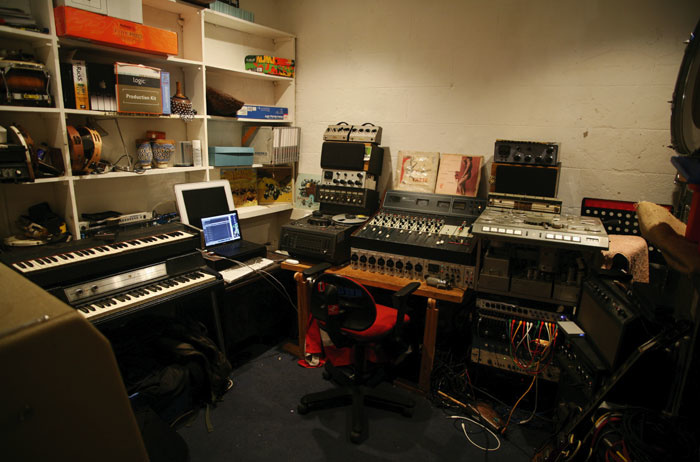 Will Holland's Brighton studio.Photo: Richard EcclestoneSo what's on the agenda when he's looking for records? "I'm collecting 78s, I'm collecting African, Latin American, Indian. I'm interested in a lot of different sources and I'm not necessarily collecting them for samples. I'm collecting them because I enjoy dancing to them, or I just think they're interesting records."
In Search Of Spanky
When asked to describe his own music, Holland remarks: "You're asking the wrong person really, but some stuff is hip-hop-orientated, some stuff is at house tempo, but not necessarily 'house' music, some of it has a strong Latin influence, some of it has a strong African influence, and some of it is just a mix-up of loads of styles."
His latest projects — I'm Thankful, a collaboration with veteran funk-soul singer Spanky Wilson and the Quantic Soul Orchestra (QSO), and Quantic's An Announcement To Answer — were both released in Autumn 2006. "The Spanky thing began in 2004, when I tracked her down and asked her if she'd do some stuff for [Quantic's] Mishaps Happening. I'd been a fan of hers for ages and she was fairly open-minded, so we started work on I'm Thankful shortly after."
The recording was done in various parts. Drums, bass and guitar were recorded in Will's studio, while horns and Spanky's vocals were tracked in various locations around California. Brass arrangements were handled by LA-based Todd Simons, who has worked with artists including Macy Gray, Talib Kweli and Eels. "I work with Todd for a lot of my stuff; he's got a similar setup to mine and we usually work over iChat. I'll send him files and he'll send them back when he's finished putting the horns on. It's so easy.
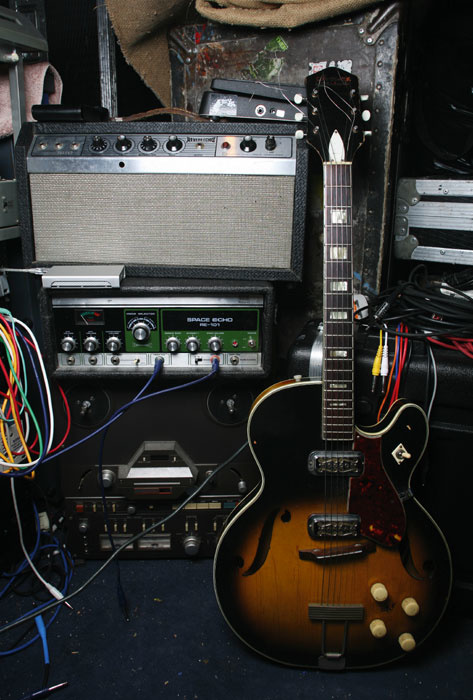 Will Holland's Roland RE101 Space Echo (in the centre of this picture) is often used to process the mix to achieve a lo-fi sound, as heard in the QSO material. The Gibson Reverb Echo (top) is oil-filled and, when used to process guitar, creates a different sound each time a note is played.Photo: Richard Ecclestone"With the Spanky project it was different, as there were more players, so we used Joey Altruda's studio in Hollywood, which is really well preserved and can accommodate multiple players. On that session, there were just four RCA ribbon mics, and to be honest, I didn't do anything to the tracks: no EQ, compression or anything. Whenever you're recording away, you're at the mercy of the studio that you're recording in and the experience they have. But I've been really fortunate, because a lot of those guys in those studios have been there for the last 40 years or whatever, so they really know what they're doing."
One-room Wonder
When Will is in the UK, he uses a small room in a shared studio facility in Brighton's North Laine. Inside, a selection of vintage broadcast equipment resides, centred round a particularly conspicuous mixer. "It's a late-1970s Cambridge-made Pye, which I bought recently from a radio station. It's discrete and the channel strips are pretty simple: you can get to them and clean them easily."
 The Studer C37 two-track, which Holland hopes to get working with his Pye desk.Photo: Richard Ecclestone
Underneath is an older eight-channel solid-state mic pre, which Will thinks was the main routing module for the radio station. "It runs at mic and line level, and it's pretty quiet. It's only designed to mix to stereo, but I soldered in some direct outputs so I can route things to different places. I've got a Space Echo [a Roland RE101] and two Pye four-channel mic mixers, which I've done loads of mixes through. I use the spring reverb from a Hammond organ a lot, too. It's cool, 'cause you can use the transit dampener to make those 'dubby' sounds."
Playback comes either from Will's black Apple Macbook running Logic Pro, an Otari MX5050 eight-track tape machine, or a Studer C37 tube-based two-track, but his studio equipment is constantly changing: "In the end, I want to get down to using just the Pye desk and the C37, but I need to get it all working in stereo."
Most of An Announcement To Answer was recorded either in Will's studio or in one of the corridors in the studio complex. "All the guitars are done in here, as were the violins, and some of the horns and percussion. It's all pretty much in one room, and that's how it's always done." Samples are added using software, but Will admits that all is not as it seems: "A lot of that stuff is sampled, but most of the main elements are recorded fresh, and I've dolled it up as a sample — it obviously works!"
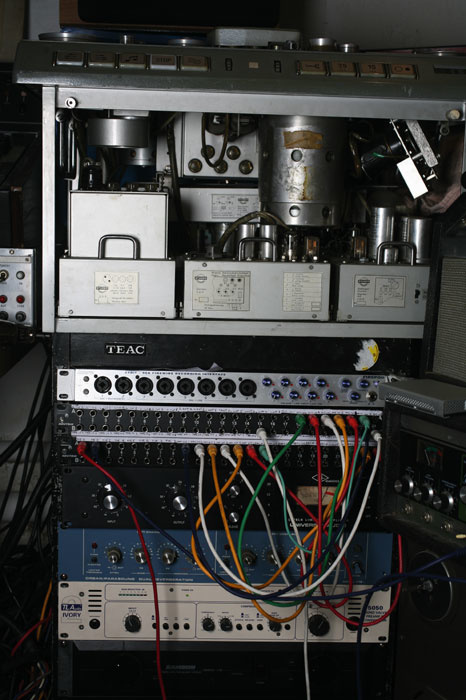 The equipment rack. From top: Studer C37 stereo tape recorder electronics, Presonus Firepod Firewire interface, Universal Audio 1176LN compressor, Orban/Parasound Dual Reverberation reverb, TL Audio 5050 compressor and Samson Servo 170 power amp.Photo: Richard Ecclestone
He plays a lot of the parts himself. An accomplished guitarist, he uses a Fender Twin and Gibson ES150 as his main setup, but has a Yamaha Hundred B212 combo and other guitars of various vintage at his disposal. Lying around the studio is a multitude of weird and wonderful percussive instruments, including an old Turkish Delight tin full of rice grains, a miniature cowbell and a selection of tambourines, which sit alongside some equally unusual microphones, including an Italian ribbon model, which Will believes to be from the '50s. "I've used it on drums and it's cool. The front of the mic says 'Si' and 'No'. It's like make it funky, Si? or make it funky, No!"
Although they're all made in the same room, there are stark differences in sound across Will's range of projects. He explains how, depending on the project, he uses the gear in different ways. "With the Quantic stuff, it's quite a hi-fi sound, so I'll be mixing in Logic, using the built-in effects. I use EXS24 and a lot of samples, but I also spend a lot of time programming drums using the audio editor. If I'm doing more lo-fi stuff, I'll mix through the Space Echo and the Pye mic mixers."
Learning From The Past
Will Holland has a lot to say about the differences between techniques that are used today and those that typified the genres that form the backbone of modern music. "In my opinion, at this stage, we're regressing, not progressing. I can see musical tastes and the way people produce records going down the toilet before my eyes. All the skills and traditions that were built up over 40 or 50 years of recording are just being lost, and if we don't learn them now, there won't be anyone around to teach us. We're at a really bad point. That's why I'm going around speaking to all these old guys and learning from them and trying to find out what they were doing: where they were placing the mics, what equipment they were using and how they were playing. I'm not alone in this, and I know Malcolm Catto [funk drummer and prolific 45 collector] is doing a similar thing. It's an art, a tradition, like woodwork. Even though it could be argued that it isn't as relevant any more, because anyone can make electronic music on a computer, it's something that's dying and something that needs to be preserved. Listening to old 78s from back in the '50s, you realise that they were doing shit that we can't even touch upon now. They were so advanced; the sound setup and the acoustics of all those big halls and all the playing. It's like nothing that exists now."
Referring to today's 'laptop culture', Will states "I think it's an interesting postmodern method of taking music and summing it in a montage fashion, and that's definitely what I do with Quantic, but I don't think it has longevity. I think longevity comes from people learning their skills and people learning how to be good musicians, arrangers or engineers. Although I think we can get by with home studios — there's certainly loads of ingenuity that comes from people who perhaps wouldn't have otherwise got the chance to record properly or lead a big band, for example — at the end of the day, we'll go back to good bands and good arrangers and good producers, because that's the way I see that music is made. I don't think there is much interesting music out there at the moment. I want to hear something that is pushing boundaries and being innovative. What interests me is dance music — and I don't mean dance music, I mean music that you can dance to and that a community of people is interested in.
"This concept is less mainstream these days, partly because we think of music as a product, and something you purchase, as well as a lifestyle that you choose. There will always be a large group of people who go for what's big and what's popular, and that's cool. But in the '60s and '70s, they thought of music in a different way. Back then it was more like an art, and there was an art to recording. I know that there was a lot of crap around during those times as well, but there was a lot more innovation with studio techniques and pushing different ways of doing stuff that I don't think exists any more.
"And it's not just the audiences; I don't think artists or record companies are prepared to spend budget on orchestras. They'd rather just use a sample CD. There's a reason that all of that soundtrack stuff like Dirty Harry or Get Carter sounds the way it does. It's because they thought 'Let's get a piano and pluck it,' or 'Let's get a guy with a sitar and put him in this area,' rather than something like 'Let's try a brass hit 'cause it worked last time,' and 'I normally put the mic here because that works.'
"I hate the fact that, if I switch on the radio during the day, I can probably write down how a record has been programmed, you know, I can see it on the page. I love it when you hear something and you don't know how it's been recorded, or whether it's a sample, or whatever."
Part-time Remixer
On top of his own productions, Holland is a prolific remixer. His discography includes remixes for artists including Nitin Sawhney, Xpress 2, Roy Hargrove and Bonobo. Explaining his approach, Holland remarks: "I'll get a CD or a DVD of the multitracks and line them up in Logic and just add new elements. If they want a QSO mix, there are certain things that I'll use to give it that sound. For example, I use the [Universal Audio] 1176LN a lot on the drums, 'cause that's generally what has been used for years. The UA one is good, but I need to get one of the originals. They just bring things out that you didn't know was even there in the audio. I used them in the studio in LA, and I just see them everywhere".
 Will relies on his Tannoy hi-fi speakers, which he's had since he was a teenager. One of the Pye four-channel mic mixers resides above this one and you can see his spring reverb, which was salvaged from a Hammond organ, sitting on top.Photo: Richard Ecclestone
His concept from a technical point of view is squarely focused on the '45' culture. "Creating songs for 45 is coming back into fashion; it died out in the last 30 years, but now it's back in vogue." Holland approaches mixing for 45 differently than mixing for CD. "For me, mixing for 45 means mixing in mono, and taking into consideration things like putting drum breaks in certain places for DJs. I think that definitely affects the way you mix stuff, and you do so with an ear, maybe, for somebody sampling it. In a way, you're creating samples for future generations."
The Beat Goes On
Drums are taken very seriously, too. "As far as production goes and the focus of a record, it's always about drums. I think the way people play and record drums these days is totally wrong. Because everything is individually close-miked, everything can be individually turned down, so people play in a different way. In the '60s, when there were all these drummers in hotel bands and show bands, they had to be good all-round players, so you could record their sound using one mic, because they played in balance. I don't think drummers nowadays get that balance, and you don't get the real sound of the drums as a result. Also, people don't play snare like they used to and it's definitely recorded in the wrong way. I'm not being retro about it, or saying that we should regress and start doing things in a '60s style. There's a way of having a modern sound, but being innovative at the same time, and keeping things interesting rather than having the same sound.
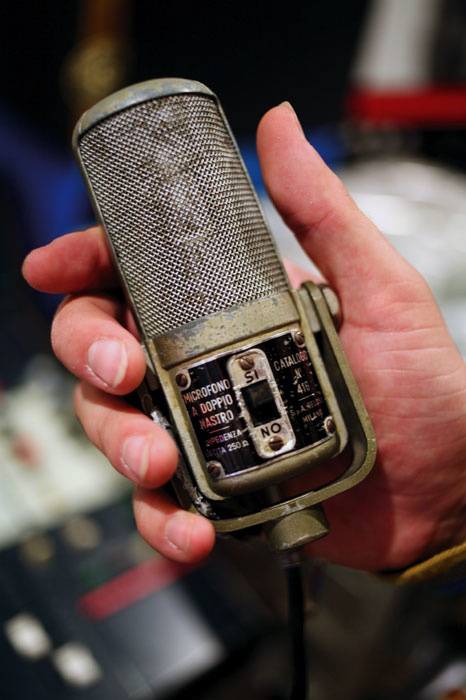 A vintage Italian ribbon microphone. "The front says 'Si' and 'No'. It's like make it funky, Si? or make it funky, No!"Photo: Richard Ecclestone
"Take this example: say you're going to sample 'Use Me' by Bill Withers. OK, it's a great drum break, and you can clear the sample with Warner Brothers or whoever, but you can probably find James Gadson in LA. He's still playing, he's still got the same drum kit, why not go and record him? That's what I realised with Spanky: these people are still alive and kicking it, and they're still accessible. We shouldn't see them as two different entities. All music is connected, and I think a lot of people think of 'old music' and 'new music', and it's not like that. That music is the same. Jurassic 5 didn't come from nowhere: there's a whole set of musicians and producers who made that sound, and are responsible for that kind of music. You can't separate the two, they're part of the same family tree. If we can get more people to learn about that, I think we'll start to get back to the music."
Tru Thoughts
Brighton-based Tru Thoughts Recordings provides a fertile breeding ground for Quantic and his stable mates. The label's community encompasses soulful songbird Alice Russell, who also fronts the QSO's live shows as lead singer when Spanky Wilson is out of town, Alex Cowan, who produces the aforementioned Miss Russell and makes solo records under the moniker TM Juke, and Ben Lamdin, whose recent exploits with the Nostalgia 77 Octet took him to a farmhouse on the Welsh border to record Borderlands, some of the finest new jazz around.
The Tru Thoughts sound is raw and fresh and, to the critical listener, may seem unpolished. However, their artists' quest for performance over technical precision make their releases captivating and something out of the ordinary. Voted 'record label of the year' by Radio 1's Gilles Peterson in 2005, Tru Thoughts reflects Will Holland's belief that great labels should have their own sound and ethos. "There are not many studio stables like Atlantic, Trojan, Studio 1 and Motown with a certain sound. There aren't these family concepts in the mainstream any more. Only in the underground, but where they do appear, they're one-person crews, like DJ Shadow or Mark Ronson. People like Daptone, who used to be Desco studios in New York, are doing good things now, and it's good that Fania has been relaunched in Europe."
Cooking It 'Til It's Burned
 Below: The centrepiece of Holland's studio, a Pye TVTSM8 Audio Mixing System, nestles atop a Pye eight-channel mic pre/mixer.Photo: Richard EcclestoneWill's love for all things analogue is clear, not only from pictures of his studio. "I don't know whether it's a British thing, but this desire to make everything as synthetic and clean as possible is just wrong. Music isn't like that: everything is distorted, that's the nature of air, and air is the best console you'll ever have. Don't fucking mess around with recording every single thing and putting it through all these channels on a 96-channel desk. The biggest problems I've had recording were when there was some uptight guy saying 'No, we can't do that.' The best engineers are the ones that just pressed Record. They worked on getting a good sound and they pressed Record, and that was it. They didn't fiddle or mess around with it, they just trusted that the musicians were good."
 The Otari MX5050 lets Will record eight tracks to analogue tape. Level meters rarely venture out of the red.Photo: Richard Ecclestone
Will played me the original eight-track tapes from a QSO session; the levels of all the tracks were all constantly in the red. "You must record pretty hot," I commented, to which Holland replied: "That's an understatement. Sort of cooking it 'til it's burned is probably a more accurate description!
"Agreed, I do think you should always strive to get as clean a source recording of a sound as possible, but pushing this concept of clinically clean recording is just bad; you shouldn't let engineering affect the music — you should reflect the music, and not tamper with it. A lot of the problem is that modern recording processes make players play in a different fashion, which corrupts the end result."
But the idea of high-specification recording techniques also appeals. "I think if you're recording or mastering digitally, something like 24-bit/192kHz is going to be more accurate than recording at 16-bit/44.1kHz, but I still believe tape is the best recording medium and I still believe vinyl is best for storage and playback. If a record label is trying to reissue something from the '60s, they usually can't find anything, they just don't have the masters any more. But you can still find a record in a warehouse in the middle of nowhere, and you can master from it. I doubt many CDs will last 45 years in the corner of some dank record shop.
 Modules for the Pye eight-channel mic pre easily slide out from the chassis. Will soldered direct outputs from each one, allowing each channel to be routed independently. Photo: Richard Ecclestone"It's the same with photographs. The way things are going now, there's not gonna be the culture of finding postcards and photographs in charity shops 30 years down the line, for example, because everything's digitally stored. In a way, the digital stuff is really cool. Storage-wise, it's a lot easier, but the physical copies aren't in existence, and they won't be available to future generations. Perhaps the Internet will eternally store everything, I don't know, but I doubt it. I have enough trouble keeping up with Myspace, let alone documenting every recording that was ever made!"
Looking Forward To The Past
Will Holland is a lucky man. He spends his life travelling the world, doing what he loves and meeting (and recording) his heroes. He has just come off tour with QSO and Spanky Wilson, where he played venues across the UK, and is currently in the studio working on both Quantic and QSO material for release in 2007. Watch out for Quantic's forthcoming 12-inch single, Sabor, due out at the end of January.