

One of the most successful writer/producers of his generation shares his advice on getting the best from artists and forging a career in an uncertain music industry.
 Glen Ballard at the piano in his High Window recording studio.Photo: Mr BonzaiGlen Ballard is one of the true success stories in modern music. Through a career that has spanned more than two decades and has accounted for an extraordinary 150 million albums sold, Ballard has exercised a special instinct for what makes a song memorable.
As a songwriter, producer and record executive, Ballard has been a driving creative force with Alanis Morrissette, Aerosmith, the Dave Matthews Band, No Doubt, Christina Aguilera and Van Halen, to name just a few. His contributions to the careers of established as well as breakthrough artists continues today. Ballard recently completed work on High Window, his new recording studio in Los Angeles, and has established Sly-Fi, a production partnership with Eurythmics mastermind Dave Stewart.
Listen Before You Leap
What is it about Ballard that has enabled him to achieve such success? "My greatest asset is perhaps as a listener," he says. "When I collaborate with an artist, it is very important for me to understand what their goals are. It sounds like a question that doesn't need to be asked, but it is a very important question. Some people want to be famous. If that is their number one goal, I am probably not the right person to be working with. I want them to be famous as a result of what we do. For me, the most important thing is the motivation of the artist and the commitment to making great music. So that is the first question. What do you want to do? When I get to the core of what somebody wants to accomplish, it makes it much easier to go out and do that.
"It's all about the artist. The artist is the medium for a lot of people, including the producer. I am the first person to hear what this artist has to say, and how they are going to say it. On some level I have to be receptive to all of it — the message, the nuance — and if I am not paying attention, I don't think anybody else really should either. It's like a sacred Hippocratic oath to first do no harm, but really be involved. I just don't know how to make records and not be involved all the way. For me, there has never been any lack of enthusiasm. I usually have to make myself hold back because I love music so much."
Get Your Priorities Right
Ballard likens the process of producing a record to construction, and emphasises the importance of retaining a wider sense of perspective rather than getting lost in details. "It's like building a house," he explains. "One nail at a time. It's the boards, the drywall, and the other elements of construction. You don't build it all at once. And the artist can sometimes be overwhelmed when something isn't working in a particular phrase or a passage. You can spend 90 percent of your time worrying over something that is only worth 10 percent of your time. Prioritising how to spend that time is probably the biggest thing I can bring to the entire process of recording.
"So don't get obsessed with changing one thing. A special effect you're looking for could take a day, and you waste a day chasing after something that isn't going to make that much difference. I have learned over the years to try and keep focused on what really is important."
So how does he keep things on track when problems arise? "Humour is always a good idea," he remarks. "I usually have a few jokes ready. But more than anything, it requires just stepping out of it — maybe just stopping. Sometimes all you need is a change of perspective. I try to be encouraging, but not dictatorial. There are two styles: intimidation or collaboration. I much prefer the collaboration approach, and I am always trying to direct it toward the goal of communicating as clearly and as powerfully as possible."
Learn The Basics
Asked what advice he would give to an aspiring producer just starting out, Ballard notes that the first step is to gain a working knowledge of modern software and equipment. "I think the first goal is to acquire the basic skills of interacting with the program you choose, whether it's Pro Tools, Logic, or any other. That knowledge is going to be of great benefit to you. I encourage everyone, as they are expanding their musical vocabulary, to expand their technical vocabulary, too. The two are merging now in a way that has never happened before. Music and technology are really intertwined, almost like a double helix — this DNA of music and technology cannot be separated. You ignore it at your peril as a musician.
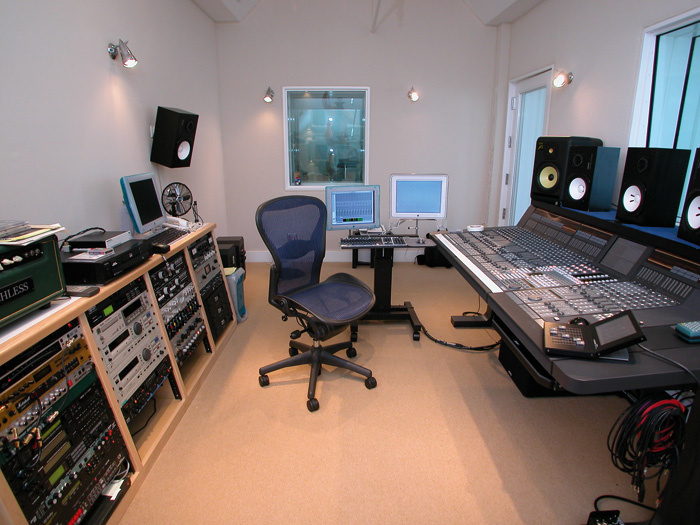 High Window studio is based around a Euphonix mixer."We are at a moment now in history when musicians are empowered to a greater degree than was ever possible before. I work in Logic every day, and it has been an epiphany for me, because the power to express yourself across the musical spectrum is in a box now. It's in a computer, and it's elegantly laid out so that you can do just about anything that your imagination can conjure up. It can be accomplished with you and a computer.
"I started off writing charts, but I don't do it as much anymore because it's much easier to put it into Sibelius, or have the Logic program do it. The hours and weeks and months that I used to spend writing arrangements, while it is very important, is also very time-consuming. And now all of that can be accomplished in a fraction of the time. In addition, you can basically get any sound you want and use it, when previously it might take days to create one sound."
Know Genius When You Hear It
However, the most important skill in the producer's armoury is the ability to recognise a brilliant song. "I think a producer's job involves many aspects. The most important thing that a producer can bring is judgment of material. A great song or a great piece of music is very hard to mess up. Your skills as a producer will only be elevated by the level of the material you are working with. If you are working with mediocre material, it takes a lot of work to make it palatable. Most of us have spent time on material that probably didn't deserve that much time.
"For me, it starts with that and knowing where to spend your time. It all goes back to developing a critical faculty in terms of understanding what really works. While it's intangible, it's something that you can develop an instinct about. I start with material. That is the first thing. If you are going to produce a record, what are the songs? If you don't have any songs, that is your first order of business. If you don't have anything that makes you excited, then you must find it.
"The most important thing you can do after you acquire a basic skill set is to really develop your taste in music. To me, that is the future for all of us in the somewhat fragmented marketplace. Your taste will be more important than anything. Being able to define that in a way that is distinctive is very important now. Work on the kind of music that you like to make and you will probably find an audience. If you are a creative musician, you are in better shape now than ever before."
Be Committed
The music business is in the midst of enormous upheaval at present. How does this affect the role of the producer? "In recent years, there has been a lot of doom and gloom in the business. It has a lot to do with everybody aiming for the Top Ten, because that was where you could make a living. That was where all the glory was, and all the money. But that has all changed. There has been a devaluation of the currency of music as we have known it, its remunerative value. It's a shocking development for a lot of producers, like me, but there is an up side of this decentralisation, and the fact that you don't get paid as much as you used to, for a variety of reasons.
"At this point in history, we have the accumulated recordings of everything that has happened up to now, and it is available on some level to us to use as components of what we are calling 'new music'. This is a great moment for musicians; it is also a scary moment. Now we have a diverse universe of music, but the audience is still looking for the music they love. They may not find it on the radio, but it's out there.
"We, as musicians should create the music, first of all, that we like. We have to be confident enough to make the music that should be made. We have the ability to do that now, at a fraction of the cost. I think that is what's happening everywhere, whether it's in jazz, classical, different forms of pop music, world music, or other forms. There is an audience for all of it. Because of the new changes in technology, people can get to it from all over the world. It's a great time to be a musician, a producer, an engineer.
"You have an opportunity to make the music that you really want to make, or which you really have an affinity for. You may not get paid as much for it, but I tell you, you will have more fun doing it. We must have realistic expectations of what music can bring us. It's got to be more than just the money. You can still make money in this business, but it's a defining moment for those who are into music because they love it, and for those who just want to make money. You will make money if you love it enough to put your heart and soul into it. But if you don't, and you just want the royalty cheque — and maybe it's not coming this year — maybe you shouldn't be in music.
"You start off in music not getting paid. You do it because you love it. And somewhere along the way you get paid, but it's now a time when we are reorganising how we can be compensated for the music we create. It may call for some lowered expectations in terms of what monetary riches and fame music can bring you, but instead call for more of a commitment to making great music. And, with that in mind, I believe you can make a living from it."
Prepare To Succeed
In closing, Ballard looks again at the importance of properly preparing for a career in music. "If you go into a profession with a strong skill set you have a much greater opportunity to be successful at it. While you are acquiring the skill set, you should really figure out what music you really love and what music you really have an affinity for. When you do that, you have found your place in music.
"You have a much greater chance of success if you are working with music that is natural to you. It shouldn't be a stretch, and it's not about trying to recreate something that is already there. It's really about developing what you already have. Whatever it is that turns you on, that is what is most important. Don't ignore that. That is your key."
No Boundaries
Glen Ballard learned his trade under the tutelage of one of the all-time great singer-songwriters. "I started off in the music industry working for Elton John as a go-fer," he recalls. "It was a wonderful opportunity to learn the business side of music before I was actually trying to make a living as a musician. It was three years of answering phones and making myself useful. Slowly, in that organisation, it became apparent that I was also a musician and I was given my first opportunity to work with some great artists.
"I owe a lot of my start to the Elton John band, specifically James Newton Howard, who was Elton's keyboard player. James encouraged me and actually suggested that I work with Kiki Dee, who was signed to Elton's label at the time, Rocket Records. I wrote and recorded my first song with her while I was still a go-fer and assistant. It's a pretty remarkable story, because I was answering the phone and my song came on the radio and it felt like maybe I wouldn't be answering the phone for the rest of my life. That was my start, and it was strictly being in the right place at the right time."
One thing that's noticeable about Ballard's career to date is the sheer diversity of the artists he's worked with. "I think the fact that I have a diverse palette as a producer has been a great advantage for me," he explains. "Maybe because I grew up with all kinds of influences, music just seemed like music to me. I grew up in Natchez, Mississippi, and New Orleans, Louisiana, and there was a lot of local music going on. I was hearing blues, jazz, R&B, rock and even classical music — which I was studying at the time. To me, it all seemed like music, without categories. I wasn't sufficiently prepared to make great differentiations among styles. I still look at it that way. Whether you are orchestrating a piece, or writing a pop song, or writing a country song, you are accomplishing some of the same things. You are trying to tell a story, musically and lyrically. The fundamentals still apply."
Learn With Ballard
Berkleemusic.com, the on-line arm of the Berklee College of Music, recently created the Glen Ballard Scholarship as part of the Celebrity Online Scholarship program, which is designed to reward and assist outstanding students studying in certificate programs at Berkleemusic. "Berklee has always had the reputation of not only being an excellent music school, but also one which is really in touch with contemporary music and all other kinds of music, too," he remarks. "There has been a fundamental difference in the way that Berklee approaches and differentiates itself from a lot of other great schools. It's the practical application of what you are learning, and the sense that it isn't just theoretical."
Studios In Boxes
Despite the boom in home studios and the availability of every instrument under the sun in software, Glen Ballard is a firm believer that professional recording studios still have a place in music. "For the last 40 years, all of us have been recording sounds," he explains. "We set up microphones and worried about the sounds, and spent an inordinate amount of time making music sound good. Fast forward to 2007 and it seems like all that work has been done and is essentially available, whether it's in sample form, or it's someone else's record that you put a beat over, or whatever — the artifacts of recording history have been made available to people in their box at home.
"But the continuation of creating new music and new sounds requires well-built and well-maintained recording studios, like the Record Plant here in LA and many others, where people actually have great knowledge about how to record real instruments. I can't tell you how many people I know, younger producers or engineers, who don't really know how to record. There is a great art and a great science involved with recording and understanding how to record something well.
"I've always thought that Los Angeles was the place most conducive to recording because so many people out here are not only interested in recording, but are inventing gear. In LA's San Fernando Valley about half of the garages have people in them making new gear. It's great that this place still exists, because the things that you can do here can't be done anywhere else."