

Younger Brother brings together two of the Twisted label's biggest names. We visited Simon Posford's studio in a bid to uncover the secrets of psytrance...
 Left: Younger Brother: Benji Vaughan (left) and Simon Posford.Photo: Richard EcclestoneThe names Simon Posford and Benji Vaughan may be unfamiliar to some Sound On Sound readers. After all, their background is the hazy world of psychedelic trance, a musical byproduct of the LSD and ecstasyfuelled parties and raves of the '90s. With its roots deeply entwined in Goa trance and, to a lesser extent, acid house, Psytrance remained an underground scene even at its zenith. Despite this, Posford's first album reached number 27 in the French album charts, and over the next decade his Twisted record label established a reputation as a source of highquality dance and electronic music. Foremost amongst its artists was Shpongle, the collaboration between Posford and legendary innovator Raja Ram that straddles so many boundaries there's surely a UN charter about it.
Benji Vaughan is best known for his footstomping trance identity Prometheus, although his long list of credits includes performing remix work for EMI and Jive, scoring an advert for Sony and producing electronic funk band The Egg. Benji and Simon work together as Younger Brother, a partnership characterised by high production values, lush melodies and intricate arrangements. As their second album, The Last Days Of Gravity, was released in October 2007, we thought it high time we floated on down to see them.
Youth Before Beauty
Simon Posford's musical career began as a teenager, when he had the choice of either going to Oxford to study botany, or going to work at Virgin recording studios. The decision to go to Virgin as tapeop was a nobrainer, especially as it offered an opportunity to learn the ropes alongside such luminaries as Spike Stent. For a while, Posford rotated round the various Virgin studios — the Town House, Olympic, Town House 2 and the Manor — but the life of making tea and dealing with fevered egos couldn't go on indefinitely. Things came to a head with the band James, who had recently finished touring but had not yet abandoned 'tour mentality'. It was, Posford recalls, an absolute nightmare.
Seeing his unhappiness, Stent took him aside and told him that the producer Martin 'Youth' Glover was looking for someone to work for him at his Butterfly Studios. The offer was sweetened further as it offered the opportunity to work on some of Posford's own musical ideas. "The urge to make my own music was just too strong and so, wondering who this mad hippy Youth was, I went to work for him in 1991 or maybe '92. Prior to that I'd learnt a lot from watching these top engineers like Spike, Dave Bascombe, people like that, but now I had hands on — I was the engineer.
 Simon Posford's studio is based around a Mackie 8bus analogue mixer."Apart from sessions with the KLF, I hadn't really seen much electronic music at Virgin, it was all bands. But now I was starting to go to acid parties and it was from there I got into electronic music. I remember getting my hands on a sampler for the first time — an Akai S950. The very first sample I took was this 30second chunk of Ozric Tentacles. I simply tuned it down two semitones, slotted it into a tune I was working on and it fit perfectly. If only all samples fitted in so well!"
In contrast, Benji Vaughan found he preferred the otherworldly tones of Aphex Twin and the Orb to the music he was hearing at acid parties. It was only after a trip to Goa that he threw himself fully into trance. Those early experiments were with basic equipment — an Alesis SR16 drum machine and an Akai S01 sampler — but they paved the way for his first release, the trance classic 'Clarity From Deep Fog' with Sean Williams. More collaborations followed, including Process (with Williams), Citizen Kaned with Nick Doof and Cyber Babas with Raja Ram. He met Simon Posford while delivering essential 'studio supplies' and has been associated with the Twisted Label (formed in 1996 by Posford and exDragonfly manager Simon Holton), ever since.
Hot Desking
An hour out of London, tucked away in quiet woodland, is Posford's unassuming home studio. Here, Speak & Spell machines are strewn casually amongst topclass outboard gear, and it's immediately apparent that comfort and a relaxed working environment rate higher than controlroom acoustics or laboratory conditions. From the first Hallucinogen album to the latest Younger Brother release, all of Posford's output has been recorded on a Mackie 32:8 analogue desk. "I've had one since they first came out," he says. "I must admit I don't really like it but I can't complain too much — people do say our production is very good. I'd love a big desk — not digital — something like the TL Audio valve desk. I really like the SSL thing, the halfcontroller, halfdesk SSL AWS900. Maybe there aren't enough physical aux sends, though, and they only do a 24channel version.
"I haven't mastered this mixinginthebox thing. I love mixing desks, I love the feel of them, the touch of them, feeling the faders. When something needs a bit more top, you reach over and the knob's there and it's done quicker than I can say it. On the computer you've got to find the right page, you've got to select the thing, you do it with the mouse or even a controller, and by the time you've actually done it, I could have done 10 other things on a mixing desk."
Ergonomics aside, though, Posford has no objection to the sound of software processors. "In the last two years, plugins have really started to come on. I mean the SSL stuff in Waves would take some beating in the analogue domain — you'd need a pretty serious desk. And a lot of stuff coming out on the UAD card, the Neve stuff, is absolutely fantastic. So in the end we use both plugins and hardware. Even though on this mix we EQ stuff with SSL plugins, it comes through the Mackie, where I might EQ it again. The desk is still a tool — and a valuable tool."
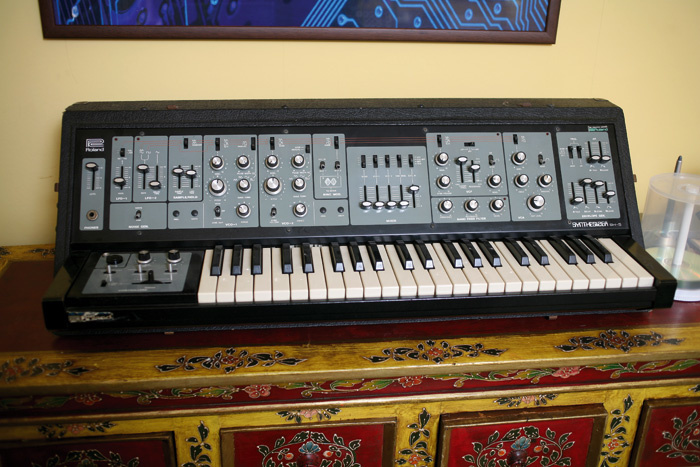 A nice collection of vintage analogue keyboards includes Roland SH5, OSCar and Korg MS20 synths.Benji Vaughan, by contrast, has been thinking of getting rid of his desk. "The thing that gets me most is when I'm working on a few things at the same time. I hate that feeling when I've committed to the desk. There's 32 outputs and all these outboard effects and you have to pull it all out to work on something else. For the last few months we've been editing this band, so I've been bringing it down here without committing to any outboard because I want to pass the files over to Si. I'm doing it all inside my laptop with the Waves stuff. The trouble is it never comes up right, to be honest. We both use Logic, we have the same plugins and still it doesn't come back correctly. Who knows why but it just doesn't copy plugin settings; all the SSL EQs come up but they aren't set to anything."
Logic Bomb
If mixing via DAW is subject to ongoing debate, there is at least agreement on the sequencer of choice. Both use Logic, although they contend that even this isn't perfect.
Simon Posford: "Logic is our main workhorse. The main feature we still want, and we hear people bang on about it all the time in Sound On Sound, is 'bounce in place'. So many times we've set up edits of audio on a track with loads of plugins and we want to bounce it to an audio file and use that in our arrangement. I counted the amount of clicks you have to do to achieve that in Logic and it's over 30 or something — utterly ridiculous! You bounce it, then import it into your audio window, then drag it out of the audio window back into the arrange, make a track for it, delete all your plugins, delete the old track that was there, take the parts off, you know... I'm falling asleep just talking about it.
"Every time a new version comes out it's got new graphics, which I really don't care about. I'd love it if, instead, they spent their time updating the timestretch algorithms. In each version there's all this stuff that seems to have been there for 10 years but now has a new interface.
"You'd think that by now they'd incorporate some way of quantising audio that wasn't a complete disaster. Ideally you'd click on an audio part in Logic and it'd bring up a matrix like a MIDI part and you could move it around. It's key to music to be able to take audio and put it in time efficiently without cracks and clicks everywhere. If Melodyne can do it, if Ableton can do it..."
Last Days Of Gravity
The second Younger Brother release is an assured and diverse collection of tracks with, it seems to me, a decidedly bandlike feel. I ask Simon if this was intentional.
"The first album was more centred around making a sound, then basing the song on that. When it was complete we found we wanted to do a proper album, without worrying about whether it was trance or whatever. We had a vibe and a direction and created sounds to fit in with that. We went back to our band roots — something we could do because the technology had changed so much. It's extraordinary to think that when we started Younger Brother, we were still using Akai samplers, which made putting on big chunks of guitar much more complicated. Now, years later, the whole process has changed and the dividing line between an electronic album and a band album has completely broken down. We now can be a band, just two people."
In his band days, it was always Posford who wanted to have a go on the others' instruments. "That's how I learnt everything. Back when we started, if you put in a slightly dodgy guitar part then it remained a dodgy guitar part. Yes, you could edit it, but it took hours. Whereas now you can get ideas and emotions down from an instrument and then fix it up a bit with audio quantise, without killing it.
 "The Voyager I quite like," says Posford. "I got it after using a Minimoog in a gig. It just sounded so fat and the Voyager is close. Each Minimoog sounds so different, though, and this wasn't quite like the Minimoog I was hoping for.""One of the rules for this album was, where possible, we wanted to do it all ourselves. We got in Gerry Hogan to play slide guitar and Ruu Campbell the singer, but otherwise we played the drums, the bass, the guitar, the keyboards."
From its wistful opening track, 'Happy Pills', with its lush pads, driving percussion and swirling synths, to the New Orderesque guitars and deeply processed vocals of 'Psychic Gibbon', The Last Days Of Gravity is varied beyond my ability to categorise. Its unusual time signatures and shifts of perspective suggest progressive rock at its most imaginative, and I reckon there's a spacedout indie band tucked away in there too. Most surprising is the lack of any obvious dance tracks, perhaps because the drumming — although tight and effective — never loses its natural, human feel. And, as ever, the synthesizers are splendid throughout.
"On the album we used [Native Instruments'] Reaktor, the Roland VSynth, the Korg MS20, Roland SH101, a Mellotron, Macbeth M3X and the OSCAR — there's OSCar all over it!" says Vaughan. "And the M3X — Ken MacBeth makes crazy stuff. The sound of it is just gorgeous, so warm and silky and creamy, plus it's got that heritage; you want to buy it because you know he's some crazy guy up in Scotland knocking it together.
"Whenever fans get in touch they always ask if we use a Virus, as they say their dream is to have one. I've had two of them and neither worked. The potential is very good; as a synthesis engine it is quite powerful, but the TC Powercore one didn't work and the Virus Indigo crashed, which is the last thing you need in a keyboard."
 Unique and circuitbent gear is popular with Younger Brother. By contrast, Posford's enthusiasm for the M3X nicely sums up Younger Brother's approach to music creation. "What we're after, and what musicians should strive for, is uniqueness," says Posford. "That's where hardware scores. You're getting a bit of uniqueness, a bit of character that software can't give you. Look for those weird old effects, guitar pedals, old synths, things that don't work properly. Or circuitbent stuff. We've sent quite a bit of gear to CircuitBenders.co.uk for modification. Take the Alesis drum machine: it is quite uncontrollable, unpredictable and has these unlabelled sockets that you patch together so it glitches up in different ways. Some of the options decrease the bit rate or mix the samples so it gets really crunchy. Sometimes it totally crashes the machine and you have to power off and start again. We used it on the tracks 'Psychic Gibbon' and 'Elephant Machine' for that really dirty, lofi sound."
Hardware Versus Software
Noticing both a real Korg MS20 and the Legacy software version, I couldn't help asking Simon for his firsthand comparison. "The little thingy I never use. I was really hoping for an easy replacement for the MS20; it didn't even have to sound as good, but I wanted something that was easier, as I use its filter a lot. But it was no fun, no joy; it all sounds the same. Put stuff through the real MS20 and you never know quite what you're going to get; the way the filter distorts is always changing and very different from the plugin. We used it a lot on the CD, often just for the filter and modulation side.
 Simon Posford: "The Eventide stuff is an example of something purely digital that I've never heard any plugin get close to. We may start with something really gritty, say made with Buffer Override, that comes out sounding all 8bit, then the Eventide poshes it up. Makes it a massive, stereo, beautiful sound again. The Distressors are brilliant, my latest addition and one I'm really pleased with. I met the guy from Empirical Labs at the AES convention and he was like John McEnroe on PCP.""As much as software is brilliant and clever and can do fantastic things, I just find hardware so much more inspiring. It's like when you sit at a piano, it makes you want to play and write songs. I never think of sitting down at a controller, loading up a soft synth patch and playing. You don't feel like reaching for the mouse to select a new sound when you can reach over and grab a knob instead. Hardware is more fun but you get the uniqueness too.
"In the early days of software instruments you could say hardware always sounded better. I don't know if that really applies any more, but hardware certainly sounds more unique and characterful. With software generally it's good that you can get so much — a compressor on every channel or whatever — but with synths it's best when they stop trying to emulate. Something like Reaktor is absolutely fantastic, but when you go through magazines and see what's coming out, it's page after page of emulations, even of gear that's already been emulated by somebody else. Another Minimoog, another Odyssey."
Warped and often outrageously timestretched vocals are a Simon Posford trademark, and I confess one of my ulterior motives for nabbing this interview was my desire to uncover these secrets. As is so often the case, it turns out that these effects are not attributable to any one, easily lifted process, but are the result of painstaking work with accumulated plugins.
"Sorry, but there's no secret formula. You might use something to get it in tune, then something else to fuck it up; then you might change the formant or something like that, then chop it up to get it in time. It's really all about editing and graft. We often employ lofi solutions such as putting it into the [Korg] MS20, which has a frequencytopitch converter, so you can add some analogue into the equation and mix it together."
Are You Shpongled?
Ultimately, one theme that Simon Posford keeps returning to is the fact that technical wizardry can't make up for a paucity of musical ideas. "I think that more people are now coming to music from computer or DJ backgrounds and less musical ones. It's a bit like photography, where in the old days if you wanted a photograph, you'd hire a specialist and he'd come round with this thing that looked like an accordion, put a towel over his head, set the equipment up and take an amazing photograph. Nowadays everyone has got a camera — but that doesn't mean I want to see everybody's pictures. There's still a market for goodquality photographs, and it's the same with music. The specialists will always stand out."
Younger Brother Live
The night before my visit, Simon and Benji had taken Younger Brother out to play in Soho, aided and abetted by some top session musicians. Simon explains: "The gig was fairly chaotic. The stage was tiny and we didn't have the bass player, so that came from computer along with some of the synths and backing tracks, all in separate channels to the mixing desk manned by Benji. I took a guitar and a controller keyboard and played the ImpOSCar rather than the real one. I also played a Roland SH101, which is such a great synth live. It's so nice to just look at the knobs and know what's going to come out."
The intention is that Younger Brother will do more gigs together as a live act and try to get another album together before everyone goes their separate ways; being indemand session players, Posford is aware they might have a narrow window of availability. "Take Andy Gangadeen, the drummer — he's absolutely fantastic. The hardest thing with mixing live and electronics is the drumming. If the drummer is even slightly out it just sounds like the whole thing is falling down the stairs. Andy is metronomic and enjoys it. He's not one of these drummers who hates the idea of a click track or wishes he was in a 'proper band'. We could also lose Matt White, the guitar player, as he plays with a few bands and does session work — as does Ruu Campbell. We've got them all together, we're playing together, so we should record!"
Asking whether improvisation is a factor in live work reveals Simon's more productionbased approach. "I quite like things to be tightly scripted. I was surprised to read how tightly scripted The Office was, for example. It feels loose and improvised, yet isn't. So we don't improvise so much, but increasingly with Ableton Live we're heading in that direction. We may start like the CD and towards the end we can go off. Once we leave the backing track behind the band can improvise, we can jam out the ends. At the moment the backing track is too complex and we keep it in Arrange mode rather than Session mode. There's a lot going on. Eventually we may use it in Session mode, so for a future album we might work with Ableton and the band that way. We don't want to get too freeform though, end up doing jazz!"
Twisted Plugins
"We'd love to put out Twisted plugins," says Simon Posford. "We come up with new ideas each time we make a track. So if any programmers want to get in touch, give us a shout! We'd love to put them out for #15 or something from the web site."
"If companies want to stop piracy they just have to make plugins cheaper," says Benji Vaughan. "Like Waves, which are heavily pirated, if they just made them cheaper and you could select what you want, people would support them. I believe that. It's the same here at Twisted — the fans want to buy the stuff if they can get it. I often find piracy can be good. If I use something and like it, I want to have it forever, get all the updates and not have it cocking up on me, so I buy it. All the software I buy I've first tested out as a pirate."
Posford adds: "For the first time we want a hardware version of a plugin: Buffer Override, a free download from DestroyFX, which is a glitchy machine that takes your audio and cuts bits out, screws around with the audio buffer, loops and repeats and is quite unpredictable. You get great sounds out of it and to have that in a guitar pedal would be fantastic — so if anyone can make that for us, please get in touch! That's what manufacturers should be striving for — to make different things. With all this computing power, stop emulating and do new things we've never heard before. We want to hear effects you could never have done before computers! Often the ones that come out and fulfil our brief are from small guys just pissing about, rather than from a large company."
Brotherly Love
Younger Brother was born after Survival International, a charity supporting indigenous tribes, requested a track for a forthcoming compilation album. They asked Si and Benji to work together, not even realising they were on the same label. Posford explains how the name came about. "They offered us this tribe called the Kogi from Columbia as our inspiration. With a completely different time perspective to ours, they even refer to events such as Columbus arriving as if it happened only recently! Their view of the world is that they are the 'older brother' and their ecosystem a microcosm of the entire planet. They refer to us as the younger brother — hence the name — and when they started noticing things going wrong, the water changing, wanted to tell us 'stop fucking up the world!'"
Twisted Brothers
Founded in 1996 by Simon Posford and Simon Holton, Twisted Records is an underground or indie label, making it all the more remarkable that the first Shpongle album, Are You Shpongled?, sold in excess of 30,000 copies — mostly by word of mouth at gigs and parties, and via online forums. Twisted features some of the world's top trance acts and is a hotbed of crosspollination. Artists include Shpongle, Hallucinogen, Celtic Cross, Younger Brother, Prometheus, Ott, GBU, Tristan, Koxbox and more.
Contemplating the future of the music business, I asked Simon whether he would be following Radiohead's example of selling music directly on a 'pay what you like' basis. "It's very nice to be able to record your album in top studios, pay off all these top engineers and producers, then give away your album for free. It's brilliant, actually, because it's cracked open the music industry in one week. At the same time, people are paying. Whether this would apply to mere mortals such as ourselves I don't know. SOS readers and we who are trying to make a career out of music would find it pretty risky. The important thing is still publicity and that comes from money spent. When you get a record deal, you get an advance and you then know you don't have to go out and get a job, be an accountant or whatever, for the next year. You can make a record after all."