

SE Electronics have enlisted the help of renowned acoustician Andy Munro to design these striking studio monitors. Does their unique approach to speaker design pay off in the real world?
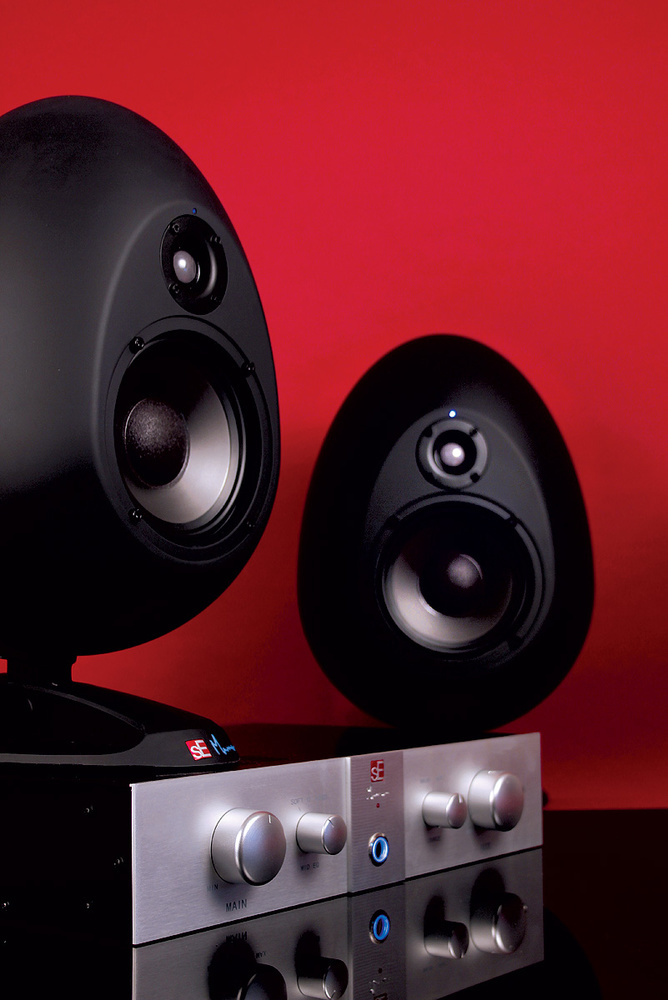
In an ever-changing world, the one thing we can probably always rely on is the fact that, at some point, the 'music' (in whatever electrical form it might be) has to be turned into acoustic sound waves for us to hear — and in most cases that means some form of monitoring loudspeaker. The Sound On Sound Monitors & Headphones Smart Guide catalogues 185 small and medium-sized monitors, and there are probably even more currently available on the global market, each with different strengths and weaknesses.
And that's an important point: none could be said to be 'perfect', and it's very hard even to point at a high-end professional monitor that could approach true perfection in every respect! The plain fact is that loudspeaker monitoring remains the weakest link in the audio chain by a considerable margin, producing far more distortion and unwanted response irregularities than anything else. Although it's true to say that small and incremental advances are still being made, fundamental loudspeaker science has barely changed in well over 50 years. The differences between the countless monitor speakers basically come down to slightly different design compromises and priorities, with the end users choosing one model over another largely on the basis of personal preference rather than technical achievement.
Amplifier technology is mature, and even low-cost systems can deliver extremely good quality. Loudspeaker drive units, too, have reached something of a quality plateau: yes, a bigger budget buys a fractionally more capable driver, but even budget units perform acceptably. However, the most influential aspect of a loudspeaker design is, arguably, the cabinet: the big wooden box that holds everything together. Although constrained by the size and budget restrictions imposed by the intended market, cabinet design plays a huge role in determining the overall sound quality and character of the loudspeaker.
There are several different cabinet operating principles available to a loudspeaker designer, such as sealed cabinets, vented or ported cabinets (with the option of passive radiators instead of open ports), and the so-called (but not really in the true engineering sense) 'transmission-line' cabinets. Each approach has different strengths and weaknesses, and each manufacturer tries to optimise those in creating a well-balanced final product, albeit with varying degrees of success! One thing that almost all cabinet designs share, though, is that they are almost all rectangular cuboid in shape...
Thinking Outside The Box
Rectangular boxes are relatively easy to construct, relatively efficient in terms of enclosed volume, and relatively easy to live with. If you place a rectangular box on a flat surface, it won't fall over or roll away, for example! In a hi-fi application, the 'domestic manager' can place a flower vase and a photo-frame on the top to make it look less industrial, and in a studio we often place all manner of technical studio debris on top! This might be very convenient, but is not necessarily the best way of building a loudspeaker cabinet.
The acoustic effects of different shapes of loudspeaker cabinets have been known about empirically since at least the early 1940s, but it was really the academic work of HF Olson that properly documented what was going on, in a paper he published in the Journal of the AES in 1969. This work revealed very clearly that cubic and rectangular cabinets had a very damaging effect on the overall frequency response, whereas cabinets with rounded or deeply angled front-baffle edges performed considerably better. A spherical cabinet delivered an almost perfect frequency response. (The 'Cabinet shape and frequency response' diagram shows the frequency responses of various different cabinet shapes.)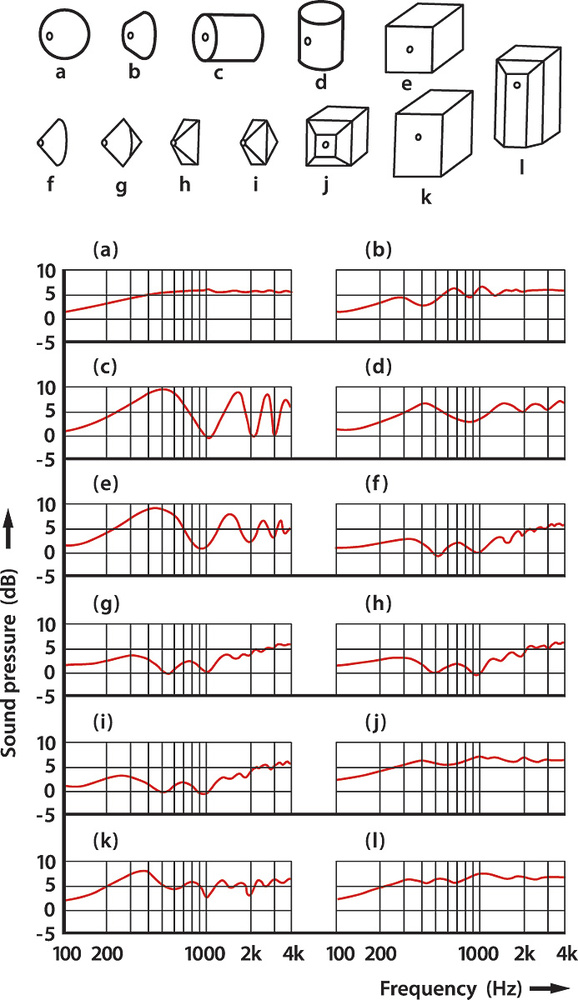 Cabinet shape and frequency response: These graphs demonstrate the effect a loudspeaker's cabinet shape has on its frequency response.
The physics of the situation is essentially that the sound wave generated by a loudspeaker driver radiates outwards in a hemispherical wave, travelling sideways across the baffle surface and out into the room. However, when the sound waves reach the baffle edge of a cuboid cabinet, they encounter a pressure discontinuity. There is nothing for the sound waves to press against any more, and that step change causes severe diffraction. In effect, the sharp cabinet edge forms a secondary source of sound-wave radiation, and sound waves from that 'virtual' source interfere with those from the loudspeaker driver itself, resulting in comb filtering, directional beaming and an uneven response. The precise frequencies affected and the strength of the interference effects depend on the relative distances between the driver and the various baffle edges.
Not surprisingly, Olson's work revealed that chamfering or rounding the front baffle edges helps to reduce these interference effects by softening the transition and severity of the pressure discontinuity at the cabinet edge — and that's why most modern loudspeaker cabinets have rounded edges to varying degrees. But the best performance was obtained with a spherical cabinet, since there are obviously absolutely no hard edges, and thus no step-change discontinuities.
However, a spherical cabinet presents other practical problems, not least being how to stop the speaker from rolling off the console meter-bridge! On a more serious note, a sphere has only one dimension and thus has a very strong resonant frequency. A better compromise, combining the soft baffle edges of a sphere but with a broad spread of internal resonant frequencies, is the ovoid or egg shape. And that's where SE's new monitors enter the picture.
Hatching The Egg
If the concept of spherical and egg-shaped loudspeaker cabinets has been around for 40 years or more, why has no-one done anything about it until now? Well, one reason is that people are used to rectangular cabinets, and another is that it is quite difficult to make an egg-shaped cabinet in a commercially viable way. It's not practical to use wood, and while a metal casting is possible, it is also quite expensive — although the current Genelec range has gone some way down this road. SE's approach has been to use a heavily engineered plastic cabinet, which, although expensive to develop, is relatively cost-effective to build in quantity.
And so we welcome the SE Munro Egg 150 monitoring system, which is the first in a planned series of related monitoring products. As the title suggests, the development of this innovative design has been guided by the highly regarded and enormously experienced acoustician, Andy Munro, along with SE's James Ishmaev-Young and Siwei Zou.
The fundamental engineering concept of the SE Egg monitor is to replace the familiar rectangular cuboid cabinet with a far more strongly curved, egg-like enclosure, with the aim of virtually eliminating both edge diffraction on the outside and strong resonant effects on the inside. It's a beautifully simple and attractive idea but, as is always the case, turning the concept into engineering reality is far from trivial and it has taken the team over two years to perfect.
Egg Boxes
The Egg 150 Monitoring System is exactly that: a fully integrated, active, two-way monitoring system, with everything packaged in one enormous box for shipping. Indeed, the product's marketing tag-line is 'AIMS', which stands for 'Active Integrated Monitoring System'. Inside the outer shipping carton are several more separate boxes, containing two egg-shaped loudspeakers (each weighing about 5kg), two base plates (1.5kg each), a power amplifier and control unit (another 8kg), and the associated three-metre speaker cables, terminated in Neutrik Speakon connectors.
The Egg speaker cabinets have an attractive and very tactile matte-black, rubberised surface — the same as is used on many of SE's high-end microphones — and the Egg dimensions are 465 x 289 x 258 mm (HxWxD) when mounted on the supplied base plate. The base-plate area is slightly smaller than the cabinet, measuring 245mm deep by 220mm wide, and the design is such that the Egg cabinets can be tilted downwards over a useful range, but not upwards. Apparently, SE decided that their speakers would always be mounted on console meter-bridges or tall speaker stands behind a work surface, and so only a downward tilt option would be required. I suspect that there is also a balance issue here, and that to enable a tilt-up action, the base plate would have had to project behind the speaker itself.
The very unusual and visually most distinctive Egg cabinets have an internal volume of 14 litres and are ported, with the vent tuned to 51Hz and firing downwards at the front below the bass driver. The cabinet is actually formed from a very strong and acoustically inert type of plastic, moulded in three main sections and screwed together to form a unique 'monocoque shell' construction (see 'Inside the Egg' picture) Inside the Egg: The Egg's 'Monocoque' construction. The internal bracing ribs help to control cabinet resonances, while adding to the speaker's strength without significantly increasing its weight.. The final mould design was arrived at after a lot of complex mathematical modelling and exhaustive testing to achieve the ideal chassis thickness and balance. Perhaps the most critical aspect of the design — and something that apparently took a long time to fully optimise — is the use of internal bracing ribs as part of the moulding. These establish the overall shape, control any shell resonances, and give it remarkable strength for relatively little weight.
A very useful facility included in the Egg 150 speakers (something I first came across on an M&K monitor speaker several years ago, but which few other manufacturers have copied) is a deeply recessed 'aiming' LED on the front baffle. Since the LED is sunk deeply into the baffle it can only be seen when directly on axis — both vertically and horizontally — and it therefore provides a very precise means of aligning the speakers to the intended sweet spot. However, who wants to have their retinas burned out by searing blue LEDs while mixing? Thankfully, SE have recognised this and provided an off switch on the main amplifier unit, so that once the system has been installed the lights can be extinguished.
Of course, loudspeaker drive units are generally built to be mounted on flat baffles, and as a result SE have had to flatten one side of the Egg cabinet to accommodate two traditional drive units. This inevitably compromises the edge-diffraction performance slightly, because it distorts the egg shape, but the junction between the main Egg cabinet and the flattened baffle surface is as smoothly rounded as possible, and the effect seems negligible.
Both drive units are made by Monacor, and are previously discontinued models now revised to SE's own specifications. The bass driver is a 165mm polypropylene unit, rated conservatively at 50W (RMS), while the tweeter is a 25mm soft-dome unit with a neodymium magnet, rated at 40W (RMS). In effect, each physical loudspeaker cabinet is a passive box, with the two drive units wired individually back to the central system amplifier unit via an integral Speakon connector. However, it should be pointed out that the Speakon wiring is non-standard, so don't try running the Eggs from any other generic Speakon-equipped power amplifier!
Control Unit
 The 2U-high amplifier has two pairs of inputs, each with its own volume control, plus a headphone socket and a three-way switch for selecting between Soft, Hard and normal mid-range tonalities.Although the Egg 150 monitoring system is fully active, the amplifiers aren't physically integrated into the speaker cabinets, as is the case with most small and medium-sized active speakers. Such an approach wouldn't have been practical because of the curvaceous cabinet shape, and the impact it would have had on the internal volume. One option might have been to build the amplifier chassis into the speaker base in some way, but instead, SE have chosen to house all the electronics in a separate, rackmountable unit (removable rack ears are included). This 2U amplifier unit measures 88 x 420 x 300mm (HxWxD), and each of the four drive units is powered from its own 50W amplifier, with signals derived from an analogue crossover stage that splits the audio spectrum at 2.1kHz. Some potential purchasers might be put off by the idea of returning to the old ways of chunky speaker cables and central power amps, but I suspect that this configuration won't make any practical difference to most.
The amplifiers are 'chip amps' running on ±35V rails, but appear to be of high quality with high slew rates and ultra-low distortion. The internal construction places the amp chips right next to both the linear power supply's outputs and the rear-panel Speakon connectors. In effect, the amps modulate the power passing from the PSU to the speakers with the shortest possible connections to ensure the most precise control. It's a classic design approach and clearly works well here. As part of the factory quality-control testing process, all four amplifier channel gains are matched to their respective speaker drive units, to tolerances of ±0.25dB — which is extremely tight. This is why the entire system is shipped as a single package, and why the apparently identical Egg speakers are clearly labelled specifically for left or right connection to the amplifier unit.
The amplifier unit is rather more than just a set of power amps and a crossover in a shiny box. SE have built in some basic monitor‑control facilities as well, although I'm slightly disappointed that they didn't take this further — but perhaps the company have chosen to restrict the facilities provided here so that the promised larger Egg system can include more comprehensive facilities for the inevitably larger price tag.
Nevertheless, the amplifier unit features two small knobs and two large knobs, together with a lovely, blue-lit power on/off button. The small right-hand control switches between the main and auxiliary inputs (main being connected via XLRs and auxiliary via RCA phono sockets, all on the rear panel). These two input sources have independent stereo level controls, which are the two large knobs towards the outer edges of the front panel. This arrangement makes it very easy to level-match the two sources: a great help when comparing the mix from a DAW with a reference track from a CD player, for example.
 Connectivity is provided by XLR, RCA and Speakon sockets for the main input, auxiliary input and speaker outputs, respectively. Trim controls for the HF and LF drivers on each speaker are accessible, and the blue 'aiming' LEDs on the Eggs can be switched off once the speakers are correctly positioned.The fourth knob is a mid-band equaliser, with three options. Originally it was intended to emulate the Yamaha NS10's peaky response, but during the final pre-production auditions it was decided that the EQ was too harsh and not really as useful as hoped. So, after some further tweaking, the mid-range EQ options are more subtle than originally intended, but actually all the more useful for that. The control's centre position leaves the system's frequency response as flat as Andy Munro designed it to be. Rotating the knob left or right selects either 'Soft' or 'Hard' modes, in which the mid-range response is reduced or raised by about 1.5dB, respectively. The idea of these options is essentially to provide either a more 'easy listening', hi-fi-style mode with the classic 'smile' response curve, or to provide a 'shouty', mid-forward and strongly detailed character that exposes the critical mid-range region of a mix. A pair of red LEDs on the front panel warns when the amplifiers are close to clipping.
It seems a missed opportunity not to have included 'mono' and 'dim' buttons, and the lack of any scale around the volume controls makes accurate setting and resetting of the listening volume more difficult than it should be. But these are minor niggles in the grand scheme of things.
On the rear panel, alongside the IEC mains inlet, the two sets of input connectors, the Speakon output sockets, and the aiming-LED off switch, are four level-trim potentiometers for the two HF and two LF outputs. These are provided to enable the system's response to be tuned to the room, if necessary, with the ability to reduce the bass in compensation for boundary proximity, and to boost or cut the treble as necessary to match the room's acoustics.
As I mentioned previously, the Egg 150 system employs standard four-pole Speakon connectors for the speaker cable, but only three of the four internal wires carry the audio signals. The HF and LF amplifier outputs share a common return wire, leaving the fourth wire to carry the power for the switchable aiming LEDs
Listening Eggsperiences
Having unpacked the enormous Egg 150 system carton, and all the smaller inner cartons, I placed the two Egg speakers in their allotted positions on a pair of Zaor height-adjustable speaker stands, well clear of side and rear walls, with the amplifier unit on the work surface in front of them. I hooked an HHB UDP89 multi-format disc player directly to the amplifier chassis 'main' inputs as a reference source, and started to work through my usual collection of reference CDs.
The first thing I noticed on firing up the speakers was just how big they sounded. For such modestly sized units, the bass response is extraordinary, in terms of both the low-frequency extension and the speed and dynamics of bass instruments. There seems to be virtually no port resonance and no 'hangover': bass notes start and stop extremely cleanly and quickly. If only all ported cabinets could achieve as much! Andy Munro suggests that the egg-shaped cabinet has a complete absence of strong internal resonances, and that plays a big part in helping the port output to integrate almost perfectly with that of the LF driver. The result is minimal time smearing and an excellent transient response — and both are very audible.
The next thing I noticed (accidentally) was just how loud these monitors can go. Clearly, the drive units are quite efficient and the power amps are conservatively rated, but even the heaviest rocker won't find anything to complain about in terms of volume here! The Egg 150 monitors are intended as midfields, but their compact size makes them usable as nearfields as well, while their power handling would probably enable them to serve as main monitors in moderately sized rooms! And even when the red warning LEDs start to flash, there's no obvious distortion or compression to degrade the performance.
I found the stereo imaging to be very precise and completely stable, with a strong centre image and a superb impression of depth, as well as spaciousness, on well‑recorded material. The subtle room tones and reverberation of old jazz recordings was very audible — something that lesser speakers fail to extract — and the overall tonal balance was spot-on, to my ears. The Eggs exhibited excellent and seamless integration, from the surprisingly deep lows, right through the mid-range, and on to the high end, and I didn't feel any need to tweak the balance at all.
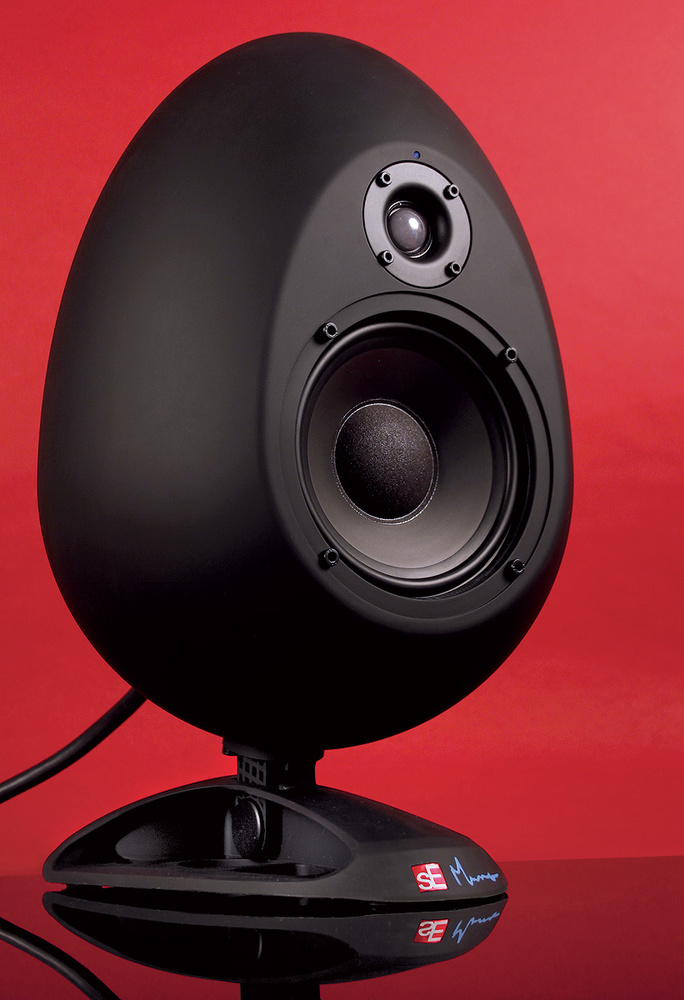 The stand built in to the Egg speakers allows them to be angled downwards by a maximum of 15 degrees.These initial impressions were obtained with the front panel mid-range EQ control in the 'off' position, but turning it to the 'Hard' position brought mid-range instruments and voices forward quite dramatically, adding a certain impact and urgency to the sound, and making subtle level differences a little more obvious and demanding of attention. Conversely, the 'Soft' mode instilled a far more laid-back effect, which was much easier on the ear, to the point of blandness. Of course, such a facility could be a dangerous thing in a studio monitoring situation if used unthinkingly, but it's handy if you just want to kick back and enjoy your music on a spiritual level, instead of analysing it on an intellectual one!
The raison d'être of every true monitor speaker, of course, is to reveal and expose information about the individual sources and the way they interact when mixed together. Monitor speakers aren't supposed to sound 'nice' — they are supposed to reveal technical and aesthetic flaws (when they're there), and I have to say that the Egg monitors do a pretty good job of that.
The bass is fast and tight, revealing the true character of any kick-drum EQ, as well as the timing relationship between the bass and kick. When the kick drum is thumped, you hear just the thump, and not the extended 'boom' that so many lesser speakers produce in the hope of appearing more powerful and impressive than they really are! Such tricks don't help when trying to fine-tune a mix. The critical mid-range region is crystal clear, and can be made even more revealing and insistent by using the 'Hard' mode, if required, and although my delicately rounded BBC ears preferred the 'off' option most of the time, even I would admit that it is a useful facility to have! The high end is open and spacious, without any edge or grittiness, and with extended listening I found little evidence of fatigue, which indicates very low distortion levels — something that is also supported by the fact that I found myself listening at far higher levels than I thought on several occasions.
The Eggs Factor
Overall, the Egg monitors delivered far more than I was expecting. The bandwidth, especially at the bass end, was far greater than a monitor of this size would normally deliver, but without any hint of over-inflated port resonances to bolster the performance. Indeed, bass clarity, precision and speed are some of the strengths of this unique design. The system is also capable of much more volume than any sane user will need, and the clarity and ability to hear into a mix is excellent. There is absolutely no doubt that these are very good monitor speakers indeed, and certainly worthy of the title. The design takes an age-old idea and implements it extremely well, to reach the promised gold at the end of the rainbow.
To some, the list price of these monitors might seem high, but the Egg 150 monitoring system stands direct comparison with its peers extremely well, and might even embarrass some! But if the asking price is a little more than your current budget can stand, I'd advise being patient, as the smaller Egg 100 monitors, which appear to share the same attributes, are in the advanced stages of production and should be revealed early next year. In the meantime, I'd urge those seriously contemplating a monitoring upgrade to take SE up on their free auditioning option.
Alternatives
I've not come across any other egg-shaped speakers, although the current Genelec range does go quite some way in a similar direction. I can't think of any other active monitors in this market sector that include a basic monitor controller either.
Try Before You Buy
SE Electronics have become well known for their policy on allowing potential customers to borrow their mid-priced and high-end microphones on a try-before-you-buy scheme, as well as on their no-quibbles warranty policy. The same facilities are being extended to the Egg 150 monitors, providing enormous peace of mind both to potential purchasers who might not be able to find a retailer with a set for auditioning, and for existing users who might not have additional monitors available should the Eggs fail at any point in the future.
Essentially, SE are providing a five-year manufacturing defect warranty, together with a three-year 'no-downtime' repair warranty, and a free auditioning loan service. There's some small-print, of course, and the full terms and conditions are on the company's web site, but it is a genuine and credible warranty. The way the loan system works is that if you are interested in the Egg 150s, you can contact your local SE distributor and they will ship a system to you to try, in the familiar comfort of your own working environment. If you like the system, you can buy it, and if you don't, you can ship it back — all at SE's expense. No risk, no pressure and no hassle... But I'd be surprised if you wanted to send them back!
The 'no-downtime' warranty works in a similar way. Should the Egg 150 system fail because of a manufacturing defect, SE will ship a complete new system to stand in for your own system, while the latter is returned to SE for repair. Once fixed, it is returned and the loan system reclaimed. Again, minimal downtime and minimal hassle. Of course, the reason the entire system has to be shipped back — both speakers and the amplifier unit — is because the amplifier channels are finely matched to the drivers, and any repair or replacement will require complete realignment of the whole system to maintain the original factory specifications and tolerances.
Clearly, the free customer-audition service and the free repair-loan service are expensive things to provide — both in terms of the service inventory and the courier costs. Few, if any, other manufacturers offer anything similar for this market sector, and this is a strong statement on SE's part of the belief they have in the quality of their products.
Frequency Response Graphs
 Polar plots for a single Egg 150, measured on axis at 0.5m. The on-axis response is shown in red, while the black line represents its response at 30 degrees off axis, and the green line shows the response at 45 degrees off axis.
 A single Egg speaker measured at 1.2m. The red line shows the response with all trim pots at maximum settings, and the Mid control set to 'Hard'. The blue line is the same, but with the HF trim turned down 90 degrees. The green line shows the same as the red, but with the system turned up 5dB, while the black line represents the same as the green, but with the Mid control set to 'Soft'. The purple line shows the system's response with the Mid control set to 'normal', and the LF trim set to minimum.
  This graph shows the speakers' left/right level and frequency response matching. The light-blue line is the response of both speakers, measured at 0.75m with the HF control turned down slightly, and the Mid control set to 'normal'. The dark-blue line is the same, but with the Mid control set to 'Hard'. The green and purple lines show the left and right speaker responses, respectively, at the same settings as for the light-blue line.
The SE Munro Egg 150 monitors were measured in a well-treated control room, using an Earthworks M30BX omnidirectional measurement mic, plugged into a Duran Axys D-Audio preamp. The graphs were generated using Morset Sound Development's WinMLS Pro software.
Pros
- Distinctive styling with very practical and audible benefits.
- Very accurate, neutral, revealing and precise sound character.
- Remarkably extended LF.
- Deep, wide and stable stereo imaging.
- Astonishing volume available.
- Bright 'aiming' LED on baffle to align the monitors — with an 'off' switch!
- Limited room-tuning EQ controls.
- Front-panel mid-range EQ modes.
- Built-in source selection and volume controls.
- Market-leading warranty and auditioning services.
Cons
- Having to run speaker cables back to a central amplifier chassis may seem like a backward step.
- The base doesn't allow the Eggs to be tilted upwards.
Summary
An innovative and very distinctive monitor speaker, applying scientific principles to audible effect. The Egg 150 delivers a remarkably high standard of sound quality in a compact space with no significant vices.
information
SE Electronics +44 (0)8455 002500.