


The toy‑like exterior of Teenage Engineering's OP1 belies the versatile synth, sequencer, sampler and recorder hidden within. We retreat to our bedroom and put it though its paces...
Sometimes a product hits the market well in advance of the technology required to do it justice. Who can forget the first brick‑sized mobile phones, or Clive Sinclair's 'pedalo' electric car? However, even the lowliest products deserve a revisit from time to time — for example, Casio's VL‑Tone. This tiny synth, sequencer and calculator was best known for its role in Trio's hit 'Da Da Da' and even though it was rather cheesy, the VL‑Tone had two points in its favour: it was small and it was cheap.
Fast forward 30 years and there's a strange feeling of déjà vu surrounding the latest toy‑like, but definitely not Fisher Price, synth. Despite originating from Sweden rather than Japan, it's difficult not to imagine Teenage Engineering's OP1, with its mini keyboard and internal speaker, as today's VL‑Tone. However, I'm sure its creators hope for a more substantial legacy, given that they've had three decades of technological advances to draw on. The OP1 has eight different synthesizer engines, a choice of three sequencers, drums, effects and a four‑track, tape-style recorder function. With a motion sensor, sampler, basic mastering capabilities and even an FM radio, you probably won't miss the calculator — unless you're a busking accountant!
Teenage Kicks
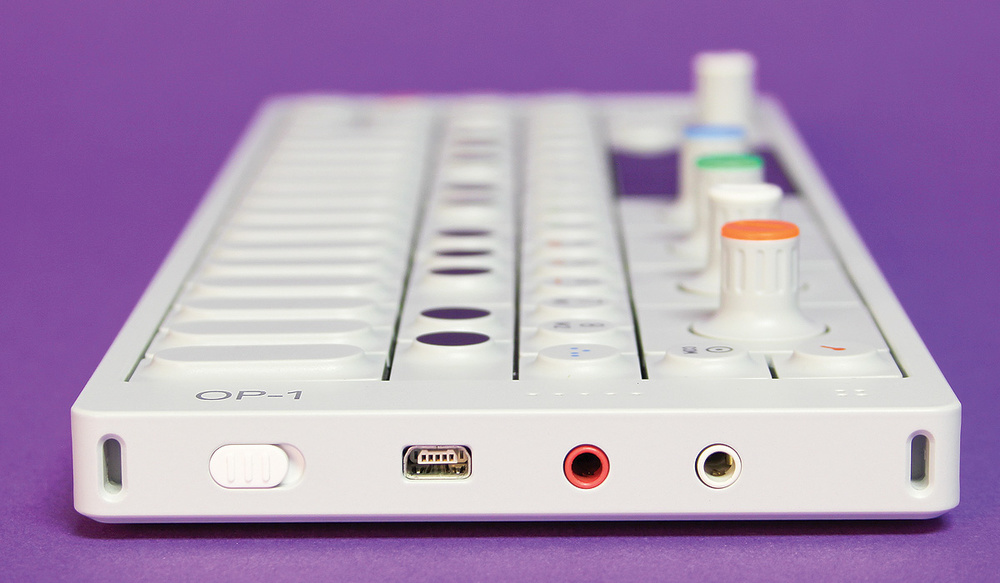 Alongside the power switch a USB 2 port and 3.5mm audio in and out sockets make up all of the OP1's connections.
Even though I'd seen its pictures on the Teenage Engineering web site, they didn't prepare me for the physical reality of the OP1. This miniature workstation is shipped in a recycled Paperfoam box, ideal to keep it safe as it travels around with you. Inside the box you'll find the OP1, two elastic bands (to keep the box together), a transparent overlay and a USB cable. There's no sign of a manual, though; for this you need to pay a visit to the Teenage Engineering web site.
For a few seconds, I wasn't quite sure what to think, until I started to handle what proved to be a surprisingly weighty slice of cold aluminium. Any lingering suspicions that this was a toy quickly faded because, despite being just 28 by 10cm, this slender metal object is a thing of beauty. Underneath is a plastic, braille‑marked panel that helpfully points to the power switch, mini-USB 2 port and stereo I/O on mini‑jacks.
Power is supplied by a Li‑Ion battery that proudly boasts 16 hours of active life. Charged via USB, this impressive battery also claims two years of stand‑by time. The main controls are four encoders and, along with the volume knob, these boost the height to approximately 2cm, while four rubber feet do their best to keep that smooth, grey underbelly scratch‑free.
Teenage Engineering describe themselves as "young minds working with technology” and anyone doubting their credentials should immediately flick the power switch and marvel at the OLED display. This 320 x 160-pixel screen is fantastic; it's pin‑sharp, intelligently laid out and uses colour and animation meaningfully. On each page, colour is the natural link between on‑screen objects and encoders — simple and highly effective.
Initially, you boot into four-track mode with its image of reels and scrolling tape. The transparent overlay describes how to progress from fledgling synth tweaks to a recording in eight easy steps. Following these, you quickly appreciate the layout and feel of the buttons, which are as positive as they are plentiful. You also appreciate the tiny internal speaker, which is perfectly adequate for extended periods of playing around the house, something I did increasingly as the days turned to weeks.
Sampling & Synthesis
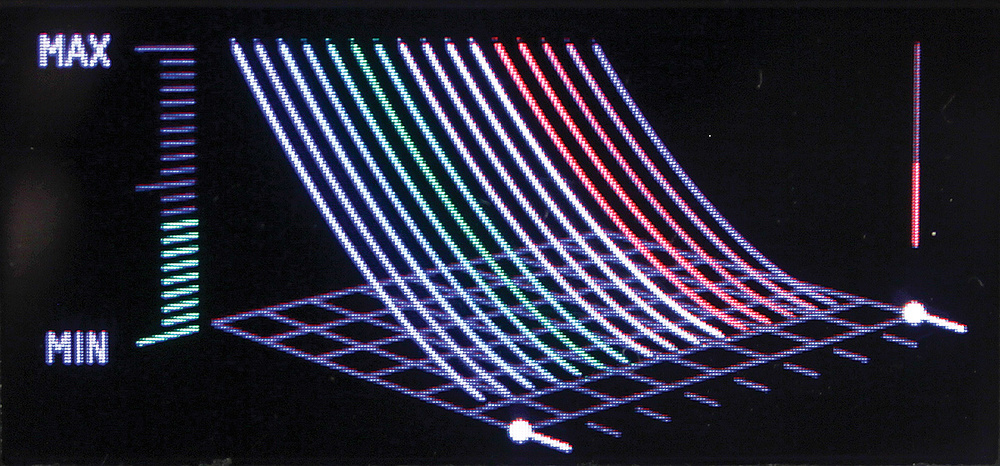 The OP1's 'String' synthesizer engine.
It was instantly clear that the OP1 is not a nerdy or techy instrument. Instead it's slick, occasionally innovative and, above all, uncluttered. There's a real feeling of restraint, of limiting the tweakable parameters only to the essentials so that you're never diverted from what matters — making music.
Internally, there's 64MB of RAM and a generous 512MB of flash storage — more than enough to hold a decent collection of audio material and synth patches. USB connectivity ensures that you can back up your work and transfer data across in either direction. In fact, pretty much all file handling is done externally, whether it's creating and naming folders for user patches or backing up the various types of data. Sometimes, with no computer nearby, I wished I could just name and save my patches or store a 'reel of tape' to flash, but this isn't currently possible. At least everything you do is instantly backed up, so whenever you feel the urge, picking up from where you left off takes only a matter of seconds.
One note shy of two octaves, the fixed‑velocity keyboard responds reliably and, though giving little scope for expression, feels durable and solid. The keyboard may be transposed by four octaves either way, the transpose keys doubling as a basic pitch bender when Shifted.
With a press of the blue Synthesizer key you're free to explore the various 'engines' on offer. The OP1 isn't multitimbral, but each engine has six notes of available polyphony and a streamlined user interface that is never daunting. Via eight sound‑selection keys you have instant access to patches of your choice based on any of the engines. Bring the Shift key into play and a list of engine types plus available presets within each type is revealed.
The engine choices are: Cluster, Digital, Dr Wave, FM, Phase, Pulse, Sampler and String, and each has its own character and supporting graphics. Considering the scope of the synthesis on offer, the factory patches aren't too spectacular, only a few hinting at the power under the hood. This is where you come in.
 The OP1's Tape Recorder function — a source of almost limitless audio‑mangling fun. Checking through each engine in turn, Cluster is revealed as a "multi‑layered oscillator cluster” delivering sounds that range from punchy and almost analogue to huge and fuzzy: think 'supersaw from hell'! The Digital engine employs waveshaping, ring modulation and a control simply named 'Digitalness'; these all combine to deliver an assault of spiky, crystalline textures or, after some encoder tweaking, noisy, distorted organs.
Dr Wave is "Frequency Domain Synthesis” and encompasses tones reminiscent of oscillator sync and formant synthesis, as demonstrated by the patch 'Talk Box'. The FM engine is more familiar territory, its parameters shifting around on screen as you adjust the frequency, FM amount or routing of its four operators. Then there's a Phase engine representing Phase Distortion and Pulse, which is two pulse waves whose positions and levels can be adjusted and modulated. Then there's an engine I couldn't help pausing on: String. Apparently this is a "waveguide string model”, but whatever the code is doing, it caught my attention as the ideal source of cutting basses and general twanginess, plus shimmering string pads.
With four main parameters per engine and no real explanations in the manual, you're left to dive in and experiment with no preconceptions or baggage — although in the case of the final engine, the sampler, you should at least recognise the terms used! The sampler offers up to six seconds of sample time per patch and, once again, is all about speed and accessibility. A sample may be sourced from the onboard mic, the line input or the built‑in FM radio; alternatively, you can feed it with tracks plucked from the recorder. Thanks to the keyboard's impressive transpose range, a single sample can be taken into some very strange regions, while, for hands‑on adjustment, the encoders set the sample start and end points, plus the loop points. Although there's no built‑in normalise function, levels can be boosted after recording, should that be necessary. A small line of LEDs at the side acts as a VU meter, and otherwise there's remarkably little else to think about.
The sampler and synth engines sit in front of common pages for the ADSR envelope, effects and modulation. At any time, you can replace the current engine without affecting parameters on these screens.
Effects & Drums
 You can record the Tape Recorder's output to create an 'album' of up to six minutes on each side.
The effects are rather idiosyncratic, a delay and spring reverb being the most 'normal'. There's a "hacked telephone system” that is so lo‑fi it doesn't just cheapen your audio, it trashes it and throws in strange artifacts of its own. Then there's a rather bonkers filter whose Frequency, Punch (resonance‑ish), Power and Rounds parameters suggest sonic pugilism of an extreme kind. This gritty digital filter varies in effectiveness according to the synth engine loaded; the more harmonics it has to work with, the better.
I wouldn't say the effects are game‑changers but they make a worthwhile contribution. Whether it's the metallic fizz of the spring reverb or the three‑dimensional feedback of the Grid effect (think broken flanger or primitive digital delay), they get under your skin — especially when modulated by one of the more unusual LFO implementations of the synthesis world. As well as setting regular cyclic modulation, you can specify the internal three‑axis motion sensor as a mod source. Waving the OP1 in the air to generate modulation felt more 'right' than I expected, even if it was too easy to hit buttons and accidentally select new patches while doing it.
If wavy vibrato doesn't appeal, how about radio‑sourced modulation? Seriously, the internal FM radio isn't just for sampling and ambience, it's for modulation too. I long ago gave up trying to persuade analogue modular synth makers to build a voltage‑controlled short-wave radio (surely the ideal random noise source?), but hearing the OP1 convinces me I should have persevered. Although not quite as packed with spacey wibbles as shortwave bands, FM is populated with plenty of bright, clear stations that can be used to modulate, say, the start point of a sample or the damping of the spring reverb. If that isn't sufficiently wacky for you, further malformation can be introduced by hijacking the microphone or line input. Any of these can act as a modulation source directed at any part of the synthesis engine, making the OP1 far less basic than it first appears.
Drum mode incorporates the same effects and LFO capabilities, its kits constructed from slices of audio sampled on the OP1 itself, or imported via USB. A kit has 24 possible sounds (all of which can play simultaneously), and there's no reason to limit them to percussion. I got great mileage from synths, vocals, even short loops packed within the maximum 12 seconds of sample time. Each drum is defined by setting start and end pointers within the sample then transposing, reversing or looping as required.
Tape Recorder
 The OP1's 'Tombola' sequencer is certainly idiosyncratic. More conventional sequencing is on offer elsewhere.
Although the synths and the drums are entertaining, it's the 'Tape Recorder' that takes the biscuit, eats the biscuit and then returns for the whole cookie jar. With a total running time of just six minutes, four mono tracks don't look too special on paper, by today's standards anyway. This isn't the place to discuss whether great music can be born from such limitations, but it is the place to remark that this particular tape-recorder simulation is eerily addictive. Everything from the graphics to the sound of tape scrubbing over tape heads adds to the feel of authenticity. There are wild liberties to be taken too, without fear that the tape might snap! For example, you can switch into reverse at any time, even during recording. Naturally, you can bounce tracks down, loop or repeat sections, and even record while manually winding, for some seriously trippy sound effects. As with real tape, if you record at a faster speed you obtain better-quality results, but my favourite trick was at the other end of the spectrum: slowing it right down, then sampling the results. Monster sampler patches are easily made by overdubbing several synth parts, then lifting them straight from tape into the sampler.
Even though each track is mono, you can overdub or cut and paste seemingly forever, capturing performances from the synth, drums or from external sources, such as the iPad I have nearby. If you turn on 'beat matching', bar lines scroll along with the tape, as an aid to making smoother loops. This won't be mistaken for a DAW in a hurry, but there are some frills, such as the built‑in metronome and tap tempo — features I never had on my old TEAC four‑track!
Each track passes through a simple mixer with just level and pan controls; the summed result then hits a three‑band EQ, a master effect and a final drive section. The master effect is a stereo version of the effects encountered earlier, placed over the entire output. As each instrument passes through the currently selected tape track, this proves to be a way of adding a second effect to synth or drum patches. The mixer even includes a simple compressor, plus a graphic representation of the entire sound path.
Having laid down some tracks, you must connect a USB cable to perform a backup or do further production work on them. If you prefer to stay in the box, you can create a stereo master 'album' by cutting some virtual vinyl. Two album sides of up to six minutes each can be recorded and the resulting stereo files (in AIFF format) are then ready for transfer to your computer. Even as the vinyl is being 'cut', you can add new material alongside the Tape Recorder's output; the album records whatever it receives.
Sequencers
 The OP1's mixer screen.
Three different sequencers provide everything from simple repetitive patterns to Tenori‑On-grade eccentricity. The most unusual is 'Tombola', dispensing welcome unpredictability from a rotating tombola tube. Notes are first cast into it by playing the keyboard. You then set their heaviness (loudness), bounciness, and the speed of the tombola's rotation, before sitting back to enjoy the mayhem. Gaps can be opened in the tube wall, letting old notes spin off to freedom and make way for new ones to be added. Ideal for weird backgrounds and textures.
For more regular grooves, there are two step‑based sequencers, one of which is fairly similar to the sequencer in Roland's SH101. First, you enter a sequence of up to 99 notes and then trigger it from the keyboard, applying swing or introducing patterns of gaps as it plays. Lastly, there's the 16-step Pattern sequencer, a more traditional grid‑based implementation ideal for polyphonic keyboard or drum parts. Sequence length can be dynamically adjusted during playback, notes rotated, and so on. The step sequencers may be latched their directions can be changed without missing a beat, and all three can drive external instruments.
Control
With no obvious MIDI connections, you'd be forgiven for thinking the OP1 was completely self‑contained. While it's true that there are gaps in its MIDI implementation, there are still goodies to enjoy, thanks to a USB port that isn't exclusively for backup purposes.
In the OP1's normal operating mode, it receives notes and pitch‑bend on a single (currently fixed) MIDI channel. Played via a master keyboard and with the line output connected to studio monitors, the various synth engines started to come alive. I found that chords and heavy velocity produced distortion that had previously gone unheard but it rarely took long to bring this under control. The OP1 doesn't respond to sustain-pedal information, nor does it sync to (or transmit) MIDI clock, but Teenage Engineering aim to polish the MIDI spec considerably before declaring their opus 'finished'. I also experienced some odd noises in the otherwise quiet output; these were traced to the USB charging process, and to suppress them I was given a preview of a forthcoming operating system featuring a switch that deactivates charging when necessary.
There's one last operating role to mention: that of possibly the most ostentatious nano‑controller ever. It could be useful, though; the four encoders can be programmed for MIDI CC transmission and even offer relative or absolute operation, which is a rare choice where endless encoders are concerned.
Conclusion
The OP1 makes me think of Keira Knightley — there, I've said it! To explain: it is incredibly slender and attractive, yet there's always a feeling its destiny lies beyond my lowly circles. The price reflects an unflinching approach to quality, but it's bound to be a significant factor in any purchase decision.
Apart from a few aspects of the MIDI implementation and the reliance on a computer for file handling, I couldn't fault the attention to detail. The OP1's technologies fit neatly together and offer a level of focus rarely seen in today's hardware, thanks in no small measure to the welcoming display. Clear graphics reveal each engine far better than long descriptive text, and if each is a relatively uncomplicated digital affair, who's to say that digital can't be beautiful too? If you prefer to work with slices of organic reality, the sampler and microphone are never far away.
It was the tape-recorder function that really grabbed me, though. I wasn't expecting such a creative tool, with nuances such as the impression of tape moving at varying speeds across the heads. It offers an unparalleled degree of interaction for a tape recorder, becoming a performance instrument in its own right — and, happily, without all that crappy head-cleaning, tape stretching and oxide dumping that nostalgia fails to mention!
Falling somewhere between 'musical sketchpad' and 'full production workstation', I found Keira to be an elegant companion, ideal to keep nearby should the muse strike, and ready for extended action, thanks to superior battery life. Even though currently out of my league, the OP1 takes portable musical fun to a whole new level.
Alternatives
There is little direct competition; perhaps the iPad is the closest, with its rounded sleekness, portability, and flexible choices of recording, sampling and synthesis apps. However, the OP1 will never distract you from the act of making music by offering a quick game of pinball, plus it has none of the iPad's annoying restrictions when it comes to transferring data via USB.
Pros
- The implementation of the 'Tape Recorder' function is excellent.
- Straightforward sampling, plus a selection of synthesis engines to explore.
- High production values. The screen, in particular, is superb.
- A self‑contained production or jamming machine that you really can take just about anywhere.
Cons
- Not cheap.
- MIDI implementation a little thin.
- File operations require a computer.
Summary
The OP1 draws you in with Furby‑like cuteness. Although you will probably wince at the bottom line, it packs a whole lot of slick, creative and approachable technology into a very small and well-designed box.
information
Teenage Engineering +46 8 641 98 53.