

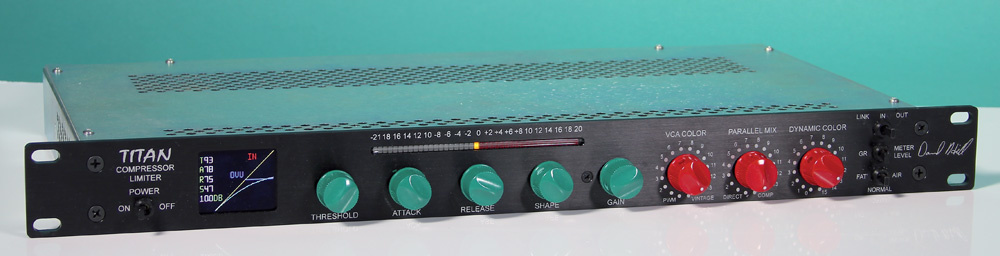
An all-analogue signal path with digital control and side-chain processing make the Titan stand out from the crowd.
Two of the most well-known manufacturers of high-end pro-audio equipment are Summit Audio and Crane Song, both of whom market products from the design desk of one of the industry's most highly regarded electronics engineers, Dave Hill. His eponymously named company, which is run alongside Crane Song, manufactures a very modest but fascinatingly unusual range of products. For example, the Europa 1 mic preamp, which I reviewed in SOS July 2011, has unique controls that allow the user to adjust the slew rate and both the even and odd harmonics. The company's latest design, the Titan, is described as an analogue compressor-limiter but, as we've come to expect, the design incorporates some unusual twists!
Overview
While the Titan is, undoubtedly, an analogue feedback-style compressor-limiter, it is digitally controlled, and includes a DSP in the side-chain, meaning that it can achieve sounds no normal analogue side-chain device could produce without complex external processing. As usual, in addition to all the familiar controls, there are several very unfamiliar ones to alter the tonal colour and character of the device, enabling it to create and shape sound far beyond what any conventional device can achieve. It even has a colour LCD display!
The back panel of this simple but elegant 1U rackmounting processor (which extends roughly 220mm (8.6) inches behind the rack ears), is simplicity embodied. There are just two XLRs for the single balanced analogue line input and output, plus a 9-pin D-sub connector for stereo-linking two units together. Mains power is hooked up via the ubiquitous IEC inlet, with an integral fuse holder and voltage selector (100-120/220-240 Volts AC).
Moving around to the front, the casual observer will initially be lulled into a sense of security on spying a set of five green-knobbed rotary controls with safe, familiar labels such as Threshold, Attack, Release and Gain. However, hidden amongst these is an unfamiliar control labelled 'Shape' (it's really a form of Ratio control), and three red ones labelled 'VCA Color', 'Dynamic Color', and 'Parallel Mix' — the last helping to restore some confidence that it's not all alien territory!
All of these controls are stepped endless rotary encoders or switches, and while the red knobs have simple numerical scales around the controls, the five green knobs have their settings indicated on a compact colour LCD screen on the left-hand side, along with a transfer-curve plot. Sadly, the Titan has no internal memories to store and recall favourite settings, so you'll still have to resort to noting down the parameter values or taking panel photos on your smartphone!
In addition to these rotary controls and display window, there are four black toggle switches. The first, on the extreme left-hand side, switches the power on and off, while the top two on the right-hand side control the In-Out bypass relay and stereo link functions, and allocate the large horizontal bar-graph meter between output level and gain-reduction duties. Again, it's all familiar territory so far, but then just to kick the chair from beneath you, the final toggle switch is labelled Fat-Normal-Air…
Internally, the main audio-path circuitry is all discrete class-A, with a bandwidth extending between 3Hz and 175kHz. The maximum signal level before clipping is a healthy +25dBu and the noise floor is -91dBu, giving a potential dynamic range of around 116dB. It's a bit pointless quoting a distortion figure for a device that exists specifically to colour the sound passed through it, but for the record when operated in its cleanest setting the distortion is given as 0.018 percent... rising to about 13 percent at its most grungy!
As anyone who has compared analogue and digital plug-in compressors will know, convincing dynamics processing in the digital domain is far from easy, and a high internal oversampling rate is essential for accuracy. It therefore came as no surprise to me that the DSP side chain in the Titan runs with a sample rate of 870kHz!
Operations
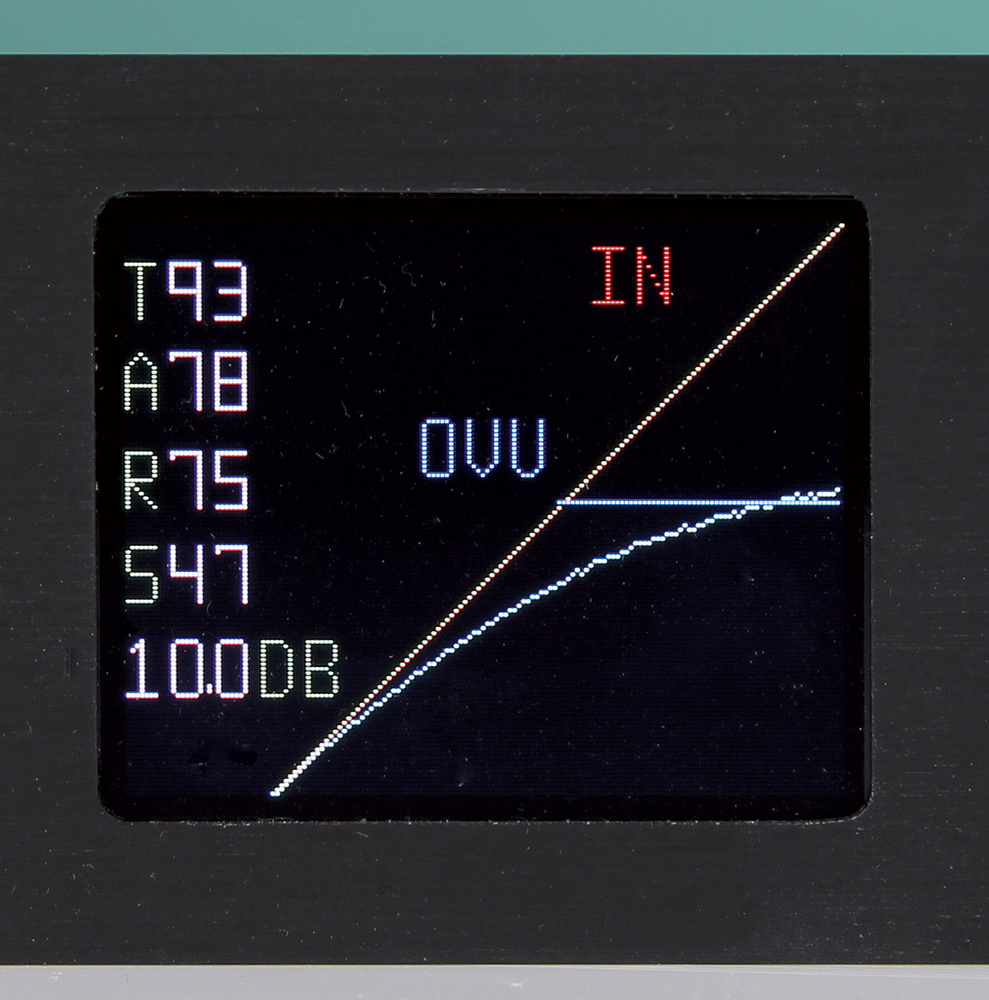 Unusually for an analogue dynamics processor, there's a graph that shows how the current compression curve compares with a linear response.
On powering up the Titan, nothing happens apart from a brief blinding flash of the entire bar-graph meter LED strip, and a simple message appearing on the LCD stating the product name and software version number (V1.0 in this case). It stays that way for about 15 seconds, until another flash from the full bar-graph burns out your retinas for a second time, and as your pupils slowly dilate it becomes clear that the LCD is now displaying a range of useful data.
A column down the left-hand side of the display lists the basic compression parameters set by the five green rotary controls. Threshold, Attack, Release, and Shape all range between 0 and 99, while make-up Gain is scaled in 0.5dB increments from 0 to 11.5dB. The rotary controls are speed dependent, so that a quick twist will span the entire range and a slower turn moves in single-digit steps. For those who need to know the parameter ranges in real-world values, the Attack time can be adjusted between 50us and 400ms, Release spans 50ms to over 5 seconds, and Shape covers ratios from 10:1 down to 1.1:1. There is no specific auto-release mode, but the release curve seems to work nicely at all settings, without introducing unpleasantly pumpy artifacts.
In practice, of course, the engineering numbers don't matter: you just turn the controls until your ears are happy — but with such precise values on the LCD, the Titan can be reset very accurately to match previous compression characteristics.
At the top of the LCD, red labels indicate the current status — whether the unit is switched in or out, or whether it is the Master or Slave of a linked pair. When two Titans are connected via the stereo link facility, one unit becomes the Master and provides all operational controls, while the Slave unit's controls are disabled. The link cable shares both DSP data and analogue control signals, to ensure accurate matching.
However, the bulk of the screen is taken up with a simple line graph showing how the current compression curve relates to a linear response. The input level is on the horizontal axis and the output level on the vertical axis, with the unit's nominal reference output level drawn as a horizontal line labelled 0VU (the maximum output level of +25dBu is represented by the top of the graph).
Adjusting the Threshold and Curve controls produces a corresponding change to the graph but, strangely, the effect of the make-up Gain control isn't reflected — I was expecting to see the compression curve move vertically in relation to the 0VU reference line. Perhaps this is something that could be incorporated in an updated software version.
The large, bright LED bar-graph display extending across the top of the green rotary controls is scaled from -21 to +20dB in 2dB steps (apart from the very lowest division), although the top LED actually illuminates at +24dBu. The meter can be switched to indicate either the audio output level or the amount of gain reduction. The 0VU mark (which corresponds to +4dBu) is yellow, with green below and red above.
Techni-Colour
 Coming up with a caption for this picture was a Titanic struggle!
Moving on from the familiar compressor controls, we enter the strange world of Dave Hill's unique colour facilities. These are 16-way endless rotary switches, which make it easy to switch quickly between maximum and minimum effect settings. The middle control blends the compressed and direct input signal together to achieve familiar parallel compression effects. This control is not quite the same as the usual analogue mix pot, however, because at the Direct end there is still around six percent of compressed signal in the mix. As the handbook points out, the bypass switch is there for when you want an all-direct signal! At the opposite end, there is a fully compressed position, but one click to the right introduces enough direct signal to dilute the compression quite significantly, and one click to the left provides almost all direct signal — so it's quite easy to not be listening to what you think you're listening to.
The 'VCA Color' switch moves between a very clean style of compressor (using pulse-width modulation, or PWM, techniques to alter the gain), through to a more 'Vintage' style of diode-based VCA, which introduces a lot more colour. With 16 steps between these two extremes, a wide range of subtle tonal coloration and character can be found.
The 'Dynamic Color' control generates harmonics — mostly third (along with a slightly raised noise floor) — but only when there is some gain reduction going on. As the control is advanced, the gain-reduction meter also illuminates a wider group of LEDs. These generated harmonics are arranged to be of the opposite phase to those produced by the VCA Colour control at the Vintage end of the scale, and the effect of increasing this knob is described as 'making the sound bigger'. It's not a subtle effect, by any means, especially at extreme settings, and it certainly adds a lot of body and crunch to the signal. It also adds a sense of increased brightness, and enhanced transient attacks which seem punchier in an interesting and effective way.
The final colour option is the Fat-Normal-Air toggle switch. This does exactly as the name suggests, by changing the spectral balance as the signal is compressed, to enhance the bottom end or the top end, respectively. This is not a simple EQ after the compressor, though; instead, it affects the side-chain processing, so the effect varies with the amount of compression being applied.
In Use
 Everything's neat and tidy inside the box.
Dave Hill's designs never fail to impress, amaze and excite – usually in equal measures. The Europa preamp and this new Titan compressor-limiter certainly both do that, with their unique abilities to sculpt and shape the sound in ways that no equivalent product can, and by using simple and obvious controls that make operating these devices so straightforward.
The Titan can certainly do clean, gentle and subtle compression, if that's really what you want — amongst the cleanest and most subtle I've ever heard, in fact — but its forté is introducing musically beneficial colour and character by shaping the source dynamics in distinct and unique ways. In that context, the Parallel Mix control is an essential feature of the Titan, since it allows the compression effects to be diluted and blended, enhancing subtlety and flexibility considerably.
Since the raison d'etre of the Titan is to alter the sound in interesting ways, it is probably inevitable that more gain reduction will be applied than would normally be the case. I was routinely dialling in 8dB (and sometimes more) gain reduction to achieve great results, when I would normally start wincing with more than 4dB on most other devices! Of course, such large amounts of gain reduction become obviously audible, but without being unpleasant or deleterious, as they often are with more conventional dynamics devices. That being said, it is certainly possible to push things too far — especially when the input level is particularly hot — and the Titan can sound pretty nasty and broken when you do.
Initially, I struggled to hear the effect of the VCA Color control; so fine are the switch increments that the effect kind of creeps up on you unnoticed! I also felt that there was an almost plug-in-like lag sometimes when operating the controls. However, rotating around the dial from extreme Vintage to PWM quickly tunes the ear to recognise the darker and grittier Vintage tone, compared to the very clean and open-sounding PWM mode. There was no doubt about the Dynamic Color control, though, which brings progressively stronger body, weight and richness, combined with a bright and lively presence. With both controls maxed out, the result is probably too much for most situations, giving an unpleasant (to me, anyway), almost fuzz-box-like quality — although winding the parallel Mix control back towards the Direct end will dilute the effect and I'm sure someone will like it! The Fat/Air switch is almost as subtle as the VCA Color control, but it does deliver nicely as the amount of compression is increased, particularly on complete drum tracks.
In fact, the Titan is most creative on strongly transient-rich sources such as drums — either individually or as a full kit — enhancing different aspects of the sound as required. It can pull up the transient snap, add punch or low-end body, emphasise or reduce the room sound, add colour and thickness, or even subdue and constrain — almost whatever your ears could wish for. I've never used a compressor so flexible or creative, and with such intuitive controls. I recorded a couple of clips to hint at the range of effects that can be achieved (see 'Listen & Learn' box), but this is only scratching the surface, as the Titan really needs to be used in context of a full mix to really show what it brings to the party.
Using the Titan on other individual sources is equally effective, too, including bass, electric and acoustic guitars, and pretty much anything that you can think of that might benefit from a bit of added colour. I tried it on vocals and was able to achieve some interesting effects which would work well where a bit of sonic attitude was required. As I was only supplied with a single unit for the review, I can't comment on stereo bus-compression applications, but I imagine it would be an equally powerful tool for creative tonal sculpting here, although probably as an effect rather than for conventional dynamic smoothing.
Verdict
The bottom line is that the Titan can do what any decent modern compressor can do, but it can also go way beyond the conventions, to create entirely new forms of dynamic shaping and sonic sculpting. However, don't be fooled into thinking the Titan can emulate the standard set of revered optical and FET compressors: that's not what it's about at all. This is a specialist professional tool that unashamedly adds subtle and not so subtle forms of colour and character in novel and interesting (but generally very controllable) ways. It stands apart from everything else — just as the Europa preamp does — and the pro-audio world is all the better for the unique creativity the Titan brings. I can't wait to see what Dave Hill Designs produces next!
Listen & Learn
We've placed a few audio files on the SOS web site to demonstrate the sound of the Titan compressor-limiter.
Pros
- Excellent technical performance.
- Makes available an astonishing range of tonal character.
- Innovative yet effective controls.
- Switched controls enable settings to be replicated.
- Stereo link facility.
- Unique — there is nothing else on the market that does what the Titan does!
Cons
- Make-up Gain not indicated on LCD plot.
- No on-board preset memories.
Summary
This latest Dave Hill design applies similar concepts to the Europa 1 preamp, to enable the Titan compressor to sound fast, clean, and modern at one moment, and rich, grungy and seriously vintage the next — with everything else in between! Technical performance is excellent, and the Titan's unique control facilities enable some stunningly effective sound textures to be created.
information
KMR Audio +44 (0)20 8445 2446.
Trans Audio Group +1 702 365 5155.