

Native Instruments have teamed up with Softube to model three pieces of highly regarded valve outboard gear.
As well as instruments that run natively, the Native Instruments product range also includes quite a few effects and processing plug-ins, from original products like The Mouth and The Finger, to emulations of classic gear. The new Premium Tube Series falls into the latter category, containing two equalisers and a compressor that are, in all but name, modelled after well-known hardware processors from Manley. Unlike most NI plug-ins, though, the Premium Tube Series was developed out-of-house by Softube; and, perhaps as a consequence, it dispenses with the need to use NI's Guitar Rig Player as a 'shell' plug-in. Instead, all three plug-ins can be called up directly in any VST, AU, RTAS or AAX host, and the bundle uses NI's standard Web-based authorisation system.
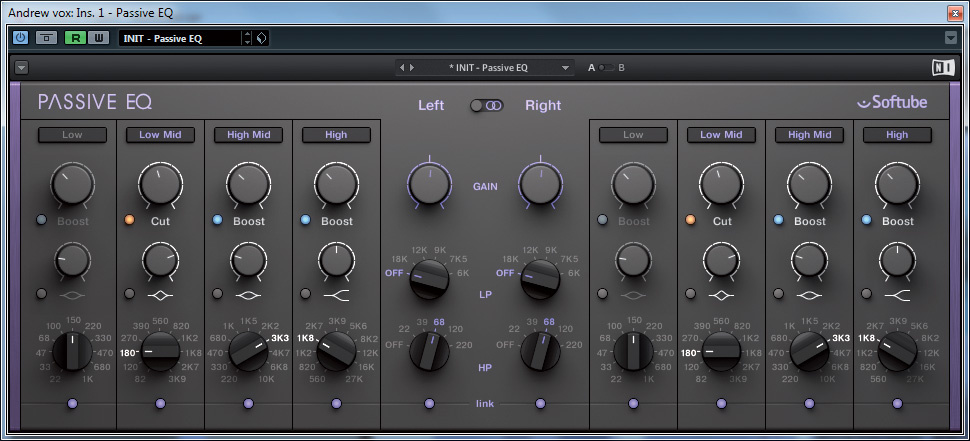
Although the visual layout and colour scheme of the Premium Tube Series plug-ins recalls the original hardware, NI and Softube have avoided any attempt at photo-realism, and the user interfaces are surprisingly plain by today's standards. The most elaborate of them is Passive EQ, which is obviously intended to replicate Manley's celebrated Massive Passive equaliser: an interesting design which, as well as high- and low-pass filters, features four main EQ bands with stepped frequency controls. Any or all of these can be set to shelving mode as well as 'bell' or quasi-parametric mode, and the Bandwidth control is active in both. This permits a variety of strange but effective Pultec-like configurations involving overlapping frequency bands and so on. As the name suggests, the Massive Passive uses no active components in its EQ circuitry; any level lost in equalisation is restored using a tube make-up gain amplifier.
As far as I know, the only existing plug-in version of the Massive Passive is Universal Audio's officially licensed emulation for their UAD platform, so the availability of a faithful copy in native form will be welcome news for many — though not, presumably, for Manley or UA. Unlike UA, NI haven't chosen to emulate the alternative Mastering version of the Massive Passive, with its stepped gain ranges, but they have added an M/S matrix, which can be useful in mastering contexts.
The Bandwidth Of A Circle
If you're accustomed to a more conventional EQ design and interface, the Passive EQ takes a bit of getting used to. One design feature that is accurately replicated is that the 'zero' point for each band's gain knob is always fully counter-clockwise. As you turn it, you apply increasing amounts of either boost or attenuation, depending on whether that band is switched to 'boost' or 'cut' mode. Another is that the Bandwidth control doesn't behave quite like a conventional Q control, but interacts with the channel gain setting. The results are usually very musical but not always very similar to what you'd get from other equalisers, and even at its narrowest setting, its effects are audible over a wide frequency range — for instance, if you put a 1kHz sine wave through it and apply a bell boost or cut at 6.8kHz you'll hear its level change, even at the narrowest Bandwidth setting. The high- and especially the low-pass filters are likewise audible way beyond their nominal turnover frequencies.
Since my old laptop with its UAD2 Solo card has now been put out to pasture, I wasn't able to do direct comparisons against the UA version, nor against a hardware Massive Passive. However, once I had got to grips with some of its quirks, I found myself using the Passive EQ plug-in extensively. It's not transparent in the sense that a high-quality linear-phase digital equaliser is, because even small amounts of boost or cut are clearly audible. Yet neither is it obviously coloured or aggressive like, say, Softube's Trident A-Range emulation. Rather, what it allows you to do is to subtly or comprehensively alter the tonality of a source in a way that just sounds right. Even when you're making quite radical changes to the timbre of an instrument or mix, it does so with such authority that it's almost as if the source had been recorded that way to start with.
When you try Passive EQ on the mix bus, it's not hard to see why the original hardware is found in so many mastering studios. For instance, if you set one of the central EQ bands somewhere in the mid-range frequencies, you can add impact to a slightly scooped and soggy mix, or conversely, eliminate an exaggerated honkiness and harshness without emasculating the sound as a whole. So often with other equalisers, it's hard to bring yourself to cut frequencies from a full mix, even when you know that it needs doing. Here, by contrast, the main danger is that its sweetness can be seductive, and it's easy to go too far! Although there is a make-up Gain control that can be used to recover any lost level, in practice Passive EQ seems to maintain a pretty constant subjective level unless a very extensive cut or boost is applied, which makes it much easier to evaluate the usefulness of your settings.
As well as conventional mastering, I found Passive EQ very useful on a restoration project where I was asked to pull together a collection of quite ropey live recordings from different sources, with wildly different balances. And while it seems decadent to use something so expensive-sounding on a mere tambourine or hi-hat, there's no denying that it makes a very effective channel equaliser too. Here, again, you quickly realise the benefits of its unique ability to cut without robbing the source of impact, or boost without making things harsh.
Swing Both Ways
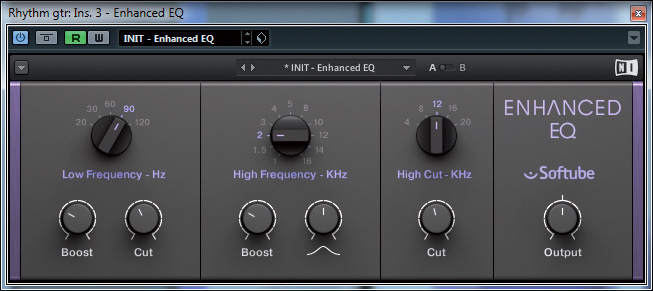
The second equaliser in the collection is the Enhanced EQ, which models Manley's updated version of the classic Pultec EQP1A. The EQP1A is, of course, a fixture in studios around the world, and perhaps its most distinctive feature is the ability to apply both boost and attenuation in the same frequency range simultaneously, with resulting frequency curves that are unusual and often useful. Manley's design incorporates a number of modifications compared with the original. Some, such as the slightly different choices of stepped frequencies, are emulated here. Others, such as the choice of transformerless or transformer-balanced inputs and outputs, are not.
Unlike the Massive Passive, the original EQP1A has already been extensively modelled by numerous software companies, with Universal Audio again having the rights to produce the official version. The creators of this plug-in, Softube, also make an officially licensed software emulation of Tube-Tech's PE1C, one of the best-known hardware Pultec copies!
Unsuprisingly, NI's Enhanced EQ and Softube's Tube-Tech PE1C sound more than a little similar, though differences do become apparent at more extreme settings. When the controls are set as closely as possible, the Tube-Tech emulation sounds a touch softer and sweeter to my ears, with the Enhanced EQ exercising a little more bite, although widening the bandwidth of the mid-range band on the latter brings it closer in some cases. Enhanced EQ's low band seemed to do a more thorough job of cleaning up a muddy bottom end compared with PE1C's, which left a slight hint of cardboardy tubbiness behind.
Comp As You Are
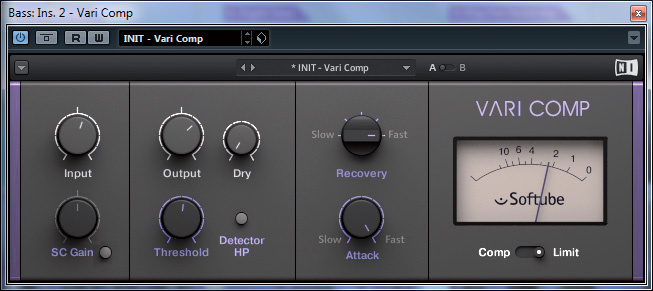
The NI/Softube Vari Comp plug-in is modelled after Manley's Variable Mu compressor. Like the classic Fairchild 670, the Variable Mu is unusual in that it actually uses a vacuum tube as the gain-control element, rather than employing an optical compression circuit with a valve make-up amplifier. There's a variable attack time, nominally between 25 and 75 milliseconds, and a choice of five stepped release times. There is no ratio control, but you have a choice of Compress or Limit modes. The former employs a very 'soft-knee' compression characteristic, with a ratio that is said to range from 1.5:1 for signals just above the threshold to 8:1 or more when pushed hard. The latter firms up the knee and applies a much higher ratio of around 12:1.
Another unusual aspect of the design is that there is an input gain control as well as a threshold control. This replicates the arrangement on the original, which has a tube input stage: by driving this harder and backing off the threshold control, you can keep the same amount of compression but add more tube saturation. Again, NI and Softube have chosen not to emulate the Mastering Version of the Variable Mu, nor any of the factory modifications that Manley offer; instead, they've added a Dry mix control to make parallel compression easier.
Like the Passive EQ, the Vari Comp takes a bit of practice to operate, and you need to use your ears rather than assuming that a particular setting will sound as you expect it to. Once you've got used to it, though, it reveals itself as a very nice and surprisingly flexible tool. Used on the master bus, it won't deliver the snap and aggression of an SSL-style compressor, and I didn't find a way of making it shine on upbeat rock tracks, but on anything a little slower or gentler, it's a star. Again, it's not exactly transparent, but adds a certain richness and sweetness to jazz and folk tracks that enhances the source in a very natural way. In compression mode it is generally very smooth, especially with longer release times. Although there are many plug-in versions of the Fairchild compressors, this is unique and subtly different; in some ways it reminded me of Abbey Road Plug-ins' RS124 emulation, but is a lot more versatile.
Vari Comp works well on individual sources, too. It makes it easy to produce a thick yet controlled bass sound, especially if you crank up the input gain. Elsewhere, I was working on a slow rock track which began and ended with the drummer playing on his own. I knew that I wanted to squash the drum bus fairly heavily for effect, but none of the other plug-ins I'd tried did it in the way I'd hoped. Switching the Vari Comp plug-in to Limit mode gave me exactly what I'd been after: obvious, yet very 'glossy' compression, which retained enough punch in the kick and snare to keep them cutting through when the guitars crashed in.
The only niggle I encountered concerns the resolution of the output gain control. In a situation where you're using Vari Comp on a fairly hot input signal, it can be necessary to attenuate the output quite a bit, but for some reason, as you turn the knob to the left, it starts to jump in increasingly large steps, even if you hold down the Shift key, making it quite hard to set the level of the processed signal as accurately as I would have liked.
Premium Results
No software emulation will ever be as sexy or desirable as the real thing, but for those of us who don't have studio budgets running into the hundreds of thousands, plug-ins have plenty to commend them. For one thing, although these are not CPU-light processors, a modern computer will let you run more of each in a single project than any control room in the world has of the hardware originals. During the course of this review, I mixed several small projects using almost no plug-ins apart from Passive EQ and Vari Comp. Once I'd got my head around their quirks, I found them easy to set up and amazingly forgiving of bad source material, yet able to positively enhance well-recorded tracks too. There were a few cases where Vari Comp didn't quite give me the degree of control or the rapid response that was needed, but it was right much more often than not; and while Passive EQ won't do keyhole surgery on your sources, it nearly always makes them sound far more expensive than they deserve. As a bundle, the Premium Tube Series brings bags of character and class to your DAW, and would make a perfect complement to a more 'vanilla' set of digital EQs and compressors, especially if you need to do DIY mastering as well as mixing.
Alternatives
If you don't have a UAD2 card and the official Massive Passive emulation, you could perhaps look for suitable presets for Acustica's Nebula dynamic convolution plug-in. As far as I know, there are no other plug-ins that directly emulate the Enhanced EQ and Variable Mu, but there are plenty of Pultec and Fairchild models from the likes of UA, Waves and IK Multimedia.
Pros
- Great-sounding emulations of high-end hardware not previously modelled in native plug-in form.
- Useful for mixing and mastering.
- Not tied to Guitar Rig Player as a shell plug-in.
Cons
- Despite their apparent simplicity, it takes practice to get the best from Passive EQ and Vari Comp.
Summary
These three plug-ins will add a touch of class to almost anything you run through them, and are particularly well suited to mastering 'in the box'.
information
2twenty2 +44 (0)845 299 4222.