


If the Crumar Spirit is one of the best analogue monosynths the world has ever known, how come you've never heard of it? Gordon Reid explains...
Nowadays, when you think of synthesizers your mind probably makes a geographic leap across various ponds to Japan, home of Roland, Korg and Yamaha. When you think about vintage synthesizers, you will almost certainly think of the USA, home of all things Moog-y and ARP-ish. You may even spare a stray thought for the UK's quirky analogue synths — EMS and Analogue Systems among others — or the strange and frequently unfinished Teutonic species from PPG and Waldorf. However, as your consciousness flits around the synthesizer world, it's unlikely that you'll spare much thought for Italy, the home of ghastly Ekos, insignificant Jens and uninspiring Siels. Yet Italy is the home of two of the greatest analogue synths ever manufactured. In the polyphonic world, the Elka Synthex ranks alongside the Oberheim Matrix 12 and Prophet VS, in terms of both price and desirability. And in the monophonic world, there's the Crumar Spirit, a synth so obscure, and of such overwhelming eccentricity, that nobody bought it, nobody used it, and almost nobody remembers it. This month, we're going to change all that.
Cru... Who?
You may be surprised to know that some of the world's best accordions originate in Italy. Indeed, a whole accordion industry developed around the city of Castelfidardo (on the Adriatic coast) at the tail-end of the 19th century. Next, in the first half of the 20th century, the Italians embraced traditional organ technology and then, in the '60s and '70s, they jumped on the electronic home-organ bandwagon. By this time, numerous companies were building keyboards in and around Castelfidardo. These included Elka, Eko, Farfisa, Siel, and — you've guessed it — Crumar, whose founder was a chap named Mario Crucianelli (Cru-Mar).
Anticipating the imminent collapse of the home organ market in the early '70s, Mario Crucianelli directed Crumar down a new path, and the company soon became famous for the cheap and nasty electric pianos that were to be its hallmark for the next decade. Fortunately, Crumar's next batch of products was far more interesting, embracing primitive string and brass synthesis, and the company enjoyed a short-lived burst of fame when Emerson Lake & Palmer, Greenslade and The Enid adopted its quirky Stringman and Brassman keyboards. Unfortunately, the affordability of Crumar's instruments conjured an image of cheap shoddiness, so most serious players avoided them, no matter how innovative later models proved to be. From the groundbreaking Multiman to the company's first true synthesizers, the DS1 and DS2 (see 'Before The Spirit: The Crumar DS2' box), there was much that was unconventional about the Crumars of the late '70s. Even the cost-cutting engineered into 1982's Stratus and Trilogy helped to create unconventional synths that remain unique to this day.
Nevertheless, Crumar singularly failed to make it into the big league, so when they announced the Spirit in 1983, nobody took any notice. The world's interest was only marginally more piqued when Crumar let it be known that Jim Scott (one of the co-designers of the Minimoog), Tom Rhea (another Moog employee best known for writing many of Moog's synthesizer manuals) and none other than Bob Moog himself had helped design it. And that's a shame, because, as you will see, the Spirit is one of the most complex, challenging, and — above all — powerful monosynths ever produced.
Technologically Speaking
It's hard to know where to start when describing the Spirit. This is because it is much deeper than other analogue synthesizers. So let's ease into things gently, and start our tour with its one relatively straightforward section: the oscillators.
On the surface, Oscillator A couldn't be simpler, offering just one control, to select the waveform produced. Much like the Minimoog, there are six options: triangle; square; 30, 15 and five percent pulse; and sawtooth. The master tuning control lets you select the Oscillator A octave, with options ranging from 32' to 4'.
Oscillator B is more complex. Its six waveforms are triangle, 40, 20, 10 and three percent pulse, plus sawtooth, and it has four 'octave' ranges (-1, unison, +1 and +2 with respect to Oscillator A) and a detune control that spans ±8 semitones. But what of those range settings marked 'Bass' and 'Wide'? These disconnect Oscillator B from the pitch CV generated by the keyboard, instead offering frequency ranges from 30Hz-300Hz (Bass) and 2Hz-10kHz (Wide) that you can modulate and/or use as modulators within a patch. Used with — for example — oscillator sync (oops, didn't I mention that?), this allows you to create all manner of unusual and powerful sounds, as Oscillator A tracks the keyboard, but Oscillator B drones at constant (or modulated) frequencies. Hmm... did I say that the oscillators are relatively simple? My mistake!
The filter is, as always, the next stage in the signal path. Well... no, that's not quite right. Let's start again... The dual multi-mode filters are the next stage in just one of the signal paths. Still with me? No, I didn't think so. So let's continue by looking at the filters themselves.
Crumar called the primary signal path the Filter/ADSR path, for the simple reason that the output from the oscillators passes through the filter and ADSR/VCA stages in conventional fashion. As I've already stated above, there are two filters, named U and L, for Upper and Lower. However, don't for a moment think that these are low-pass and high-pass filters. The names describe their physical positions on the control panel, not their functions.
Filter U is the more conventional of the two. This is a low-pass device with a master cutoff-frequency control, variable keyboard tracking from zero to approximately 110 percent, and a dedicated ADSR contour generator with variable depth and both positive and inverted polarities. Furthermore, a simple rocker–switch selects between the 12dB/octave and 24dB/octave cutoff slopes of the filter, allowing you to choose between Oberheim SEM/early ARP-style (12dB/oct) or Moog/late ARP-style (24dB/oct) filtering. (There's nothing remotely Japanese about the Spirit's character, but the ARPs of early Genesis LPs leap out almost unbidden.) Filter U also offers resonance, controlled by a switch that selects between a fixed 'Low' resonance (of approximately Q=1/2) and Variable resonance, which you alter using a conventional knob.
Filter L is the weird one. This offers four modes. The first is 'Out', wherein the filter is simply removed from the signal path. In contrast, Overdrive mode introduces a distortion circuit between Filter U and Filter L, and configures Filter L as a parametric EQ that adds a peak at its cutoff frequency, but without attenuating the signal on either side of the boost. The third mode is Band-pass, which is similar to Overdrive mode but without the distortion. Finally, High-pass mode acts as you would expect, making the Spirit a more conventional dual-filter synth with high-pass and low-pass filters.
Further to this, the Spirit offers a range of controls over the modes listed above. The first of these is the Dynamic/Formant switch. In the 'Formant' position, this disconnects Filter L from the keyboard tracking, filter envelope and other filter CVs, allowing you to introduce a fixed (indeed, formant) filter into the signal path. Filter U is unaffected, so you can impose this formant on to a conventional LPF sound... nice! Furthermore, the Resonance knob always affects the parametric boost or high-pass filter resonance, whether or not you use the Low/Variable switch to disconnect the low-pass (U) filter.
Confused yet? No? Well, how about this: Filter L provides a second filter cutoff knob but, rather than controlling an absolute value for filter cutoff, it moves the cut-off relative to that of Filter U. The two filter cutoffs (U and L) are the same when the knob is in approximately the 8/10 position, thus allowing you to move the cutoff of Filter L above and below that of Filter U.
Now, if you make the two filters' cutoffs coincident and select either Overdrive or Band-pass mode for Filter L, you can play the self-oscillating filters conventionally over most of the range of the keyboard. However, if you offset them slightly you obtain a range of ghostly timbres unique to the Spirit. (This is because the 'knees' of the filters no longer coincide.) And, don't forget, you can have one filter tracking the pitch CVs while the other is stationary, so the filter characteristic can change as you play up and down the keyboard. This architecture makes the Spirit hugely flexible and, ultimately, hugely rewarding. However, the filters are far from the end of the story.
The next stage in the Filter/ADSR signal path is a simple VCA with an associated ADSR envelope. You can bypass the envelope generator using the Bypass switch, and Gate the envelope from a variety of sources. Most conventionally, you'll want to Gate it from the keyboard, using the Single or Multiple triggering option. The keyboard's priority is primarily last-note, but the Spirit also remembers the first note played. Consequently, if you release all subsequent notes while holding the first, the pitch returns to this, but without a re-trigger. This has an important and beneficial consequence: if you brush an unwanted note last, the Spirit will ignore it once you have released it, leaving the desired note sounding, and sparing your blushes. Again, I believe this to be unique to the Spirit, making it a first-class instrument for lead and bass lines. What's more, the keying system also makes the Spirit ideal for lines or phrases where you may wish to return to a 'root' drone between notes or phrases. Wonderful stuff!
There are three other sources of Gate: 'X', 'Y', and 'EXT'. So this is an ideal time to look at what is perhaps the most confusing and most powerful part of the Spirit's architecture: the modulation sources with the nattiest names in synthesis: Mod X and Shaper Y.
What's In A Name?
When you think about it, most integrated monosynths offer little in the way of modulation sources. Sure, there's usually an assignable LFO, and some synths have dedicated LFOs for pulse–width modulation and so on. But unless you fork out for one of the better endowed dual- or triple-oscillator synths, there's little or no chance of audio–frequency AM or FM, sample & hold, or an arpeggiator. Inevitably (or I wouldn't have mentioned it), the Spirit has all of these, and much more.
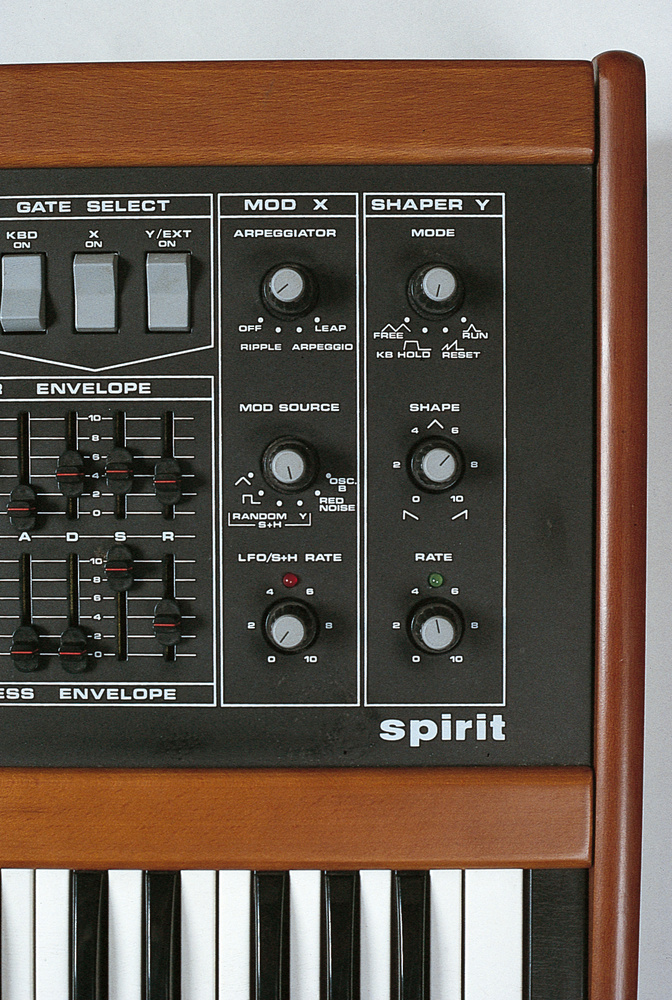 Crumar Spirit's Mod X and Shaper Y controls.Let's begin with Mod X. This offers six modulation sources: triangle wave, square wave, S&H, Shaper Y, red noise, and oscillator B. There's also a dedicated LFO, which doubles as the S&H clock if that option is selected. Then there's the arpeggiator. This has three modes, the first of which is called Ripple, and which plays any held notes in an upwards pattern at the LFO rate. The second is Arpeggio; this repeats the held notes, first at the played octave, then the one above, then the one below, thus making all arpeggios into three-octave patterns. The final mode is the confusing but rewarding 'Leap', which plays the first note in the arpeggio at the source octave, the second at +1 octave, and the third at -1 octave, then repeats the cycle. This may not sound like much, but imagine that you're holding four notes. The complete cycle is then 12 notes long. Leap arpeggios can become very complex, especially if you change one or more of the played notes during the arpeggio. I suspect that this is yet another facility unique to the Spirit, and if you've ever wanted to compose tracks in the style of Steve Reich, this is the way to do it.
Of course, you'll want to control something with Mod X, and a quick hunt to the far left of the control panel will lead you to the Wheel Destinations section, which allows you to direct the modulation to five destinations: the pitches of Oscillators A and B; the pitch of Osc A alone; the pulse width of Osc A; the Upper and Lower filter cutoff frequencies; or the cutoff frequency of filter U alone.
The reason why this is called the Wheel Destinations panel (rather than the Mod X Destinations panel) is because the modulating CV produced by Mod X passes through the dedicated Mod X wheel before being routed to its destination. This gives you full control over the amplitude of the modulation.
The action of Shaper Y is, if anything, less obvious than that of Mod X. This, too, has an LFO with a Rate knob, but in this case it's a 'triangular' generator whose waveform can be varied from sawtooth, through triangle, to ramp wave, using the Shape control. But the real power of Shaper Y lies in its Mode control, which adds four more options to the Spirit's already over-burdened feature-list.
'Free' turns Shaper Y into a simple LFO centred on 0V, thus making it ideal for simple vibrato or tremolo. In contrast, KB Hold gates the Shaper Y waveform, so you can use it as a secondary ASR contour generator whose A and R rates are determined by the Shape and Rate selected. The Reset option is similar to KB Hold, except that it describes an AD contour rather than an ASR contour (as long as you don't retrigger it before it's completed the cycle. If you do this, it resets to zero, and starts the AD contour again.). Finally, 'Run' is an unconditional AD contour that always completes its cycle, even if you take your hands away from the Spirit and start playing something else. This can be very useful for sound effects and drones that you've programmed to continue developing after you've moved your hands to other instruments.
Like Mod X, Shaper Y passes through a dedicated wheel before being presented with a list of possible destinations. These are: the pitches of Oscillators A and B (again); the pitch of Osc B alone; the pulse width of Osc B; the Mod X LFO frequency; and the cut-off frequency of filter L alone. As you can see, this list perfectly complements that of Mod X.
But hang on a minute — there's also a switch in the Wheel Destinations panel that lets you modulate (or contour) the output from Mod X with that of Shaper Y. And, if you think back, you'll remember that I've already said that one of the modulation sources within Mod X is Shaper Y. And now I've stated that one of the Shaper Y destinations is the LFO in Mod X.
Have you got a headache yet? Well, it's just about to get worse. Do you remember that the Spirit has two signal paths? The second of these is the Shaper Y path, and this passes all the sound sources, including the Ring Modulator (which I haven't yet mentioned) through a simple 6dB/octave low-pass filter and then through another VCA whose gain is controlled (or 'shaped' — hence the name) by Shaper Y. Furthermore, all the Mod X and Shaper Y modulations are still applied to this signal.
On top of that, the Mixer section allows you to mix the Oscillator A and B levels, plus Noise, within the Filter/ADSR path, to the Oscillator A and B levels, Ring Mod level, and Noise level within the Shaper Y path. And, like so much else in the Spirit, this turns out to be more than it seems. This is because — even ignoring the myriad other possibilities offered by this architecture — the U and L filters introduce tiny phase shifts in the signal that fatten up the sound considerably when you mix Filter/ADSR sounds with the same sources passed through the Shaper Y path.
In Use
Clearly, the Spirit is a fantastically complex synth. Indeed, you would be hard pressed to emulate its intricacies using a modular instrument, if only because you would run out of CV inputs and patch leads long before you recreated all its weird and wonderful routings. But if you want to patch the Spirit in simpler fashion, you can ignore Mod X, Shaper Y, and most of the oscillator and filtering options, and play it like any other dual-oscillator synth. Unfortunately, ignoring and/or switching off all the complex bits is not straightforward, and I've seen experienced players almost reduced to tears when presented with a Spirit for the first time.
 Crumar Spirit features three wheels: pitch bend, mod X and shaper Y.
But once you've mastered it... Wow! For example, you can build a simple lead patch with just one oscillator, a touch of vibrato, a touch of filtering, and appropriate envelopes to taste. Now add a little portamento (yet another facility I've failed to mention), grab the pitch-bend wheel (there's another one) and the Spirit is showing its colours as a superb performance synth with depth and character. Now add the second filter in Band-pass or Overdrive mode, set the controls, and you're moving into very expensive sonic territory. And we haven't yet touched the second oscillator and the myriad modulation options, let alone added the Shaper Y path to the signal.
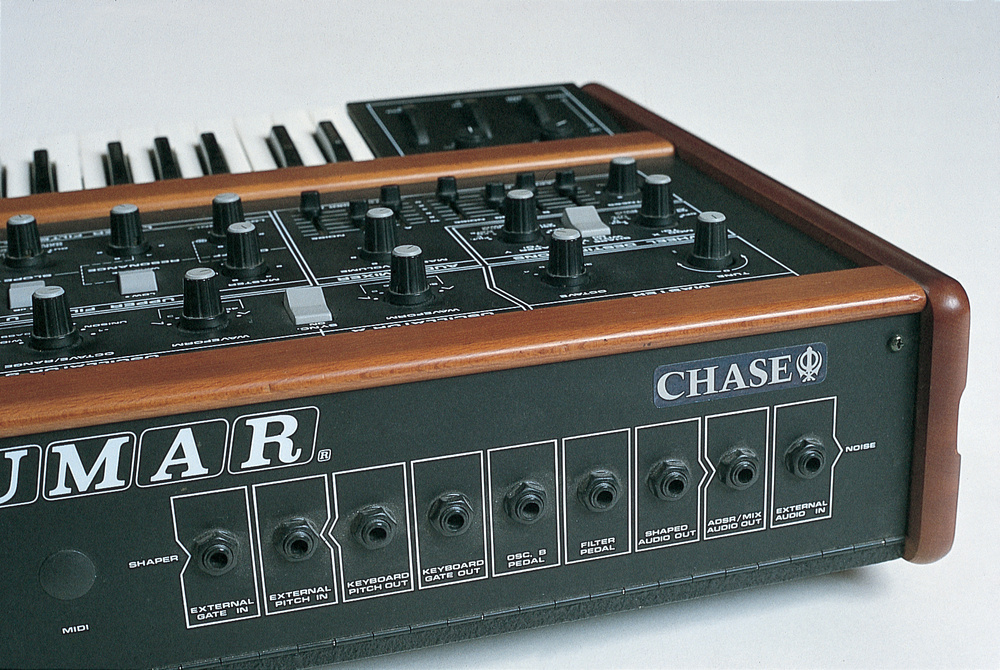
Of course, no vintage synth is complete without a selection of rear-panel inputs and outputs, and — as you might expect — the Spirit is no slouch in this department, either. For one thing, it offers individual outputs for the Filter/ADSR and Shaper Y audio paths, thus allowing you to direct the two timbres to different mixer inputs and effects paths. There's also an audio input that replaces Noise in the internal signal paths, so the phenomenal filtering and shaping power of the Spirit can be applied to external signals.
As for voltage control, there's a Filter Pedal input that controls the Lower and/or Upper filter cutoff frequencies, and an Osc B input that controls the pitch of oscillator B (which is ideal for sync sounds). Of course, there's nothing stopping you from using these inputs as general CV inputs, if you wish. Oh yes, and there are conventional CV and Gate inputs and outputs too.
All of this means that, despite its 'integrated' appearance, the Spirit is a superb addition to a modular analogue synth setup. It can provide all the keyboard functions needed, and offers a bountiful supply of voltage controlled wotsits to patch into the modular system itself.
Unfortunately, we'll probably never know whether we can attribute the power of the Spirit directly to Bob Moog, but there's no doubt in my mind that, as a performance synth, it ranks alongside the Minimoog. Sure, they sound different, but they both beg you to play them. If there is a difference between the two, it's in the Minimoog's immediacy: you can hardly fail to conjure superb sounds from it, whereas the Spirit demands that you learn and understand its complexities. Above all, the Spirit is a synth that rewards patience, experience, and a lot of thought, rather than aimless knob twiddling. But once you've mastered it, all the classic analogue timbres are at your fingertips.
And Afterwards...?
Despite its power and flexibility, the Spirit was to be the last monosynth produced by Crumar. Indeed, it was the last instrument to bear the Crumar name because, in 1984, the company launched an analogue polysynth under the name 'Bit'. Designed by none other than Mario Maggi — the man responsible for the Elka Synthex — with dual oscillators, dual contour generators, and bonuses such as MIDI, velocity sensitivity, unison, splits and bi-timbrality, it compared favourably to more expensive instruments. But the Bit One was not a DX7, and it provided none of the crisp, new sounds that dominated music from 1983 until 1988.
Nevertheless, Crumar released three incarnations of the Bit. After the Bit One, there was the improved and remarkably affordable (£499) modular version, the Bit01. Finally — in the autumn of '85 — the £699 keyboard version of the '01' appeared. Called the Bit99, this addressed many of the Bit One's shortcomings, and remains a useful but under-rated polysynth to this day.
To give Crumar credit, even in the late '70s they were well aware that the era of analogue synthesis had passed. But whereas adding a microprocessor to an analogue synth was not too expensive — either in terms of development time or cost — designing a true digital synth was beyond its means. Furthermore, Castelfidardo did not have a large industrial base or a university with which to share the R&D burden, so Crumar turned to the USA to co-develop a generation of digital instruments to release alongside its low-cost synths.
In collaboration with a New York company called Music Technology, Crumar first produced a groundbreaking digital synth called the GDS (the General Development System) which was used extensively by Wendy Carlos. This then became the precursor to the Synergy, another pioneering instrument, and one that deserves to sit alongside the Fairlight CMI and the early Synclaviers in the pantheon of synthesizer history. But neither the GDS, the Synergy, nor the Bits could beat off the onslaught from Japan, and in 1987 Crumar ceased trading.
Epilogue
Although Crumar disappeared in the late '80s, other Italian manufacturers were more fortunate. Elka were reinvented as manufacturers of MIDI master keyboards, while Siel were purchased by Roland Corporation, and survived as that company's European division. Generalmusic (GEM) manufacture digital synths and workstations to this day.
But of the deceased Italian synth manufacturers of the '70s and '80s, Crumar is the saddest loss. In retrospect, they were a hugely important company because they made keyboards that were cheap enough for players who would otherwise have been restricted to lusting after unattainable instruments in shop windows. And who knows what they may have developed had they survived? If Crumar had released a polyphonic version of the Spirit it could — with perhaps the honourable exception of the Yamaha GX1 — have become the most sought-after analogue polysynth on the planet. How's that for an endorsement?
Chips With Everything
The Spirit is a treasure trove of desirable synth chips, with a pair of CEM3340 oscillators, a pair of CEM3350 Dual VCFs, and no fewer than six CEM3360 Dual VCAs. If this means little to you, I should point out that the 3340 provided the voicing for the Moog Memorymoog, the Oberheim OBXa, OBSX and OB8, the Roland SH101, MC202 and Jupiter 6, early revisions of the Roland MKS80 Super Jupiter, the Rev.3.x Prophet 5s, all Prophet 10s, the T8, the Pro One and the Prophet 600.
Likewise, the Spirit shares its filters with the revered Rhodes Chroma, a fantastic polysynth of huge sonic potential, let down only by its unreliability. And the 3360 VCAs were used in a huge range of instruments, including the Ensoniq ESQ1 and SQ80, the Linndrum, the Memorymoog, numerous Oberheims, the PPG Wave 2.2 and 2.3, the Chroma, the Jupiter 6 and MKS80, and some of the Prophets.
You may wonder why I've taken the trouble to list all these instruments, but there is a point. If you look back at all the synths I've named, there isn't — sonically speaking — a single turkey among them. The Spirit shares its architecture with the very best.
There's Always Room For A Few Digits
Inevitably, given the sophistication of the Spirit's keyboard scanning, it boasts a fair amount of digital technology under the hood. A quick glance at the schematics reveals a selection of decoders, scanners, adders, flip-flops, shift–registers, a D-A converter (to provide the pitch CV) and even a computer connector, presumably for diagnostics and servicing. But none of these lie in the signal paths. Where its sound is concerned, the Spirit is as analogue as analogue can be.
Two Models?
Despite the Spirit's rarity, there are two models, cosmetically if not electronically. Early models were finished in the dark wood shown in the photo above (this is serial no. 00017) but some later units were housed in a gorgeous, lighter coloured case. The Spirit in the now-defunct Museum Of Synthesizer Technology was one of these 'blonde' models.
Before The Spirit: The Crumar DS2
Crumar released their first true synthesizer in 1978 — a full eight years after Moog and ARP defined the market, and more than four years after Korg and Roland began their domination of the low-cost arena. Consequently, and despite a good range of features and a price of just £495, everybody overlooked the DS1. The same fate befell its more heavily endowed brother, the DS2. In many ways identical to the DS1, but with a fledgling polysynth section, the DS2 cost £645 (later rising to £725), and sold equally few. Like the Spirit, the DS2 is a twin-oscillator monosynth with a 24dB/octave resonant low-pass filter. And, like the Spirit, the DS2's greatest strengths lie in the modulation capabilities of its twin LFOs. The warmth of a Minimoog or Pro One is far out of its reach, but it is capable of some expressive lead sounds and a huge range of sound effects.
In contrast, the DS2's polyphonic section is laughably limited, even by the standards of 1978. However, many of the monosynth's facilities act upon it, allowing it to create an unexpected range of percussive timbres.
The Crumar Family
Because of its undoubted success as a purveyor of all cheap things piano-like, organ-like, and stringy synth-like, Crumar was never perceived as a serious synth manufacturer. In the UK, this situation was exacerbated by the London Synthesizer Centre (later known as 'Chase') who advertised every instrument at double its true price, then offered it as an "amazing, unrepeatable half-price bargain".
Despite this, or maybe because of it, Crumars flooded the market. The company's electronic pianos were very cheap by the standards of the time, as were its string machines, which cost a fraction of the prices of the up-market instruments they sought to emulate. When, in 1977, Crumar released the aptly named Multiman, it was the first of the so-called 'multi-keyboards', and this broke the ground for many instruments that followed, including Crumar's own Composer, Stratus, and Trilogy.
In the end, there were nearly 40 Crumar keyboards, two sets of 'Chase' bass pedals, three 'Bits', plus a couple of Bits and a master keyboard rebadged under the 'Unique' name in the USA. Here are a few of the more interesting ones, with a list of suggested prices guaranteed to drive your "yeah, well, mate, it's expensive 'cos it's analogue..." dealer up the wall.
| Instrument | Suggested value | Comments |
| Organiser | £50 | A portable drawbar organ that sounds great through a Leslie simulator. |
| Stringman | £50 | Used by some surprisingly famous '70s names. |
| Brassman | £50 | A dedicated brass synthesizer. Rare, but not sought after. |
| Multiman | £50 | Crumar's first multi-keyboard. Known in the USA as the Orchestrator. |
| Composer | £100 | A better multi-keyboard, with Strings, brass, mono and polysynth. |
| Trilogy | £125 | A typical '80s multi-keyboard with strings, poly/brass and organ sections. |
| Stratus | £90 | The Trilogy's simplified little brother. |
| Bit One | £100 | This six-voice polysynth caused quite a stir when it was launched in 1984. |
| Bit 99 | £175 | A more reliable Bit One with more memories and a usable MIDI spec. |
| Bit 01 | £125 | The Bit 99 in module form. Well worth snapping up. |
As for the Spirit itself, I'd put a value of around £350 on it, but if you don't own one now, it's unlikely that you ever will. Estimates of the number built range from about just 100 to 300 or thereabouts, and those who have them seem to be hanging on to them. Sorry!
A Little Glide
Even the portamento on the Spirit has two modes. When simply 'On', it acts in the same way as the portamento on most vintage synths, slewing the transitions between keyboard pitch CVs at a rate determined by the Glide knob. But in Auto mode, it does this only when you hold the first key while playing the second. This allows you to add portamento (or release it) by adjusting your playing technique to suit. It's just one more way in which the Spirit exceeds most other synths' performance capabilities.
The MIDI Spirit
Despite being launched at the very birth of MIDI, in 1983, the Spirit has a hole in its rear panel marked 'MIDI'. This is covered by a plastic grommet, and there are no electronics inside the synth to take advantage of any socket that might have been installed. Moreover, nobody has developed a MIDI interface for the instrument. (Who would, with a potential market of virtually zero?) Consequently, it's very unlikely that there will ever be a MIDI Spirit. Oh well, it's fun to dream.