

 Wyclef Jean (left) and Jerry Wonda grew up together, and now form an in-demand production and writing team.Photo: Dave King
In 1996, the Fugees came like a breath of fresh air into a world of hip-hop that was becoming stale around the edges. Now Wyclef Jean is a star in his own right, and has deployed his production talents for artists ranging from urban legends like Funkmaster Flex and Cypress Hill to Whitney Houston, Michael Jackson and even Tom Jones.
Wyclef Jean is the quintessential American immigrant success story: he moved with family to New York City from Haiti, the buckle of the central Caribbean's notorious island poverty belt, at the age of nine, ending up on another island of sorts — the Marlboro Houses council flats in Brooklyn's Coney Island. Don't be misled by the neighbourhood's fame as a late-19th-century resort area; in the 1980s, when Jean was growing up, this area around the last stop on the F train subway was still like Moss Side with a beach.
It was also a place where much of the new wave of Caribbean immigration was settling, where Puerto Ricans had been replaced by Haitians and Dominicans, and its musical and cultural eclecticism fit Jean's inclinations well. Hip-hop and rap blared from car boots filled with 18-inch subs, rattling auto and apartment windows alike. This sonic palette, in which everything a 100dB sound wave hit would become a resonant instrument itself, probably reminded Jean of his earliest encounter with a musical instrument, the tambu, a conga-like drum he played as a child in the Haitian town of Croix-des-Bouquets. It fit well with the musical influence conferred by his father, a minister, in whose church Wyclef and his cousin Jerry Wonda — who is still Jean's collaborator on production and composition to this day — would direct (and eventually record) the choir.
 However, Jean doesn't think of himself as a Haitian-American, and though he has been quoted as referring to himself as "100 percent Haitian... Haiti till I die!" and has been dubbed by the press as the 'ambassador to the world for hip-hop,' in conversation he will tell you that he is neither a diplomat nor a hyphenated American, but rather "first and foremost a human being."
He is also one hell of a musical savant, as well. His Grammy wins and nominations are out of proportion for someone barely in his '30s, and his discography is equally extensive. After buttressing his native musical talents at high school in New Jersey, where he learned guitar and studied jazz, his first group, the Tranzlator Crew, evolved into the Fugees, named for the slang for 'refugee' — a status Jean had emotionally long since left behind but still empathises with. Also featuring Wyclef's cousin Prakazrel Michel (aka Pras) and Michel's high-school classmate Lauryn Hill, the Fugees would go on to blend jazz, rap, R&B and reggae into a multi-platinum career whose second record, The Score, hit number one on the pop and R&B charts in 1996. Lauryn Hill's vocal on the remake of 'Killing Me Softly With His Song' and Wyclef's cover of Bob Marley's 'No Woman No Cry' demonstrated a remarkable courage and cleverness: besides making these classics contemporary again at a time when rapidly consolidating radio was looking for sure things, the songs' familiarity allowed the production chops Jean and Wonda brought to the recordings to shine through — simple, clear, just a hint of urban edginess and, most importantly, the elusive and difficult-to-define 'vibe', the Holy Grail of urban record-making. What attitude is to rock, vibe is to hip-hop, and Wyclef Jean has supply to spare, as is amply evidenced byy his recent album The Preacher's Son.
The album was among the first to be recorded in Jean's new Platinum Sound studio, whose rooms are split between Jean's work and outside clients. It's located on the second floor of the building that formerly housed Warehouse Studios on West 46th Street, once Manhattan's nightclub row, next door to Joe Allen's bistro and on the fifth floor, three levels up from the New York City offices of Solid State Logic. Small wonder that Platinum's two studios are populated by 9000J and 9000K consoles. In a New York studio, it's rare that a spare capacitor is closer at hand than a pastrami sandwich.
 Jean's Platinum Sound studio features two SSL rooms, both with SSL consoles. This is the J9000.Photo: Dave King
The Fundamentals
Wyclef Jean's own roots in Haiti are firmly embedded in his memory and his music. "What I recall are the acousticals," he says. "The fundamentals. That everything was an instrument without being electrical, man. When we got technical later, that was just an addition. Percussion, guitars, everything was acoustical. You could hear the reality of the sound right in front of you. In you. It was Caribbean music. When I came to Brooklyn I listened to whatever they were playing in the trucks and cars, hip-hop mostly. And reggae. All that music I make now comes from that background. I'm a musical person and it all just went into making me who I am... Hold on, I got Clive Davis on the other line..."
Wyclef takes a few minutes to talk with Davis, former head of Arista Records who now heads the wildly successful J Records, developing artists such as Alicia Keys. Jean has a joint venture label deal with J Records.
He returns from the call, saying "I gotta make a change to my record for Clive. There's a track with me and Wayne Wonder and Elephant Man — 'Doctor'. Clive wants to make sure the vocals are up far enough and the drums are louder. I don't consider [Clive Davis] a producer. He 's a music man. Our conversations are about chords, major and minor, Mixolydian [scales]. They're very healthy music conversations. Any producer knows Clive Davis has been around a long time, around way before me. I don't take his comments lightly. We talk about pushing the envelope of a record."
As to the influence of radio on those decisions, Jean says, "I don't know how my stuff gets on radio, 'cause it doesn't sound like any other records. My records get on all the charts in all formats, all over the place. 'Maria Maria' [with Carlos Santana] got on all the charts. '911' [a hit duet with Mary J Blige] got on all the charts. It's my eclecticism that does it."
The Fugees, and before that the Tranzlator Crew, were Jean's developmental vehicles, as a composer, performer and producer. 'We were Haitians in America and we felt like we were translating the music for here. We rapped in five different languages. World slang for 'refugees' is 'fugees', and that's who we represented. I wasn't doing nothing different from what Miles Davis or Dizzy Gillespie was doing. They travelled the world interpreting music, too. They used all the music they found. I just happened to be growing up in the time of hip-hop, but I could take a breakbeat and fuse it with Bitches Brew. My edge is hardcore street edge, but I'm aware of jazz, of country music, of classical. It can all be fused. When I'm chillin' I listen to everything. I like Bob Dylan's 'The Joker Man', it's a kind of obscure cut of his. And Johnny Cash. I cut a record on his 'My Delilah'. I listen to Miles Davis. I'm a music man."
Waiting For The Ears To Twitch
Wyclef Jean came of age at an interesting time in technology, when certain key items, such as the drum machine, were poised to become the instruments of urban music, just as the Stratocaster had for rock & roll. "The way I learned was with a single format — a Linn 9000 [sampling drum machine]," he explains. "Kalise Bayon from Kool & The Gang taught me how to use it. It was the fastest way to make music. All you needed was a Linn 9000 and a keyboard. That's where I got my recording style. My cousin Renell bought me and Jerry [Wonda] a little Tascam [multitrack] tape recorder and we started cutting to that with the Linn and an [Ensoniq] VFX keyboard. Than I needed to plug my guitar into something and I just plugged it right into the Tascam, so we were always recording live. What I was learning was to make it happen as quickly as possible and find the sounds we wanted as quickly as possible. That's where I got my recording chops. I'll tell you a secret about 'Killing Me Softly'. I wanted a Fender Rhodes piano on that track but we didn't have one. So I took a sound in an S900 sampler and put a delay on it and detuned the sampler and played it like a Rhodes and it sounds like one. We just had to invent shit as we went along.
 The live area for the Platinum Sound J-series room.Photo: Dave King
"In the studio, I have two [engineers] I work with, Andy Grassi and Serge Tsai. Andy did a lot of drugs in the '60s and he's of the hippy generation, and he has mixed for everyone and their mother, so if I want a Nirvana guitar sound, he knows how to get it for me. Serge is from Amsterdam [Rotterdam, actually; see sidebar], so he's a pothead, but they have a certain style of production over there. He comes up with weird delays and things that only a guy on Amsterdam weed can come up with."
Still, Jean can be very hands-on when he wants to. "I start by taking every effect off of everything. I just want to hear the sound raw and pure. When you put effects on a the sound right at the beginning, you lose the natural elements of the sound, the elements that inspire you. These are the raw elements that you build from. The human ear can hear three things at a time. If you're blessed with a gift like mine you can hear dog whistles, so maybe I can hear four things at a time. But I just get in front of the Genelec or Yamaha speakers and wait for my ears to twitch. That's what you wait for. I can't explain it other than that. It twitches. It tells me where to put things. I'm looking forward to checking that out when I do some of my next CDs in 5.1."
If sampling is integral to urban record production, ripping is its dark side, and Jean has gone on record stating that he is unhappy about how artists lose out when songs are downloaded illegally. How does that jibe with the fact that much of rap is based on samples of other people's records?
"Sampling came from us listening to old records," he replies. "We grew up with the Stylistics, so we would loop a Stylistics beat and use it. There's nothing new under the sun — everyone is influenced by someone else, there's only so many chords in a musical scale. What we were doing with sampling, we were doing out of love, out of respect for the artist. We weren't thinking that we were ripping him off. That's opposed to you taking my whole CD and downloading it for free. That's different."
Given the wide range of artists that Jean has worked with over the years, how he chooses who to collaborate with is interesting. "I have to be a fan, or else I look for groups that are just coming up, not famous, like Chen of Rough Riders, who is a Chinese rapper. Destiny's Child was like that. They were new when I gave them their first hit. Same with Mya; we gave her 'Ghetto Superstar Surprise'. With Destiny's Child's first hit, 'No No No', I had them sing the melody in triplets, like a rap. Radio thought the singing was too fast but the next thing you know it was a hit. That was a very low-key production. We made it somewhere in Texas, very low-key."
Wyclef Jean's Tech Support
Serge Tsai has worked with Wyclef Jean for the past five years, alongside the producer's other regular engineer, Andy Grassi. The Rotterdam native is the detail man when Wyclef is deep inside the vibe. But part of the speedy approach to production that characterises Jean's records is having a set pattern of production techniques.
"I'll always have the Neumann U67 set up," says Tsai. "That's our main microphone. We'll try an 87 or a 251 on occasion, but it almost always goes back to the 67. It just works for everything. The same for the Pro Tools HD rigs we have. They're big — 24 inputs and 64 outputs. We just use a lot of the same gear for most of what we do. Everything is always plugged in, the MPC for percussion, the guitars, and a DAT machine is always running, to make sure we catch every idea as it goes by. The studio is always in 'ready' mode. Like Wyclef says, the vibe will take care of the rest."
One of Platinum Sound's two studios, the one fitted with the SSL 9000K, was designed originally by Tom Hidley, and his trademark front-wall monitoring system still dominates the control room's front wall, though it's now loaded with TAD components. The second studio, with a 9000J console, was designed by Frank Commentale, who did several other rooms in New York that have appealed to Jean over the years, including Chung King and some of the rooms at Hit Factor. It's fitted with Augspurger monitors, and both rooms use Genelec 1032/1074 and KRK E8 nearfields. Commentale also tweaked the original room's acoustics, while Andy Grassi did the wiring designs for both rooms.
"When I first met Wyclef and Jerry Wonda, they were definitely tape guys," Tsai says. "I was with them as they transitioned to computers and to Pro Tools, and they were not immediately down with that approach to recording. But once they saw everything they could do digitally, they were totally hip with it." A Studer A827 multitrack is on hand, a remnant of the Booga Basement days, but is hardly touched lately, Tsai says. "It's not like I don't like tape, but I know what tape sounds like, and I can simulate it pretty well when we're recording digitally. It's all in using multi-band compression wisely. I'll send the signal out from the buss on the 9000K to various compressors and return them through different EQs. You can make the sound bounce a little, like it does on tape, and this also adds a little bit of noise to the signal — the kind of grunginess that you get from analogue tape."
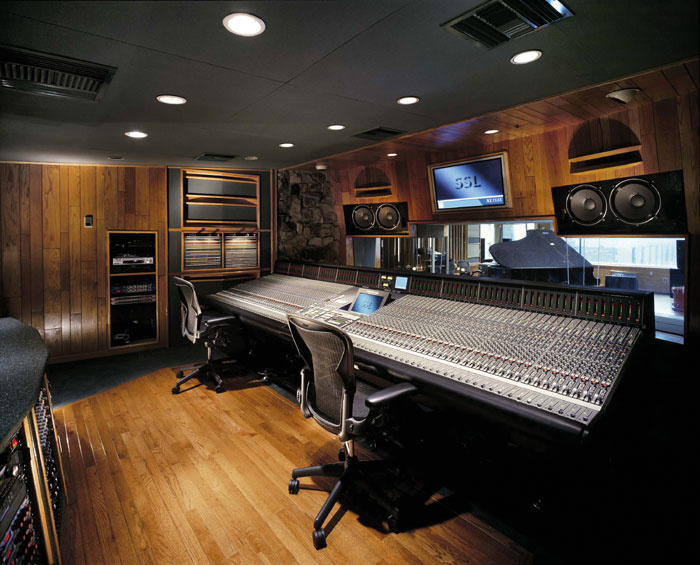 The other Platinum Sound control room, with its K9000 SSL console.Photo: Dave King
Andy Grassi was a staff engineer at the Hit Factory in Manhattan when he met Wyclef Jean and Jerry Wonda in 1998, when the producers came into the studio with singer Joan Osborne to work on a song for a movie soundtrack. He's been their regular engineer ever since, a post gained, he says, because of his experience with live rock records as well as hip-hop. He brings that combined experience to their sessions, as well.
"This is hip-hop very often, but there's also a lot of live recording of instruments going on, as well," Grassi explains. "The trick to what I do is to find ways to balance hip-hop's need for spontaneity — someone will just grab a microphone and wail at any given moment — and getting everything recorded clearly and without distortion. And that balancing act has gotten more interesting since we put Pro Tools in, because the sessions move a lot faster now."
Grassi says he likes to set up microphones around the recording room as through he was preparing a live tracking session, even though most of the percussion is created by Wonda on his Akai MPC3000. "Jerry has a lot of acoustic drums that we recorded sampled to the MPC," Grassi says. "It's a good sampler when you go in through the digital input; the analogue ones tend to sound kind of grainy. So I try to get Jerry to record digitally. I also keep an amp head set up in the control room with a cable running to a speaker cabinet in the studio. I always want to try to have things that actually move air on the tracks. Even when we're using digital drums — which is most of the time — I use a few reverb tricks, like very short setting and fast slaps, to give the sense that there's some air around the drums. The [Roland] Dimension D unit is especially good for making a digital kick drum sound like it has four walls around it."
Tsai and Grassi split mixing duties, which Jean acknowledges are not his cup of tea. "I just come in now and then and say change this or that's OK," he says. Basically, says Tsai, a day will often start with a beat, a bare skeleton of a song, and by day's end it's a finished track. "We don't record tons of stuff," he says. "Wyclef usually knows what he wants and he'll get right to it. If we record horn parts, he'll pick and choose a bit, but mostly we go right for what he has in his head the first time. Track it, record vocals, a few overdubs, and mix it. Next."
Going Platinum
Given the scale of Wyclef's production schedule, it was inevitable that he and Wonda would eventually need an expanded version of the studio they had built several years before across the Hudson River, in New Jersey. Platinum Studios opened last year. "We used to have a studio in New Jersey, Booga Basement," he says. "But I decided a while ago that, as a businessman, I'm not going to give [commercial studios] millions of dollars that I can use to build my own studio and where I don't have to watch the clock. We have two rooms, one with an SSL J and one with a K. But I like Neve sounds, too. I love the mic pres, EQs and compressors. I love the SSL compressors. We have a lot of digital gear, and we record to a Pro Tools system, but I like the warmth of an analogue console. But the important thing was that we made a place where the artists feel as comfortable working as we do. That's why I like it that we have the entire floor, for privacy. We also have a policy of not disclosing who is working here.
"Before this, I worked in just about every studio around New York City. Hit Factory, Chung King, Sound On Sound, House Of Music in New Jersey. I'm a studio whore. Different studios have different vibes, and that can affect the music one way or the other. But the risk is always that it can slow you down when things aren't flowing, when people have to be told to do things instead of just knowing that this is what you're going to want for a vocal or for a guitar part. Nothing's more important than keeping the flow going. That's part of vibe. Especially since I'm writing everywhere, 24/7. All the time. In the street. On the bathroom. On the motorcycle. The key to the way I work is that everything always be ready. The microphones set up, the sounds ready. If I pick up a guitar and get into a vibe, they know it in the control room and they know to turn on the guitar amp microphone. Vibe is all about spur of the moment. Being ready when the thing happens. You don't want to miss it when it happens."
Vibe. The magic word and elusive state of grace in urban music. "That's it," he says. "There's no second takes for vibe. If you can't get it after 10 minutes, don't even bother any more. It's about the moment. When Mick Jagger worked here with us, when Carlos Santana worked here, it was the same thing."
 The K-series room also boasts an impressive live area.Photo: Dave King
Getting Together
Wyclef Jean's collaborations have produced many memorable tracks, such as 'Maria, Maria' which he created with Carlos Santana. "That song was inspired by West Side Story, which I had seen the movie of," he recalls. "West Side Story, East LA, it's all the same. I wanted it to be a sexy story, and Santana is a guitar god, and he can play anything sexy. Carlos knew how he wanted his guitar amp miked; my job was to make sure that we captured what he did and translated it to what the song needed. He would play a part, it might go for four minutes. I'm listening for the part I want, it might be a minute of that. I find it and loop it. We do that a lot — find the parts out of longer passages and then move them around, arrange them into a song. Now, we could have Carlos play the parts over and over again and put them in the right places, but we use technology instead. We make loops and move them around. Look for the parts that strike you as the theme of the song, in terms of its vibe. We don't want to cut and paste the whole track, but the thing is to find the parts with the vibe and capture them, then put into the places you want them. I don't want to get between him and the energy of the recording. Then the magic is lost."
Jean takes a similar approach to producing vocals. "Record everything, never erase anything, when it's going let it go — I rarely stop it in the middle," he exclaims. "Then you f**k it up. Some people like to cut vocals in parts, but I like to try to get one full pass, then fix it as needed. I really don't like to use Auto-Tune. You work with great singers, you'll get what you're looking for if you give them space and the right vibe to play off of. That's why rap records are so great, so full of vibe. Because they're not perfect. You can hear someone yelling in the background. It's there, on the track. So be it. That's what Thelonious Monk would say — so be it. The dirt just goes along with everything else on the record. Only Patti LaBelle got her part on my record down perfect in one take. One single take."
 As he said earlier, Jean needs to be a fan of an artist before he can commit to working with them. But when it comes to artists such as Mick Jagger, Santana, Michael Jackson or Tom Jones, does he ever give himself a chance to just sit and listen and enjoy their presence?
"I do," he replies. "I did with Santana. I realise this is the legend sitting here. I want to sit and listen, but then I also know I have a job to do. We have to make a record, so I move my head into that space and get to work. Mick Jagger is incredible. We did work on his last solo album. He would play a run on the guitar and I'd love it and make loop of it and play it back to him and he'd make up another part. He's another guy who looks for the theme to build a song from. He understands vibe. Michael Jackson is larger than life, like a star should be. It's fun to watch how he interprets rhythm. He moves his head in one way, that Egyptian thing, side-to-side. But at the same time, he moves his feet and makes a drum part. It's like his mind is analysing the rhythm and his feet are performing it. It's as if he's turned his whole body into an entire drum kit and is playing it."
But it's the ultimate Caribbean musical ghost that infuses Jean's own spirit, an artist he can now never collaborate with: Bob Marley. "It's automatic. He's someone I grew up on," he says. "I felt like I had met him when I listened to his music. Music is an appreciation of history. Every piece of music links you to another. Quincy Jones is like my father in music. He came from Cab Calloway's band and then he flips over and produces Michael Jackson. You have to know where music is coming from to know where it's going."
The Hard Disk Pro Tools Generation
Wyclef Jean's take on the future of production is that technology will continue to progress and we'll all just keep getting used to it. But don't count on limos for everyone, like it used to be. "We're in the hard disk Pro Tools generation now," he says. "You can be in Tennessee and I can be in New York, and if you get an idea you can play the part and email it to me and I can add to it and send it back to you. I do that with Missy [Elliott] all the time. We're getting into the computer with music. I don't think that's a bad thing. I don't think you'll be able to make a complete record that way, but you can build the song. But the business is changing. The record labels are getting more strict. They'll tell you now, 'You got 10 hours to make me a record, f**kface!' Ha! Like it used to be. No more rock star stuff. But that gets you to the essence of the song very quickly. Maybe it's a good thing."