

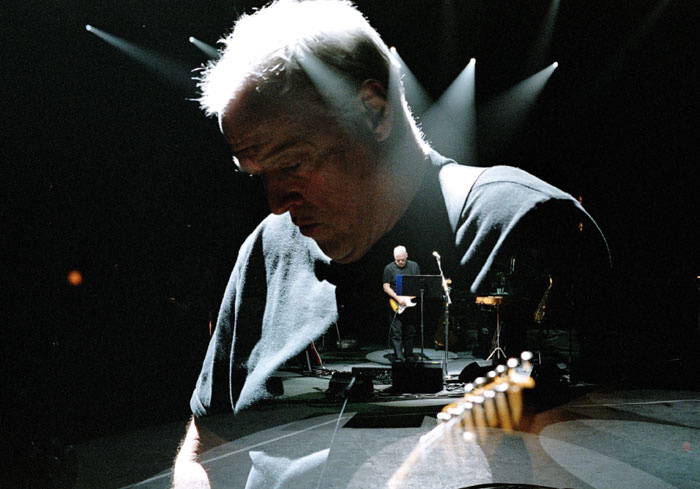
 Photo: Polly Samson
David Gilmour's chart-topping solo album was recorded on his own Astoria houseboat, a floating slice of studio heaven. Engineer Andy Jackson describes the making of the album.
On An Island, David Gilmour's third solo album in around 30 years, was one of the most high-profile releases of the year, yet it was recorded and mixed mainly on David's Thames-based houseboat studio, the Astoria, which has little more space than some of the home studios I've visited. Admittedly it is kitted out with Pro Tools and a lovely Neve analogue mixing console, and it has an enviable microphone collection, but a lot of what ended up on the final album started out as David's self-engineered demos. These were made in his home, before subsequently being sifted and reworked with the help of his friend and neighbour Phil Manzanera, who Gilmour has known since before Phil joined Roxy Music. Of course any project of this size needs a safe pair of hands in the engineering seat, and that task fell to Andy Jackson, who's worked with David Gilmour and Pink Floyd for well over two decades. Indeed, this interview had to be postponed for a week or so when Andy was called upon to step in and mix a couple of Gilmour's live tour dates.
"I started in 1976 when I got a job at Utopia Studios," says Andy, "which came about after writing lots and lots of letters. One of the engineers there was James Guthrie, and I kind of paired off with him — we tended to work together all the time with me as his second. When he left I moved up, and when the movie for The Wall album came along, he needed more bodies and asked if I could help with that, which I did. That film turned into the Final Cut album, and after that I never escaped — I did a solo album with Roger, a solo album with David and it just rolled on and on. James moved to the States so I became the engineering branch that did everything here. That was 1981, and here I am 25 years later still doing it!"
Bringing Things Together
A lot of the album's songs started life as bits and pieces David had been working on over the years, and he enlisted the help of Phil Manzanera in a production role to help him go through his ideas and see which ones fitted together. It was at this stage that Andy first heard the ideas. "It was all on hard drives as Pro Tools Sessions, as David has a Pro Tools setup at home, and as a musician/engineer, he's good. He also had a couple of really nice mics, Mastering Lab mic amps and EAR compressors, which we'd marked up with Chinagraph, so what we got in was pretty good. He'd started off with over 100 different ideas, where an idea could be as simple as just a few bars of chords or it could be an almost complete song. This was quite familiar to me as Floyd albums also tended to start life like that. He'd worked with Phil Manzanera to whittle it down and to see which bits might work together, moving it more towards finished songs.
"The indulgent part of the project was that we went into Abbey Road Studio One with a band and screened it off to one third of its size with a curtain. We used a six-piece rhythm section just to knock some of the ideas about really. Then we did another session in Studio Two, which was more of a rock band. The first session was more of a jazz band with Jools Holland on piano, Chris Stainton — Nick France on drums. It also included Bob Close, who had been with Floyd in the old days, when they were still the Abdabs or whatever they were called. He's a good jazz guitarist so we cut a few tracks like that. This was all recorded simultaneously to Pro Tools and analogue. We all liked the idea of doing everything analogue but I thought that it just wouldn't happen — Pro Tools is like being a kid in a sweet shop and you're just not going to not do that stuff! You move things, copy things, tighten things up and all the other things we can do, and what I didn't want was for us to record on analogue, copy it into Pro Tools for editing, then copy it back to analogue again! So I was fairly insistent that we recorded to both at the same time, which was a bit tricky, but we're fairly body-heavy and we had the people, so that's what we did.
 Abbey Road Studio One was used to track live band recordings of some of the songs on On An Island, but most of the resulting recordings were scrapped.Photo: Polly Samson
"This was forming the backbone of the album up until the time we broke for the summer holidays and everybody took away a CD of work in progress to listen to. Then David came back and said he didn't like it — he wanted to go back to his demos so we started again. In fact on 'Take A Breath', the drum track that we recorded survived, and we managed to pull some of Jools's playing and some of Chris Stainton playing off those sessions, then lined them up with the demos so we could use it. At that point we were still trying to keep as much as possible on analogue but then David brought in Chris Thomas to oversee the workflow — to wield the cattle prod and get it done.
"One of the things Chris felt is that a lot of the tempos were too slow. It's a fairly laid-back album anyway, completely overtly so, and David's never been apologetic about that. He said 'That's where my head's at, that's what I want to do.' But Chris still felt some of the tracks were too slow so we ended up, after a lot of experimentation, time-compressing some things using Serato Pitch 'n Time in Pro Tools, which is generally regarded as being the best-sounding time-manipulation plug-in out there. The time-compression was a very laborious process, but fortunately somebody else did it — listening to each part, deciding which algorithm worked best for which type of material! This was all done on a second Pro Tools rig in another room.
"There were a few things Serato didn't do so well, but we got round it. For example, it really messed up the kick drum — it added some kind of backwards echo — so we just took some of the uncompressed ones and replaced them manually, lining them up in the waveform display. That didn't take as long as you might think — maybe half an hour to an hour per song. It also enabled us to find a good loud one, a good quiet one, which suited Chris as he likes the kicks to be consistent and well behaved. It worked fine and it didn't end up sounding like a drum kit made of bits.
"It sounds like a lot of cutting and pasting but we did really try to keep some sense of performance. In fact some of the smaller songs, such as 'Walk Yourself Weary', are 90 percent David's demos. In some ways that gives it more of a relaxed feel than if he'd tried to replace some of the parts later.
"'Take A Breath' comprises two pieces that were originally very different — they were even at different tempos and I can't remember now whether we kept the tempo changes or used time-stretching to get them the same. But there's very little of the original that survived, whereas something like 'Smile' is almost entirely David's original demo. That's why I insisted we say the album was recorded by me and him because he did so much of the original recording. If it's good I get the credit and if it's bad he gets the blame!"
Grounding On Water
Having a recording studio on a boat must throw up a few unique technical issues, especially where grounding is concerned, and I wondered whether the Astoria was equipped with a copper anchor! "I've always thought we should just ground it straight into the river but no, we have gone to great lengths to optimise the electrics there, including fancy cable and the whole works. I do the same here in my mastering studio — it's all esoteric cable, exotic mains leads and a special braided grounding cable. No doubt I'll be shot down in flames about this, but when I changed the regular earth cable for the woven one it sounded better, even though the grounding was electrically fine before."
I was interested to hear this, as we've tried to do listening tests on cables in the past and we sometimes hear quite big differences, but the results are hard or impossible to replicate when you take the cables to a different studio. "Absolutely," agrees Jackson. "I've found exactly this when I go to James Guthrie's place in Northern California, being pretty adamant about how I want to do something because it works at home. Then we find it sounds totally different in his room so we have to come up with a different solution. That's really annoying because the subject of cables is such a minefield anyway! I've got to the point where I just call it voodoo and let somebody else worry about the physics behind it. I set myself up to be shot down in flames and then just ignore the people who are doing the shooting!
"What works works. For example, we have a couple of EQs racked up in the studio that came from a Decca broadcast console, which we call the 'better box', because even with no EQ applied, everything you pass through it sounds better. It may be because it has a couple of big, fat audio transformers in it adding a bit of second-harmonic distortion, and we like to hear second harmonic."
An Easy Person To Record
David Gilmour's voice and guitar are both very distinctive, but according to Andy, there's no mystery about how he records them. "Actually, it's very straightforward — voice — nice microphone, nice mic amp, nice compressor. There you go. For reverbs I tend to be old-school and use an EMT plate. I had a couple of plates and a Lexicon Hall — that was our palette. The vocal chain starts with that Sony tube mic with the heatsink on the side, the C800G, and it is the most fantastic microphone. We have a couple of those, one in the studio and one for David to use at home, which is another reason his demos sounded so good. That feeds an old Neumann V72 mic preamp and then EAR EQs and compressors like the ones I use here in my mastering system. I would compress his voice but only fairly gently with a tickle of 2:1, then maybe do that again on the mix. That's with the exception of the rock songs of course, which were completely mashed in a Fairchild! The thing is, David makes my life easy — stick him on the phone and he sounds great! He is not a difficult person to record — great technique and a great voice."
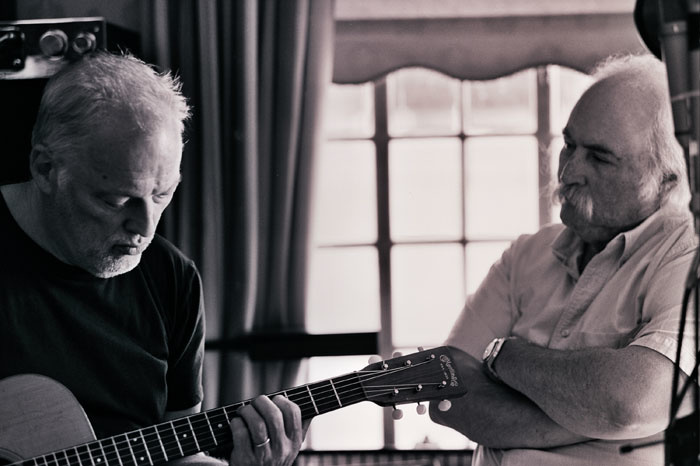 David Crosby (right) looks on...Photo: Polly Samson
During live Pink Floyd concerts, David Gilmour was renowned for using a lot of guitar effects and big amplifiers. I was curious to know what setup he used for recording. "Everyone asks what reverbs David uses, and the answer is none! He uses delays, and it's usually around 700 milliseconds or so. That's on his pedalboard, but apart from that there's probably only one or two different distortion boxes and maybe a compressor. It's not that complex — it's just finely tinkered with and he's got some nice guitars and good fingers. The amp was generally an old Fender Tweed Twin Reverb, with a little bit from his Hi-Watts occasionally. When he's recording at home, he just kind of sticks that Sony mic in a non-specific place in front of the speaker and I tried to replicate that in the studio, but it wasn't really working in our room. Chris wanted to stick an SM57 on it, maybe four inches from the grille cloth and a bit off-axis, but then I put a Coles 4040 ribbon mic next to it, dead in the middle of the cone, and we found that mixing that in behind the 57 really worked. What you hear is mainly the 57, but when you bring up the Coles, the sound just goes 'expensive'. Nearly all the guitar I recorded ended up being done like that — you just have to be really careful about the mic positions and make sure both are exactly the same distance from the speaker.
"Some of the guitars would be from David's home recording as he has a similar amp and effects setup at home. In fact on the guitar solo for 'On An Island' where there are two guitars, the first is a Les Paul and the second one a Strat. He recorded the Les Paul at home using the Sony mic and I recorded the Strat in the studio using the SM57 and the Coles ribbon, so if you want to hear how the two approaches compare, that's a good place to do it.
"With that combination of mics, the guitar had a real bite to it and it's very different to what we have done before. On Division Bell, we used a U87 eight inches to a foot away, a bit off-axis, and the floor of the room on Astoria is carpeted. It's actually very small — around 14 feet square — and sounds fairly dead, so when we record vocals, I just make sure the mic isn't right in the middle of the room as that gives a little 'boing'. All the drums were done there apart from a couple of the really live-sounding ones, as were all the Division Bell drums, and it's good for that typical Pink Floyd drum sound — even though it is [Andy] Newmark on that album, it still sounds like Pink Floyd."
At one time David used a guitar fitted with EMG pickups to play live, but does he record using that too? "He has done, but mostly he's reverted to his old guitar. Division Bell was mostly his red Strat with the EMGs, but Phil Taylor, his guitar tech, thrust his old passive one into his hands and said 'Play that!' He plugged it in and it sounded great — it is a good one. I think he bought it new in 1971 or something, but he's swapped pickups and parts on it over the years and it does sound good. Of course, with those passive single-coil pickups, you have to face Mecca when recording to avoid hum problems! Usually we don't need to do any cleaning up afterwards, other than topping and tailing the various sections so they start and finish cleanly."
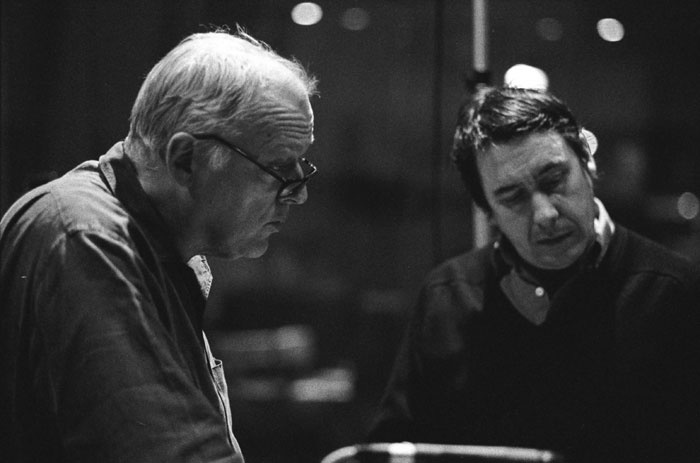 Jools Holland (right) contributes to the album.Photo: Polly Samson
The album also sees Gilmour playing lap steel, with what sounds like a ton of compression to make it sustain — but isn't. "Actually that guitar just sounds like that. It's a very old Gibson lap steel and it has an unbelievably hot pickup. He just plugs it into his rig and that's what comes out. I might occasionally compress some of the guitars on the album, but it was an 'icing on the cake' type of compression with just a couple of dBs here or there because it helped the focus. We have almost the opposite problem, because David plays so loud that when he stops playing everything squeals! When he's setting up, he turns up the levels so it's just about to go, so that he gets the sustain he needs without having to use lots of distortion. Certainly, on stage his amplifier is frighteningly loud, but it's remarkable — he's still got really good ears."
The Measured Approach
As you might expect, Andy is strongly of the opinion that making the right choices at the recording stage is the key to a successful mix. "It's got the point where I keep everything very simple, but then I suppose I've had 25 years of making the choices that have got me to that point. I know what's going to work in terms of what mics I put on things. I always think that if you simply take a microphone and record the world, it's a rather boxy and low middly place. You spend the rest of your life trying to get rid of that stuff. I tend to pull out a lot of low-mid, and with vocals it might be up to 500Hz. That's just automatic for me, then I'll add a little fairly dust. Ditto drums. The way I approach overheads is that I take the old-school Glyn Johns approach and use the overheads as kit mics rather than just cymbal mics.
"One of my favourite tools for recording is a tape measure! It sounds really anal but it's worth it. If you get the two drum overheads exactly the same distance from the snare, it sits bang in the middle of them with no phase problems, and in fact on this project, a lot was recorded for surround as well so I used four overheads set up as a square, all equidistant from the snare. The overheads were exactly a metre and a half from the snare, and I used Coles 4038 ribbon mics, which of course have a figure-of-eight pattern so you get a bit of the room in it, but it sounded good. I had to take out some low mid, but then most of the drum mics get the low mid taken out somewhere or another. I try to pay a lot of attention to what goes on at the bottom end really — the relationship between the kick and the bass. I don't know if I can put my finger on any magic technique, it's somehow just a sum of everything — of experience.
 Robert Wyatt, founder of Soft Machine, another of the many famous guest musicians who contributed to the album.Photo: Polly Samson
"With bass guitars I often find myself pulling out stuff that seems unlikely at around 80 to 100 Hz, which is where all the action is. But you still get the whole sense of weight below it and it just cleans up the whole mix. Same with the kick — sometimes I'll be pulling out stuff in the high bass region and leaving the low stuff in.
"One nice thing about having a pet studio you can go and play in is that myself and Damon, who works there, can try things out without time pressures. There is a studio kit that's left set up there so one day we decided to try out absolutely everything we had to see what sounded the best on kick. I started off with all the things I'd normally choose but ended up liking none of them, which I found really interesting. Finally we tried a Neumann FET47 capacitor mic, and I've stuck with that ever since. It's not the instinctive first choice — most people think of D12s or D112s, but I really liked the result. I believe George Massenburg also likes to use a 47 FET on kicks, and it's fine. Once you stick the pad in it's absolutely happy. I also use a little Beyer M160 ribbon on the snare — there seems to be a phase coherence or something about a ribbon, and it's the same with the overheads. The Coles 4038s are not very bright so it seems odd to choose something that needs a lot of EQ, but once you add some top it sounds great — and somehow better than using a mic that has a naturally extended high end in the first place."
Mastering
 Andy Jackson in his mastering suite.Photo: Polly Samson
As well as manning the controls at the Astoria, Andy Jackson is also building a parallel career as a mastering engineer. "That was a strategic decision I made about four years ago. Aside from the commercial reason that mastering is more buoyant, it's also perhaps a reaction to the Floyd stuff where we'd spend a year on an album — they were enormous projects. With mastering, I really enjoy having a relationship with a record for just five or six hours and my experience in that area has been really positive. It's a time when people have finished the record and are happy!
"I have noticed that some of the stuff coming in now from home studios, where everything has been mixed in a DAW, has a different kind of 'not very well done' feel compared to what I used to get 20 years ago from analogue tape, and in some ways it is harder to deal with. There seems to be a particular kind of digital crunchiness. I don't know what the problem is, but if I play with digital limiters or other processes, they all seem to do it to some extent. I hope I'm not being a Luddite but I still have a degree of suspicion about things digital. It seems that the more you start processing a signal in the digital domain, the more it deteriorates, in a quite different way to analogue."
Mix & Mix Again
Despite his emphasis on traditional techniques, Andy is certainly not averse to using new technology where it helps. "Having recall has made such a difference to mixing. Even when we did [Pink Floyd's] Division Bell we didn't have a recallable mixing board, but there are so many times when you just need to go back and change something by a little bit that it's great to have it now. Of course all the home studio software has it as standard now, but working on an analogue board that doesn't have recall seems preposterous now. I'd be interested to try to do some serious mixing in the box, but I'd need to have first-class interfaces to do that. I'd also need a really good control surface.
 David Gilmour rehearses with his touring band, featuring Phil Manzanera and Pink Floyd's Rick Wright, for live dates in support of the album.Photo: Polly Samson
"David's album was done on Pro Tools, but we used it as a tape machine where everything came out of 48 outputs and got mixed on the Neve analogue board. There was some submixing inside Pro Tools, but then if we'd been working on two analogue 24-tracks locked up, we would have had to bounce some things down to stay within the track count anyway. In that case it means you're doing the summing digitally rather than analogue, which means you can undo the bounce if you have to, which we did on occasions. We had to do a little processing with plug-ins within these submixes, for example, when we recorded the Crosby and Nash vocal parts for 'On An Island'.
"I must admit that it quite surprised me that they recorded their parts one at a time when I'd set up assuming they'd sing together, perhaps with David adding a third part — a kind of Crosby Gils and Nash! That ended up coming up on the board as a stereo pair, but then I had to use a plug-in to EQ Crosby relative to Nash, just to tip him up a little brighter to match Nash. But the bulk of the EQ was done analogue afterwards."
The rest of the album was also recorded and mixed in fairly traditional fashion. "There are odd bits of Kurzweil and maybe the odd bit of synthetic Rhodes, but mainly it was old-school mic recordings plus using the EMT plate and things like that. It was mixed through the Neve analogue board and onto half-inch analogue tape. I think David looks back to some of the things we did in the '80s using AMS reverbs and things like that and says 'What were we thinking?' You can listen to the plate all this time later and it still doesn't sound old-fashioned.
"I did use a Lexicon 480 for the preset hall used on the orchestra and things like that — you'd think that when you record in Abbey Road Studio One the last thing you need is more reverb, but we did! On this album it felt like I needed to have a great deal of control so I could always get back to where we were, and the EMT plates plus the Lexicon were all we needed. But I'm a great fan of things like the TC System 6000 and we did use Altiverb on a few daft things, such as to get the effect of the fireworks in the opening section sounding as though they were outside [using the 'Forest by Lake' impulse response]. I think they originally came from a stock sound effects library. We had a flirtation with trying to record our own sound effects using Holophonics back in the '80s, but it's really hard to get anything that's any good."
Phil Manzanera: Co-Producing On An Island
Phil Manzanera and David Gilmour have known each other since the late 1960s, and their friendship progressed naturally into a production partnership. "I live close to David's house in Sussex," says Manzanera, "and I would regularly visit him and ask him whether he'd been recording. It turned out that he'd been doing stuff over a 10-year period, and had so much that he didn't know what to do with it. I suggested that I come round once a week and we'd go through these pieces together. Many were on Minidisc and recorded in his kitchen or living room. David began by selecting perhaps 150 pieces, enough for three albums. I picked some of these and took them to my studio. Together with my engineer, Jamie Johnson, I would try and develop these ideas. Sometimes we'd make loops, sometimes I'd take vocal lines from one song and stick them in another, just to create something different and weird. The next week I'd play David what I'd done and he'd give feedback.
"David and I spent most our time together at his home studio, where he has Pro Tools, a 12-channel mixer, a fantastic Sony microphone [the C800G], and a couple of good limiters, Urei I think. It's all very simple, but of high quality. David did all the engineering. It is a nice room with high ceilings, looking out over the countryside, and there are birds twittering around everywhere. The birds you hear all over the album were just picked up on the microphone in his home studio. What he recorded there has a feel that can't be recreated anywhere else. The songs 'Smile' and 'Where We Start' were almost entirely recorded by David at his home studio."
Work began in May 2004 and continued for six months at Gilmour's home studio and Manzanera's Gallery Studio, where he has a Euphonix desk and a Pro Tools setup, but works mainly in Logic. Even when sessions moved to the Astoria and Abbey Road, Manzanera still found time at the Gallery to concoct all manner of ambient atmospherics. "The rhythmic thing in the background on 'This Heaven' is a loop based on a sample from David's Minidisc," says Manzanera. "It was recorded in the kitchen with children shouting in the background and Polly [Samson, Gilmour's wife] talking, and so on. Once she and David had decided to call the album On An Island it really helped me with my conceptual thinking and with the making of little soundscapes.
 Phil Manzanera co-produced On An Island.Photo: Polly Samson "For the opening track, 'Castellorizon' [the name of the Greek island to which the album title refers], I took samples from all over the album. I put them all in the same key, and messed around with them. 'Then I Close My Eyes' was originally just a jam of David and [pedal steel player] BJ Cole, so I took this guitar riff from the Minidisc and made a backwards loop out of it. I then made an ambient soundscape from the soundtrack of a video shot at Castellorizon, with David in a boat, playing the cümbüs. So there are waves lapping and him playing and a ferry going past, and I slowed down a double bass playing harmonics and created this musical collage that was grafted onto the front of that track.
"I also made up an ambient track for 'Red Sky At Night', with children's voices and other sounds, while 'Take A Breath' has underwater sounds and a bell, plus the sound of something being thrown in the water. I may also have some dolphin and whale sounds. I've always enjoyed doing things like that, and with Pro Tools and Logic it's become so much easier to do. Basically, the album ended up with sound effects all over the place. We had set up an additional Pro Tools studio in a tea house right by the river, close to the Astoria, where Polly, David, an engineer and myself would go to mess around, experimenting with soundscapes and other things. In the end we had too many of them, so some were taken off during the mix."
Chris Thomas joined to complete the project in the last quarter of 2005. "Chris is a hero of mine," remarks Manzanera, "and we felt that we needed a final push for the last three months. David felt that we needed some fresh energy, and I loved the idea of having Chris around. It did put David in a position where he had to very much fight his corner, with me being a referee, saying 'This is all very well, but it's David's album, it's his choice.'
"Basically a lot of the early stuff was very acoustic; we almost entered into English folk territory. This was very interesting, but I like things a little heavier, and was perhaps trying to push a side of David that he wasn't feeling so much at the time. When Chris said that the tracks were too slow, he articulated something I had been feeling as well. But it needed the two of us to push the speeding up through! We sped up pretty much all the tracks, except for maybe one, by two or three bpm. We're not talking huge amounts here, but there's slow, and there's too slow, and I don't like too slow. We did it in Pro Tools because we already had a lot of stuff recorded that we didn't want to re-record at that stage. Obviously we were very concerned about sound quality and we A/B'ed stuff all the time, but there didn't appear to be any difference at all.
"The other aspects that changed at the last stage was that the album was initially not only very acoustic, but also very orchestral. I didn't think it was a brilliant idea to have so much orchestra, so it was diluted in the end. And finally, David's electric guitar solos were all done in November, which was the last month of recording. He left the electric stuff to the last moment, and I wasn't sure he wasn't going to do it at all. So I was very pleased that we managed to get him back onto the electric guitar, and he put some great things on." Paul Tingen