

What can we, as engineers or musicians, do to prevent our recorded legacy being lost?
Audio preservation is a topic that keeps rearing its ugly head, and will not easily go away. The human species seems concerned about its past, but would rather wait 1000 years and try to reconstruct what might have happened instead of dutifully preserving the information for future generations that will remove any doubt. It is more fun to argue about the multiple possible origins based on incomplete data. Roger Nichols has been professionally involved in the music business since 1968, working as a staff recording/mixing engineer at ABC Records and Warner Bros before becoming an independent engineer/producer in 1978. His work with Steely Dan in particular has led to a string of Grammy Awards and nominations, including a Best Engineered Album award for Two Against Nature. An advocate of digital recording since 1977, Roger designed and built the first digital audio percussion replacement device and has lectured on digital audio around the world.Photo: Ashlee Nichols
It seems like we want our recordings to slowly fade into oblivion. The record companies still have the attitude that they will not spend money to preserve what they have, but will spend tons of money later to recover something that is gone when they need it for a release. Record companies will not pay for extra archival copies on alternate formats during mastering sessions. Record companies and production companies will not pay for the additional time necessary to correctly document and consolidate DAW sessions so that they can be recalled years later for additional releases in new formats. "We will not pay for the additional time or media. We just want the CD master now for release, and send the multitracks to our office." There are exceptions, but they are few and far between.
I, personally, have made a copy of every project I have ever worked on. I decided to do this in 1970 after seeing the storage facility at ABC Dunhill Records in Hollywood. Tapes were damaged or missing after being stored for only a few months. In 1981 all of the Steely Dan two-track tapes were transferred to digital. The record company could not find the 'B' side of the Aja album. We had to use the copy I made during the original mixing. We did not make digital copies of the multitracks, and since then the record company has lost the 24-track tapes of that album.
Formats
I don't really care whether someone likes analogue or digital, but you must accommodate the medium to which you are recording. Some digital formats are more robust than others, so why not print your mix to more than one? You want to print your mixes to analogue tape? OK, it has worked for all the years prior to digital, but analogue tape does not reproduce exactly what you put on it.
When an ad agency is producing a magazine ad, they look at the final proof after it has been printed, and then go back and change colour balance and lighting until the results are what they want. I have almost never seen anyone do that when recording or mixing to analogue tape. The engineer spends three days making a perfect mix, then prints it to the 30ips quarter-inch tape and hangs out in the lounge while the assistant plays the tape back to make sure it was actually recorded. I have only once seen an engineer rewind the two-track and play it back in sync with the actual mix to A/B what the tape did to the sound, and then make small corrections to the mix to somewhat compensate for those differences.
Once the analogue tape has been recorded, there is never any mention of the sound change that occurs over time from the minute the recorder was stopped. The message on the analogue tape starts deteriorating as fast as skywriting messages over Brands Hatch on race day.
Overlooked Remedies
All formats have their flaws. The trick is to admit what they are, correct them in future formats, and figure out how to correct for them when migrating the data to the new ones. You don't complain about CD rot until your music disappears: you are supposed to clone the music to a new format while the error correction can still correct.
 Baking tapes in special ovens can temporarily make 'sticky' tapes playable for transfer to another format, but baked tapes are not usable in the long term.Photo: Ashlee NicholsWhen the only format for mixing to was analogue tape, I did not mix to a piece of tape then copy it. I had a second tape machine recording in parallel to avoid the generation loss. Now the backup was equal to the original. After the advent of digital, I printed the mix to two different formats in case one did not last as advertised. When DAT tape life was in doubt, I transferred to CD-R as audio files and to Exabyte tapes as DDP files while the DAT tapes would still play back. Now whatever I record is also stored on CD-ROM, DVD-ROM, or Blu-Ray as AIFF or BWAV files. Data files have more error correction than audio CDs, allowing for a better chance for recovery.
Ten years ago I submitted to the US Library of Congress a method for recovering audio from cylinders and records photographically. I am glad to see that they have finally funded Berkley National Laboratory to investigate that process. But it took 10 years.
As everyone knows by now, analogue tape suffers from 'sticky shed syndrome'. The tape companies suggested baking the tapes to enable playback temporarily. In 1992 I started using a vacuum process to recover these tapes; I enlisted one of the original scientists who developed Mylar and the oxide binders for DuPont to help develop it. It works perfectly and turns out to be permanent. Tapes processed in 1992 still play back perfectly today, without the increase in distortion as a result of baking.
Everyone also knows that wow and flutter are natural occurrences when recording analogue. You can measure it, but you couldn't do anything about it. Until three years ago. Jamie Howarth developed a system that removes the wow and flutter from analogue tapes. Analogue tape machines use a high-frequency bias signal of around 100kHz during the recording process. This bias frequency actually gets recorded on the tape, and if you manually move the tape by the head at a very slow speed you can hear it as a whistle. Since this frequency is constant, the pitch of it on the playback tape is modulated by the wow and flutter. If you detect the bias and correct the pitch of the program material, you have removed the wow and flutter. Brilliant.
I have heard the process, and it sounds amazing. The difference between the before and after quality is about the same as the difference between 16-bit and 24-bit audio. It is not subtle, it is amazing. The film industry has jumped on it, and has been transferring the audio tracks from old movies that are being re-purposed for DVD. Jamie's company, Plangent Processes (www.plangentprocesses.com) has partnered with Chace Productions in Burbank, California to recover the audio from the six-track mag-tracks.
The record industry is, however, slow to get on board. The comment I have heard most is "Why would you want to change what I have recorded?" The answer is that the process does not change what you have done: it removes an artifact that was introduced by the medium. In the digital world everyone was quick to minimise the jitter caused by inferior clocking, so why do they fight the removal of the analogue jitter recorded by every analogue machine ever used? Maybe a shovel upside the head would help. It works for my mule.
Storage And Handling
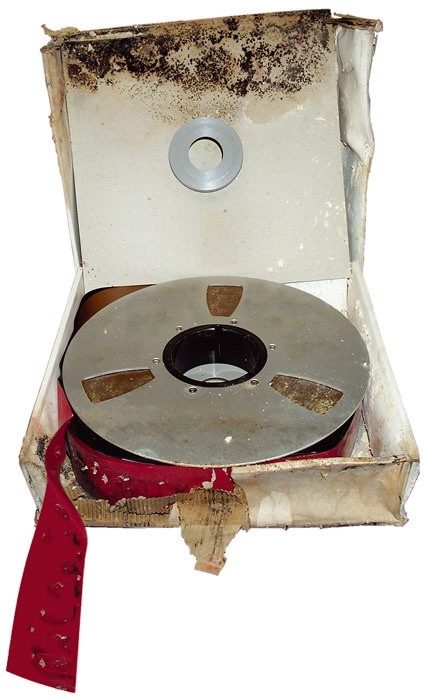 Photo: Ashlee NicholsAudio storage is all too often overlooked. Cool and dry is always good, and vertical storage is very important. Store your records, CDs, DAT tapes, reel-to-reel tapes, videotapes, Mini-DV and DVDs vertically, never flat. Tape, especially, tends to slip down and damage the edges if stored flat, even if they are in a cassette.
Don't touch tape. Don't touch the surface of records or CDs. Handle by the edges or the CD hole. Don't touch the playing surfaces of any recording. Don't store tapes on or near speakers or amplifiers. This may sound intuitive, but every day I see someone lean a tape against a speaker or pick up a CD like it was a ham sandwich.
Make sure the playback machine, be it a tape machine, CD player, turntable or cassette player, is in good working order and adjusted properly. I have many times seen a hungry player eat the only copy of a cassette, DAT or videotape. Demagnetise the machine, clean the machine and use a test tape (and then the tones on the tape that you are playing back) to align the machine. Some new engineers have never even seen an analogue multitrack.
Restoration Works
So what to do if your master recording has decayed and needs work? Forensic audio was a big topic at the Paris AES show this year. Police departments around the world are buying CEDAR systems to clean up bad audio. At the other end of the spectrum there are very inexpensive and even free software programs to clean up your old record collection so you can make your own CDs or MP3s for your iPod. These are great products, but they are only as good as the person using them. As with any new software process, two things happen. The user gets better at using the program as he gains experience, and the software is improved over time. The clicks and pops you could not remove now will be much easier to remove in the future.
 Tape storage done right... and wrong (above).Photo: Ashlee NicholsTo save extra work in the future, make the best flat transfers you can, and save them. Do the processing to the flat transfers instead of processing during the transfer. When the processing improves in the future you can then use the flat transfer and re-process it instead of having to go back and re-transfer the audio. In 1997 we tried to transfer the old Steely Dan two-track masters again with newer technology. Because of the additional 15 years of deterioration, the digital transfers done in 1981 sounded much better than anything we could do in 1997. So, the sooner you make the transfers, the better your results will be.
If you are transferring records, make sure you clean the records first. Learn how to do it properly. There are plenty of companies with helpful information on the Web that will increase your chances of success. Remember, cleanliness is next to high fidelity.
There are flat preamps available without an RIAA or CCIR frequency response curve. Companies like Enhanced Audio (www.enhancedaudio.com) have very good flat preamps, and even the Griffin iMic (www.griffintechnology.com) allows flat transfer with software equalisation. After transferring flat, you can use software curves to recover the original audio more accurately; the curves are complex and inexpensive preamps with curves built-in are most often incorrectly implemented. Also, early recordings before the '60s did not all use these curves, and sometimes the curves were different between record companies and even between different releases from the same record company.
If you are going to remove the clicks, pops and noise from the transfers, the best results are achieved if you perform the processes in the following order: de-click, de-crackle, de-buzz, de-hiss and de-rumble. Performing the processes in the wrong order can mask information needed for the next process or create audible artifacts by not completing a required prior process.
There are hundreds of recordings lost every year because they were not transferred when it was still possible to save them. Take care of your music so others may enjoy it in the future. If you have questions search the Web, contact archival companies in your area, or write to Sound On Sound.