

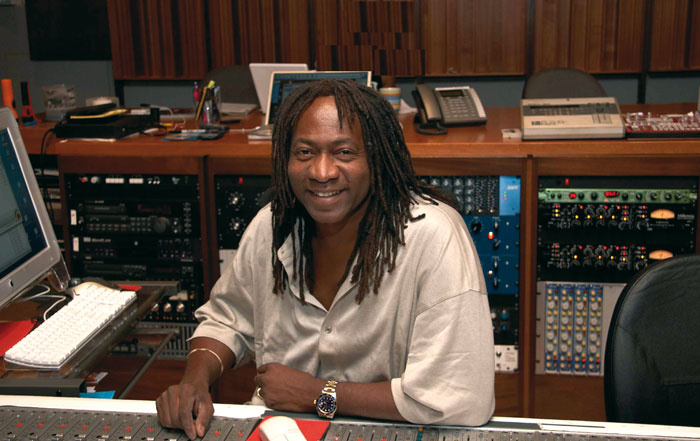
Megastar Justin Timberlake shot back into the charts last year with 'Sexyback', a hugely successful - and highly unusual - collaboration with hot-shot producer Timbaland. Jimmy Douglass was behind the desk.
Justin Timberlake and Timbaland's 'Sexyback' was a 2006 number one in at least a dozen countries, including the UK and the US. It came in at number three in Media Traffic's United World Chart for 2006 and received a Grammy for Best Dance Recording. The phrase 'bringing sexy back' even became a hip catchphrase for the image-savvy.
The surprising feature of this mega-hit is that it doesn't have a hook in the traditional sense. The song is a robotic exercise in minimalism, with heavily distorted singing, a two-note keyboard bass riff, hypnotic four-to-the floor drums, and minimal shifts between verse, bridge and chorus, which Timbaland, in an exaggerated theatrical voice, announces at each stage of the song.
At the controls for tracking and mixing of this unusual smash hit was engineer and producer supreme Jimmy Douglass, aka Senator Jimmy D. Douglass has been at the very cutting edge of the whole US R&B/hip-hop movement in recent years, in part because he has, since the late '90s, been Timbaland's engineer and mixer of choice. His recent credit list contains names such as Ginuwine, Aaliyah, Lenny Kravitz, Missy Elliott, Sean Paul, and, of course, Justin Timberlake. And he's recently mixed the new Duran Duran album and some songs from Björk's Volta.

Douglass's partnership with Timbaland is a very equal one, with Douglass bringing his decades of experience and getting plenty of creative input. He built and developed the producer's state-of-the-art studio in Virginia Beach, called Thomas Crown Headquarters/Magic Mix Factory. "My company is called Magic Mix, and he calls his stuff Thomas Crown," explains Douglass. "I also have another studio, in Miami, called The Spot, where I have a full Pro Tools rig with all six of my racks of analogue outboard gear, and I'm about to put a Neve VR desk in.
"Timbaland is one of the masters of the modern day," concludes the engineer/mixer. "The two of us clicked, and together we've been kind of untouchable. I also do my own productions and I become the second producer if the original producer falls down. Mixers make production decisions all the time, and I often add music to people's records when it's not finished or done correctly. In my work as a mixer, I'm a finisher. That's what I do."
As we shall see, with the track 'Sexyback', Douglass got plenty of opportunities to try new things and even to add his own sounds. It was recorded and written directly into Pro Tools, and mixed via a Neve VR-series desk.
'Sexyback'
Writers & producers: Justin Timberlake, Tim 'Timbaland' Mosely, Nate 'Danja' Hills
"The song was recorded in December 2005 and mixed in April 2006 at Timbaland's studio," says Jimmy Douglass. "The recording was done very quickly, it took less than a day. Timbaland and Danja were jamming behind me, with Danja on an [Akai] MPC3000 and Tim an [Ensoniq] ASR10. Danja also used several virtual synths in his Mac. Justin and Timbaland added their vocals right away, so it was ready to mix. It was all about vibe and attitude. If you look at the Pro Tools Edit window, you can see two tracks at the top that are greyed out, and that was the original idea, which we almost mixed. But in the end we went back in again and broke things up in individual instruments so I could EQ and treat them.
"You know what's brilliant about that song? When they were recording it and Justin goes in the chorus 'Go head be gone with it', I called the song 'Be Gone With It', just to label it. So they're developing this song and they're going nuts and loving it, and as they play it, and I'm like: 'I don't think this hook is strong enough.' But then, at the very last minute, Justin very, very cleverly decided to call it 'Sexyback', and that changed the whole dimension of the song. The first thing you hear when you listen to the song is 'I'm bringing sexy back', and after that you don't care or don't notice that there is no hook. And then there's the unique thing of Timbaland acting as a narrator, saying things like 'take it to the bridge', or 'yeah'. Every time Justin leaves a space, he fills it in. It's two guys interacting.
"You're looking at messy charts in the Edit window [below].I had the benefit of recording as well as mixing 'Sexyback', and labelling tracks is not important for me. I don't label shit — it comes up on the board and I know what it is. If I was sending it out to another mixer, I'd label everything and clean up all the tracks. When you record something in the same place as you mix it, you end up with a quicker mix, because you know the vibe, and when you mix it you start where you left off and there's not really that much to do.
"You build the Session as you go along, and this is why Pro Tools is so great. The only problem is that the sound quality is not. The infinite arrangements of the molecules on the tape versus the finite sampling rate on a digital thing — it may be more than we can hear with our human ears, but on digital it is a finite thing. The analogue world also gives you extra warmth, and it gives you variation. It is inexact, and that is what makes it interesting. When you play an instrument, it's always the things that you do between the notes that make it hot. On the other hand, the art of recording has benefited a million percent from digital. And when I'm mixing I can clean stuff, like taking out little clicks and pops and so on."
 Part of the Edit window for 'Sexyback', complete with Douglass's cryptic track labelling. Drums & keyboards: Neve VR EQ
"There are no interesting treatments on the drums, just some Neve VR EQ, to get the kick to sound thick around 60 cycles, but not muddy. The same with the keyboards. I kind of stay away from adding things that come from workstations because these guys have their own plug-ins and stuff. They can get it to sound exactly the way they want. They have the same power that I have. So they give me what they like, and I tend to respect their domain. One of the smarter things for a mixer is to know when to leave stuff alone. Of course, I'll work on their stuff sitting perfectly with the other stuff, using EQ and balancing and so on. In this case I added some EQ to the synths to fatten them up. But other than that I tend to spend most of my time treating vocals and live instruments."
Guitar & bass: McDSP Compressor Bank
"The bass and guitar were overdubbed during mixing, via DI. The bass just comes in at the chorus. It's a real bass, played by Darryl Pearson. I used the McDSP Compressor Bank on it. The guitar is played by Bill Pettaway. There's always a guitar in the studio and some musicians hanging around the camp, and he started doing this part, and I was like 'Holy shit, we have to put that down.' So he played it and we recorded it in two minutes. Then I took the section I wanted and copied and pasted it and treated the shit out of it. The end sound is very clean and very compressed. We were on our own when recording the guitar, and the 'frstdrylgtrdp' tracks in the Edit window are there because we tried different things, and I assumed that Timbaland and Danja wanted to hear the other parts also. But they ended up liking what I used, and I never went back to tidy up the Edit window."
The lead vocals in the Edit window. Note the send to the aux channel with Izotope's Trash plug-in.
Lead vocals: Universal Audio 1176, MXR flanger, Izotope Trash
"The signal chain for Justin's vocals was an Audio-Technica 4060 mic, into a Presonus ADL600 mic pre, and then a Universal Audio 1176 limiter. I normally use the U87 for recording vocals, but I was curious about the AT and I had both mics in front of Justin. The effects I used on his vocals seemed to work better with the AT. I used the U87 on Timbaland's vocals and went straight into the desk. I like using the Neve VR mic pre. It's a little crunchy, it's not quite the 1072 or 1073, but it works.
"Justin then said 'Man, can you put some effect on the vocal? Something crazy, like a distorted kind of thing?' So I put the Trash plug-in on [Izotope's distortion, filter, delay and amplifier modelling plug-in]. I just happened to have it. To give you my exact settings would be silly. But I'll give you one clue: it wasn't something that I worked really hard to get. Just by using the plug-in the setting almost came up.
"The Trash plug-in wasn't the only thing I used on the lead vocals. I also had an outboard MXR flanger on it. Plus there was an outboard compressor, the Urei 1176. I used the same three effects on Timbaland's vocals, just less than on Justin's. But you can hear the flanger and compressor acting in the spaces, like just before Justin sings 'dirty baby'. There's no hiding it, and it creates a whole other dimension of sound."
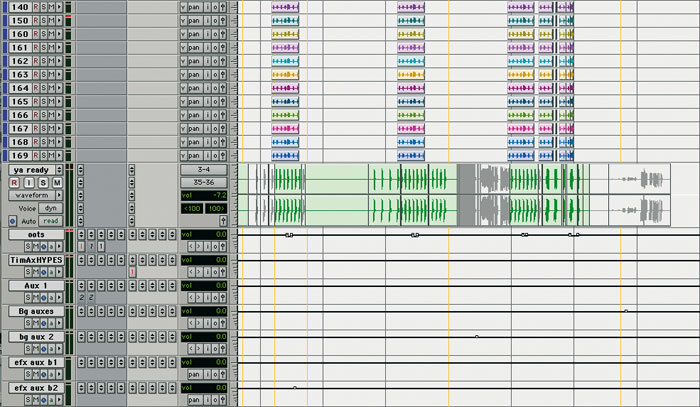 'Sexyback' featured 12 tracks of backing vocals (top half of screen) routed to a number of different effects on aux channels (lower half of screen). Backing vocals: MXR flanger, Digidesign Impact, Sound Toys Filter Freak, Celemony Melodyne, Waves Q10, Metaflanger and Renaissance Reverb, Pultec EQ
"The backing vocals are all Justin. I'd say it's about 12 tracks, three-part harmony. I'm sure I used the MXR flanger on this as well, and also the Impact plug-in, which is supposed to simulate the SSL board compressor. I wanted to really hit it hard, with an attack-y kind of sound that releases really quickly. I also used the Filter Freak plug-in, which is great, and Melodyne, Metaflanger, the Waves Q10 EQ, the Pultec EQP1A and the Rverb [Renaissance Reverb] plug-ins. Rverb is not a great reverb, but I like it, because it's low-grade. The weird backing vox effects are a combination of things, and I have no idea how I did what."
Replacement vocal sample: Digidesign Pitch and Lo-Fi
"In the middle and end of the song you can hear a voice going 'You ready?' That's me. That phrase was originally a sample, but we knew we didn't want to go for trying to get clearance, so we took it out. I tried to imitate it, but I couldn't get the sound, until I realised that it was not played back at the right speed. Wherever he put it under his keyboard, he liked this sound, to make it more interesting. So I used varispeed in Pro Tools to bring the tape machine down when I recorded my vocal, and then sped it back up, so my voice sounded just like the sample. After that I tried to match the sample with EQ and compression and I also put a noise thing on it. This was all done with plug-ins, as you can see on the window." 
Jimmy Douglass recreated a vocal sample with the help of Digidesign's Pitch and Lo-Fi plug-ins.
Mix effects: Digidesign Vari-Fi, Eventide H3000, Lexicon 960
"There's a record slowdown at the end which was done with the Digidesign Vari-Fi plug-in. I also used an H3000 flanger in the overall mix, and the Lexicon 960 for some general reverb across the vocals. I use reverb only moderately. If you listen to my records from day one, you'll hear a dry sound. That's my sound, and that's what I do. I'm not great at doing lush ballads, because they require lush ambience and lots of reverb, and I prefer to experiment with dry sounds. I learned this from working with British bands in the '70s, who forbade me to use reverbs on vocals. So I had to learn other ways to take what's naturally there and enhance it and make it 'in your face'.
"For me this has been one of the problems with switching to the digital medium. You spend a lot of time carving in analogue to make things poke out. But in digital everything is poking out and sticking in your face already, so the challenge is to smooth it out and stick it back there. In effect I'm trying to de-emphasise: smoothing things without muddying them up. I try to use less digital reverb for that reason, because everything in digital sounds the same, and digital reverb multiplies that emphasis. So instead I try to find wacky effects like I used in this song, that aren't just mirrors of the same frequencies that are already there. Finally, the whole project was done on 44.1/24 and mastering was done by Herb Powers at Powers Mastering Studio. He did a great job."
And also, it has to be noted, did Jimmy Douglass.
Going Downhill
Jimmy Douglass came through the ranks in the '70s, building on his experience of watching greats like Tom Dowd and Arif Mardin do their thing. Douglass's talent for combining time-honoured skills with innovation soon saw him surf the heights of the music industry, working with legends such as the Rolling Stones, Led Zeppelin, Bryan Ferry, Roxy Music, Aretha Franklin, Otis Redding, Stevie Wonder and Hall & Oates. And although he's successfully updated his skills to complement the new production styles of urban music, he bemoans the lack of traditional skills in today's world.
"What I did a few years ago was tune my ears to get back in the game. But once I got there, and understood what it was, I realised that I did not really like it. When you take the Pro Tools approach to playing, which is moving little bits around, and not really playing instruments, it changes the contour of the whole landscape. I keep trying to find ways of describing what digital has done to us. Things are so perfect, there's no variation. Things have become too easy; one person can be everything overnight. We are listening to a lot of one person's mind, rather than people collaborating, which lends itself to a broader and more interesting sound that may have assimilated years of music history. In short, digital is robbing us of our history!
"The studio and the art of sound engineering used to represent a mysterious place with a big board and loads of equipment, and nobody could figure out how to work it. It was magic. But the digital technology has taken that mystery away. Today's engineer really has become a computer operator. Engineers are now librarians and technologists who keep track of digital audio files and bits before the sound is even considered. The creative side of things has moved away from the engineer, and towards the producer."