

Some say that nothing does analogue tape like analogue tape does, but AnaMod think they're wrong — and are doing a pretty good job of proving it!
Emulation of analogue tape recorders, using synthesis, modelling or convolution technologies, has been with us for quite some time. Many DAWs include quite effective tape-emulation plug‑ins, and third-party ones are also available. There have also been a few hardware analogue‑tape simulators, one of the most impressive to date being Rupert Neve Designs' Portico, which uses inductive circuitry to recreate the complex magnetic non‑linearities associated with tape recording. The AnaMod ATS1 is a new and impressive hardware device, which takes an entirely novel, or even radical, approach.
AnaMod was founded only three years ago by Dave Amels (previous co‑founder of the Bomb Factory Digital, Amels Audio, Voce, and Diversi Organs) and Greg Gualtieri (also the president of Pendulum Audio). Their product range is fairly limited, but already includes compressors based on the Fairchild 670 and 660 vari‑mu designs, an equaliser based on the API 500‑series EPQ1A, and the ATS1 tape‑recorder emulator, reviewed here.
The fundamental ethos of their venture is to take a mathematical modelling approach to the design of their analogue equipment — a technique developed by Amels in many of the digital plug‑ins he created at the Bomb Factory (and, interestingly, Digidesign's Reel Tape plug‑in). However, whereas all of those software plug‑ins applied the technique within the digital computational domain, in the AnaMod products they're applied entirely in the analogue domain, using, essentially, rather more 'traditional' analogue computing techniques (based in part on the use of four‑quadrant multipliers and other non‑linear analogue design techniques) to build the various signal-processing elements of complex analogue circuitry. Analogue 'computing' of this kind certainly isn't a new technology, but it's not one you find very often in audio equipment, and it is an innovative approach. Being entirely analogue, there is no latency to worry about, and no A‑D and D‑A conversions either.
Overview
 The modelling is done via analogue electronic circuits, with the specific tape‑machine and tape‑formulation models added to the main PCB using daughterboards.
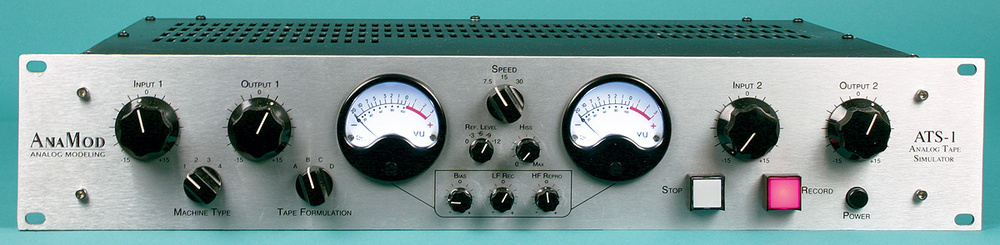
The ATS1 is a two‑channel analogue tape simulator housed in a large, 2U, rackmounting box, which extends 280mm behind the rack ears, and weighing just under 5kg. The pressed‑steel case and brushed-aluminium front panel give it a fairly traditional look, enhanced by the vintage dials and control knobs. The internal mains power supply is a fixed‑voltage design (230V in the case of the review model, of course) with the protective fuse fitted on the main PCB inside the unit. Mains power is connected via the usual IEC socket, and the two channels of audio via XLRs.
Internally, the ATS1 is built to high standards, with the majority of the electronics carried on a large PCB that covers the entire base of the unit. Most of the electronics come in the form of normal‑sized components and integrated circuits, but the plug‑in cards are all surface mount (see below). A number of small sub‑boards connected to the front‑panel controls are wired back to the main board, which also has eight memory‑type SIMM sockets. These sockets are used to accommodate a selection of up to four each of different tape-recorder and tape-type emulation high‑density surface‑mount circuit cards (which can be changed by the user).
The review model was fitted with cards for two solid‑state recorders (the 3M M79 and Studer A800), plus a valve recorder (the Ampex 351). It also had cards for two tape types: Quantegy GP9 (a very high‑output tape formulation) and Ampex 456 (the classic reference, to many). All bar the Ampex 351 recorder emulation are supplied as standard with the ATS1, but by the time you read this a card should also be available for an ATR102 recorder, and AnaMod are currently working on one for Scotch 111 tape. However, without taking the lid off I wouldn't have known what options were installed, or which positions they occupied.
The front panel has large rotary controls to set the input and output levels of each channel (all with a marked ±15dB range but no centre detent), allowing the relative 'tape drive' and output levels to be established. All of the other controls affect both channels equally, and comprise rotary selector switches for the four machine types (labelled 1 2 3 4), four tape types (A B C D), and three tape speeds (7.5, 15 or 30ips). Much smaller vintage‑style knobs are provided for setting the 'reference level' for the metering (0 to +12dB in four 3dB steps — the small knob making this a hard switch to change!), hiss level (zero to 'Max'!), and trims for the bias level, LF record EQ and HF replay EQ (all uncalibrated, with only plus and minus end‑stop marks). A push‑button in the bottom right‑hand corner powers the unit.
The two round, retro‑styled but frighteningly bright VU meters indicate the signal levels, but it gets a little complicated if you're not familiar with the mysteries of tape alignment levels... With the reference level control set to +6, the meter will show 0VU when a +4dBu signal is applied (and the input and output controls set to unity). This also equates to a 'tape' level of 370nW/m. With the record level switch set to zero, 0VU equates to 185nW/m on 'tape.' Finally, large, interlocked, illuminated, square buttons provide a hard bypass mode ('Stop') or engage the tape-simulation circuitry ('Record'). If a vacant machine- or tape‑emulation card is selected, the relevant button flashes, which is a nice touch.
The ATS1 doesn't attempt to emulate wow and flutter at all — as the brochure is pleased to announce — although I can't help but think that wow and flutter was actually an important and integral element of the classic analogue sound, creating a complex of 'side tones' and noise modulation around the recorded signal.
The technical specifications cite electronically balanced inputs with a nominal 20kΩ impedance and +4dBu sensitivity. Maximum output level is +27dBu, and the level is compensated automatically when feeding unbalanced destinations. Everything else — frequency response, noise and distortion — varies with the selected tape emulation and control settings. For those running their studios from environmentally‑friendly wind generators, the ATS1 consumes a measly 25W — although I reckon they could get that down to 5W if they used less meter illumination!
Operation
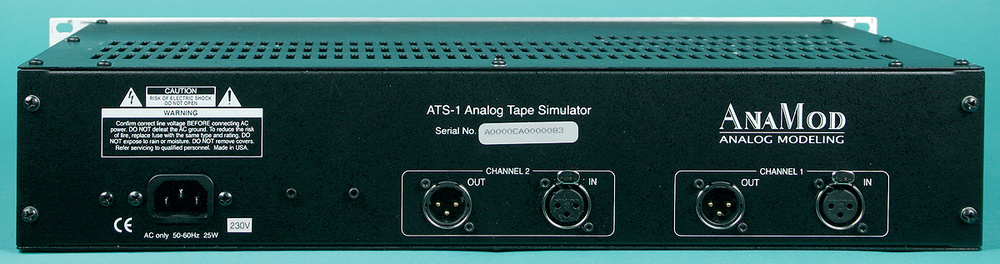 The rear of the AnaMod ATS1 is as simple as you'd expect from a tape machine: in, out and power.
The discrete, two‑channel design of the ATS1 obviously makes it very easy to process two separate mono sources simultaneously with different levels and styles of tape simulation, but I suspect that most people will be using this unit essentially as a stereo mastering process... and as such, the four rotary level controls are rather less than convenient. Obviously, ganged stereo input and output controls would restrict the flexibility of the machine, so I would have much preferred the compromise of rotary switches so that settings could be matched easily and precisely between channels. Moreover, ganging the input and output controls for each channel would be a better idea so that as input drive is increased, output level would reduce correspondingly, to provide unity gain throughout. These small changes would, for me at least, have made the ATS1 far easier and less frustrating to operate.
All the other controls work pretty much as expected. The reference level switch allows the metering to be set in a way that more sensibly relates to modern digital converter I/O levels, while also encouraging more drive level at the higher reference settings — and consequently more non‑linearity and stronger tape saturation effects. The hiss control introduces a very analogue noise floor that I found a very worthwhile feature indeed, and although I found the control range excessive (I rarely set it higher than about 30 percent) it did seem to add a quality that was very pleasant and natural. The tape speed, bias and rec/rep equalisers all made the expected tonal changes, allowing useful sonic variety to be introduced as appropriate. Time for another tiny gripe, though: the review machine was supplied without a manual. I was able to access the on‑line version, but was a little disappointed with its sketchiness. It gives no information at all on the standard machine or tape‑type emulations supplied, or even about the original recorders and tape characteristics that it is trying to emulate. The description of the controls is also very shallow. Not a problem for anyone familiar with the mysteries (and calibration) of analogue tape recorders, but for anyone else, the facilities will remain little more than mysterious tone controls!
Initially, I ran the unit with machine '2' (A800), tape 'B' (456) and the 15ips settings, since this was more or less the configuration I used virtually daily when working with real reel recorders. I also started with the bias and EQ controls at their centre, zero, positions, and found I was getting very good, completely believable results with all recorder and tape emulations, working on a variety of commercial stereo recordings and some of my own recordings and works in progress. Of the many software and (fewer) hardware tape‑emulation systems I've tried, without doubt this is the closest yet to being a convincing substitute. Pushing the levels hotter and hotter, the bottom end started to fill out and the dynamics became increasingly squashed, before giving way to a lovely organic distortion. Exactly like a tape machine. Wind the bias level back and the high end brightens and smears, introducing edgy sibilance to vocals while simultaneously adding a mid-range fuzz of increasing distortion.
If I was being really picky (well, it's what they pay me for...), I could complain that it sounds a touch too perfectly stable in some very subtle, subliminal way. But in every other respect it is phenomenally accurate. Stick a 150ms delay on its output and flip the monitoring between direct and processed, and you'd swear blind you were listening off the replay heads of a proper tape machine! That's how convincing it is.
Changing to 7.5ips reduced the HF extension and filled out the bottom a little, and switching to 30ips did the opposite (just as it should). The bias control zero mark provides the 'recommended' amount of over‑bias for the given tape type and speed. Increasing the bias results in more self‑erasure and a duller sound, and vice versa, while also affecting modulation noise and distortion, in a real tape recorder. Here, it becomes a useful pseudo tone-control, and one that's complemented by the LF record and HF replay equalisers. The former affects drive level and thus distortion, to a degree, while the latter affects the Hiss level.
Switching to the alternative recorder and tape settings was fascinating. The 3M M79 isn't a machine I've used in earnest, but when I've heard it the sound has seemed heavier and softer than the sweeter Swiss standard-bearer. Sure enough, flipping the switch to select the M79 revealed a slightly richer, punchier sound straight away: a sound that I found rather flattering and cosy, but which lacked the top‑end clarity of the A800. Selecting the vintage Ampex 351 recorder (I guess they're all vintage now!), I was instantly transported back a lifetime to the 1960s, with a really smooth, rounded and 'dark chocolate' sound. Years ago, I inherited a 1956 Truvox Mk IV valve tape recorder, and the sound from the ATS1 was reminiscent of that fondly remembered machine. Of all the options, I found this model a little too heavy‑handed to be useful in a mastering context, but it was great for individual instruments, and worked wonders on bass guitar and some vocal tracks.
Switching the tape‑type emulations also brought the expected sonic variations — to the point that I almost started to forget I was working with a rackmount unit. The emulations seem so accurate that you almost take it for granted that you're using the real (reel) thing! Ampex 456 tape saturates nicely when pushed, squashing transient peaks gently while delivering a fairly full bottom end — and that characteristic was portrayed remarkably well with the ATS1 emulation. Switching to the GP9 emulation immediately sounded cleaner and more transparent, noticeably tighter at the bottom and with far less (almost negligible) transient compression at normal drive levels. It also showed less variation with different tape speeds at the extremes of the frequency response than the 456 emulation. This isn't a tape type I've had any practical experience with, but I know it can take much higher drive levels, to give lower noise and distortion, with a very clean, bright sound. The emulation seems to match that expectation.
Verdict
The AnaMod ATS1 impressed me very much. The processing ranges from very subtle and realistic (representing the very best that perfectly set-up tape recorders can offer) all the way to blatant, in‑your‑face tape warming and gross saturation effects. The subtle addition of some hiss adds enormously to the realism (which surprised me), and the often very subtle tonal shaping afforded by the bias, EQ and speed controls is useful, once familiar, as is the choice of tape speed. The different machine and tape cards ring more subtle sonic character changes (fairly subtle in the case of the M79 and A800, anyway, but more of a 'look at me, look at me!!!' character with the 351 card), which is an added bonus.
In the days when analogue tape was the only recording medium available, signals passed through the magnetic format many times (tracking, numerous bounce-downs, stereo mixing, and final mastering), and with each pass more of the harmonic complexity and non‑linearities of the different tape machines, operating with different speed, drive, bias and EQ settings and on different tapes, was added, giving something musical and worthy to the sound. The complete amalgamation resulted in the kind of sound we now refer to as that 'warm analogue sound' and the AnaMod ATS1 does a very fine job of replicating a substantial part of that, with modern digital‑age flexibility and instant gratification.
If the nice people at KMR Audio forgot to ask for this ATS1 back, I'd end up using it every day, and probably on almost everything. It can be adjusted to add a certain something for all occasions, whether you want incredibly subtle warming, obvious crunchiness, or anything in between. At well over three grand here in the UK, you'd have to be extremely well‑heeled (or save the pennies for a very long time) to afford the ATS1, but at least justifying the purchase would be easy every time you switched it on. If you have a friendly bank manager, you need to hear this. If you don't, then stay away... or be frustrated forever!
Alternatives
There are several broadly similar (in concept, at least) hardware tape‑emulation systems, and all are less costly than the ATS1. The Crane Song Hedd 192 is the closest in price, and it adds high‑quality digital converters — but is a digital system rather than an analogue one. The Rupert Neve Designs Portico 5042 is analogue through and through. At roughly half the price of the AnaMod it sounds extremely good and portrays the key tape characteristics, but it doesn't have the versatility or precision modelling of the ATS1.
Pros
- Superbly accurate tape emulation characteristics — the best I know of.
- Stylish, retro looks.
- Full set of parameter controls, including adjustable tape hiss.
- User‑fit recorder and tape option cards.
Cons
- Separate and continuous I/O level controls not ideal for stereo working.
- Separate input and output controls not as convenient as a simple 'drive' control.
- No indication of installed (or selected) machine and tape types.
- Quality costs.
Summary
An all‑analogue tape-simulation system using relatively novel analogue computing techniques to recreate the sonic characteristics of classic recorder and tape combinations. Effects range from extremely subtle to quite blatant, and the ease of use and instant flexibility make this an enormously satisfying and creative tool for the studio. The ATS1 sets a new benchmark standard for hardware analogue tape emulation systems.
information
KMR +44 (0)20 8445 2446.
AnaMod +1 201 728 8490.