

Thunderous reverbs, haunting vocals and Mellotron galore: we tell the story of recording the Moody Blues' symphonic rock masterpiece, 'Nights In White Satin'.

By the autumn of 1966, the Moody Blues' best days were apparently behind them. Two years on from scoring a hit with 'Go Now', the Birmingham‑formed band was dealing with the departures of bass player Clint Warwick and singer‑guitarist Denny Laine, while owing Decca Records several thousand pounds in advances. Their fortunes, however, were about to change.
After replacing Warwick and Laine with John Lodge and Justin Hayward, the group — which also comprised drummer Graeme Edge, keyboardist Mike Pinder and multi‑instrumentalist Ray Thomas — did a total and unexpected about‑face, by deserting their R&B roots for classical/progressive rock. A deal with Decca's experimental new Deram Records label assisted in this regard, as did the commencement of working relationships with A&R executive Hugh Mendl, staff producer Tony Clarke, staff engineer Derek Varnals and conductor/arranger Peter Knight. This resulted in the Moodies adopting a lush, grandiose, orchestrally integrated sound, and the first real fruit of these collaborations was the most successful, influential and enduring album of the band's career.
Orchestral Rock
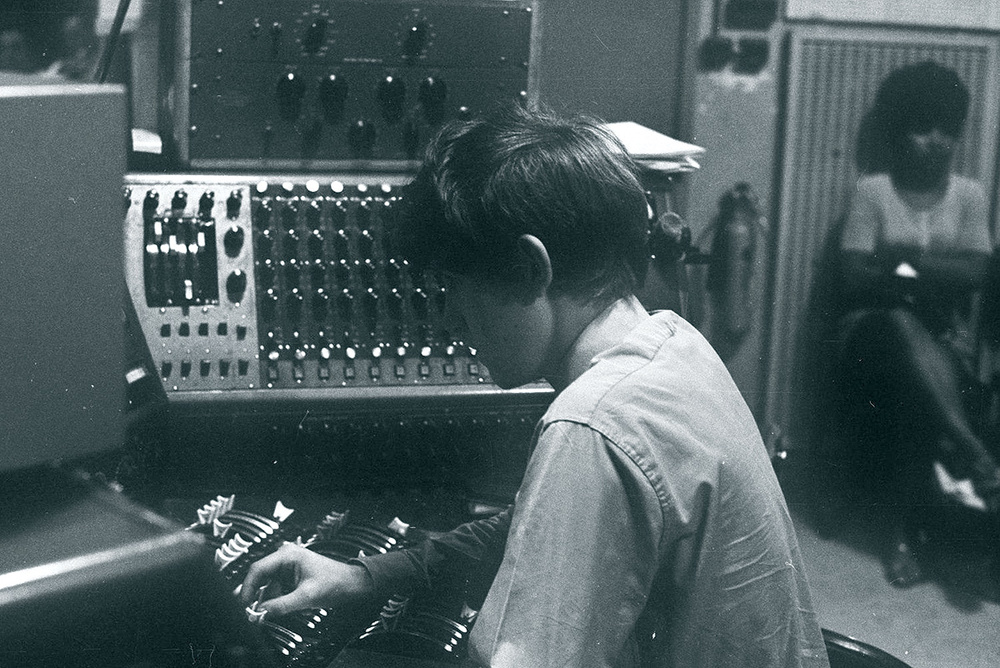 Derek Varnals at work in Studio Two, mid‑'60s.
Drawing inspiration from the Beatles' recently released Sgt. Pepper's Lonely Hearts Club Band LP, Days Of Future Passed was another large‑scale manifestation of the psychedelic era. Melding rock instrumentation centred on Mike Pinder's electro‑mechanical, polyphonic, Mellotron sample‑playback keyboard with the backing of the London Festival Orchestra, the LP is a song‑cycle set within the context of a single day. And this includes 'Nights In White Satin', Justin Hayward's haunting tale of unrequited love that, despite taking several years to become a hit on both sides of the Atlantic, is still the group's most popular number, on the radio and in concert. Nevertheless, there are conflicting theories as to how the entire, conceptual project came to pass.
The most prevalent story is that, in the spring of 1967, Decca wanted to show off their new Deramic Stereo Sound (DSS) format — a more symmetrical, realistic alternative to the kind of 'ping‑pong stereo' that was then still in vogue — by having the Moody Blues record a rock version of Antonin Dvorak's 'New World Symphony'. It's said that Tony Clarke and the band members aborted this idea in favour of working on their own material, with Peter Knight taking care of the orchestral accompaniment, the sections linking all seven songs, and the album's opening and closing sequences. Then again, according to Derek Varnals, this was never the case.
"Between June and August of '67, Decca Records produced six orchestral albums with the Deramic Sound system. All had 'night' in the title,” he recalls. "Strings In The Night, Brass In The Night, Piano In The Night... It was a pretty straightforward theme.”
And not one shared by 'Nights In White Satin', which had been written a couple of years earlier, after a friend had presented Justin Hayward with some satin bedsheets.
"At some point, Decca decided to liven up the label by having a pop group record with an orchestra,” Varnals continues, "but I only heard the 'New World Symphony' story way after the event and I don't think that ever happened. The Moody Blues project was simply described to me as an album with recurring themes, and for the orchestration they'd be using Peter Knight who, among other things, had worked on Voices In The Night. That having been said, 'Nights In White Satin' was recorded as a single before the album was even conceived — the company wanted to get it out because the previous single had failed, and so, with a B‑side ['Cities'] already in the can, the session was booked at short notice, the song was recorded in a day and it didn't even make use of an orchestra or Deramic Sound. What's more, three other tracks had also been written before the album was conceived — 'Dawn Is A Feeling', 'Peak Hour' and 'Tuesday Afternoon' — and so the theme of the record was virtually dictated in advance.”
Custom Console
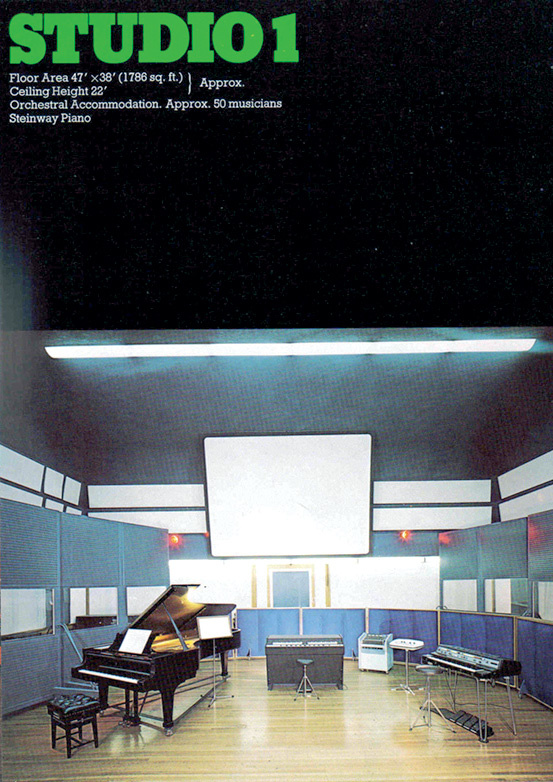 A picture of the Studio One live room from an early '70s Decca brochure. Apart from the projector screen, this is how it was during the 'Nights In White Satin' sessions.
Days Of Future Passed came Varnals' way during the early part of his first career. Recorded and mixed between 8th October and 3rd November 1967, it utilised Decca's Studio One, where the control room, located upstairs from the live area, was equipped with a custom, 20‑channel, wrap‑around console, 15‑inch Tannoy monitors in Lockwood cabinets, and a Studer J37 four‑track tape machine, as well as an Ampex half‑inch four‑track.
"The console had four groups of five channels in the centre section,” Varnals recalls, "and above them there was another row of faders for echo send, with the equalisers above that. It had four outputs, and what you could do was switch any of the four groups of five channels to any pair of tracks. The only drawback was that if, say, you wanted 15 microphones across the stereo pair and then one mic on track three and another on track four, you'd have to figure out which channel you'd put those mics in. In most cases, you were dealing with rhythm sections and brass, and it was done with a view to thinking about stereo, even though pop music was mainly done in mono back then. The splitting up of the instruments on four‑track was purely for re‑balancing during the mix, and it would give you a chance to replace the vocal. In fact, the Ampex machine was fairly idle until Days Of Future Passed, when we began doing what Brian Wilson was doing [with the Beach Boys], going from four to four — or, in his case, three to three — and back again.
"Meanwhile, the left and right panels on the console had the stereo pan pots. You selected the location on the stereo output of each of the groups — you could have the mic positioned either left or right, meaning it would be on, say, track one or track two, or you could locate that anywhere within the divisions of the pot. So, if, for example, you were putting an orchestra on a stereo pair, you could locate the microphones across the spectrum by spotting them rather than using the so‑called 'Decca Tree'.
This tree usually comprised five omnidirectional mics placed about five feet in front of an orchestra, 11 feet in the air, with the main three‑mic tree arranged above the conductor's head — half‑left, centre, half‑right — and the other two positioned to pick up the outside of the orchestra.
Live Sound
 Producer Tony Clarke at the board in the Studio One control room.
With the staircase between the control room and live area located on the left side of Studio One, the main layout for the Days Of Future Passed sessions consisted of piano to the right of the staircase and, from left to right towards the back of the room, Hayward's acoustic guitar, Lodge's bass, Pinder's Mellotron and Edge's drums, all screened off from one another. Nevertheless, this wasn't quite how Varnals had planned things when the first track, 'Nights In White Satin', was recorded on 8th October.
"I told the roadie who arrived with the band's equipment where I wanted to set everything up, and he got the bass and the Mellotron the wrong way around,” he recalls. "Immediately under the control room window there was a stage area, and then there was a small step, half the height of the stage, down to a mezzanine level that ran the width of the studio. Normally, we put the guitar amps on that intermediate stage level, and in this case the Marshall amp for Mike's Mellotron was there, too, blowing away from the control room, while he and John (who also had a Marshall amp) were positioned the wrong way around. Since musicians are often creatures of habit or superstition — 'Oh, that's my spot, I go here' — this setup was cast in stone from then onwards and Mike was playing with his back to the drums, which he was actually happy to do as that's what he did on stage.
"The whole building was on sloping land in both directions, sloping downwards from west to east and from north to south, and although the floor wasn't designed to be a floating floor, when you walked on it you could feel it bounce a bit. We'd therefore laid down big concrete paving slabs where the drums were positioned so that they wouldn't be transmitted to the floor, and that's why the kit was always against the right wall, side‑on to the control room, with screens around it.
"There was a ribbon mic directly above the snare, a couple of feet up, and that particularly suited rock drummers because they played louder than session drummers. They hit their cymbals louder, and if you had your ribbon mic high enough you would pick up the entire kit without the cymbals overloading like they would on a condenser mic. For instance, I once recorded Ginger Baker, and he had a very difficult kit — the way he set it up, there were cymbals everywhere and you somehow couldn't get the mic to just point at the drums. A ribbon therefore worked far better, and so that's what I tended to use, although for 'Nights In White Satin' I also had to use a spot mic of some kind, because at the beginning there was a little time‑marker where a cymbal was in time with the acoustic guitar.
"Graeme had a rivet cymbal, which I hate; a cymbal with two or three drilled holes and little brass rivets that just buzz along. This is fine if it's played delicately, but if you give it a smash it will go on for too long. I therefore used a spot mic on that because the ribbon mic was doing its job of not letting the cymbal overwhelm the drums, and aside from an AKG dynamic on the bass drum — which, I must confess, didn't feature very heavily — that was it.”
Mellotron Matters
 The custom console in Studio Two.
Since DIs were nowhere to be seen at Decca in 1967, the Mellotron's amp was miked with a Neumann U67 (as were the bass and acoustic guitars), using a technique that Derek Varnals had developed a short time before, when he'd overdubbed Mike Pinder's Mellotron part onto the Moody Blues previous single, 'Love & Beauty'.
"It was completely new to me, and so I'd just decided to treat it like a keyboard instrument that sounded like strings,” he explains. "The job was to make it sound as sweet and smooth as possible, but of course some of that's down to the player. The Mellotron's attack gives it a percussive quality that strings don't have, but Mike developed the technique of hitting a chord and then using the swell pedal to bring it up a split second later to avoid that attack. Of course, he couldn't hold a chord for very long, because he'd be running out of tape, and he also had to anticipate by half a beat, a bit like playing a church organ where the sound doesn't come out straight away.
"I certainly remember on 'Nights In White Satin' that, while he was putting his sound through the Marshall amp, I was getting hold of that amp and trying to find out what I could do to sweeten it up a bit. We needed a certain amount of clarity, but we didn't want shrieking treble or for it to be too muddy if he was playing low down. You know, if he was playing a gig somewhere, he'd want to fill the hall with sound, but we were only projecting it as far as the microphone. The Marshall had at least three tone controls, so I spent some time trying to get some reasonable ingredients out of it before going into the control room and getting rid of that edgy sound. For that, I kept on using a reverb to blur the edges a bit, and I also gave it sustain that helped Mike and his foot pedal in the chord changes.
"Although the single wasn't being done in Deramic Sound, as it was their first one to be released on the Deram label rather than Decca, it coincided with marketing the Moody Blues in a new way. I therefore decided to try to use the round sound of the echo chamber rather than the EMT plate — I didn't delay it, I just wanted to soften the edges, and so I did a bit of EQ'ing, and whatever I did rounded the sound out. I can't tell you what setting I used — although we did some similar numbers, we never quite got the same sound, but at least on this song we ended up with a smoother‑sounding Mellotron, and from then on, having laid the rhythm track down, it was just a case of adding the layers.”
Initially, these consisted of three Mellotron parts that, together with the rhythm track, were mixed back down to a couple of tracks to provide space for Ray Thomas to perform a flute solo that was created and refined over the course of numerous takes.
"The Mellotron was always a battle,” says Varnals. "You couldn't do the smoothing out if it had a featured part where the individual notes were important as a melody line. Blurring it too much with reverb would mess it up, so you had to take the sound as it was.”
Finishing Touches

Meanwhile, another mixdown provided an extra track for Justin Hayward's lead vocal, as well as a couple more for him, Lodge and Thomas to sing backup around a U67.
"By the time we began recording the vocals, the reverb wasn't exactly dominating the track, but it was becoming a feature,” Varnals remarks. "The high sound of John's backing vocals was an octave above everything else, so I just pushed up the reverb, attempted to blend it, and the overall effect was quite dramatic. Obviously, we couldn't do the same to the lead vocal, which had to tell the story, or to the flute — that would have lost definition, and we still had to present the music.”
Performing in a three‑sided mobile booth that faced the studio floor at the very back of the live area, Hayward was recorded with the ubiquitous U67 and a touch of reverb.
"In those days, we wouldn't have been able to put any reverb on the monitors,” Varnals says. "However, we also wouldn't want to have the singer listen to a playback that sounded flat and unlike a record, so we did put a certain amount of reverb on the tape. At the same time, we didn't want to end up with too much on there because we couldn't take it off.”
After recording 'Nights In White Satin' in a single day and mixing it in mono later that week, the band members and studio crew quickly reconvened to record tracks for the newly conceived concept album. Recording commenced with 'Dawn Is A Feeling' on 18th October and ended on 27th October, before all of Peter Knight's orchestral parts were tracked on 3rd November. The most difficult orchestral overdub, according to Derek Varnals, was the part stretching from the middle of 'Nights In White Satin' to the grand finale, which entailed Knight conducting in time with the band's contribution, already mixed down to two tracks of the four‑track tape.
"There was never any plan to have an orchestra on that song,” he says. "Peter Knight just wrote the little descending woodwind piece before 'Nights in White Satin' comes in, and then he decided it would be hard to pick up the end of the song without having an orchestra over the last verse and chorus.”
Chart Success
Released as a single on 10th November 1967, without the orchestral overdubs or Graeme Edge's spoken‑word poem, 'Late Lament', that is recited by Mike Pinder near the six‑minute mark of the song's album version, 'Nights In White Satin' initially peaked at number 19 on the UK chart, at around the same time that Days Of Future Passed topped out there at number 27. Nevertheless, despite Deram's uncertain approach to marketing an album that combined rock with classical, it did reach number three on the Billboard 200 following its American debut in April 1968. Furthermore, after the aforementioned single hit number two there in 1972, it was re‑released in the UK and climbed to number nine.
"It's just a song, really,” Justin Hayward commented about 'Nights In White Satin' in a July 2008 radio interview, "but we recorded it first, a long time before we recorded it for Decca; we recorded it for the BBC. We recorded it and weren't invited into the control room to listen to it back. And then in our van on the way to a gig we listened to it, because it was on a program called Saturday Club — on a Saturday, of course — and we were going up the motorway and we heard it on the radio. And we pulled the car over, or the van, over to the side of the road, and we said, 'Hey, maybe there's something in that song,' because there was something about it, it sounded really good. We hadn't realised until we'd heard it back ourselves. And then it kind of took on a life of its own...”
Artist: The Moody Blues
Track: 'Nights In White Satin'
Label: Deram
Released: 1967
Producer: Tony Clarke
Engineer: Derek Varnals
Studio: Decca
Moody Personnel
Tony Clarke was a former bass player whose ability to help build songs from the ground up and coax performances out of the musicians saw him produce the Moody Blues' 'classic seven' albums from 1967 to 1979. Derek Varnals closely aligned himself with the same group by recording all seven of those albums and mixing all but 1970's A Question Of Balance. This was after having joined Decca in November 1963, within the same two‑year time frame that saw the company recruit other future luminaries such as Vic Coppersmith‑Heaven, Gus Dudgeon, Roy Thomas Baker and Bill Price.
Among Varnals' eclectic array of Decca‑based engineering credits are names like John Mayall, Tom Jones, Lulu, Keef Hartley, Tony Christie and Thin Lizzy. He has followed his 17‑year tenure at the now‑defunct studio on Broadhurst Gardens in West Hampstead, Northwest London, with an ongoing 29‑year stint as a Technical Advisor to the British Phonographic Industry (BPI), examining suspect and counterfeit product, giving court evidence and conducting listening tests. In January 2007 he received an MBE in recognition of his services to the British recording industry.
"The CV for court reads quite well now,” he says. "After all, the more you do something, the more it looks like you can do it, and there is almost legal precedent in that if you've done something for long enough, you're deemed to be an expert. You basically generate your own qualifications.”
Sound Control
"The Studio One live area had an old‑fashioned sound, and you can hear it on tracks like 'Tuesday Afternoon',” Varnals explains. "You can hear the drums going around the room and ending up in the acoustic guitar mic. Still, that was accepted back then — it was the old‑fashioned way of doing things. The sound wasn't particularly controllable and you weren't always sure where to put the instruments. It was one of those tricky things, and we didn't have too much screening‑off of quiet instruments or loud things. We just relied on microphone positioning.
"The live area did have swinging panels, where we could have a hardwood surface or absorbent wall tiles, yet part of the key to the sound there was the echo chamber on the roof — there was another one for Studio Two, but none for the big Studio Three, which had been built in 1961 or 1962 and was a bit of a failure. Because of multitrack, there were also four EMT echo plates in the basement that could be switched between Studio One and Studio Two, and we had to plug them in to tie lines, as we did for the echo chambers. That meant there were six echo sources for the two studios, and another pair were installed for the remix room that was very close to Studio Three.
"That was the limit of what we could have. We didn't have any stereo plates. The idea was that, if you wanted to put some echo on the tape while you were recording, you would have one echo for that track and another echo for another track. That was, unless you were planning to do something outlandish, like some tricks on the vocal, in which case you wouldn't do it at the time but leave it until later. These days, virtually everything is left to the end and you can almost change your mind even after the thing's been released.”