

Doves have overcome writer's block, the perils of democracy and a silly studio name to produce an early contender for album of the year.
 Doves (from left): Andy Williams, Jimi Goodwin and Jez Williams.
Missing in action since 2005's Some Cities, it might have been reasonable to assume that we'd heard the last of Doves. Instead, it turns out that the band have been painstakingly crafting the follow‑up, Kingdom Of Rust, already rightfully hailed as their best record to date.
That's not to say that the Wilmslow trio — twins Jez (guitar) and Andy (drums) Williams, plus singer/bassist Jimi Goodwin — are particularly happy about their apparently tortoise‑like work rate. They would dearly love, Jez insists, to make their records faster. "Oh yeah,” he laughs. "But, y'know, because Doves is a democracy, everyone has an equal opinion, therefore the old wheel of democracy turns at a slower pace than it would under a dictator.”
Out Of The Blocks
Williams admits that it wasn't just this democratic approach, along with an obsessive attention to detail, that created such a long gap between Doves albums. There was a bit of writer's block involved too, which the guitarist tackled by employing the radical Immersion Music Method, invented in 2001 by a pair of songwriters from Oakland, California.
"I was finding myself getting into bad habits,” he says. "Like music avoidance — instead of knuckling down and getting on with songwriting, you might find an excuse to get your emails or pop out and see your mates. So I read this amazing book [The Frustrated Songwriter's Handbook, by Karl Coryat and Nicholas Dobson]. I'm simplifying it here, but basically what it boils down to is you have to write a song every half an hour for 12 hours. It's incredible. I had my Logic all set up as a template, everything plugged in ready to go. Then quite a few songs started to come out of these sessions.”
In Control
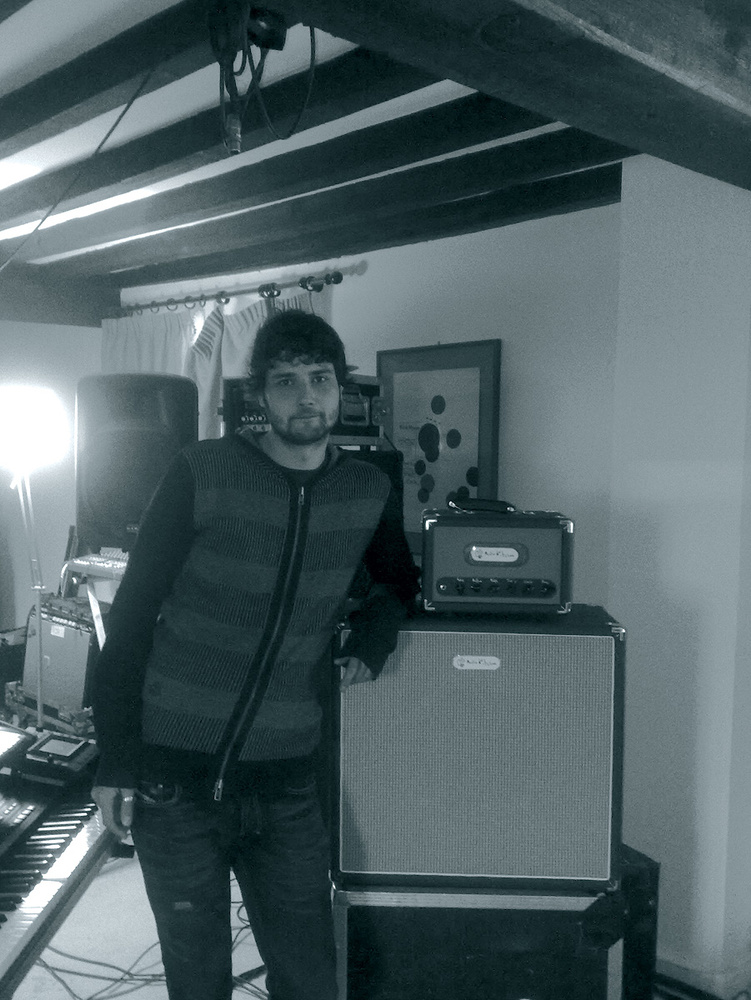 Dan Austin engineered and co‑produced the bulk of Kingdom Of Rust.Photo: Soup Collective
Kingdom Of Rust co‑producer Dan Austin (Massive Attack, Cherry Ghost) first engineered for Doves in 2004 during the recording of Some Cities. "I recorded three tracks on that at 2kHz in London,” he recalls. "It was just the tracking I was involved with, but it went fantastically well. The songs were ready to record, so there wasn't a lot of messing around, it was just all about getting a sound. They wanted to do something very vintage‑sounding. They had the EMI TG board in there and we went to 16‑track, 2-inch at 15ips, so it was a proper old sound.”
"We were impressed by Dan and it felt right to work together again,” Jez remembers. "He's an excellent set of ears and a great producer. We wanted to take control again this time and not have maybe this kind of mystical producer come in. I think, if I'm honest, we're more comfortable when we're in control ourselves really. Dan was coming in from the level that we were all working on it together.”
Keen not to enter a commercial facility — perhaps unsurprisingly, considering the costs that would have been involved — the band opted instead to rent a Cheshire farmhouse and build their own makeshift residential studio. Austin says that only the barest amount of acoustic treatment was done to the improvised control room.
"There's a bedroom at one end with three racks of gear in and the Pro Tools and a load of mattresses to try and stop the sound flying around,” he explains. "Very, very basic setup, but throughout the course of the 18 months that we worked here, we managed to get it to a point where you could take a monitor mix away and it sounded all right. It's still pretty inaccurate but it was never designed to mix in.”
When it came to the recording environment of the living‑cum‑live room, Jez Williams says it was a matter of trial and error. "But it was one of those lucky ones,” he points out. "You move all the gear in and you put up the mics and then start moving the drum kit all around the room. Dan found this optimum place near the fireplace that sounded great. Half is carpet, half of it's timber and there's this brick fireplace that obviously reflects the sound, so it's got a bit of everything.”
The farmhouse location is the third in a succession of studios that Doves have set up. The first was a disused warehouse in Manchester where they suffered a serious fire in the late '90s that destroyed most of their equipment ("But that's another story,” deadpans Williams), the second a long‑term borrow from New Order located in the city's Cheetham Hill, where chancing locals climbed onto the roof to steal the band's CCTV cameras.
In the tradition of their previous facilities, their latest studio is — bizarrely — named after former breakfast TV host Frank Bough. "It's Andy's perverse sense of humour,” his brother explains. Not that Frank Bough Sound III is likely to last much longer than its predecessors, since Doves are already becoming keen to move on.
 A composite photo showing the inside of Frank Bough Sound III.
"We're getting a little bit tired of it now, 'cause it was such an intense, long period to record this fourth album,” Jez laughs. "There's only so much cowshit you can take.”
Cottage Industry
The initial plan for the recording of Kingdom Of Rust was for Dan Austin to set up the studio for the trio and then leave them to record their typically elaborate demos, some elements of which usually make it to their final masters.
"The reality of it was that didn't quite work out,” Dan says. "A lot of the time they ended up going back to their laptops and just doing stuff in Logic at various people's houses or various cottages they went away to write in. They're all really tech‑ed up. By the time you get the demos, they sound really, really great. So it's generally a case of — track by track — deciding, 'Do we start again on everything?' If the drum sounds need fixing up, I always like sending stuff out into the room here through a PA and just trying to match all the sounds up, so there's a coherence to them.”
All three members of Doves run Logic 8 on their MacBook laptops. "We're all Logic‑heads really,” says Jez. "But we decided, for our proper studio, to get Pro Tools HD. Dan managed to front‑end Logic on the system. He set it up in a certain way that it was very easy to work on both and import stuff in.”
"If they had lots of automated Logic effects, say, on the guide vocal,” Dan says, "I'd record the vocal properly and then I'd fire the vocal back through their Logic automation and effects. I love all the plug‑ins in Logic — the bit‑crushers and distortions and the Tape Delay. We really got into Space Designer. Someone sent us some [EMT] 240 plate impulses and then we bought Revolver, the McDSP plug‑in for Pro Tools, put the IRs into that and it actually sounded even better than Space Designer.”
Tracking
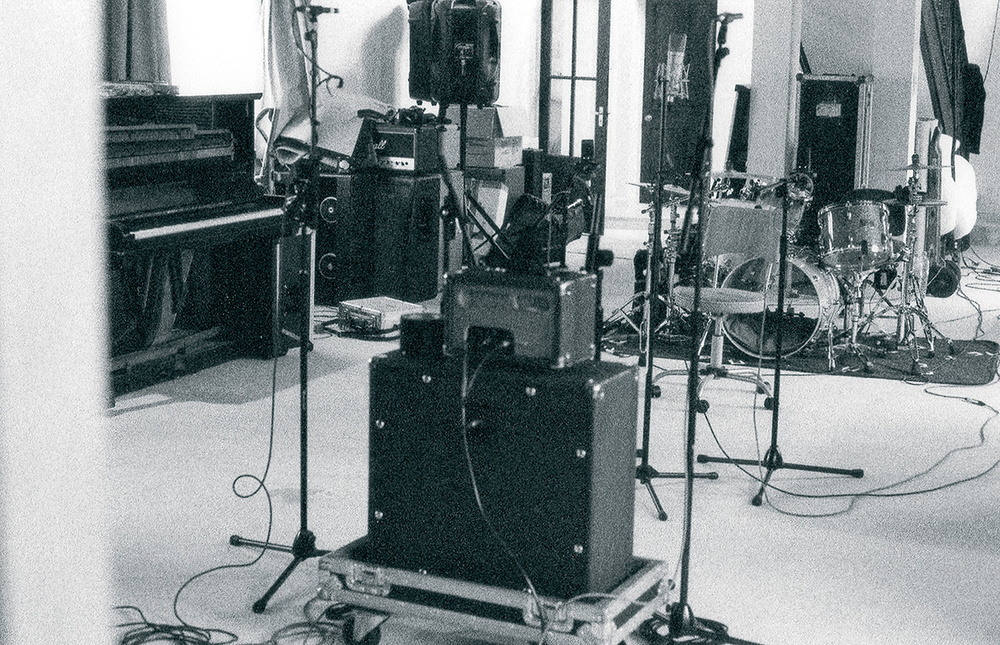 The improvised studio seen from the other end.
Austin and the group's time at the farmhouse was broken up into four‑ to six‑week recording segments, interspersed with songwriting periods. Then all involved would return and swap the various files they'd been working on. "Yeah, just Bluetooth each other and drop files in,” Jez explains. "It's instant, so it really helps us just to get on with the track and not get distracted by technology.”
In terms of tracking, Doves have no set formula. "Quite a lot of times,” Jez says, "we'd have the rough demo and then go in and knock it out to see where else we could go with it. We did get obsessed, probably a bit unhealthily, about BPMs and key.”
"If the track had a rhythm acoustic guitar, that would absolutely be done with the drums,” says Dan. "With those tracks, we'd set them all up, generally with Jimi playing bass in the DI to minimise the spill. There's a toilet which we occasionally locked the bass amp in to do live takes. Jez would be hidden behind a couple of screens playing the acoustic and the drums would go down. If it was an electric take, the guitar amp would go in the kitchen.
"Then, if we decided to keep the floor takes, we'd re‑amp, basically. I've got one of those Red Eye re‑amp boxes and it's just such a lifesaver. It means you can keep a really great performance and worry about the sound later. If you can get a pretty good sound, but you know you've got the DI and a re‑amp box, you're away.”
Aside from a Mackie 32:8 mixer used for headphone monitors, Austin and Doves were desk‑less and working in the box, using an array of preamps, including four Neve 1073s and two API 7600s, the latter being particular favourites. "You can rack them all up together and make yourself a little desk,” says Austin. "I love the APIs for the sharpness of them — on snares and guitars they're just fantastic.
"Then we've got a lot of the UA stuff. I just love the 8110s because they've got the tone switching, which is really subtle but it always seems to sound better in one position. You can really tan them as well, because they've got a separate output level — you can send the input right into the red and just pull the output down and it sounds really great. Then we've got the UA 2108. It's very, very coloured, but I love it on overheads. It just takes that horrible sheen out.”
Mic‑wise, as Dan Austin puts it, the band used "pretty standard fare — the poshest thing was probably a [Neumann] U87. Then it was a vintage [AKG] D12 for kick drum and bass, and [AKG] 451s and 414s as stereo pairs and overheads. The SE Ribbon mics are just fantastic. We used them all the time on guitars with either a [Sennheiser] 421, a [Beyer] 201 or a [Shure] 57. But we've always got the ribbon there just to get the fatness in the low‑mid.”
While other producers have been known to rewire an NS10 driver as a mic to capture low end from bass drums and bass amps, Austin and Doves experimented with smaller speakers. "They're just speakers out of an old Rover,” Dan laughs. "But you get a lot of mid‑range with them. If you put them a few feet back from the kit and effect them up — generally distort them through a [Thermionic Culture] Culture Vulture and compress them through a [UREI] 1176 — it's the best ambient mic you've ever heard. There's just something about it. It pulls it away from being a standard drum recording.”
Even more unusually, Doves have got into the habit of using vintage reel‑to‑reel tape recorders as mic preamps. "With The Last Broadcast, our second album, I started using Dictaphones for 'lo‑fi‑ing' sounds,” Williams remembers. "Then, with Max Heyes, who was engineering, we started using tape recorders from the '70s, along with the Neumanns and stuff. Since then we've built our arsenal of late‑'70s tape recorders. The inbuilt compression on these things is amazing and you can get this raw, exciting sound. Then you mix it with the posh mics and it's incredible. It's got embedded in the Doves sound. The band's collection of cheap tape recorders was widely used for interesting, lo‑fi sounds.
"A lot of them have got these super‑crusty limiters in them that are super‑fast,” Austin adds. "We quite often just have the tape recorder under the snare. It's just that thing that you can't get from EQ'ing or distorting another microphone.”
Eastern Promise
Although Doves are best known as a guitar band, Kingdom Of Rust opens with a mostly programmed affair called 'Jetstream', featuring Jez Williams' newly acquired analogue synths, the Octave Kitten and the Polivoks — the latter the early‑'80s Russian‑built take on the Moog Prodigy.
"I was after a proper analogue keyboard but something a bit different,” he recalls. "So I went on eBay and found this mad thing that was built in a military factory. It's rock hard. But it's an incredible, individual‑sounding machine and 'Jetstream' is mainly that. The track was originally just this very simple thing on the guitar, and we were trying to push it in a futuristic direction. We put the chords down onto a little reed organ that I bought off eBay for 20 quid, and then we put some phased hi‑hats down and started layering it with bass lines and getting the whole thing pulsating.”
"All those white‑noisey snares are from the Polivoks,” Dan points out. "They were all hand‑played, none of it's quantised, and that was the whole point, to make it feel organic. You could have done that track all in the grid and programmed it and it would've sounded disgusting.”
In terms of instrument plug‑ins, Doves are huge fans of GForce's M‑Tron Mellotron simulator. "We're pretty obsessed with that M‑Tron plug‑in,” Jez says. "It sits with guitars very nicely.”
"They use it all the time,” Dan adds. "It'd be great to have a real Mellotron, but I've had such problems with trying to record real ones in the past. I've actually ended up using the plug‑in, 'cause half the notes on the real one don't work and they're noisy.”
Most of Kingdom Of Rust's rattling, Spaghetti Western‑flavoured title track, meanwhile, was built from the original Logic demo, recorded during a songwriting session in a cottage in Eyam, Derbyshire.
"We imported the drums, the bass, the guitars, and then Dan started doing sound replacements,” says Jez. "It'd be like, 'Well Andy hit a tom there, but there was no mic on it cause we didn't have enough channels.' So we sampled a few toms and put them in and mucked around with some of the timings.”
"The glock in the chorus was just an EXS patch,” says Dan. "But we put it through various things. They're really into putting stuff slightly out of tune. There's a lot in that track that's deliberately sharp and I think that gives it a magical quality. We're constantly messing about with tunings, just pulling stuff wide. It gives you that width when everything's not on the note. It's the same with timing — when everything lands at the same time, it doesn't sound as big as when it's all slightly blurred.”
Some tracks feature orchestral elements, a subtle blend of the real and the sampled. "A lot of orchestral stuff is from the EXS,” Austin says. "Some of it is played — we used a quartet from Manchester — a lot if it is a combination and some of it's just samples. It was as and when, really.”
When it came to guitars, Jez Williams used mostly his Gretsch Country Classic II, through a vintage Fender Vibrolux or a Vox AC30. "But then I just bought this new amp that's amazing, called the Audio Kitchen Little Chopper,” he says. "It's hand built and it got made and delivered for the very last session on the album, so I managed to sneak it into a couple of the songs.”
Elsewhere, while the Krautrock‑echoing 'The Outsiders' went down more or less live in a handful of takes, the atmospheric ballad 'Birds Flew Backwards' required four different versions before it was ready for the album. "We didn't want it to be entirely acoustic, but we didn't want it to be an overblown orchestral thing,” Austin stresses. "It was just getting it right, really. I think what kick-started it being right was the dilruba that we had this guy come down and play. It just put it in a different place — this strange Indian instrument in a lot of reverb in the background. A lot of the orchestral stuff, all the kettle drums and so on, that's just Logic EXS stuff that we pumped out into the PA in the room just to give them a bit of vibe.”  Dilruba added an exotic flavour to 'Birds Flew Backwards'.
In general, Austin says, there's always much comparing and contrasting of sounds going on. "There's a lot of that stuff with Doves where you record things and capture them in two ways and then pick later. It's all about A/B'ing with them — 'Right, let's hear it one way and let's hear it the other way.' With arrangements, with sounds, with everything really.”
Emotional Involvement
By the end of the 18‑month recording period, perhaps understandably, Austin and Doves were to keen to hand the mixing of Kingdom Of Rust over to someone else. "We didn't want to mix it, simple as that,” Jez states. "I think it's better to get someone else who isn't involved to mix your record, 'cause he or she's not going to have an emotional attachment to certain parts that took you four hours to get right. Because if you were involved in it, you damn well make sure that that four‑hour sweat session is in the mix.”
Enter superstar mixer Michael Brauer (featured in SOS's Inside Track feature, in the November 2008 issue of the magazine: see /sos/nov08/articles/itbrauer.htm). "The guy's a mixing legend,” says Jez. "He's just one of these mixers that can seem to get different styles of songs nailed. So he was perfect for our album.”
"It was important to get a fresh pair of ears on it,” says Dan. "What he does is very clear mixes — everything's there in its place. I love the mixes on the record, I think they're great. But it wasn't always easy to get there. There were a couple of recalls going on.”
Austin also points out that — taking into consideration the amount of honing the tracks had undergone — the files that he and the band sent to Brauer were already embedded with a lot of the effect and automation information. "If you just put the track up with the faders in a line at zero, it would not resemble the song at all. So he just took it further. His vocal sounds are just fantastic — that's what he's really strong at. Just getting the vocal sitting in the track.”
Instead of travelling to New York to attend the mix sessions, Doves and Austin took the progressive move of communicating with Brauer via Skype, using a program called Nicecast, designed for on‑line radio streaming. "What he'd do is send us WAVs via YouSendIt, and we'd send email comments back,” Dan explains. "That would happen two or three times. So maybe by the time we got the third WAV, we'd be really close. He'd send me a Nicecast link, which would open up in my iTunes as a stream, and then basically his output from his desk in New York fired down that and I would pump it out of my M Box.
"We'd got him on another laptop on iChat so we could see him and talk to him and then we gent through the tweaks. There's about a five‑second delay on it, but it's 192kbps MP3 compression, so it sounds pretty good — enough to do changes like that. Then he'd send us the full‑rate WAV and we'd listen to that. It was a fantastic way of working.”
"This was the first time we'd ever done it and we loved it,” Jez enthuses. "Here we were in Frank Bough III, mixing live from New York. It was amazing. We'd work on it with him for an hour, tops, and it'd be done.”
So, after 18 months of solid recording and writing, can Jez Williams actually bring himself to listen to the finished version of Kingdom Of Rust? "God, no,” he laughs. "I reckon I'll probably give it about a year before I listen to it again. That's the only way you can really find out the kind of record you actually made.”
Chemically Altered: Mixing '10.03'
Prior to the Cheshire farmhouse sessions with Dan Austin, Doves travelled to Rockfield in Wales to record three tracks with John Leckie, before the producer's other commitments forced them to make the decision to go it alone. Two of the tracks — 'Winter Hill' and '10:03' — made it to the final track-listing, though the latter, in particular, was radically reworked in subsequent sessions.
"'Winter Hill' was pretty much straightforward — go in, record it, quite straight down the middle,” says Jez Williams. "But '10:03' was a bit more of a tricky one. We bedded the tracks with John Leckie and then we deconstructed them again, re‑edited the arrangement. It was one of those we kept coming back to. At one point it wasn't gonna make the album. We had to wrestle that one to the ground.”
"Where that track is now from the original recording is very different,” Dan continues. "It was totally hacked around. They'd actually mixed it with John and got it back here and thought, 'Maybe there's a different version of this.'”
In the end, the band turned '10:03' over to their friend and labelmate Tom Rowlands of the Chemical Brothers, who rearranged the track. "Tom did a version that we really liked,” Dan says. "It's good when you send stuff to other people, because they're not attached to things and they'll do very brave things — like he cut a verse and a chorus, about two minutes of the song. And we probably never would've done that. Generally, there's a lot of editing with them. We'd do different edits of arrangements and be constantly moving songs around. Y'know, final choruses would become the first chorus two months later and things like that.”
'10:03' was also unusual in the sense that the final master originated from a Logic laptop mix that Jez Williams did and Dan Austin subsequently took to Modern World Studios in Tetbury. "Jez's mix was great, but because it was coming out of two outputs, it just didn't have the width,” Dan explains. "So I took it to Modern World and matched it — kept all his automation and levels but just opened the mix out. Modern World is the only place I want to mix now, it's just fantastic. They've got an SSL Duality, a very medium‑sized control room, but it just sounds amazing. The automation system on the Duality is just so simple and it integrates with Pro Tools seamlessly. It's just an amazing‑sounding board.”
Vocal Sounds
 Dan Austin typically recorded Jimi Goodwin's vocals through two phase‑aligned mics simultaneously, usually an SM58 and a U87.
In recording Jimi Goodwin's vocals, Dan Austin usually opted for a high‑end/low‑end blend of Neumann U87 and Shure SM58. "Jimi really suits a U87,” he says, "but I've got into a habit recently of setting up an SM58 right next to it and matching the phase and then blending. U87s are very sweet, and that's great for some songs. If you want a bit more poke, you don't always get that. I don't necessarily like SM58s on their own because sometimes you need a bit of poshness. So if you get the phase right, you can blend the two and it sounds great.
"Also, it gave me the option later of maybe just using the 58 on a backing vocal or just using the 87 on a chorus or something, just flicking the sound. It's that thing of not wanting to put someone through singing through 10 mics. If you put the two up, it means he hasn't got to mess around and I can decide later.”
Given the lengthy recording period, however, there was the odd occasion where Austin had to match up a vocal sound he'd engineered some months before, in order to do new drop-ins. "I always recall everything,” he points out. "There were a few times where, a couple of months later, we'd send for him again. As long as he did a few takes to get his throat in the same place and you recall it, you can do it, no problem.”