

Thirty years after their debut, Simple Minds returned to their roots as a live band and relit the old fires to record their most impressive album in years.
 Simple Minds: from left, Charlie Burchill (guitar), Eddie Duffy (bass), Jim Kerr (vocals), Mel Gaynor (drums).Photo: David Ellis
Two thousand and eight was a pretty big year for Simple Minds. The Scottish pop‑rockers not only celebrated their 30th anniversary with a sold‑out arena tour across the UK, but they also spent the latter part of the summer recording their first album in over four years with producer Jez Coad. With a new label, Universal, in tow and with principal songwriters Jim Kerr and Charlie Burchill enjoying their most fertile period for years, the omens were good. Kerr and Burchill duly logged a call with Coad, who'd been at the helm for 2005's Black & White 050505, and got him involved in the demos they were crafting at Glasgow's Lofi studios. From a very early point, it was clear to the trio how they wanted the record to both sound and feel once they got back in the studio with bassist Eddie Duffy and drummer Mel Gaynor.
"We definitely wanted a band focus, so you can close your eyes and see a band, so a high degree of honesty. Simple Minds are known as a fantastic live band, so why wouldn't you go and be a fantastic live band in a recording studio?” explains Jez Coad. "Secondly, there was a real desire not to go over old ground, because you can write a whole album of songs that sound like their hits, but nobody's really very interested in doing that. Also, we wanted something that would be as accessible as it would be challenging — something that was going to surprise you but not alienate you. All of us love a good tune and all of us love a good rhythm, and we wanted great memorable tunes but with an attitude, with elements in them that would take you to different places.”
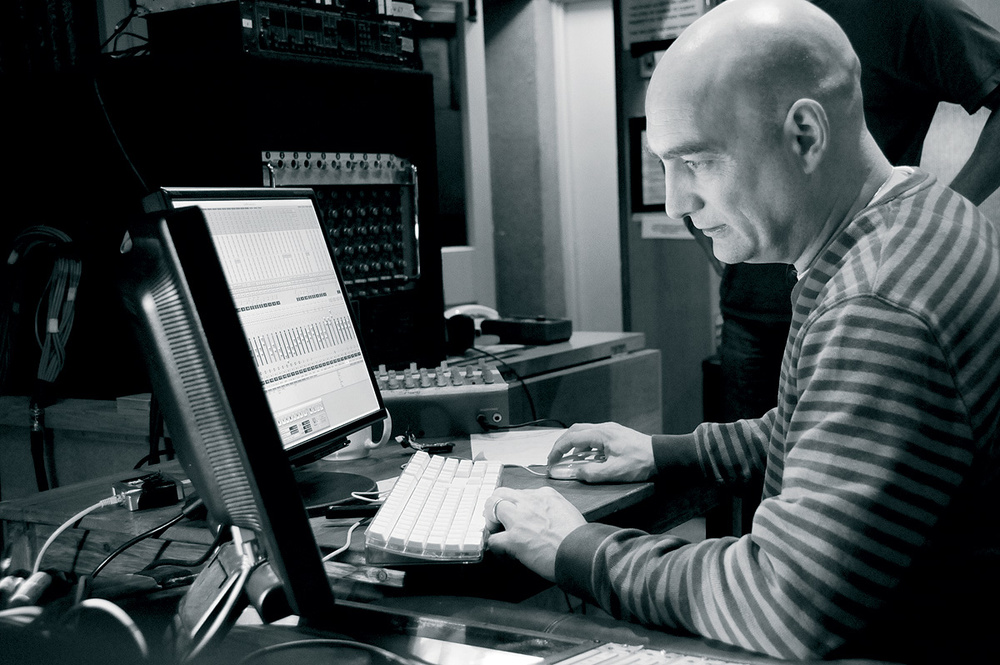 Producer Jez Coad at his Pro Tools rig during the Rockfield sessions.Photo: Hilko Nackaerts"I think we definitely knew what we wanted before we went in, and that always helps,” says Jim Kerr, "Sometimes, you're a lot less clear. Sometimes, there's a lot of different options and you're writing varied music in different styles and the album can be a hotch‑potch. Sometimes [albums] are great for that, and sometimes they suffer because of that. When we started to write, I started putting things in sequence early on. I had this feeling that, being with a new record company, this was an album that needed to be totally focused and immediate, and that was combined with the fact that we'd just done this thing about being 30 years old: we couldn't have an album that sounded like it was 30 years old! We wanted something energetic and really trying to prove itself, vibrant and imaginative: that was the list of demands. At least we knew what we wanted — but how we were gonna get it was another thing...”
The first big decision Jim Kerr and Charlie Burchill took as regards "getting it right” with Graffiti Soul was to enlist Jez Coad. "Jez is amazing,” enthuses Jim Kerr. "What he especially has that we lack is that we're great at piling up the ideas but he's got a great analytical mind — 'That's not working because of that!' or 'That worked before, but it isn't working now because we've changed this!' He can zone in, in a way that Charlie and I can't. When you're working with someone, you're looking for them to have the things that you don't have, as well as covering the things that you do have and giving you objectivity. With us, he's great — he's really good at getting the performances out of the band!”
Boarding School Of Rock

Simple Minds recorded 1979's Reel To Real Cacophony and 1980's Empires And Dance at Rockfield in Wales, and Jez suggested they return for the new album. Aside from the fact that the band had previously enjoyed great creativity there, Jez felt it important that they literally "get away from it all” at a residential facility.
"It's like being in boarding school!,” laughs Jez. "You're doing the same thing and you're cocooned in the same place! You all eat together and we had this, almost, regime where we'd tend to do midday to midnight, which is 12 hours a day intensive with very little wasted time. Then, at midnight, we'd go and sit in the television room and play cards and drink whisky! And after a week of that, you're completely a unit and a family, and the outside world just melts away. The entrenched feeling was also made even more so in that it pissed down with rain almost the whole time we were there, so you really couldn't physically go out anyway — but we all felt like we were really in this together!”
By the time Simple Minds arrived at Rockfield for their scheduled six weeks of Graffiti Soul sessions at the beginning of August 2008, the album's eight songs had already been pushed into rough demo form at Glasgow's Lofi studios. It was during those sessions that Burchill, Coad and Kerr really hammered into the arrangements; again, honesty was one of the most important factors.
"What we established was such amazingly quick communication, because there was an element of trust between us which takes time to build,” explains Jez Coad. "There was never any problem with any of us saying, 'That's a rubbish idea!' There was never anything other than a need to make it better, and we'd have quite vigorous arguments about why something should be this way or that way, but we would always come to an agreed decision at the end. I've never been in a situation where you can be so strident in your opinion and then, by the end of it, even if it's not your opinion — and this would go for anyone in the room — you or they'd go 'OK, I understand what you're saying, let's do that.' It happened to all of us!”
Both bass player Eddie Duffy and drummer Mel Gaynor were sent out MP3s of the rough tracks prior to everybody getting together at Rockfield, but it was certainly not a case of the arrangements being fixed in stone.
"We'd give them it as we saw it, but then we also then said 'How would you see it?'” says Jim Kerr. "The last [album] was really nailed down but this one was a bit more open with the writing. The melodies were taken care of, the concepts were taken care of, but we left them a wee bit open‑ended so there was somewhere to go!”
A Band After All
 Mel Gaynor's drum kits were set up in the main live area at Rockfield, in order to capture the feel of a band playing together. This photo from early in the sessions shows a mic setup that was not eventually used, with two 'esoteric' mics belonging to Arjen Mensinga as overheads.
To engineer the Rockfield sessions, Jez Coad brought in Arjen Mensinga, who had been an assistant engineer on Black & White 050505 and had suitably impressed both Jez and the band with both his innovation and pragmatism. Arjen was not available for the entirety of the sessions, but his absence was more than adequately filled by resident Rockfield engineer Simon Dawson. Also part of the team was Charlie Burchill's long‑standing amp and guitar tech, Hilko Nackaerts. The first week of the six was spent setting up all the gear and microphones; once everything was running smoothly, it was time to lay down some live backing tracks in Rockfield's famed Quadrangle studio. Getting a 'live feel' to nail the groove of the tracks had been a key aim going right the way back to Jez's earliest conversations with Jim and Charlie.
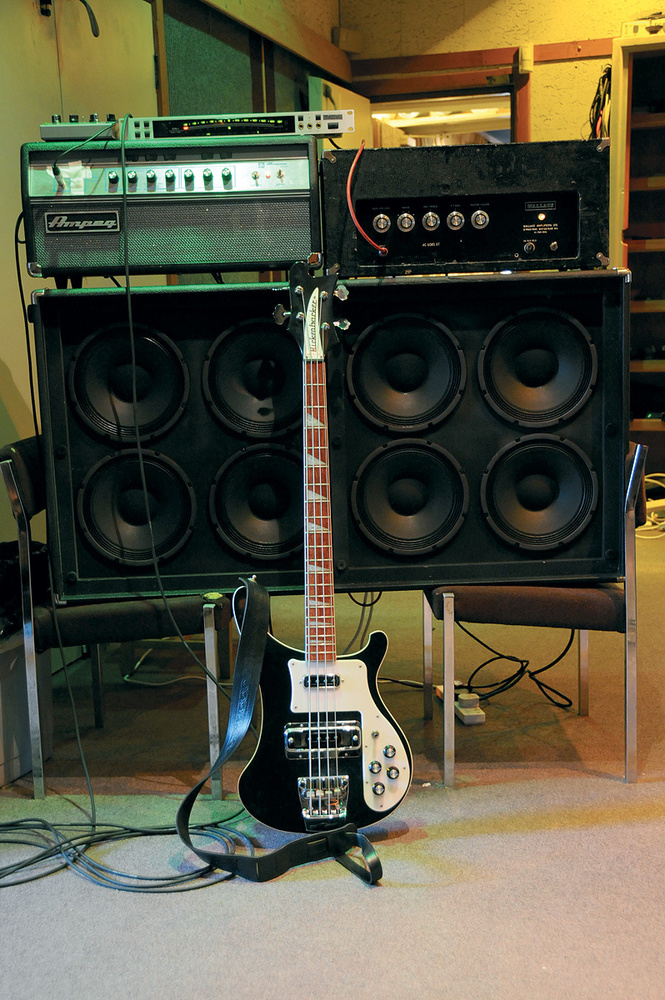 Before Jez Coad and Eddie Duffy settled on the AC30/Wallace bass setup they experimented by combining the Wallace with an Ampeg amp."Every single time, the performance is more important than the sound for me,” says Jez Coad. "The drums have to be in the same room as the guitars for the feel, and if there's a bit of spill, I just don't care, because I know that the performance will be more impressive! It's always performance first, technical stuff second. Don't get me wrong, because [technical stuff is] really important, but if it both sounds and feels great, you've won. I always, always, always try and record everyone together, which is 90 percent of the time what we did on this record — everyone together having visual eye contact and, more importantly, visual body contact. What happens on stage is that you look at each other and you get vital clues from each other — why would you have it any other way?”
Before Simple Minds began working with Jez back in 2004, the 'live band' approach to recording had become something rather alien to Jim Kerr and Charlie Burchill.
"It's kind of ironic, because Simple Minds are a band, after all,” says Jim. "And why would that be a hard thing to do? Why would it be novel? But, in a way, it had become that to us… through the gear and through the various band members coming and going, we started to depend on ourselves, and the occasions for the band to get together for the sake of getting together became few and far between.”
During the recording of the backing tracks, Charlie Burchill was playing guitar along with the bass and drums. Keyboards would be overdubbed and tracked by Charlie at a later point. It was rare for Jez to need more than five or six takes to nail the band's performance, and another important role Jez took at this stage was to identify any mistakes that could actually be utilised to embellish the basic arrangements.
"You can get lovely things — you can get strange timings and you can get mistakes and, as with all recording, it's the mistakes you look for!” says Coad. "It's the mistakes, sometimes, that are the magic, and as a producer, a major, major part of my job is to say, 'OK, let's go again but play that — I know it's not what you meant to do but there's some unbelievable magic there!' My job is always to identify the correct take where the magic sits, and sometimes it's a universal thing — by the end of the take everyone looks at each other and everyone knows!”
Because Jez, Jim and Charlie had decided they might want to use some of the Lofi pre‑production material on the album, the backing tracks were recorded to clicks. Jez is adamant that none of the natural human feel, raw emotion and excitement created by a live drummer and a live band performance was lost by doing so.
Tracking Details
 Charlie Burchill's guitar corner at Rockfield, where three Matchless amps were set up in a row to capture both a 'main' guitar sound and stereo effects.
Graffiti Soul was tracked on a Pro Tools HD 3 rig with 192 converters at 96kHz/24‑bit, using an MCI 500-series in‑line console with 42 inputs. A selection of Neve and Rosser preamps, provided by the studio and the band themselves, were also utilised.
Mel Gaynor played two drum kits across the Rockfield sessions. The two kits — Gaynor's standard rock kit and a small, hired‑in '60s Ludwig kit — were screened off in the main Quadrangle live room but with enough visibility to ensure the other band members could see and react to Mel's playing. As far as the standard kit went, the kick drum was recorded with a Sennheiser MD421 inside, a Neumann FET 47 on the outside and a Yamaha NS10 driver for the sub‑bass. The snare was miked with a Shure SM57 "for the mid‑range smack”, a Neumann KM84 for "clarity” and an SM58 underneath. A Coles 4038 was also initially placed between the snare and the kick, until the power of Mel Gaynor's drumming broke it, after which point an AKG 414 was used. An AKG 414 was also used on the hi‑hat, Sennheiser 421s on the toms, with an Electrovoice RE20 on the floor tom, a Neumann U87 on Mel's gong bass drum, a B&K 4011 on the ride and Neumann U67s and a single Coles 4038 as overheads. For ambience, two Neumann KM84s were placed at the rear of the kit, while the drum sound was also fed into a stone‑walled back room with wooden floor, through Tannoy speakers, where two ambient mics were set up. The '60s Ludwig kit had an AKG D12 and B&K 4007 on the kick, a Shure SM57 on the snare, an AKG 451 on the hi‑hat, a Sennheiser 421 on the toms and another Coles 4038 as an overhead.
Three Matchless amplifiers were used for Charlie Burchill's guitars, each miked with a Shure SM57 and a Sennheiser 421. The central amp projected the "main raw guitar sound”, while the two on either side were operating in stereo and projecting whatever effects Charlie was stomping on at the time.
"You got the best of all worlds,” explains Jez Coad, "You got all the power in the middle, and then you got all the lovely, diffused, echoey chorus and any other kind of modulation coming out of the two side ones, so we could balance the amount of power to the amount of sort of psychedelia going on!” A pair of Neumann KM84s was also placed 15 feet away from the amps to capture room ambience.
For Eddie Duffy's bass, three amps were used: a '60s Wallace amp belonging to Jez Coad's brother, for a clean sound through an Ampeg 8x10 cab; Jez's Vox AC30 for a more raw, aggressive sound, sometimes dirtied up further with a fuzz effect; and Rockfield owner Kingsley Ward's 50 Watt Marshall amp, which was used as a substitute for the AC30 after the speakers blew mid‑session. Three tracks were recorded: a DI going through an old BBC valve mic preamp, an RE20 on the Ampeg speaker and an SM57 on the Vox/Marshall.
Jim Kerr's vocals, which Jez and the engineers recorded at whatever point Jim felt in the mood to lay some down, were recorded twith three different microphones "to give three completely different characters”. A Sennheiser MD441 was used as the "rock mic”, and there were also an "ancient” Neumann U87 belonging to the studio for "wonderful, defined, mid‑range” and a Neumann U47 belonging to the band. The U47 was actually held together with bits of gaffer tape, but gave "the warmest, Bing Crosby-type sound possible”.
Still Alive & Kicking
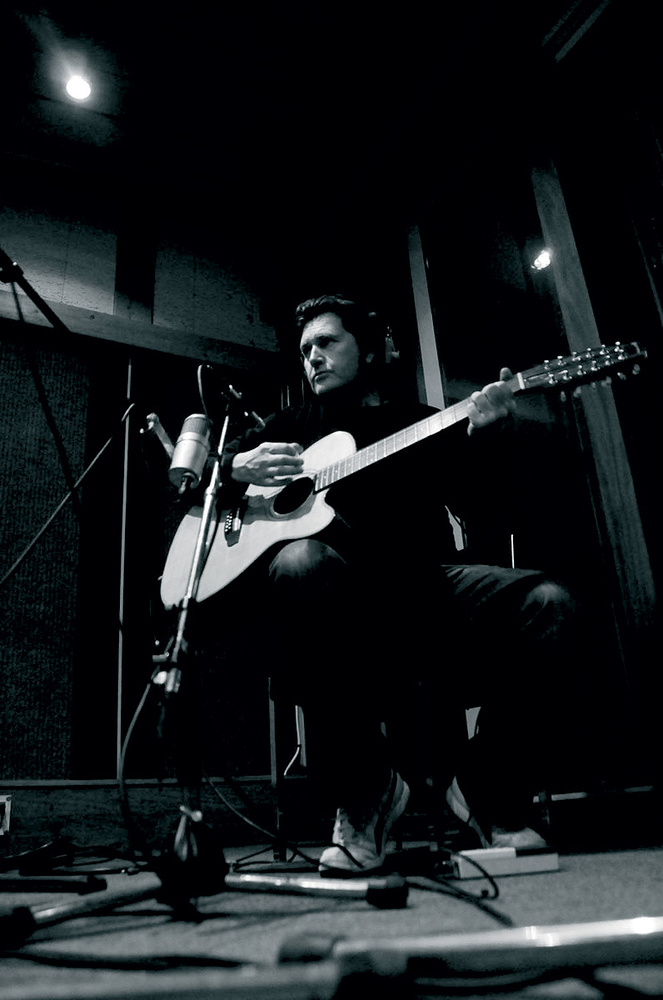 Charlie Burchill tracking a 12‑string guitar at Rockfield.
After the basic tracks were recorded, and prior to Charlie Burchill letting loose on keys and guitars in 'overdub mode' (see 'Bend It, Break It' box), Simple Minds took time out to have a bit of fun and recorded a slew of live cover versions, which make up disc two in the deluxe version release of Graffiti Soul. Their versions of some of their favourite tracks, which include Neil Young's 'Rockin' In The Free World' and 'Teardrop' by Massive Attack, epitomise the live feel and ebullient atmosphere everyone involved enjoyed during the Rockfield sessions.
Graffiti Soul was largely mixed by Bob Clearmountain at his Mix This! 'home' studio in Santa Monica, although Jez Coad and Cenzo Townshend enjoy one mix apiece on the final cut. Thanks to the strong songs and live‑in‑the‑studio philosophy of recording, the result is an album that sounds surprisingly fresh and alive, three decades after Jim Kerr and Charlie Burchill first started jamming as teenagers. Graffiti Soul is out now, and the band start a tour with OMD in November.
"What you can certainly see with the Minds is that they are still, after all these years and all these records, passionate about what they do,” concludes Jez Coad. "Sometimes, the older you get, the more your edges are dulled, but with them not only is there a great deal of passion, there is also a need to push the boundaries. There's no sitting back on laurels and going 'Yeah, that's OK, that'll do. That's doing what people would expect us to do.' The combination of the freshness and the real passion is something that's just fantastic.”
Bend It, Break It: Charlie Burchill's Effects
After Simple Minds had laid down the basic live rhythm tracks for Graffiti Soul, it was time for Charlie Burchill to get busy overdubbing guitars, keyboards, and anything else that took his fancy, as well as working like a mad professor on the sounds that had already been recorded. Burchill had brought dozens of guitars, a stash of old '80s synths and classic keyboards, and literally hundreds of different rackmounted and pedal‑based effects, through which both guitars and keyboards were fed by Jez and Charlie.
"We had marvellous fun,” laughs Jez. "'I wonder what happens if you stick that into this or stick this into that!' If there was a standard sound, Charlie would want to bend it and break it in some way — someone described what Charlie was doing as being 'Bin‑Ladened' because it would sound like it had come out of Bin Laden's cave, full of strangeness. If the sound was three‑dimensional, he'd make it four‑dimensional!”
In fact, Charlie was messing with already‑recorded sounds all the way through the sessions, thanks to the way his own Pro Tools laptop system had been plugged into the desk.
"We had feeds from the keyboards into the main desk, then from the main desk into his system, then also from his system back into the main desk, and then from the main desk into a floor full of pedals. So without disturbing tracking, he could take sounds from his system back into a channel on the desk that wasn't open in the room, back to a bunch of effects pedals, processed back into the main desk and then back into his system. So he could be screwing with stuff through the desk, playing with sounds, using plug‑ins, chopping stuff up, reversing things, and then also taking stuff from completely unrelated songs that were recorded in 1995!”
One great example of the experimental 'Charliefying' that was going on at Rockfield was the use of a Stylophone, throbbing and pulsing with various guitar effects, as the musical backbone of the track 'Blood Type O'. "Charlie had brought along a Stylophone that he'd bought for his kids in Hamley's — well, he said he bought it for his kids!” laughs Jez, "It just ended up being a completely different sonic thing, and about 80 percent of that track is weird stuff going on with a Stylophone.”
"It has a great tone when put through pedals and an amp,” adds Charlie. "It's a pretty anarchic sound and it gets a bit out of control, which is great. When I put it through a tape echo, it was dynamite!”