

When producer Martin Rushent took the Human League's leaden new song and turned it into pop gold, the band hated it — but that didn't stop it from being a number one hit on both sides of the Atlantic...
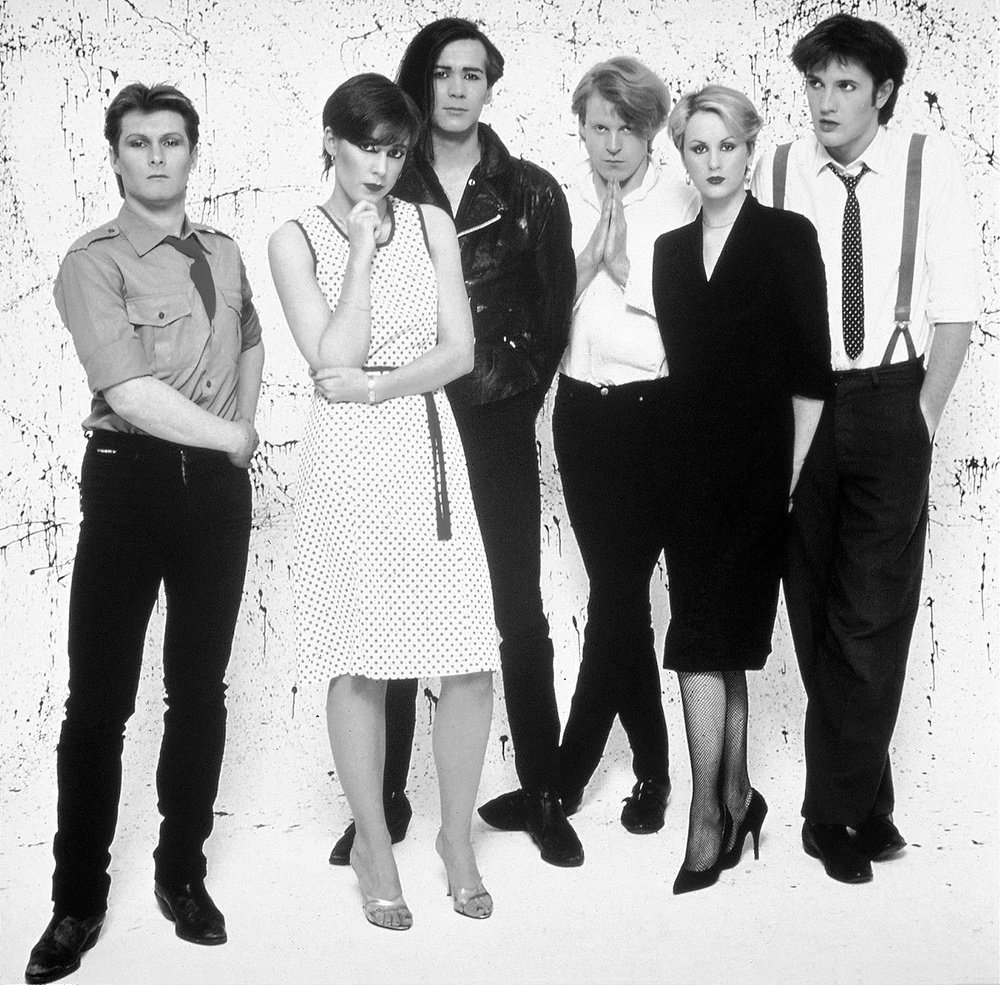 The Human League, 1981. From left to right: Jo Callis, Joanne Catherall, Phil Oakey, Adrian Wright, Susan Sulley, Ian Burden.Photo: GAB Archive/Redferns
In October 1980, Phil Oakey found himself in a really tight spot. The lead singer with Sheffield‑based avant‑garde electronic outfit the Human League, Oakey was a former hospital porter who, about three years earlier, had been recruited by keyboardists/composers Martyn Ware and Ian Craig Marsh on the strength of his flamboyant, sexually ambiguous appearance rather than his untested vocal ability. Now, a couple of weeks before the start of a British and European tour, Oakey had to pick up the pieces after the aforementioned founder members had quit as a result of artistic differences arising from a lack of mainstream success.
Fed up with Oakey's insistence on pursuing a more pop‑oriented direction, electronica purists Ware and Marsh departed to form a new group that would soon be known as Heaven 17. That left Oakey with not only the rights to the Human League name, but also the responsibility for the Human League's debts and contractual obligations, both to Virgin Records and to the concert promoter who was threatening to sue if the tour didn't go ahead. Able to count on the loyalty of his art-college friend Philip Adrian Wright, who had recently taken to playing keyboards, while spicing up the band's live performances with lighting and slide shows in his capacity as 'Director Of Visuals', Oakey didn't waste any time, hiring synth player Ian Burden and a pair of female backing singers.
Scouring Sheffield's city-centre venues for just one girl vocalist, Oakey spotted a couple of schoolgirls dancing at the Crazy Daisy Nightclub and — echoing his own recruitment by Ware and Marsh — enlisted them because he thought they looked good, even though they had no professional singing or dancing experience whatsoever. Susan Ann Sulley was just 17, Joanne Catherall was 18, and after the October/November tour had somehow been completed — amid press jibes about Phil Oakey and his "dancing girls” — they went back to school, while Oakey and Wright recorded 'Boys & Girls', which peaked at just number 47 on the UK singles chart in February 1981.
Professional Help
 All of Martin Rushent's photographs of his Genetic Sound Studios were, sadly, destroyed in a house fire. This photo, reproduced from newsprint, shows him sitting at his beloved MCI desk.
Clearly, some help was required, and this came in the form of producer‑engineer Martin Rushent, who began working with the group at his own Genetic Sound Studios in Reading, Berkshire. That March, while Sulley and Catherall commuted between there and Sheffield so that they could take their final school exams, Rushent took charge of the production of the Oakey/Burden‑penned single 'The Sound Of The Crowd'. This reached number 12 in the UK a couple of months later. By then, the band's line‑up had been rounded out with the addition of former Rezillos guitarist/songwriter Jo Callis, who quickly learned to also play synths, and sessions were well under way for Dare, the Human League's multi‑platinum third album, which would remain on the UK charts for 71 weeks and would serve as a highly influential blueprint for '80s electronica‑driven synth pop.
"In those days, making electronic music was a big job, particularly the way that I was doing it,” says Martin Rushent. "To get the sounds I wanted, I was layering synths — I might have 24 synths playing one synth line, all programmed, all analogue and all drifting out of tune. It used to take hours and hours and hours, and I don't know how we ever got through it.”
Born in 1948, Rushent was a singer with several school bands during his early teens, at around the same time he indulged his burgeoning interest in recording with a four‑track reel‑to‑reel tape recorder purchased for him by his father.
"I worked out how to bounce stuff,” he recalls, "so I would spend my days as a 14‑year‑old doing different versions of 'Stay' by the Hollies, multitracking my voice and the guitars.”
Still, it was while tracking a demo with one of his bands at the EMI Studios on Abbey Road that Rushent truly fell in love with the recording process and set his sights on becoming an engineer and producer. Accordingly, he "wrote to just about every studio on the planet” and in 1968 secured a job at London's Advision, where he learned the art of engineering, courtesy of T‑Rex sessions with producer Tony Visconti, as well as others with a then‑typically eclectic array of artists, ranging from Osibisa, Yes and ELP to Shirley Bassey, Petula Clark and Jerry Lee Lewis.
Genetic Sound
 The Human League on stage shortly after the success of 'Don't You Want Me'.
In the early 1970s, at around the same time that Rushent became one of the first freelance engineers on the London scene, alongside Roy Thomas Baker and Eddy Offord, he built his own little studio in the garage of his Henley home. There, he recorded a band called Stretch and enjoyed his first success as a producer with the single 'Why Did You Do It'. A stint as a producer and A&R man for United Artists Records then saw him working with the Stranglers, the Buzzcocks and Generation X, before Rushent purchased a large home in Reading where, in 1979, he launched Genetic Sound Studios.
"It had one of the biggest control rooms in the world up until that time,” he remarks. "It must have been at least 30 foot wide by 25 foot long, which back then was the size of a lot of live rooms, and in this case the studio was only slightly larger than the control room. This was because I could see more and more work being done in the control room, and also because it could accommodate all of the synthesizer equipment and programming equipment that I'd bought.”
This was in addition to a 32‑channel MCI console that Rushent describes as "the greatest console I've ever had. I rue the day I got rid of it. Because of its rudimentary computer mixing, I had VCA faders and mutes, the two things I could program, which used to lift 90 percent of the load off me once I'd done a mix and could then get on with working the effects. However, what I really loved about that desk was the EQ. The closest thing to it now is the Mackie, which in essence is a modern, reverse‑engineered MCI — that's why I've got a Mackie in my current studio. I can always grab that EQ if I need it. However, I'd love to have the MCI back.
"You see, after the success of Dare there was an awful lot of money flying about, and our financial people said, 'Martin, you'd better do something with this or you're going to give it to the Government.' So, as more and more people wanted to come to Genetic, I decided to build another control room with an overdub booth at the other end of the building, put the MCI in there with all of the computer‑based gear, and then I could work there while the main studio would house an SSL for outside clients. The SSL had the most advanced mix functions of any board available at the time, so everybody wanted to use it. What everybody missed was the fact that, in my view, the SSL may sound technically correct, but it's never sounded musically correct. I hated working on it, and it ended up ruining my main control room. At the same time, you can never build two rooms that are identical, and I never got the monitoring sound up the other end the way it was in the main room when the MCI was in there.”
While that original control room's Otari 24‑track machine with Dolby noise reduction sat near MCI quarter‑ and half‑inch machines and plenty of outboard gear, JBL 160 monitors were built into concrete blocks in the wall.
"The sound in there was awesome,” Rushent asserts. "I wanted a really loud control room that I could take up to the levels that I heard in a club or at a gig, because I used to mix on these tiny Dentons and then flip between them and the JBLs to make sure something sounded great when it was played really loud, as well as when it was played over the radio and on people's home stereos.”
Meanwhile, there were similar options in the live area, where an unconventional acoustical design allowed for greater than usual flexibility.
"There was a sort of matrix in the ceiling, with walls dropping down, attached to screens,” Rushent explains. "This enabled us to build booths wherever — and at whatever size — we wanted. Then there were panels on the walls that could be turned around; one side was very absorbent, the other was really reflective, so if you wanted a huge great drum sound, you'd just set the drums up in the middle of the room, turn all of the panels around to the live side, and off you'd go. If, on the other hand, you wanted a disco sound, you'd just turn them around the other way. It all worked brilliantly for me.”
The Master Plan
 Martin Rushent: back in action and ready to face his fifth decade in the studio.
Rushent's work on Dare evolved out of Phil Oakey's pop‑oriented sensibilities — driven by his love of Abba — and the producer's organic approach to recording allowed for experimentation rather than following any sort of master plan.
"I think the only master plan that existed was how the band should look,” says Rushent. "That was very important to Phil, who was trying to make a new electronic Abba. He probably thought it was going to sound a bit darker than how it ended up, and the best example of that was 'Don't You Want Me'. When I first heard it, only about half of the song had been written and it was very, very rudimentary. That was the case with most of the songs — they were semi‑written or they just consisted of a riff. You know, 'Yeah, that's a great riff, let's build it into a song,' and everyone then singing their ideas.
"It would always start off with me laying down a sort of guide drum track. The only track that didn't use the LinnDrum was 'The Sound Of The Crowd', because I didn't have the LM1 yet. Once I did, I'd lay down a very rudimentary guide beat and then we'd add the bass synths, programming them and working out all the different bits. Next, there'd be a guide vocal, just so we knew where we were, and this would be followed by a basic keyboard pad to give us some chords, before I'd program in all of the drum fills. After that, we'd keep layering stuff on until we thought the track sounded finished, and some time during that process we'd also do the vocals.
"In the case of 'Don't You Want Me', the vocals went on quite early. That was because the drums and bass were finished, and we also had a really good guide synth keyboard, but there were logistical problems due to the availability of Phil and the girls. So I said, 'Let's do the vocals now. Then, when you're away, Jo [Callis] and I can finish the track.' That's what happened — once Phil and the girls had buggered off to do whatever they had to do, Jo and I went to town on it and made it far more commercial.
"Phil is a great singer. His voice is so distinctive and so microphone‑friendly, it was easy doing his vocals. I'd get him to do three takes, comp them and it always worked. A Neumann U77 was the mic that I used, and occasionally we'd record him in the toilet. That's what we did for 'Don't You Want Me'. For some reason, Phil's voice sounded really good in there, and I remember telling Jo, 'The window is open. When he's singing, why don't you lean in and flush the loo?' Well, that happened about three times before Phil finally said, 'Martin, there's something really weird going on here. The toilet keeps flushing itself. Can't you hear it on the mic?' I said, 'No. Can you hear it, Jo?' and Jo said, 'No.' For a time, Phil probably thought he was in the Twilight Zone, but we told him in the end.
"Toilets tend to be quite live because of the tiles and the mirrors and the porcelain, and they're also normally quite small. So you get a sort of live, boxy resonance which, on hand claps and occasionally on vocals, can sound really good. It certainly suited Phil's voice, and it was also fun to record him in there. I mean, you spend all of this money on the flashy acoustic stuff and then you end up doing the vocals to one of the biggest ever hit singles in the bloody toilet! I love the irony of that.”
Girl Trouble

Not the most romantic of settings for a song in which Oakey, as the Svengali‑type protagonist, unsuccessfully tries to regain the affections of his ungrateful protégée, as portrayed by Sulley who, in real life, had never been "a waitress in a cocktail bar” before being placed on the fast track to fame and fortune.
"The girls, bless their little cotton socks, were very young, very inexperienced,” Rushent continues, "and while both of them would mature into really good singers, back then they could barely sing their way out of a paper bag. For obvious reasons, they were also desperately nervous — having been plucked out of a discotheque and plucked out of school to appear on Top Of The Pops, it was all a bit of a strange experience for them. Susan was the better singer of the two, but it still took hours and hours and hours to get her lead bit on 'Don't You Want Me', and I also had to track up Jo Catherall loads and loads of times. Still, one thing I have to say about them is that they went for it. Sue must have done about 60 takes of the verse to 'Don't You Want Me', but not once did she complain.
"Towards the end, we were getting so close to what we wanted, and Sue was starting to get a bit fatigued and pissed off, at which point the door to the studio opened and my four‑year‑old son James — who's now the lead singer with Does It Offend You, Yeah? — walked in stark‑bollock naked except for a pair of green Wellington boots with frog faces on the toes and went, 'Allo!' Sue just cracked up, it broke the ice, and the next take we got the one missing line I was after: 'I was working as a waitress in a cocktail bar, that much is true.' So, thank you, James. He was a producer even back then.”
Without a doubt, among the song's many appealing aspects is the totally natural, unaffected quality of Sue Sulley's vocal. Both intrinsically English and innocent‑sounding, it is charmingly amateurish, while fitting perfectly within the lyrical/musical context.
"Both Sue and Jo were young innocents singing the best they could, and they did add a certain unique charm to the whole album,” Rushent says. "Had we used professional singers, it wouldn't have been the same. Remember, for Phil it was all about the look, and having a blonde girl and a dark girl who could dance in a very modern way was his Abba brain at work. Whether they could sing or not was not really of importance to him, so the fact that it worked was all a fucking accident.”
Band Vs Single
With the drums, bass and vocal parts all completed, Martin Rushent and Jo Callis next set about adding sweeteners — or, as Rushent calls it, "the ear candy” — to 'Don't You Want Me' while Phil Oakey and the girls attended to other commitments. These amounted to various synth lines, including one that sounds like a guitar, horns on the chorus playing pad chords, and also strings.
"By the time Jo and I finished it, we had an upbeat pop record,” says Rushent. "Phil's original vision was for 'Don't You Want Me' to actually be rather dark, cold and lonely, but I didn't know this, and when he and the girls returned and we played it to them they absolutely hated it. 'We need a band meeting, Martin. This is horrible. You've completely ruined the song.' Jo [Callis] and I were sitting there, going, 'Yeah, but it sounds like a hit.' I said, 'I think it's the strongest tune we've done.' They weren't convinced, so then I said, 'Look, let's send it to [A&R executive] Simon Draper and the Virgin boys and see what they think.' That's what we did, and when Simon heard it he went into orgasms of ecstasy, going, 'This is amazing! This is it! This is the one!'”
Following 'The Sound Of The Crowd', another track from Dare, 'Love Action (I Believe In Love)' had been released in July 1981 and climbed to number three on the UK chart, making it the Human League's first top 10 hit. This had been followed by 'Open Your Heart' that October, which reached number six and served as a promotional taster for the album that was issued just three weeks later. Hence Phil Oakey's conviction that the public would be sick of hearing his band when Virgin scheduled 'Don't You Want Me' for release on the 27th November.
"The record company's view was that it had a shot at being a Christmas number one,” says Martin Rushent. "That's also what Phil's manager was saying, what his publisher was saying, what his producer was saying and what the rest of the band — bar the girls — were saying, and I think at that point he gave up. He just got steam-rollered under the weight of opinion, and of course the song did hit number one for Christmas, which was nice. I mean, all producers have an ambition of producing a Christmas number one — I know it's very cheesy, but it just has to be done...”
Not only that, but in mid‑1982, driven by a compelling, classily produced video that was played in heavy rotation on the fledgling MTV, 'Don't You Want Me' also spent three weeks atop the Billboard Hot 100 in the US, where the album (re‑titled Dare! with an exclamation mark by A&M) peaked at number three. Meanwhile, back in the UK, the record was Virgin's first chart‑topping album since Mike Oldfield's Tubular Bells in 1973, and Virgin boss Richard Branson was reportedly so grateful for the financial assistance this provided to his ailing company that he bought Phil Oakey a motorbike; the same Phil Oakey who had earlier dismissed 'Don't You Want Me' as sub-standard.
"During the making of Dare, I think every one of us felt like we were on a mission,” says Martin Rushent. "We had all of this technology that was highly temperamental and barely held together, we had to make it do what we wanted it to do, and sometimes I felt like we were climbing Everest.”
Victims Of Their Own Success
It was after Rushent had produced the 1982 platinum‑selling album Love & Dancing — featuring still‑acclaimed remixes of many of the tracks from Dare and released under the pseudonym of the League Unlimited Orchestra — as well as the Fascination! EP, that conflicts arose between him and the group. This was during the recording of 1984's appropriately‑titled Hysteria album, which followed successful projects with Pete Shelley, Altered Images, XTC, Hazel O'Connor and the Go‑Go's.
"To be fair, we were all very young at the time, particularly the girls, who were kids,” Rushent states with regard to the Human League. "We'd had this huge global success that was completely unanticipated and it did knock us off the straight and narrow for a while, emotionally and psychologically. I mean, I'd achieved the ambition that I had set for myself when I'd first become a record producer and wanted to have a number one album and single in America at the same time, as well as a number one album and single in the UK at the same time. Suddenly, all of your dreams come true and people's attitudes towards you change. From being just an average bloke who worked in a studio, suddenly I was Mr Superstar, and it was the same for the band.
"By the time we went back into the studio, Philip was more interested in playing with his new motorbike and his new remote control hi‑fi system than he was in working, and the girls wanted much more of a musical say in everything. The problem was, they weren't musicians, and in reality they didn't have anything to contribute. I think they learned that early on, so they worked in the background and there was a lot of politics.”
None of which was helped by Oakey's relationship with Joanne Catherall.
"It was a difficult period,” Rushent continues, "and after spending the usual day that it took to get a song's kick sound and snare sound before moving on to the bass, Susan Sully came in and said, 'Martin, we want to have a band meeting.' This turned out to be with just the two girls and Phil, and when I asked them, 'What's up?' I was told, 'We think you are spending too long doing the drums.' I said, 'Well, I don't care. I'm the producer. I decide how long we spend on the drums. Like everything else, we spend as long as we need to get it dead right; the same as if I was recording your vocal, Sue. If it takes three days, it takes three days, but when we're finished, it's dead right.'
"'Yeah, yeah,' she piped up, 'but what do you know about what young people want?' I said, 'Sue, hang on a minute. Correct me if I'm wrong, but haven't you just had an album out called Dare that has gone platinum in just about every country in the world? And am I right in saying that I produced it for you? Still, I'll tell you what; if you think I'm not the right producer for you because I don't know what the market wants, I'll do you a favour and resign. Consider you have just been handed my resignation.' At that point, I walked out of my own studio, never to return! Still, contrary to all the rumours, there were no fisticuffs between Susan and me... and I'm also not dead, despite having once read my own obituary.”
Epilogue
Exhausted after many years of hard work, and convinced that he and the band were incapable of reproducing the synth‑pop success of Dare, Rushent resisted attempts by Richard Branson, Simon Draper, the group's manager and even an apologetic Susan Sully to change his mind. So he quit the business. That was, until recently, when he put together a new home studio built around a Mackie console and Cubase 5, and recorded the new album by the Pipettes.
As it happens, having re‑established his friendships with all of the Human League members, Rushent is currently in the middle of doing an updated Love & Dancing‑style remix of Dare for its 30th anniversary, and is investigating how things would have sounded with conventional strings, brass, guitars and drums.
"Right now, I'm experimenting with 'Don't You Want Me', gradually replacing everything with real instruments,” he says. "It might be interesting, but it might also sound dreadful, in which case I'll dump the whole idea. That'll be ironic, since we busted a gut on the original recording, trying to make the synth sounds like the real thing...”
Happy Accidents
"On 'Don't You Want Me', there's a moving line under the chorus that sounds like a low, guitar‑y type of synth sound, programmed on a Roland 800”, explains Martin Rushent. "That came about because the computer screwed up and played the line a half‑beat out of time. The moment we heard it, Jo [Callis] and I went, 'Wow, that's amazing! What the hell has happened?' So the next time around I played it as originally intended and said, 'Shit, I think we've lost it, Jo.' Then he did it again and I said, 'Oh, I've worked it out, it's half a beat late. So what we need to do is move it all back half a beat, and that's it.' That's what occasionally happens in the studio — you hear something and think, 'That sounds really good. I never would have thought of that.'”