


Cardigans producer Tore Johansson was thrown into unfamiliar musical territory when asked to produce the debut album by Scottish guitar band Franz Ferdinand, but the result was a commercial and artistic triumph.
With UK sales of 300,000 and rising, Franz Ferdinand's debut album is the surprise indie-to-mainstream hit of the year, thanks in no small part to their angular guitar-funk single 'Take Me Out' making the top 10 back in February. But when Malmo-based producer Tore Johansson was first approached to work with the Scottish quartet, he might have easily been forgiven for thinking their record company had the wrong man. He admits to having only a sketchy knowledge of the scratchy early-'80s guitar bands like Orange Juice and Josef K that the group list as their main influences.
"I didn't get into the post-punk stuff at the time," he says. "But I thought that was what was fresh about Franz Ferdinand, the fact that they made reference to these early '80s records. Normally I reach for '60s and '70s records when I'm in the studio, so it was a change to bring out those old synthesizers instead of the Hammond organ."
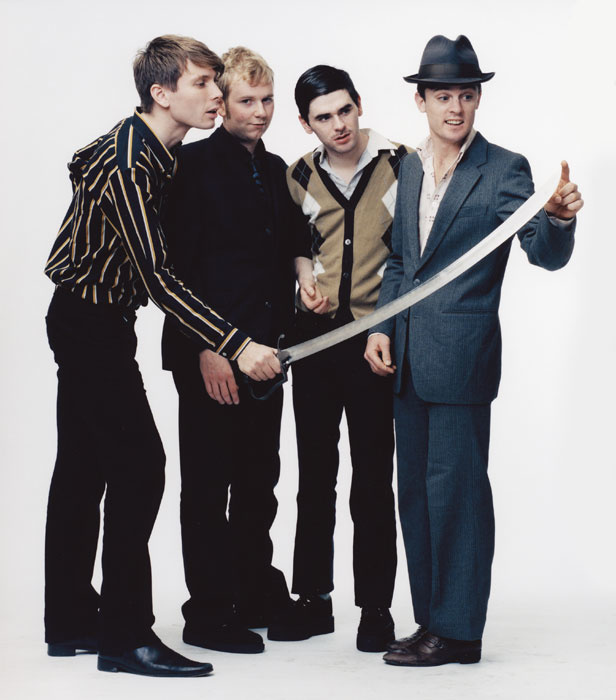 Franz Ferdinand, taking more than their musical influences from the early '80s... In other ways, of course, Johansson was the perfect man for the job, having guided the Cardigans through five albums, from the jangling guitars of 1996's First Band On The Moon, through the pristine electronic pop of Gran Turismo in 2002 to the polished country-rock of last year's Long Gone Before Daylight. Most of these albums were recorded at his now-defunct Tambourine studio in Malmo, and Johansson admits that having to negotiate the group's stylistic diversions down the years really helped to expand his repertoire as a producer.
"When we started out, I was very inexperienced and we kind of grew up together. Every time we started on a new album, we sat down and listened to the old album and we decided what we liked about it and what we didn't like about it and what direction the new album should go in. So my first five years actually working as a producer, that was very much developing and growing up together with the Cardigans."
Natural Light, Natural Sound
Johansson then relocated to England for a year, writing and producing pop tracks on a Pro Tools setup from his home in Sussex. But despite moderate successes with Mel C and Sophie-Ellis Bextor, he says he didn't much enjoy the experience. "I was actually fed up of working in studios with bands. But then when I came to England and started to write, I hadn't realised that the competition was so tough. I had no idea how many people were sitting out there with Pro Tools doing fantastic demos of fantastic songs with fantastic singers."
On his return to Malmo, Johansson began working in a new sister facility of Tambourine, Gula Studion, which had been recently built in an old printing factory. Gula — Swedish for 'yellow' — is bright and airy with plenty of natural light. More than anything else, the producer credits this working environment for helping him to regain his enthusiasm for studio recording. "When you go into studios for whole albums, 30 or 40 days," he points out, "natural light is so important. Natural light, oxygen, table tennis... all the important stuff."
The producer was first sent the Franz Ferdinand demos in the spring of 2003 and says he was immediately impressed by the artful energy of the songs, no matter how makeshift the actual recordings were. "The demos had been recorded very simply in rehearsal rooms and kitchens," Johansson explains, "so they were very rough, but they worked well. The album is just kind of a luxury version of that.
"My first feeling was 'I have to make sure that I don't overproduce this.' But I did! It took some time and actually it took some help from them to get into thinking indie again, to get thinking that the important thing is to get this band sounding right as a band and not to go wild in the studio and start recording a lot of vibraphones and backing vocals and things. But I didn't realise that until we started to mix and I had to mute quite a few tracks because it felt overproduced.
"Working with the Cardigans had been different because they're very much a studio band, so they come in without having played the songs at all and develop their music in the studio. But with a band like Franz Ferdinand, they come to the studio with the songs and they can play them and they have their sound. So it's more about trying to find some working model of how to capture it."
 The main live area in Gula's Mothership.
Into The Mothership
The main room at Gula, the Mothership, is built around a Neve 8014 with 16 x 1066 modules. "It's really good for basic recordings. It's hard to fail when you're recording with that kind of stuff. If I want something extra, some more expressive EQ or compression, then I use other stuff. I really like the Neve 33122. There are a lot of those late '70s preamps and EQs around, but the Neve is the most aggressive one I've used. If I want something more edgy, I use that. The mid-range is fantastic, you can bring out the guitars on their own shelf."
 Franz Ferdinand's material was initially tracked to an MCI JH16 reel-to-reel recorder.No matter what the production, Johansson always turns to a 16-track two-inch MCI JH16 reel-to-reel recorder for initial tracking. "I think we've had three of those over the years, we really like them. We were really lucky because when we started Tambourine we bought a whole studio that went down and we didn't know anything about equipment. So it just happened to be that tape machine and a couple of good Dbx compressors and this old Amek desk from the mid '70s that had belonged to Manfred Mann's Earth Band. Desks always have a history. Once we went to the UK to buy a desk and the guy told us that it'd been involved in the late Beatles recordings — and it'd actually been made in 1972! With all of those EMI desks and compressors it's always 'Yeah, this was at Abbey Road...'"
Naturally enough, in sticking with the JH16, the producer swears by the benefits of tape compression and admits he isn't afraid of pushing the recording levels. "I record very high and keep on listening back to the tape. I have the drummer play and I go up, up, up until the bass drum flattens out and then I back down a couple of dBs. Because there's something extra at that point, some kind of mushy effect that's very musical. I haven't tried all the plug-ins that you get for Pro Tools, so I can't really say if there's anything else can emulate that. But I have the tape recorder available, so I don't need it. I've also tried to get that tape compression effect on 24-track and it's quite a bit different."
For monitoring in the Mothership, there are KRK 6000s — which Johansson says he never uses — and Altec 19s. The Altecs are an old favourite. "They're a bit harsh when it comes to listening to modern music, but if you're into doing '60s and '70s-sounding productions, they're great. They have that kind of presence that modern speakers don't really have.
"Otherwise, for a couple of years I've had these American speakers from the '60s/'70s called EPI or Epicure. I have a small model called the EPI 100 with one eight-inch woofer and a concave tweeter and they're so good. I'd have to go up to $10,000 to get something that have a similar sound and these cost me almost nothing, maybe $200. I bought them from a company in America called Human Speakers. Normally when I switch between nearfields and those big Altecs, the difference is too big and I can't make up my mind. But when I switch between the EPIs and the Altecs, it's fine. They're so much more like a proper studio monitor. Everyone who passes the studio comments on how great they sound and they can't believe how cheap they are."
 Tore Johansson's favoured nearfield monitors are these battered Epicure EPI 100s.
Luxury Spill
Sessions for the Franz Ferdinand album began in June 2003 when the band arrived in Malmo for a month of recording. Since they were so well-rehearsed, Johansson decided to try to record as much of the basic tracks as possible live, setting the band up in the live room at Gula, with their amps cranked as high as they normally are in rehearsals and on stage. He says that limiting potential problems with spill wasn't high on his list of priorities.
 "Of course there's spill, but in Gula it's a luxury kind of spill, it doesn't have a rehearsal-room sound to it. Sometimes they played with headphones and sometimes they didn't, depending on the song. Sometimes we wanted to separate the drum sound more and so the amplifiers were too low in the mix for the drummer to hear, and we had to use headphones."
Rather than ship in a dozen different guitar/amp configurations, Tore and the band decided to stick with their tried and trusted setups. In the end, nearly all of singer/guitarist Alex Kapranos and guitarist Nick McCarthy's parts were recorded using the former's battered old Selmer amp and bassist Robert Hardy's Fender Bassman 100. "Both Nick and Alex swap around playing rhythm and lead guitars. Nick has a tendency to play those kind of funky Talking Heads/Devo parts and Alex plays the more orthodox rock guitar parts."
Less orthodox is Johansson's approach to recording drums. For a start, he often gaffer-tapes two bass drums together lengthwise and places a 57 inside, which he says never fails to give him a great kick sound. Elsewhere on the kit, he maintains a minimal mic setup: another 57 on the snare, 'anything' on the hi-hats and a pair of Sennheiser MD421s doubling up as tom mics and overheads. "I also love the BBC AM6/3 compressor we have, which is part of a lot of stuff that we bought from BBC TV that we butchered and turned into modules. It's very aggressive, really fast, you can use it on a snare drum, no problem. It distorts and it's very noisy, but it's good in a musical way."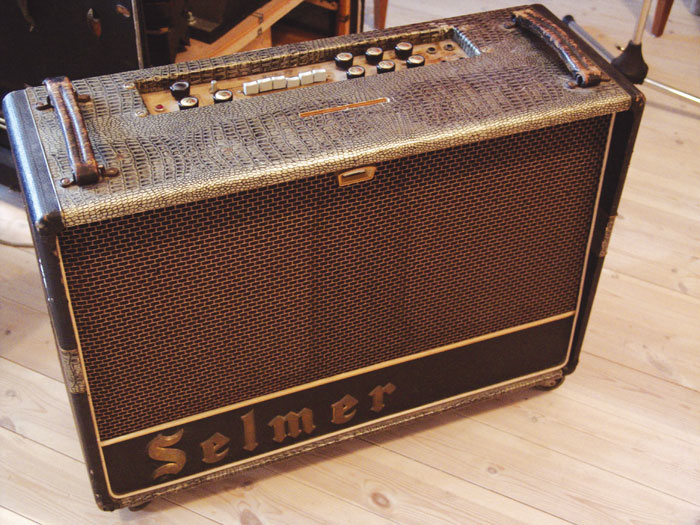 Most of Alex Kapranos's guitar parts were recorded using this ancient Selmer valve combo.
The producer is also very keen to sing the praises of Franz Ferdinand drummer Paul Thomson. "He's brilliant, one of the best indie drummers I've ever recorded. I mean, he could hardly walk... he was one of those guys who was always stumbling round the studio, spilling milk into the desk and stuff! But when he got behind the drums he was brilliant. So it was easy to do those driving songs because he was driving them. The rockier the song, the easier it was to record. A lot of them sounded kind of finished even from the basic take."
Even the distinctive intro of 'Take Me Out' — in which the band usher the song in by way of a punky introduction before slowing the tempo down into the main groove of the track — was actually recorded live, rather than created through editing. "There was no editing other than that we compiled the best take. We didn't do any tricks of, like, doing that on a separate take and then doing the rest of the track. They actually did the whole track with the tempo changes because we were in the situation where they'd played it live quite a few times, so they could actually all slow down in the same way."
Farming The Mix
Two tracks on the Franz Ferdinand album, 'Tell Her Tonight' and 'This Fire', were recorded by the band themselves and then mixed by Johansson. "Actually we recorded those songs here, but we weren't happy with the results. We were trying different tempos and stuff and we'd experimented quite a lot with them in the studio. But then we didn't have time to continue to record them because the band had to go to England to do some touring. So they had a couple of days off and then they did the recording of the songs themselves in Scotland. It ended up that they wanted to play them more like they play them live.
"So then I mixed them in Pro Tools. At first I had problems with them because when I just mixed them normally, they tended to sound a bit wimpy and clean, '80s kind of sounding. Then once I realised they'd been recorded with a bit too little compression, I started to experiment putting the whole mix through the Neve compressor. And that was quite good, until I actually did something that you're not supposed to do. I actually put the whole mixes through [Line 6's plug-in] Amp Farm — no speaker though, just the amp. So I used the cleanest amp, the Fender Twin, and then I had to fiddle around a lot with the equalisers because it was way too bright.
"If you don't use the speakers in Amp Farm, it has this tendency of making everything sound bigger, almost like those Aural Exciters in the '80s. It's simulating some kind of tube distortion and you get that extra twinkling brightness on top of it and a bit of extra bass. When I did that, those two songs sounded more like the things we'd recorded here. If you've got recordings that sound good, but wimpy, that's a good trick."
Out Of The Control Room
Once the basic live passes had been committed to 16-track, Johansson threw them over into Pro Tools on his Apple G4 and began editing together the takes until he and the band had one comped performance that they were all happy with. From there on in, all the overdubbing was done in Pro Tools, which the producer first began using when making the Cardigans' Gran Turismo and hasn't really bothered to update since.
 An unusual but effective approach to getting a great kick-drum sound, using a Shure SM57 inside a double-length drum."I'm not a computer buff," he insists, "so I don't have the energy to use new programs and stuff. I started off with Pro Tools, learned that and so I stay with that. It will have to come to a situation where everyone is saying that the latest thing is so much better before I decide to change. I think I'll wait for the next generation because it's always a couple of generations before you see a big change.
"My favourite development has been Autosave, because it saved a lot of pain looking for audio files and lost sessions. I've hundreds and hundreds of old sessions, so I can go back any time I want. You can think maybe it was a better groove last Friday when you worked on the song, so you can go back. Also if I want to upgrade now, I'd have to start using OS X on the G4 and that's just a nightmare. I've checked out Logic, but I feel that Pro Tools looks and feels more like an analogue studio. It's easier to find your way around."
Once an album reaches the overdub stage, Johansson likes to get out of the control room, setting up his G4 and EPIs in the live area. "Normally I sit in the corner of the big room with my system. It just means that I can have assistants editing vocals or whatever in the control room. Normally I'm quite efficient and I like to get a lot of things done, so they can be compiling a vocal and I'll sit in the live room doing a rough mix or something. Also I like to sit in a room where there are instruments, so I can get a guitar amp up or whatever. I can't sit in control rooms for too long.
"When I'm working in the big room, if I'm not using the EPI 100s, I use AKG 1000s, those weird headphones that don't connect to your head — they're speakers that hang at either side of your ears. They're really good because they're inbetween listening to speakers and headphones, and because they're not actually on your ears, you can have them on forever, your ears don't get tired."
Hard Vocals
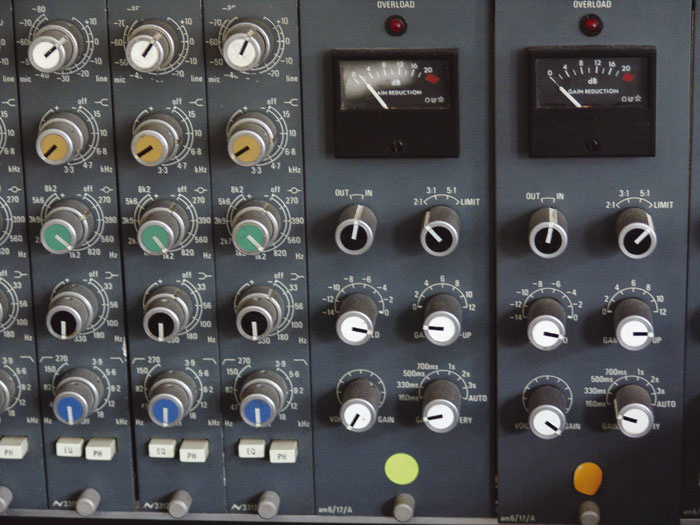 The Neve compressors were used in tandem with an 1176 to create Alex Kapranos's gritty vocal sound.In keeping with the live nature of the sessions, singer Alex Kapranos would usually manage to nail each of his vocals within two or three takes, in an attempt to capture the 'attitude' of the performance. "We were certain that we wanted a very, very hard, compressed, distorted sound," says Tore Johansson, "so we actually recorded it like that.
"I'm a fan of rolling off a lot of bass before the compressors because I think they work better when they don't get a lot of bass. Quite often we used the 421 and rolled off a lot of bass using the filter on the microphone. So we had this very, very thin sound going into first the Neve compressor — very heavy, almost distorting — and then the Universal Audio 1176, so we had double compression. The sound you hear is the sound we recorded. Then sometimes we'd spend a couple of hours adding backing vocals and stuff. But normally we ended up with quite a simple version of Nick shouting in the background, which is what he does live."
More Thrash
Once recording was complete, Franz Ferdinand returned to Scotland and let Johansson get on with the preliminary mixes. As mentioned earlier, some of the slower tracks on the album had seen good use being made of Gula's array of synths, celestes and vibraphones during the overdubbing process, but very few of these parts actually made the final mixes.
"I did some basic mixing first and then Alex and Paul came over for the proper mixes. Normally they listened to my mix and then said 'No, it's too good! It has to be more thrashy!' Then I found myself having to mute most of the keyboard parts. Normally they'd played everything themselves — they all swapped around on the keyboard parts. Paul is a very musical guy. He actually tried to play bass on a couple of tracks, but I don't think we used his parts. Overall, they wanted to scale it down and have it sound more like a band playing, not too produced. On 'Take Me Out', I put almost all the instruments through a couple of echoes to get that marching, machiney, industrial feel to it. It's very organic, but we wanted it to sound like you're in a big workshop or something."
As opposed to the recording process, where the rockier tracks had been relatively easy to commit to tape, during mixing Johansson found that the more produced tracks were easier to balance, while the rock songs proved trickier. "Tracks like 'Jacqueline' were hard. We ended up spending a lot of time going half a dB up and down on different guitar parts and it was quite hard because, you know, when you have three guitars playing kind of the same thing, it's hard to get the perfect mix. But on tracks when you have an acoustic guitar and an electric guitar and a piano, it's easier to get the levels."
Praise Indeed
Impressive sales aside, Johansson is clearly very happy with his work on the Franz Ferdinand album. So much so, he affords it perhaps the highest compliment any producer can pay an album that they've worked on, day in day out, for weeks on end. "It's one of those albums that you actually want to listen to when you've done it!" he laughs. "I think that's because I actually didn't overproduce it and just captured the band. I think I did a good job of recording it — it sounds good — but it's very much the band sounding like that. So it's all thanks to them really."