

 Photo: Mike Cameron
Most of the major Windows sequencers now support dual processing, and if you want the ultimate performance, machines like Red Submarine's dual Xeon PC could be the way to go.
Despite huge leaps in processor clock speed and performance over the last few years, some musicians are still finding that they can't run all the plug-ins and soft synths that they want, even with the fastest processors currently available such as AMD's Athlon XP3200+, Athlon 64 3400+ and Athlon FX51, or Intel's hugely expensive P4C 3.4GHz Extreme Edition. Adding a TC Powercore or Universal Audio UAD1 DSP card can help, but only a small range of plug-ins is available in these two proprietary formats. The other solution is to install a motherboard that supports two processors to share the load, running under an operating system that also supports multi-processing, such as Microsoft's XP Professional or Linux 2.4x.
Red Submarine already have a wide range of systems, including machines running AMD Athlon XP and Athlon 64 processors, and have now added one featuring two Intel Xeon 3.06GHz processors. With 1GB of RAM and twin 80GB Seagate Barracuda 7200.7 hard drives, it's the most powerful system they have ever assembled.
Under The Hood
The Lian-Li PC7 MIDI Tower case is a favourite with system builders, and it's not hard to see why. It's well engineered with attractive hard anodised aluminium panels, nearly every part bolting rather than being clipped together, and provides plenty of expansion potential with its four 5.25-inch drive bays, three 3.5-inch bays, and three more internal 3.5-inch bays. Red Submarine had also fitted the CD-RW and floppy drives with aluminium bezels to complete the all-metal effect.
 The two Xeon processors can each draw 100 Watts of power, necessitating the use of a hefty 520W supply, but the thoughtful cooling arrangements mean that this computer is quiet enough for most studio environments.Photo: Mike CameronThe inside of this PC proved to be a model of neatness, with all wiring formed into tidy looms. All exposed panels had been carefully lined with Acoustipack Deluxe acoustic material, a composite of thin and heavy damping sheet joined to acoustic foam, while all the unused 5.25-inch and 3.5-inch drive bays had been filled with blocks of acoustic foam to minimise the chances of internal noise reaching the outside world. To complete the cooling arrangements, a 520 Watt SilenX power supply unit had also been fitted — these truly live up to their name, with incredibly quiet cooling fans. The beefier-than-usual PSU is needed for the Xeon processors, each of which can consume a hefty 100W.
The Asus PC-DL motherboard runs Intel's 875P chip set with an FSB (front side buss) of 400 or 533 MHz, here running at 533MHz. Each of the Intel Xeon 3.06GHz processors is cooled by a Zalman Ultra Quiet Xeon CPU cooler fitted with a 60mm fan and Fan Mate speed controller. Dual Xeon machines traditionally use motherboards with Intel's E7505, which only supports the much slower dual DDR266 RAM, and are more expensive. Intel's 875P chip set officially supports only the single-processor Pentium 4C series partnered with dual DDR400 RAM, but on the PC-DL Deluxe motherboard Asus have managed to couple the 875P chip set with dual Xeon processors, so they can use up to 4GB of the faster dual-channel DDR333 RAM, as well as providing SATA (Serial ATA) support. Red Sub had filled RAM slots one and three with 512MB sticks in dual-channel configuration. They had used DDR400 RAM, although the motherboard only supports speeds up to 333MHz, so the DDR400 sticks appeared in the BIOS readout as DDR333 Dual Channel Mode.
Up to six drives are supported by the PC-DL Deluxe motherboard: the ICH5R South Bridge chip provides two UDMA100 connectors, plus two Serial ATA connectors, while an additional Promise PDC20378 controller (disabled by Red Sub) provides a further UDMA133 and two Serial ATA connectors. Each SATA pair can support drives in a RAID 0 (extra performance) or RAID 1 (extra security) configuration, although in this system the two 80GB drives were left separate and devoted to System and Audio duties respectively, showing up inside the BIOS as Primary Master and Primary Slave, while the LG CD-RW drive was Master on the Secondary IDE connection.
There are five 32-bit PCI slots and one AGP Pro slot; PCI slots one and five share an IRQ, as do slots slot two and three, while slot four shares with the onboard 1394 Firewire controller. Red Sub had wisely selected slot two for the M Audio 1010LT soundcard they supplied with the review system, since slots two and three, while sharing among themselves, are the only ones that don't seem to share with any other onboard device.
The ATI Radeon 9200SE graphics card with 128MB RAM is a popular choice with DAW builders at the moment. It's not hard to see why, since it's got dual-head capability, doesn't have a noisy cooling fan, provides perfectly adequate graphic performance for a music PC, and is fairly cheap. However, Red Sub currently offer a choice of 12 graphics cards with this system, so there are alternatives.
Around the back the motherboard provides the usual clutch of PS/2 mouse and keyboard ports, two serial and one parallel port, RJ45 LAN port, one IEEE 1394 Firewire port, and four USB 2.0 ports. A further two USB 2.0 ports had been wired to the Lian-Li's drop-down front-panel access. However, the motherboard supports eight ports in total, and since you can't enable/disable them individually in the BIOS, they all show up in Windows — perhaps Red Sub should fit a backplate with the missing two USB ports so you can take advantage of them.
This particular review system was supplied with a 17-inch TFT monitor from Relisys with a maximum resolution of 1280 x 1024 pixels, although Red Sub had set it to 1024 x 768, which I felt resulted in a less sharp image. Resetting it to its native 1280 x 1024 sharpened this up noticeably, as well as providing significantly more screen real estate in Cubase, so unless you anticipate working a long way away from the screen I suggest you do the same.
Completing the setup was an A4Tech wireless keyboard and mouse with 'A-type' ergonomic key layout. The latest models have a big advantage over their predecessors: the RF receiver also acts as a twin AA-cell recharger, and you get six AA cells in total, so two spare ones are always fully charged and available.
Dual Processor Options
At first, the only real option for multi-processing was Intel, because there were no dual-CPU AMD motherboards. Then AMD introduced their 760MP chip set in mid-2001, partnering it with the Athlon MP processors, whose architecture is very closely based on AMD's Athlon XP 'Palomino' range, and this gave Intel some much-needed competition for running servers. AMD's subsequent introduction of the Opteron processor early in 2003 must have sounded alarm bells at Intel HQ. Again based on an enhanced Athlon XP (this time with the 'Thoroughbred' core), and with 1MB L2 cache and an integrated memory controller, a dual Opteron 244 system with each processor clocking at 1.8GHz proved to run many benchmarks nearly as fast as Intel's own dual Xeon 3.06GHz with 512MB L2 cache.
Only a few months elapsed before Intel fought back with a new Xeon, fitted with an additional 1MB L3 cache as well as the existing 512k L2 cache, but this made only a few percent difference to the majority of benchmark tests, and most experts ended up recommending that users buy the far cheaper Xeon model without the extra cache (as used in this Red Submarine review system). Moreover, the dual Xeon only runs with a 133MHz FSB (with Dual DDR266 RAM), compared with the 200MHz (and Dual DDR400 RAM) of Intel's latest Pentium 4C range, so in some memory-intensive tests a dual Xeon 3.06GHz lags behind PCs equipped with a single P4C 3.2GHz or Athlon XP3200+. Games benchmarks also consistently show that dual Xeon machines lag behind Opteron ones.
So far I've painted a pretty damning picture of dual Xeon machines, but don't write them off just yet. With multimedia encoding benchmarks (which, after all, are probably the closest mainstream test to running music applications), the dual Xeon 3.06GHz processors and 875P chip set used in the Asus PC-DL Deluxe motherboard in the PC under review consistently perform much better, beating off P4C 3.2GHz and XP3200+ machines with ease (some published tests show a doubling or even trebling of performance). My own tests show that when running the most popular PC music applications, the dual Xeon 3.06GHz would outperform a P4C 3.2GHz by some 43 percent running Cubase SX 2.0 at 23ms latency, and 37 percent at 3ms latency, and by about 36 percent when running Sonar 3.1 with a high latency of 46.4ms, or about 19 percent at 3ms.
Powering Up
It didn't take more than a couple of seconds after pressing the power switch to answer what is always the most important practical question about any PC built for musicians: is it going to be quiet enough? Thankfully, Red Sub's good reputation in this area remained intact, since the combined noise of the cooling fans was still a soft purr, and you ought to be able to record through mics in the same room as this PC, as long as they stay a couple of metres away. The motherboard provides a readout of three different temperatures, plus one for each of the CPUs. After several hours of general activity the motherboard ended up at about 35 degrees Centigrade, while both processors stabilised at around 50 degrees. This proves that the cooling system was working well, despite its low noise.
I was particularly interested to see how the BIOS had been set up, since Xeon processors, being based on the Pentium 4 range, support Hyperthreading, so if this was enabled, Windows XP would find a total of four processors (two physical and two virtual). However, as I expected, Red Sub had disabled the HT technology in the BIOS, since it would work against the true dual-processing in this configuration, and apparently many plug-ins, soft synths and applications have problems when more than two processors are used.
 This case provides four 5.25-inch drive bays and a further three 3.5-inch bays, with five PCI slots offering extensive expansion potential. Photo: Mike CameronAlso disabled were the onboard AC97 sound chip, MIDI and Game ports, and the Promise controller. However, if you fancied using the MIDI interface and/or two further USB 2.0 ports, it would only cost a few pounds to buy a Game/MIDI backplate and Gameport cable and plug it into the appropriate motherboard headers. I got on well with the keyboard and mouse, both of which worked reliably up to a couple of metres away from their base unit, although I did find it difficult to adapt to the way the cursor keys merged into the numeric keypad.
Windows Performance
Although Linux 2.4x also supports multiple processors, the most obvious choice of operating system for musicians is still Windows XP Professional, which is what Red Sub had installed. All the usual XP tweaks had been implemented to disable cosmetic slowdown and prevent interruptions from untimely tasks, and a fixed 2GB page file had been set up. Both drives had been formatted as NTFS, and Dskbench showed that the Seagate Barracuda 7220.7 drives provided exactly the same speedy performance as they did when I tested them in INTA Audio's 3GHz P4 PC in SOS November 2003, namely a 56MB/second sustained read and write speed, and over 250 potential 44.1kHz/16-bit audio tracks using a 128k block buffer size.
As expected given that the RAM was running at 333 rather than 400 MHz, memory bandwidth as measured by Sisoftware's Sandra 2004 was significantly lower than with Pentium 4C PCs, at 3044MB/second integer and 3041MB/second floating-point. However, the CPU Arithmetic benchmarks for the dual Xeon 3.06GHz were a huge improvement over my own single Pentium 4C 2.8GHz machine. Dhrystone ALU measured 15839 MIPS compared with 8496 MIPS for the P4C, Whetstone FPU measured 4320 MFLOPS (3548 for the P4C), and iSSE2 managed 8306 MFLOPS (6210).
Probably more important still for a musician, Sandra 's CPU Multimedia benchmarks measured 38256 it/s and 48204 it/s for Integer and Floating Point respectively, compared with 21573 it/s and 30782 it/s for the 2.8GHz P4C. If we accept that Multimedia floating-point performance is probably the single most important parameter for the best performance of modern music applications, this is a good result for the dual Xeon machine, providing 1.43 times more processing power than a single processor of similar clock speed — in other words you'd need a 4.4GHz P4C to match it, if one existed. However, benchmarks never tell the whole story, so I was just as interested in real-world figures measured with music applications.
Specifications Of Review PC
- Case: Lian-Li PC7 Aluminium ATX MIDI Tower, fitted with aluminium CD and floppy doors, and 520 Watt SilenX PSU.
- Motherboard: Asus PC-DL Deluxe, with Intel 875P 'Canterwood' chip set running 533MHz system buss, with four DDR DIMM sockets supporting up to 4GB of PC2700/2100 DDR SDRAM.
- Processor: two Intel Socket 603 Xeon 3.06GHz 512kb L2 cache, 4 times 133MHz front side buss.
- CPU heatsink and fan: two Zalman Ultra Quiet Xeon with Fan Mate controller.
- Case cooling & silencing: Lian-Li 80 rear 80mm case fan, twin Zalman 80mm front case fans with Fan Mate controllers, case lined and all unused drive bays filled with Acoustipack Deluxe acoustic material kit.
- System RAM: 1GB of PC3200 (DDR400) CAS2.5 SDRAM, running as DDR333 Dual Channel.
- System drive: Seagate Barracuda ST380013AS, 80GB, 7200rpm, 8MB buffer, Serial ATA.
- Audio drive: Seagate Barracuda ST3120026AS, 80GB, 7200rpm, 8MB buffer, Serial ATA.
- Graphics card: ATI Radeon 9200SE dual head with 128MB RAM.
- Floppy drive: 1.4MB 3.5-inch.
- CD-RW Drive: LG GCE-8542B, E-IDE interface, 52x read, 52x write, 32x rewrite speed, 2MB buffer with buffer under-run protection.
- Monitor: Relisys TL775 silver/black TFT colour, with 17-inch diagonal, 1280 x 1024 maximum resolution, 16ms response time, DVI (Digital Video Interface) connector, with built-in multimedia speakers.
- Keyboard & mouse: A4Tech rechargeable wireless desktop Ergo A-shape keyboard & optical mouse.
- Installed operating system: Windows XP Professional Edition plus Service Pack 1.
- Installed soundcard: M Audio Delta 1010LT with version 5.10.00.0036 drivers.
Audio Performance
Red Submarine had installed Steinberg's Cubase SX 2.0.1 and an M Audio 1010LT in the review system, but of course you can choose whichever combination of music hardware and software you want, or buy the PC without either. The 1010LT drivers had been set to a 6ms latency at 44.1kHz, which is normally the most suitable compromise on modern PCs between responsiveness and CPU overhead, but in line with Steinberg's own suggestions, I measured performance with both 23ms and 3ms latency when running the Fivetowers 2.0 test songs. You can see my results along with some comparative systems I've measured in the graph. By extrapolation, you'd need a Pentium 4C processor of a hypothetical 5.6GHz to match the results for Red Sub's dual Xeon 3.06GHz machine, or a 3.5GHz Centrino laptop. This is an excellent result.
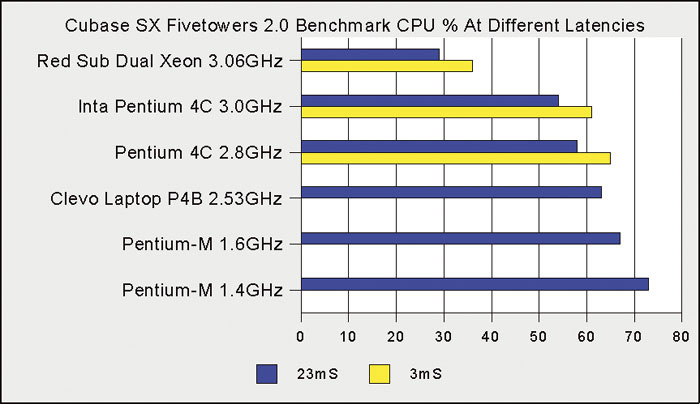 Compared with a single Pentium 4C processor, the dual Xeon provides a huge leap in performance at both high and low latency values.
I also installed Cakewalk's Sonar Producer 3.0 and then the version 3.1 update. This adds a redesigned multi-threaded engine to maximise the benefits of multiple processors, which shares the load between the two processors far more effectively than before, a result easily proven by a quick look in the twin CPU Usage windows of the Windows Task Manager, making it another ideal candidate for testing the benefits of a dual Xeon machine.
Even better, Scott Reams of California-based LiquidDAW (www.liquiddaw.com) has created a new benchmark test specifically for Sonar 3.1, which attempts to test the CPU, front side buss, and memory in isolation by running a wide variety of plug-ins and soft synths, but without disk access. This is achieved by using input monitoring rather than playback of audio tracks, and the CPU overhead is far easier and more consistent to measure than any Cubase test, since Cakewalk thoughtfully provide a numeric rather than a bargraph readout. Cakewalk have endorsed this test, and what's more, lots of users of Sonar Producer 3.1 have already posted their results, so I can compare the performance of Red Sub's dual Xeon with various other PCs using both single and dual processors.
 When running Sonar 3.1 the dual Xeon still shows considerable improvement over single-processor machines, and seems to match more expensive dual Opteron PCs at high latencies, but loses this lead at lower latency values.
Using ASIO drivers with a range of buffer sizes providing latencies of between 46.4ms right down to 1.5ms, I can reveal that with Cakewalk's Multiprocessing Engine enabled, the dual Xeon 3.06GHz CPU overhead was just 16 percent at 46ms and 18 percent at 23ms, making it neck and neck with a dual Opteron 248 running 2.2GHz processors. However, although Cubase SX overheads increase by between 10 and 25 percent as you lower latency from 23 to 3 ms, Sonar overheads can more than double over the same range, and dual Opteron systems pull ahead once you lower the latency to more realistic real-world values. At 12ms and 6ms, the dual Xeon measured 23 and 31 percent respectively, slightly faster than a dual Opteron 242 at 1.6GHz. Sonar 3.1 overheads rise alarmingly with nearly all processor types below 6ms latency, and this time the Opteron 242 pulled slightly ahead, at 44 percent to the Xeon's 46.
Final Thoughts
This dual Xeon PC is certainly a very capable performer, and Red Sub are to be congratulated on building their fastest yet still extremely quiet machine to date. Comparing its performance with other processor families isn't a trivial exercise, but Cubase SX 2.0 users should find this dual Xeon machine a huge improvement over even the current fastest 3.4GHz Pentium 4C, despite the lower memory bandwidth. Users of DIY dual Opteron systems have reported excellent figures when running Cubase SX, but some vary so wildly that I'm loath to publish them as a comparison.
When it comes to Sonar 3.1 there are some more established comparative figures available. The dual Xeon still beats a 3.4GHz Pentium 4C by a comfortable margin, but the difference is not as great as with Cubase SX 2, particularly at lower latency values. At high latency this dual Xeon 3.06GHz PC seems to equal the performance of a dual Opteron 248 when running Sonar, and considering the latter processor is currently almost twice the price of the Xeon, this is an excellent result. Unfortunately, at lower latencies the dual Xeon/Sonar combination measures closer to an Opteron 242 system, which would cost about £200 less overall.
Both Xeon and Opteron systems still seem to suffer from occasional incompatibility problems with music software and hardware, but buying from a specialist music retailer like Red Submarine means you get a guarantee that your dual-processor machine will work perfectly with whatever combination of soundcard and music software you purchase, and for many musicians this makes a dual Xeon the way to go. Millennium Music also have two dual Xeon PCs in their range, both using the same Asus PC-DL Deluxe motherboard, for the same reasons of performance and cost. Overall, as a Cubase SX user, I was most impressed with the performance of Red Sub's dual Xeon PC.
Pros
- A huge performance improvement over the fastest available Pentium 4C model, particularly with Cubase SX.
- Very low acoustic noise considering the two processor fans and 520 Watt PSU.
- Rechargeable wireless keyboard and mouse.
Cons
- Sonar users won't see as much benefit, particularly when running at low latencies.
Summary
If you want to run yet more plug-ins and soft synths without networking multiple PCs, the dual Xeon 3.06GHz processors in this Red Submarine PC take its performance way beyond any other machine I've measured to date, yet despite this power it still remains very quiet.
information
Basic system as reviewed without monitor, music hardware or software £2031.09; including 17-inch TFT monitor as reviewed £2388.59; including M Audio Delta 1010LT soundcard and Steinberg Cubase SX 2.0 £3135.48. Prices include VAT.
Red Submarine +44 (0)870 740 4787.