


'Hips Don't Lie', by Shakira and Wyclef Jean, is indisputably the biggest single of the 21st Century so far. Engineer Serge Tsai was the man who brought together many diverse elements to create a colossal hit.
"At some point during the making of 'Hips Don't Lie'," recalls Serge Tsai, "I turned to my assistant and said 'Man, this sounds like it's going to be big.' But I didn't know it was going to be that big." Tsai's amazement is understandable, as 'Hips Don't Lie' must have exceeded the wildest expectations of everyone, even the two performing stars, Shakira and Wyclef Jean, by becoming by far the biggest single of 2006, and one of the biggest singles of all time. It reached number one in almost every charting country in the world, including the UK and the US, became the second most successful single (after Cher's 'Believe') since 1999 in the United World Chart, and sold about nine million copies worldwide.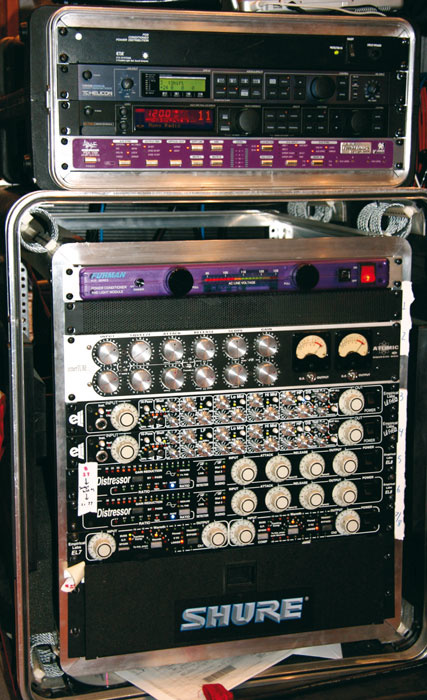
'Hips Don't Lie' is a remake of a track called 'Dance Like This', co-written and produced by Wyclef Jean for the 2004 movie Dirty Dancing: Havana Nights, which had Claudette Ortiz, formerly of City High, sharing vocal duties with Jean. Serge Tsai engineered most sections of the two songs and also mixed both versions. 'Dance Like This' and 'Hips Don't Lie' share the main vocal hook as well as the characteristic descending brass sample, which is originally from the song 'Amores Como El Nuestro' by singer Jerry Rivera; everything other than the sample was re-recorded in the new version. While the original leans towards hip-hop, the 2006 update has a percussion-rich, world music feel.
Structurally, the new version is a showcase for the old entertainment adage 'always leave them wanting more'. The original version clocks in at 4:08 and repeats the main hook ('I never really knew that she could dance like this...') 12 times, while the 'Bayla' chorus section appears four times. By contrast, 'Hips Don't Lie' lasts only 3:37, repeats the main hook a meagre six times, and the 'Bayla' section appears just once. Shakira wrote a new section, which includes the words 'Hips Don't Lie' and occurs three times, functioning like a new refrain. A new rap, the frequent cheering ('Shakira! Shakira!'), and the Columbian percussion add to the general celebratory feel.
A structural novelty is that the main hook is only featured in the beginning and the middle of the song, but not at the end — contrary to the original, which follows the common format of repeating the main hook at the end. Add the new version's short length, and the structure seems to compel listeners to put it on again, and again, perhaps explaining why it was the most-often played song in a single week in the history of American radio.
Serge Tsai
"I think that my speciality is world music," says Serge Tsai. "It's to do with my background in Surinam. My first recordings were live drums, not even a kit, but 15 guys playing ethnic drums. I used to record hardcore voodoo drums, and I know the sound of real drums. I grew up with world music, and have been exposed to many different kinds of music. So I can't really do the traditional American sound. Guys like Jason [Goldstein] can do that. We all have the same skills, but I probably have an approach that's a little bit different."
Tsai's background as a Surinam native arguably made him the ideal person to mix the world-music flavoured 'Hips Don't Lie'. Tsai is unusually cosmopolitan in also being partly of Asian origin and speaking five languages (Dutch, English, Surinamese or Taki Taki, French and Portuguese). He spent part of his childhood in the Netherlands (Surinam is a former Dutch colony), and first came to New York in 1989, when he acquired a diploma in multitrack recording at the Institute of Audio Research. During 1992-94 he worked as an engineer in Paramaribo, Surinam's capital, and he settled in New York in 1995, when he began working at Funky Slice Studios on Brooklyn.
Since 1998, Tsai has held the position of senior studio recording and mixing engineer at Wyclef Jean and Jerry Wonda's Platinum Studios in New York (see SOS July 2004 for more info on Jean and Platinum). Tsai has garnered an impressive list of credits, among them Bono, Mick Jagger, John Legend, Jimmy Cliff and Lauryn Hill.
Tsai sees himself as someone who is a blend of old-style and new-style engineering, extensively working with Pro Tools, but in fact preferring the sound of analogue and mixing via a desk. "I work with an SSL every day, so I'm probably biased, but I just think a mix sounds better when you send it through a desk. It goes through all sorts of electronics, while in a computer it's all virtual. I understand the speed and convenience of working in a computer and the fact that things come back to you the same every time, but I think you sacrifice on sonics that way. The computer can't yet do summing in the way an SSL can."
Tsai uses Genelec 1032As as his main monitors, with a 1094 sub, and also a pair of Dynaudio Air 6's with sub ("I plug them in digitally") and "of course some NS10s".
Like This Dance
Musing on the phenomenal success of 'Hips Don't Lie' and the central part Shakira played in it, Tsai comments: "The initial idea was to do a remix with Shakira singing the part of Claudette, but when she came to the studio, she became so excited about the song that they decided to redo it. She had a big influence on where she wanted the record to go. She was there from the beginning to the end, and it was fun, because she knows what she wants. We mixed her very upfront, because it was her record, there was no other way. The earlier version of the song was good, the new one is great. I think a lot of people relate to the world music thing. It has a strong party feel, and they really captured that."

Shakira insisted on being present for as many of the recording sessions as possible, and since she was in the middle of a world tour, the recordings for 'Hips Don't Lie' took place in a variety of locations, among them Miami, London, the Bahamas, Columbia, and, of course, New York, at Platinum Sound, the studio of Wyclef Jean and Jerry Duplessis. Duplessis, aka 'Wonda' is Jean's cousin, and he also co-wrote and co-produced 'Hips Don't Lie'.
 As well as using outboard processing on Shakira's lead vocals, Serge Tsai used Waves' Renaissance De-esser and Compressor."During recording they were really vibing," recalls Tsai. "We started with Shakira in Miami and we always have the same setup, with Jerry playing MPC3000 and bass guitar, and guitars and keyboards in the room. She had all these musicians coming in, including at some stage a Columbian group. She wanted to have the same drums as on her single 'La Tortura' [2005], which were kind of reggaeton, so they created a drum loop and later in London replaced that with a programmed pattern, recorded by Gustavo [Celis, the other engineer on the song. Tracks recorded by him are marked GC in the Edit window screens]. We always have a microphone up, and I always have my SSL in record/mix mode, so I can instantly record, whatever is happening. For example, Shakira did a last-minute ad lib maybe two hours before we started printing the mix."
Vocal Work
Final mixdown for 'Hips Don't Lie' was at Pacifique Studios in Los Angeles, where Tsai ran the Pro Tools Session through a 96-input K-series SSL desk. The session consisted of 93 tracks, but many of them were stereo, bumping the total number of audio voices to well over 100. "I had to do some submixing in Pro Tools," comments Tsai. "Track 65, for example, is a [Wy-]Clef vocal stem, and there are guitar stems and a keys stem. It may seem like a lot of tracks, but you can see that a lot is greyed out [ie. muted]. There are a lot of layered drums, with drum loops and live percussion. Things come in and out all the time, particularly in the rhythm — the beat moves all the time. And I combined many vocal ad libs, if they didn't occur in the same place."

When discussing how he treated the different elements of 'Hips Don't Lie', Tsai begins with its most important feature, Shakira's vocals. In this context there's first some controversy to get out of the way. There have been accusations that the Columbian singer's vocals on 'Hips Don't Lie' were heavily treated with Auto-Tune, and it has been held up as an example of the damage that unnecessary over-use of Antares' pitch-correction software does to the cause of music. "Everybody uses Auto-Tune these days, so of course there's some tuning on her vocals," replies the mixer. "But it's not heavy, heavy tuning. Most of the stuff that you hear is exactly how she sang it, without any tuning or other tricks. We tuned the vocal in process, so it wasn't like using a plug-in. And she does have that quality in her voice, she also sings in the Arabic scale. She can do things like that with her voice."
 Wyclef Jean's vocals required radical sonic surgery from Waves' Renaissance EQ and Digidesign's Digirack EQ III to make them fit with Shakira's contributions.
Whatever Tsai and the song's producers did or did not do to Shakira's vocals, her singing clearly lifts the song and nails the main hook. She brings a supple rhythmic feel that sits perfectly with the rhythm section. Tsai also remarks that Shakira's vocals didn't need a lot of work on his part, in contrast to Wyclef Jean's — not because the latter were of bad quality, but because, in the mixer's words "I had to create space for Shakira, and curve Clef's vocals around her's. The song was about her, and Clef's vocals were meant to complement. Most of what you hear is a single vocal by Shakira, and she carried that so cool. She sang seven harmony parts, but they're only used occasionally. By contrast, Clef's vocals had a lot of layers, so we had to make sure he didn't overtake her, which is why you see some radical EQs on his vocals."
Shakira's lead vocals: Urei LA2A, Sony S777, Lexicon 960L, Empirical Labs Fatso, Waves Renaissance De-esser and Renaissance Compressor
"I recorded Shakira with a Telefunken Elam 251 through a Neve 1073 mic pre, no EQ on the return in the mix, and only an LA2A on the insert. The reverb on her vocals was the S777, set to the small hall in the Concertgebouw in Amsterdam. There were certain words on which she didn't want any reverb, so we had to automate the reverb send on the SSL. The main reverb in the track was a delayed plate from the 960L, used in moderation. I don't like things that are overwhelmed by reverb. And I tell you one thing, I have not heard a plug-in sound as good as the 960L. It's a crazy box.
"You can have eight sends on an SSL — six auxes and cue left and right — and the first four are dedicated to my Lexicon 960L, which is fully loaded. I'll have a TC 2290 on another send, usually set to a quarter-note delay with a little panning. Aux six tends to be connected to a [Lexicon] PCM70, and the cue left and right to an Eventide H4500. When working in Pro Tools, I also use a lot of plug-ins, including delays and filtering. This is cool because you can go really deep into automating plug-ins.
"I still prefer the sound of analogue, which is why I like to mix through an SSL. One plus one is different in a computer than on an analogue desk. I also have the Inner Tube Atomic Squeezebox, which has eight vacuum tubes in it, and there's no way you can replicate the sound of that box in a computer. In the case of Shakira's vocals, I used the Fatso to thicken the sound a little bit. It's like tape simulation, it does harmonic compression or something. I often use it on vocals. I'll send things I want to process to bus 25-26, into the Fatso, and then bring that back to the board.
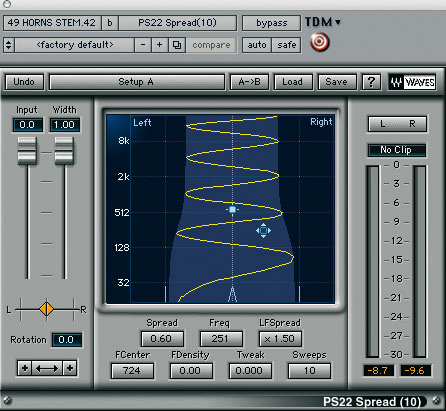
 The horn sample at the heart of the song was treated in order to make it sound fuller, with the Digirack Mod Delay II and Waves PS22 Spread plug-ins, and using Waves L2 Ultramaximizer to make it stand out more."The only plug-ins I used on Shakira's vocals were the Renaissance De-esser, just to get rid of any high sibilance above 4k and smooth things out, and the Renaissance Compressor, which is set very gently, with quite a long release of 50.2. It's not capturing a lot, because the threshold was way up at 1.6. The Renaissance and LA2A are pretty much doing the same thing, but I added the LA2A more for warmth. With digital recording you try to add as much warmth as you can. And the Elam is a $15,000 mic, so you don't want to mess too much with its sound. I was just trying to make the sound cut through, not over-process it."
Wyclef Jean's lead vocals: Inner Tube Atomic Squeezebox, Waves Renaissance EQ, Digirack EQ III
"I used the Atomic Squeezebox on Clef's vocals, not too much compression, just to add some warmth. There was a lot of radical EQ on his vocals, to create space for Shakira, mostly taking out low end, which you can see on the Renaissance and on the Digirack EQs. On the latter I also took out most of the mids. In general I like to take off any rumble from the room things are recorded in. I like to keep my low end clean, so I take out what's not necessary."
Horn sample: SSL G384, Digirack Mod Delay II, Waves PS22 Spread and L2 Ultramaximiser
"The loop was in stereo and came from the MPC3000. I used different effects on it than on the 'Dance Like This' original version. On 'Hips Don't Lie' I EQ'd the horns on the SSL on the return, and I may have bussed it to the C-bus to the SSL G384 compressor. I have four 384 compressors, and will have them on the A-bus, B-bus, C-bus, and D-bus, so I can play with the dynamics, send stuff to a bus and return it. The Mod Delay is set to eighth notes, mixed in at eight percent, to give it some space and make it trail a little longer. The delay goes into a PS22, just to spread things out a little bit more, and then into the L2, to maximise it and make it pump, so the horns always sound loud. Without it, they'd be less prominent."
Bass and guitars: Neve 1073 EQ, Tube-Tech EQ1, Urei 1176
"The sub-bass was a keyboard sound from a Roland XP80, or it might have been a sound from the MPC3000, I don't remember. It was played by Jerry [Wonda]. He also played a five-string bass guitar, for which I used a little compression and EQ via the board, with a Neve 1073, probably a Tube-Tech EQ1 and the 1176. I think I boosted around 100Hz and added a little brightness as well. I'm not 100 percent sure what settings — I go by feeling and try not to over-process things. The guitars on tracks 14-15 are marked NY, but were recorded in London. They were all live. I probably had a little chorus on them, some compression, and some EQ, but nothing in the computer."
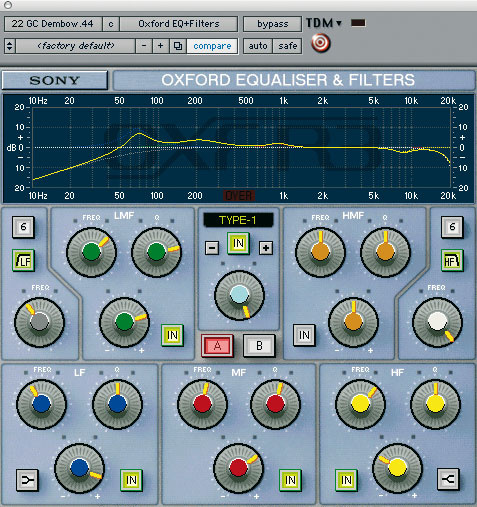 Oxford EQ & Filters.
 McDSP Filterbank F2.Drums: Empirical Labs Distressor, Tube-Tech EQ1, Sony Oxford EQ, McDSP Filterbank F2, Waves L1 Ultramaximiser
"The key to this track is that there is a lot of low end, and it's very heavy on the drums and percussion, so that needed a lot of careful EQ. Track 22 is a drum loop made by Gustavo, and I've used the Sony Oxford EQ to bump things up around 75Hz and roll off below 50Hz. On the kick drum there's an EQ with an even bigger bump, +20dB at 50Hz! This kick drum was supporting the kick drum in the loop. I also had an EL8 [Distressor] and a EQ1 on the kick, I think, with a slight bump at 60Hz. Almost all the tracks marked GC are drums that replaced programmed drums.
"The bass drum breaks in the turnaround, where you only hear the bass drum with vocals, were programmed. Some of the kicks were programmed out of time on purpose, and Shakira laid her vocals over them exactly the way they sound. The drums in general had a reggaeton flavour, and so instead of the snare hitting two and four, it has a rolling snare. The snare was probably programmed. I use the McDSP Filterbank EQ to add around 142Hz, to make the snare sound cut through, and roll everything off below that, so it doesn't get in the way of the kick drum.
"I also put a 'reverb bomb' on track 23, which is a soft, low boom on the '1', that I maximise with the L1, so it comes through. It boosts everything above the threshold, and I set the ceiling to zero. You hear it on all the turnarounds. We did rides on the turnarounds, to make the beat move a little on the '1', and Shakira really liked this. These were all SSL rides, so we had to put the faders into really fast mode, and just do a little ride on the '1's and the turnarounds to bump these up a bit."
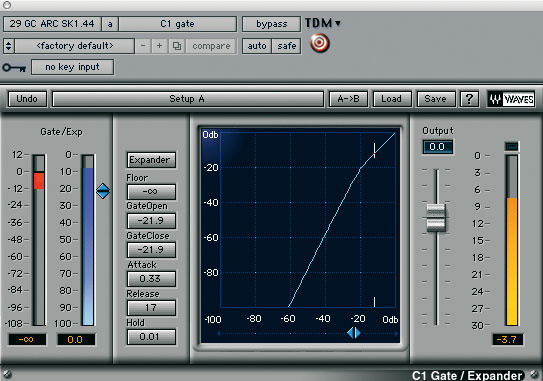 Waves C1 Gate/Expander.
 Waves Q4 Parametric EQ.Percussion: Focusrite D2 and D3, Waves C1 Gate/Expander, Waves Q4 Parametric EQ
"There is so much stuff going on in the percussion that a lot of my treatments were done to make sure that everything has its own place. The C1 on the shaker has a threshold around 21dB, with quite a fast attack, and a fast release as well. The D3 I used on Archi Pena's percussion was also just to keep that sitting in the track. Just a little compression, nothing too heavy. I think it was some authentic hand drum — there were a couple of those on the track — and the compression just helps them to cut through a little better. It has a slow attack [109.8ms], just to catch slow, heavy things.
"I added EQ around 83Hz and 9045Hz using the Q4 on the percussion in the Cumbia section because you need some brightness on a record like this — it's a happy record. So I tried to get the brightness from this; plus you want it to cut through, and the high end also helps with that. The two tambora tracks, also in the Cumbia section, complement each other. One was a low sound, a boom , the other a stick thing with a higher sound. One was panned to the left and the other was panned to the right. I tried to make the lower tambora sound rounder, dipping heavily at 4.8k using the D2 to take all the mid out. I just wanted the low tone so it sounded better in combination with the higher sound, which I boosted at around 12k.
"I mixed back into Pro Tools. The Session was 44.1kHz/24-bit. I would have loved to have done it at a higher resolution, but it was way too big to go 88.2. I did print back at 88.2/24. We did a lot of print backs, lots of passes with vocals up or down a dB, so we had many different versions of where the vocals sit. In the end it was important to make it Shakira's song, and I think we accomplished that." And, one could say, with some understatement, a lot more...