


I know they are all dynamics processors, but what's the difference between a levelling amplifier, a limiter and a compressor?
Chris Haslingfield
Technical Editor Hugh Robjohns replies: They are, in fact, all variations on the same thing. The term 'levelling amplifier' is just another name for a compressor. It was the popular name back in the '50s and '60s, and stems from the idea that a compressor is used to level out variations in volume. However, you will still see the term used in modern products, such as the Universal Audio 2LA2, which is a 'feature-enhanced', two-channel version of the Teletronix LA2A.
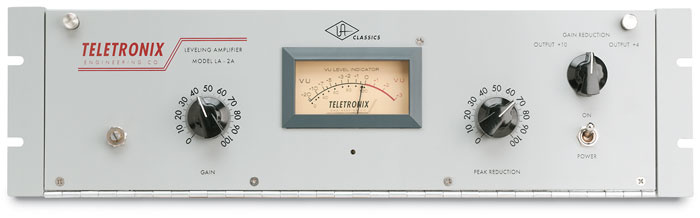 The term levelling amplifier was common in the '50s and '60s, and was clearly written on the front of the compressors of the time, such as the Teletronix LA2A, pictured below. This unit is still manufactured by US manufacturers Universal Audio. It's no surprise, therefore, that they apply the levelling amplifier badge some of their other products (including the 2LA2, pictured above), to give them that 'vintage' je ne sais quoi.
The difference between a compressor and a limiter is only in the compression ratio used. A limiter is intended to limit the maximum level, normally to provide overload protection. This involves setting a threshold close to the maximum desired audio level, and using a very steep ratio (anything above 10:1). What this means is that the input signal has to go 10dB above the threshold before the output will rise 1dB above it. And in practice, that means that the signal doesn't exceed the limit threshold to any significant degree.
A compressor is used for less drastic, more creative dynamic control, and tends to use lower ratios; typically 5:1 or less. A ratio of 2:1 means that for every 2dB of input level above the threshold, the output level only rises by 1dB, so the dynamic range above the threshold is halved.
The only other significant difference between a compressor and limiter is that the latter tends to have much faster attack and release times, so that it can respond to brief transient peaks very efficiently, and without affecting the rest of the audio signal. Compressors tend to be set up with a slower attack specifically so that they don't squash the attack transient on percussive sounds. They also usually have a slower release so that their gain changes are more gentle; more like pushing a fader up and down.