

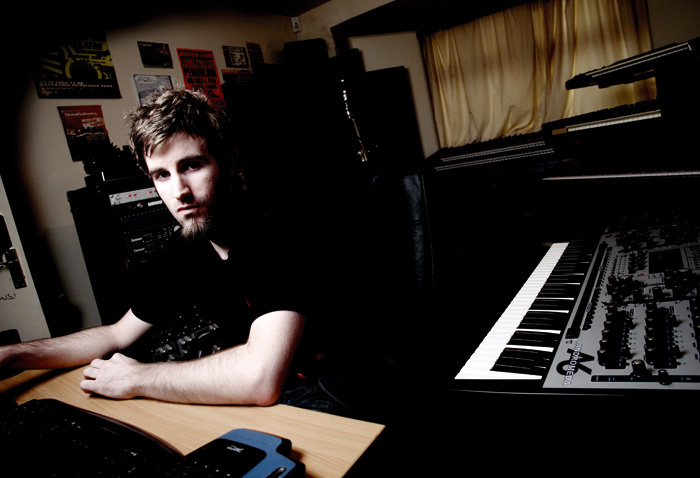
From their roots as a drum & bass act, Pendulum have transformed themselves into a dance-rock powerhouse.
Drum & bass has proved one of the most enduring genres of electronic music, despite — or perhaps because of — remaining largely outside the mainstream music industry. If anyone can drag it above ground, it's Pendulum, whose debut long player Hold Your Colour is widely cited as the best-selling drum & bass album of all time.
That album showed a band developing at a furious pace, and in the three years since its release, things have continued to move on. Pendulum have signed to major label Warner Brothers, recorded and scrapped a follow-up to Hold Your Colour, transformed themselves into a powerful live band, and at the time of writing, are finally poised to release their second album. In Silico has the potential to become one of those elusive dance-rock crossover hits, blending electronica with metal guitars and live drums to create a sound that is brutal yet thrilling, complex yet immediate. Above all, it's a proper album that's satisfying to listen to from beginning to end. How have Pendulum made the transition from DJs and remixers to songwriters and album artists?
"It was hard," admits Rob Swire, "because the tracks which we did to play in clubs in the beginning ended up with a lot of people listening to them in their cars and shit, which we didn't really take into mind. We were trying not to really shift from that too much, I just wanted to include more of the band side of things — the acoustic drums and the vocals and the guitars. We knew we wanted some tracks that weren't just the drum & bass one minute 30 intro, 64 bars of drop, 32 bars of breakdown, 64 bars of drop, 32 outro, so we did have in mind that we wanted to try to put together something with proper lyrics, proper vocals, proper parts and everything. It was a bit harder than I think we had in mind."
Swire is the brains behind Pendulum's studio operations, and as well as writing and producing all the tracks on the album, he's also become the band's main vocalist. The decision to have a single lead vocalist on all the tracks was, again, prompted by the desire to make a consistent-sounding album. "We wanted to make sure of that, unlike the last one where we approached it more producer–like and got anyone that we could." This, however, added to his burden as producer. "Since I was doing the vocals, it's a bit harder to keep the objectivity on the engineer's side, because I don't think anyone likes hearing themself back, and when you're trying to mix that, it adds a whole different, annoying dimension to it."
Pendulum Remixing Pendulum
The process of developing the album material reflected both Pendulum's reinvention as a live band and their love of remixing. "We basically put together all the tracks as very shitty demos, because I had this idea that it'd be quite good, since we love doing remixes, to have these demos of the songs, go and record them as a band so we get the parts for them, and then come back with the parts and tear them apart like we were doing a remix of someone. So we recorded the drums straight after we'd done those demo tracks, so we'd have something to play along to. They're mostly complete performances, apart from tracks where we didn't know what we were doing and we just recorded as many different things as we could."
 Pendulum's studio occupies one room in a suburban house. The acoustically treated area to the left of the window is where Rob Swire's vocals are recorded, and the pink cupboard visible at the right is "full of tiny wooden squares that go all the way to the back", somehow evening up the bass response!Thereafter, says Rob, "It's pretty much constantly back and forth [between him and the band] until we get approval from everyone. We try not to sample as much as we can. We usually just start with us tearing some sound apart and then work it from there. There's a breakbeat in the second track that we used because we needed an old hardcore–style vibe, but we were going into this album saying 'If we need a breakbeat, we'll record it. If we need a high-pitched, happy hardcore-style vocal, we'll record that, and try to do it ourselves.'
"A lot of what we were trying to do with this album was listening back to bands, new shit and old stuff, and hooking into a particular sound that gave the song a particular vibe or style, and then being like: that, but with our usual stuff. We wanted to hear that combination, and we'd go out and try to recreate it."
As Bonham As Possible
The emphasis on creating fresh recordings was particularly important with the drums, which were tracked by engineering legend Dave Bascombe at Olympic Studios. The point, as Rob explains, was to give Pendulum access to "something that no-one else has, basically. If you're using breaks, it's probably a break that everyone's used millions of times, and we wanted to go in and say 'Well, no-one's touched these. We've got fresh breaks, it's our album.'
"It ended up being quite flexible, because we got him to do dynamic multisamples of each kit that we got [drummer Paul Kodish] to play, and then loaded that into Kontakt, and had both the live recorded audio and the audio from Kontakt coming out of about 32 different channels into 32 groups, and we just mixed them from the groups. So any time if we played something and we were changing the song, at any point we could just switch the live drums out and play it in Kontakt. It was quite cool mixing through the groups, because you couldn't even tell that it was switched. Literally, it just sounded like the same take.
 All the vintage synths in the Pendulum studio are still in showroom condition, notably this Sequential Prophet 10."For the live drums, we went as John Bonham as possible, with the big 26-inch bass drum and Ludwig Black Beauty snares. We found some raw John Bonham drums and decided they were the easiest in the world to have against electronic stuff, but the sound was a bit harder to replicate than we thought."
Rob has a theory as to why the Led Zeppelin drum sound works so well in an electronic context: "I think it's because of how huge the sound is, without having to rely on the clicky transients that generally you can't really put into a dance music mix. Like, if you listen to a Nickelback track and listen to the kick, there's no way that's going to fit into any dance record ever. It's too low, for one, and there's too much pop, there's too much click. Something like the Bonham drums, the transients are all so soft, but the sound is still so big, it's really easy to use."
The live drums were frequently layered with samples after the fact. "We pretty much just have a folder of as many kicks as we can find. If we're stuck for something we go through and raid that, or start combining things, or tearing bits of the samples apart and using different parts of them."
Soft Guitars
 Rob Swire has high praise for his Mitchell & Todd monitors.Guitarist Perry ap Gwynedd has seen his role in the band grow since Hold Your Colour, and the instrument is now central to Pendulum's sound. On the new album, the guitar sounds were created using IK Multimedia's Amplitube 2 and TC Electronic's TC Thirty plug-in. "There's a lot of guitars in there, and our guitarist was a bit pissed that we wouldn't record an amp, to begin with. We wanted to keep it software-based, just because you don't really know what sort of sound you're going to end up with. For what it is, even including a guitar in the first place is going to throw our fans off like nothing else, so for us to have that sort of last-minute 'That doesn't sound right, let's use this...' We just use them as walls of sound alongside the synths. They don't tend to feature by themselves too much at any point. With one of the tracks we tried to do a guitar solo as Aphex Twin might have done it, which I liked the idea of. The brilliant thing about our guitarist Perry is that you can have nothing in mind and he'll go 'OK, just leave me here for 10 minutes,' and he'll come up with something that is better than the entire tune you had before."
Vocals, meanwhile, were recorded in a corner of the band's main working area. "It's all me," says Rob. "I recorded them with a Brauner VMA, and unless we were using it as an effect vocal, there might be a bit of EQ first, and then through the Blue Stripe [1176 compressor]. The sound of that, compared to what we were using before — before, there was so much tweaking involved to get it to stand above a mix just right, to the point where it wasn't too loud, just fitting nicely against it — as soon as we ran it through that thing, we were like 'That's it.'"
Some tracks feature relatively straight vocals, whilst others employ vocoders, talk boxes and other effects. "We don't mind tearing something apart if it's going to end up the way it sounds in our heads, and it threw our live engineer off a bit, because he's like 'But I can hear the tuning on that!' and we're like 'Good.' Obviously you want to stop it before it gets to Cher territory, but... We do a lot of vocoding and talk box. We do it with a physical talk box, with a DX100 sound piped through. It's more difficult than I bargained for, because you have this fucking tube in your mouth and you're trying to say esses and tees and shit. It's like having one of those things that the dentist chucks in your mouth to suck up the spit, except that it's not sucking up the spit!"
Pendulum Synths
 The OSC OSCar: "Shit at leads and good at bass". "We did record bass guitar," says Rob, "and it's used as a layer like the guitars on some tracks, because it adds a subharmonic that gets lost otherwise." Nevertheless, most of the leads and basses on the album are, as you might expect, synthesized, and although the studio boasts a mint-condition Prophet 10 and several other desirable analogue synths, Rob has some other favourite sound sources that are more unusual. "For a lot of the bass sounds we just start off with something simple and then mangle it, or use our old favourite [Cakewalk] Z3TA plug-in. I love it, for anything. For some reason it's one of the quickest go-to synths for anything I want to do. I just think of a sound, go to that and do it, which I don't really have with anything else. There's sounds you can't get from Z3TA and that's why we have analogue synths, but at the same time, if you want something digital and fucked-up, they aren't really going to do it, except maybe for the Andromeda. If you want something like that it's not going to come from a Prophet. I find with Z3TA, more than anything else, it just fits right in against drums, the way that we do them, and I've never found anything else that does it so well."
I was curious to see Rob making extensive use of the Gforce ImpOSCar plug-in, given that he has a real OSCar behind him. Does the emulation not sound the same as the original? "Not at all, and that's why I like it. The OSCar is possibly the dirtiest, most depraved–sounding synth ever — it's fucking gritty — and the ImpOSCar doesn't sound like that at all. It's clean and trance-like, which is probably why I like it for leads. I find the actual OSCar is shit at leads and good at bass."
Other hardware in the studio includes an Alesis Andromeda analogue polysynth, of which Rob says "I love how much you can do with it. It's like the Reaktor of analogue. It is a bit of a headfuck, with that interface. Leaning over that small [display] thing trying to dial in plastic knobs that seem to go a bit dodgy over time isn't really ideal. It splits its messages over multiple NRPNs, I think, so if you use the ribbon controller you can see about four different controllers coming in.
"For pads we usually use the Andromeda or try to layer something with the Prophet. With the Prophet there's a sort of Blade Runner-esque thing you can't really get from anything else. I use a lot of weird little freeware shit. [Krakli Software's] Cygnus is the best thing ever for spacey pads. It's like Absynth but just made for those sort of sounds in the background. If something that looks good comes out I just buy it!"
Digital Heart
 The small room adjacent to the studio, which serves as a machine room-cum-junk store.The heart of Rob's studio is Steinberg's Nuendo 4 DAW ("I switched over to this from Logic, I think when Nuendo 1 came out. The layout of it feels a lot better than Logic did — I hated the Environment"), running on a Windows PC. "Macs don't work all the time like everyone claims! The software available... I wouldn't say it's better than what the Mac has, especially since the Mac has Metasynth, but once you get stuck into an OS, with the amount of plug–ins we use that are just PC, it'd be too hard to change over."
The PC's own processing power is augmented by TC Powercore and Focusrite Liquid Mix DSP units. Does Rob find much use for these? "The Powercore, definitely, mainly for the VSS3. I can't find a better reverb than that without buying something stupid like a Lexicon 480L. I find it does the job, and it doesn't tax the processor. There's usually quite a bit of stuff going to the VSS: drums, just to fill out snares, or pads or vocals. Little things like trying to emulate the Killers' Elvis effect."
There's also a small but well-used selection of outboard processing gear, which is integrated into Nuendo "with the [Lynx] Aurora [interface] and the External Effects thing in Nuendo, although Nuendo has a bug where it keeps on trying to reassess the delay compensation, and it's really fucking annoying. So as soon as we find something we like we print it to disk and get the settings if we need to."
There's also a Neve 8816 rackmounting mixer, which is used purely for mixing line–level sources when required, as Rob is not a convert to the idea of analogue summing mixers. "I just don't buy it. I've heard examples, people have posted up examples around the 'net, and every time they do it, they go 'Listen to how much better that sounds when it's summed,' and I've always preferred the digital mix. So I think I'm just going to stick with that."
Pendulum Live
Pendulum's decision to remodel themselves as a live act has as much to do with the changing face of the music business as with artistic fulfilment, and it's a decision that seems to be paying off. On the day this interview takes place, the band are jetting off to their native Australia for the first leg of a punishing summer schedule that encompasses virtually every UK festival from Download to Creamfields, as well as numerous headline dates of their own. "The way the music industry is headed, it's a lot more important on the live side than it seems to be in the studio, which is a big shame," admits Rob Swire. "There's not the perfectionist, tweak-one-synth-for-a-month element with the live stuff; you've got to accept that some things aren't going to be perfect and move on, that's the nature of live. It's going to be different every night, and that's the good side to it, I think."
Meanwhile, In Silico itself was released on May 12th. It's been a long time coming, perhaps thanks to Rob Swire's perfectionist tweak-one-synth-for-a-month element, but the wait has definitely been worthwhile. "The label were saying 'When's it going to be finished?'" he laughs. "We're like, 'When it's good.'" If only more artists adopted that philosophy...
Little Boxes On The Hillside
Pendulum's studio occupies one room of a nondescript house in the London suburbs. There's not much by way of acoustic treatment, but as Rob Swire explains, that's partly because of their unique approach to house-hunting. "We actually looked at quite a few houses before settling on this one. We took a speaker with us in the car, and set the speaker up in the room and played test tones. The estate agent was trying to sell us on kitchens, and we were like, 'We don't care, dude! — whooooooooooo [he does an uncanny impression of a sine sweep]'. For some reason, sitting right here it did actually work the best. I think that can only be because of the cupboard, which is full of tiny wooden squares that go all the way to the back. I don't know what the fuck they're for, but somehow I think it evened up the bass!"
Though there's a pair of Mackie speakers stacked on the floor, and a subwoofer under the window seat for testing mixes intended for club PAs, the main playback system is a pair of Mitchell & Todd active monitors. "I got introduced to them by Simon Askew, the Maida Vale guy we stole to do our live sound. He was using a pair, it was the model below this, and the PMCs. I heard these and I said 'What the fuck is that, it's like everything you want in a monitor!' It's Dynaudio drivers, but the Mitchell & Todd guys designed the enclosures and the amps for them. They're really flat. The guys actually came down here and set them up themselves. Something was a bit weird with the tweeter and he came down and replaced it, so they're good like that."
A Warm Reception
Pendulum's recordings make extensive use of both vintage analogue synths and software instruments, neither of which are renowned for their reliability on stage. Rob Swire's solution? "For the live stuff we just sample everything into Kontakt and load it up onto Muse Receptors. They're the only things that are stable in a live environment, because if those things crash, two seconds and they're back up. With a laptop running Kore or something, if one thing goes wrong you're fucked.
"Since I've found an FBI disk-cloning tool that backs up the hard drives, I love them. Before that, when you had to send the drives to Muse to get backed up, they were probably shaving five years off my life."
On A Roll With Mix Compression
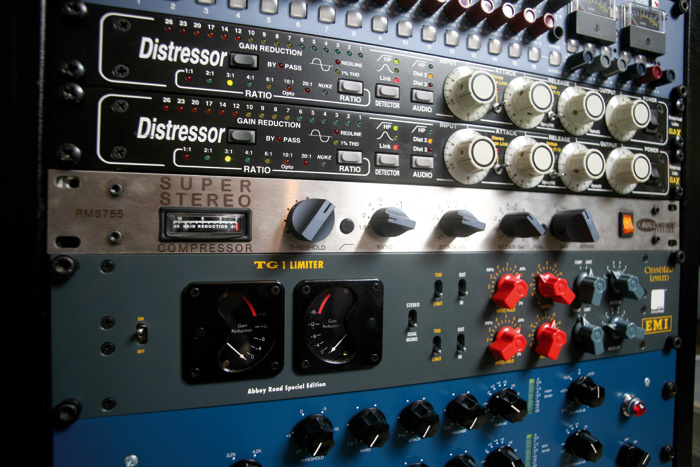 The Roll Music Super Stereo Compressor is the closest thing Rob has yet found to his ideal mix compressor.One of the most important pieces of outboard gear in Rob Swire's studio is the Roll Music stereo compressor, which is a major component of the Pendulum sound. "It feels like pushing a mix into a pillow!" Rob explains. "Which I like. You just get some sort of resistance there, which you can work off. We'll start without it, and then when it starts sounding good we'll whack that on and keep A/B–ing between that and bypass.
"I love that, but I'm sure there's something that could do the job a tiny bit better. I've heard an SSL, and for our mixes I liked the Roll Music better. Most of the other ones we tested I couldn't stand. The API 2500 was the one other one that I liked, especially the 'Old' setting, but there was something about the top end, it made it slightly watery, it wasn't really what we were after. But I think if I had to get another one that'd be it.
"Before we used that we used something weird, which was Waves' Audiotrack [plug-in]. It was the only thing I could find that got the same sort of sound that this has. There's better stuff out, the Waves SSL pack had been released, but I didn't like that at all. I think it's just that the Waves Audiotrack was straight peak compression, no RMS involved. I think the Roll Music compressor has a combination of the two, which gets a similar effect, just straight linear compression. It's also the side-chain filter on that. They should tell people this in the manual, but if you open the box, there's a jumper and you can set the side-chain [filter] to whatever you want, so we can sort of get it above our big Def Leppard-style snare.
"I find as long as you mix into it it's fine, but we ended up going to get the album mastered at Metropolis and bringing that with us, which was a big mistake. Obviously we'd been mixing the album with that on all the tracks, cutting about 2 or 3 dB off, and then we took it to Metropolis, and on the big PMCs you think 'Oh no, that's way too much,' and you tweak it back — but as soon as we got in the car on the way home, the snare blew our heads off. So you do have to mix through it and then more or less stick with what you did. For a club mix we'd do a much different mix from the ground up, with a lot more bass and drums."