

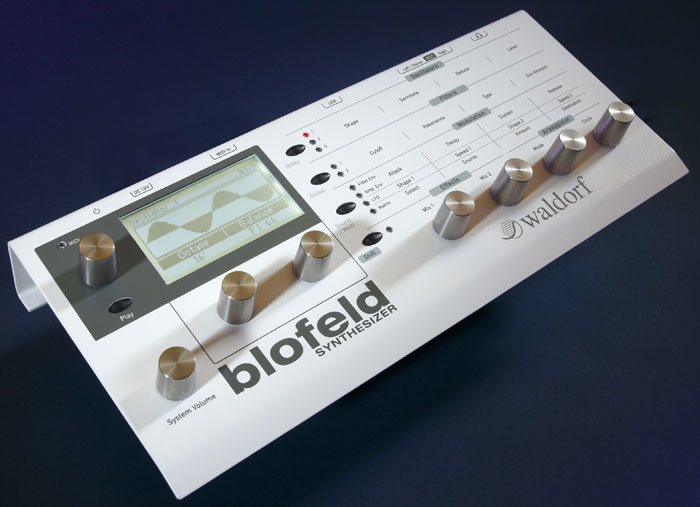
In 2004 it looked like game over for Waldorf, but the German company are back, with a hardware synth that more than lives up to their former reputation...
Named after James Bond's pussy-fondling antagonist, the Blofeld is the first product from a revitalised Waldorf Music GmbH. Unlike Donald Pleasance's portrayal of the sinister Spectre overlord, Waldorf's Blofeld is benign and refreshingly free of cat hairs, thus should be welcome around your house, studio or secret base.
In 2004 Waldorf ceased trading and it seemed this would be the end of the line for its distinctive brand of hard-sounding, wavetable-grunging, bass-bin-shaking and often garishly-coloured synthesizers. Then rumours began to circulate that all was not lost, that something might be salvaged by the enthusiastic employees of this quirky company. Ultimately, Joachim Flor, one of Waldorf's former sales representatives, collected some people and some money to build a new company with the same name and most of the key players of the previous company. To cut to the chase, after a long gestation period, Waldorf are shipping hardware once more!
Plundering Q's Laboratory
Although judging good looks always involves a fair measure of personal taste, the Blofeld's white, slimline, metal exterior, shiny aluminium encoders and clear graphical screen won't fail to impress anyone who appreciates quality workmanship and stylish design. Internally, the Blofeld represents the ripest cherries plucked from the Microwave 2 and the Q and Micro Q series. I should stress that this synthesizer isn't simply a rehash of existing ideas; the Blofeld is a new creature with a fresh identity — it even manages to surpass the power of those classic instruments in some cases.
The Blofeld has three oscillators per voice, two of which are capable of delivering wavetable synthesis or analogue modelling, while the third is devoted to analogue emulation only. Each oscillator may be routed freely through two filters; these are selected from a diverse collection of filter types and topped off with filter panning and drive options that take sonic mangling to another level. Three fully-featured LFOs, four snappy envelopes and Waldorf's ever-powerful modulation matrix are on hand for when you need controlled complexity in your patches. Further delights include 16-part multitimbrality, a programmable arpeggiator and more than 1000 sounds to use or to overwrite. Polyphony can be up to 25 voices, depending on DSP load. Oh, and did I mention that there are effects too? Clearly, this would be an impressive synthesizer in any class but is all the more so when you take a look the bottom line.
There are limits to Waldorf's generosity, of course, and some of them become obvious when you take a look at the rear panel. The presence of just two audio outputs is probably to be expected at this price point, but it is the single MIDI port that caused me the most immediate concern. The Blofeld has MIDI In only — there's no MIDI Out and definitely no Thru. This means that if you wish to offload any of your patches for external storage, you must use a computer and USB. Fortunately the USB port provides full MIDI I/O, so if you are a PC or Mac owner you do have options — but if your studio is hardware MIDI-only, you'll have issues.
A headphone socket and connection for the external power supply complete the rear-panel offerings — and I sincerely hope the wall-wart supplied to UK buyers is different to the one I received. I've really had my fill of perching Euro connections into wobbly shaver adaptors — I thought there was some kind of law against this sort of thing!
Getting Started
Just for a change (no, not really!), my first job prior to making any noises was to upgrade the Operating System and factory sounds. Waldorf recommend Windows 98, Windows XP (or higher) or Mac OSX 10.3.9 (or higher) as supported platforms. Upgrading the OS proved perfectly straightforward: I connected the synth to my Windows XP PC via USB, at which point the Blofeld was recognised as a generic USB Audio device. This device appeared in the MIDI port list in my sequencer program, making it a simple matter to send the appropriate MIDI file. The whole OS updating process took about 11 seconds and probably left me feeling rather over-confident about the prospect of updating the factory sounds.
I needed to upgrade these because initial versions of the soundset reportedly suffer from drastic variations in volume and I wanted to start with a clean sheet. As it happened, this updating procedure proved rather less painless than the first one. Firstly, sending the data produced no indication that all the sounds had been correctly loaded. There was an occasional message that SysEx was being received but afterwards I could spot no obvious differences — my data load had clearly not worked. I experienced a vague sense of déjà vu, remembering similar issues with my Microwave XT, which at least offered the clue that it was reorganising its memory during a receive, meaning that you had to try again. Sometimes again and again, watching the damn thing throughout! Anyway, in the end I completely re-initialised all patches and reloaded from scratch, this time sending the MIDI file at a very slow tempo. Thankfully, this appeared to work, although I thought some patches still sounded a tad quiet. I can only hope that Waldorf manage to improve the process in the future, perhaps providing some kind of simple software application to do it via USB.
Something also worthy of note, if you have purchased a Blofeld but are unable to find the latest soundset, is that the printed 'Quick Start' manual points you to the wrong Waldorf web site — the correct one is documented in the full manual to be found on the supplied CD.
Enter The Matrix
It was in 1996 that I first encountered a Waldorf synthesizer that employed the matrix method of parameter access. This was the powerful analogue monosynth they call the Pulse, and it used a matrix instead of a panel of dedicated knobs. The system worked pretty well, saving considerable cost by allowing just a few physical controls to operate a wide array of parameters. Time passed, and further refinements came along in the form of proper displays and continuous encoders. The Microwave 2 possessed what I still regard as the fastest, most intuitive variation on this theme.
The Blofeld's matrix is a two-tier system based around seven perky encoders, a delightfully sharp graphical display and a series of buttons and LEDs. At its simplest level, the menu system is navigated via the four buttons for oscillators, filters, modulation and so on. Where there are several options, multiple button-presses step through them, the position at all times shown by an LED. The matrix rows are labelled in a small neat font that my ageing eyes can just about cope with, and having done your button pushing, you simply grab the relevant encoder and tweak away. For most quick editing purposes, you might never need to go much deeper.
 The Bloefeld's rather spartan rear panel — and yes, that is just a single MIDI input port.Photo: Mike CameronBeneath the display are two encoders that line up with items appearing on the display screen. These items don't necessarily correspond to the current selection in the matrix, which confused me occasionally; it is implemented in this way so that you can use the matrix encoders independently of the display encoders.
When exploring the menu system further, the selection dial is used to navigate through the edit pages. Knowing where you are in this 'deeper' realm of the menu system is aided by the 'page of pages' area of the display, in the top right-hand corner. You soon learn that there are lots of these pages, many of which are populated by excellent graphics, illustrating oscillator and LFO waveforms, envelope shapes and so on. At any time you can return to play mode by hitting the Play button, then use the selection dial to select patches and the encoders beneath the display to change banks and perform category searches. The latter is essential when you consider that there are eight banks of 128 patches to choose from.
The selection encoder is notched for ease of use (all other encoders are smooth in operation) and when initially clicking through the preset banks I was overwhelmed by the sheer number of patches, even though they are conveniently organised into 13 different categories. There was no way I could meaningfully audition them all and still get a review written, but I soon realised they represent the sort of sounds I've grown to love from Waldorf — hard, biting basses, mad sound effects, evolving wavetable pads, brassy leads and more. I also thought I noticed a warmer, more fuzzy character than I am familiar with, which was intriguing.
I decided to pitch in and program some patches myself from scratch, perhaps using the ever-useful randomise function to generate some starting points. The Utility menu contains patch store, initialise, randomise, and various dump options. Some of the patches thrown up by randomise were astonishing, although I concede that very few would be classed as 'normal'. Randomise gave me strange, eerie and downright unsettling tones, all ready to tweak and develop further if necessary. I wanted to start overwriting many of those factory electric pianos, organs, basses and soft, girly pads right away! Having concluded that every synth should have randomise, I then pondered how much nicer it would be if degrees of randomisation (or some other way of taming the results) were offered for those times when you want to generate something you can actually play.
Note The Arpeggiator...
A programmable arpeggiator stored with each patch is something we encountered on the Microwave 2, and the Blofeld's has grown considerably in stature from those early beginnings. Needless to say, it can cope with all the standard up, down, and up/down directions, curiously lacking only a random option. There are 15 ROM patterns that use gaps to break things up, or you can make your own pattern, adding glide, shuffle, pauses, accents and more to build something truly unique. The arpeggiator uses a 'note list' — up to 16 input notes that it memorises and from which you can choose when building user patterns. As each step in a pattern can specify a random choice from this list, you should soon find a way to simulate any 'Rio'-type arpeggios you might need. There really isn't space to cover every option in glorious detail so I'll just say that layering up a few arpeggiating patches in Multi mode proved a fine way to occupy a rainy Saturday afternoon, even if I had to generate my input notes on several MIDI channels simultaneously.
Oscillator Action
I kicked off by exploring the oscillators, which instantly impressed me with their range of 128' to 1/2' — that's before modulation! This is a synth that could seriously disturb any bats you have in the attic! The Blofeld includes all the wavetables from the Microwave 2, plus the two 'Alt' tables from the Q series and, although there is no provision for adding your own tables, you can have two different wavetables active at once — something not possible on the Microwave. This is mightily cool for creating complex, evolving pads, especially when you draft in some of those LFOs and envelopes to modulate each wavetable independently.
The wavetables sound slightly different to the Microwave 2's implementation; they are expanded to 16-bit and use the same high-quality blend algorithm found in the Q and Micro Q. Even the 'speech' wavetables (namely: '1-2-3-4-5' and '19-20') sounded less glitchy (and also less intelligible) than I remember from the Microwave, but personally I prefer the Blofeld's versions, especially as there is an oscillator brilliance control that can bring back the grittier, scratchier sound if needed. Some of the tables have 'gaps' in them, and these, when swept, suggest those Microwave sounds we know and love, just somehow 'nicer'.
One feature that works differently to earlier Waldorf synths is that after selecting a new wavetable you must then play a note before the new table can be heard. Similarly, adjusting brilliance or selecting a new FM source for the oscillator appears to do nothing until, again, you play a new note. This is something to be aware of if you are scratching your head or trying to extract imagined earwax, as I was.
 The Blofeld's austere front-panel design belies the complexity of the synth engine beneath.Photo: Mike CameronWhen I selected the modelled analogue waveforms, I thought I noticed something interesting occurring. One thing I never imagined I'd write about a Waldorf synth is that the oscillators, when detuned, can sound lush, swimmy and 'analogue'. But that's exactly what I thought here. Perhaps the degrees of detune are simply finer or there's some other German magic going on; either way all the expected analogue waveforms are present and correct and can be delivered by all three oscillators (only oscillators one and two can handle wavetables). Setting brilliance to 64 gives an oscillator sound very like the Micro Q, whereas 128 more closely matches the Q. In other words, analogue modelling with balls. My only wish was for a single page to show the levels of all three oscillators, plus the noise source and ring modulator. Fortunately the MIDI spec is such that you could assign these source levels to a series of sliders on your favourite controller, which would also speed up programming considerably.
Pulse width may be adjusted either for the wavetables (in which case it sweeps the wavetable) or the square wave, where it performs as you'd expect. The oscillators can serve as audio-level modulation sources too, plus there's dirty, evil sync available between Oscillators 2 and 3. Sync even works with wavetables, rather than being restricted, as on some synths, to only the analogue waves.
For those Incredible Hulk moments, there are several unison options on tap for multiplying and detuning each voice up to six times. Or, if you prefer to show your more lyrical side, portamento and glissando are present for those expressive 'glidey' and 'steppy' sweeps between notes. Finally, and possibly the most versatile oscillator feature of all, there's the balance control, which routes each oscillator freely between the two filters.
Filter Tips
Configurable either in series or in parallel, the twin filters may be picked from an impressive list of filter types. The list includes the usual 2-pole and 4-pole low-, high- and band-pass options, plus a notch filter, positive and negative comb filters and the PPG low-pass filter, modelled on the 24dB SSM2044 chip of the PPG Wave. While it may be unfair to single out any for special praise, I'm going to do it anyway. This filter sounds fantastic. I had always wanted to combine it with the wavetables of the Microwave 2; finally I was able to do so — and I was not disappointed. Similarly, with no more than a couple of detuned sawtooth waves as a source, the PPG filter yielded some of the best pads I've heard from a Waldorf synth.
It's easy to get diverted by the number of ways you can use a filter arrangement this versatile; I found myself connecting a flanging comb filter in series before the PPG, then controlling the filter balance with velocity, so that quieter notes passed through both filters, the loudest going only through the PPG, those in between varying position according to note strength. In just a few minutes I had a patch in which I could articulate notes to rise out of a flanged mush purely by how hard I hit the keys.
As well as a selection of filter types, there are a number of drive curves that drastically affect the filter's output and tone. These include tube and pickup simulations, audio level modulation (by Oscillator 1), a rectifier, clipper, sine shaper and more. Each one imparts its own tonal changes to the selected filter, and as you crank up the drive for the first time you really begin to grasp the enormity of what is concealed in this tiny white synth. Each filter has its own panning control too, so you can move the filters around dynamically with creative use of modulation.
Modulate Your Tones
It's often at this point in a review of any Waldorf gear that I recall why their synths stand out from the crowd: very few other manufacturers let you tinker with such minute details of sound sculpting. In common with earlier products and alongside many built-in modulation routings — the (variable) source connected to oscillator pitch, pulse width and FM — the Blofeld has 16 completely free modulation slots. With these you can connect any of 29 modulation souces to most of the destinations you might want. To give you a flavour, these destinations include envelope stages, cutoff and resonance of both filters, and the level and filter balance of every sound source; they encompass oscillator and filter FM amounts, filter drive amounts and panning, LFO speeds and more. The destinations that I found absent include the myriad parameters of the arpeggiator, oscillator detune and filter envelope amount.
Various Waldorfian modifiers are also present for when you wish to perform mathematical operations on the modulation signals. So if, for example, you wanted to 'unsmooth' some modulation, perhaps to recreate the steppy wave changes of the Microwave, the 'OR' and the 'AND' modifiers are your friends.
Multitimbral Operation
When programming, you can save DSP power by turning off unused oscillators or filters. This could be very important if you wish to use the Blofeld multitimbrally, although this is one aspect of the synth that's incomplete. In fact, it rates just one page in the manual, where Multi mode is shown as a means of selecting patches on 16 separate parts, each part corresponding to a MIDI channel.
Multi mode is engaged via shift and the Sound/Multi button. You can then pick a part to edit by holding the Play button while turning the selection encoder. It's a bit primitive right now, and you can't even layer sounds on the same channel or do keyboard splits, for example, nor can you name and save Multi assignments. Nevertheless, each patch keeps its own Effect 1 setting and there's a mix level available to all parts for the common Effect 2. This would typically be reverb or delay and is sourced in whichever patch you pick for Part 1. I am assured that Multi mode will be refined in a forthcoming Blofeld software release.
About Effects
To finish off, where would we be without effects? The Blofeld has two sets of effects for each program: Effect 1 and Effect 2.
Effect 1 consists of either chorus, flanger, phaser, overdrive or 'triple FX', the last a slightly simplified combination of chorus, sample and hold and overdrive. Effect 2 adds delay, clocked delay and reverb to the list. With its maximum delay time of 557ms, the Blofeld can't produce delay lengths as long as the Q or even the Micro Q, but at least it offers MIDI-clockable delays. These have a range starting at a very fast 1/96 division right up to 10 bars, although goodness knows how high your bpm would need to be to achieve that! I also noticed a few audible clicks that occur when you adjust delay time or feedback during play; I mention this because the manual specifically claims it won't happen.
Finally, the reverb really doesn't sound too bad in context. There are a number of tweakable parameters that help you get more mileage from it, including diffusion, size, shape, decay and damping, with the reverb's character further adjustable using low- and high-pass filters. Overall it's a welcome, if unspectacular, inclusion.
Licensed To Thrill?
Blofeld was 007's chameleon-like adversary and an evil genius to boot, so finding holes in his fiendish schemes is no easy task. In fact, most of the shortcomings I unearthed can probably be attributed to cost saving. Admittedly, just two audio outputs isn't ideal for a multitimbral synth, and the matrix method of parameter access can never be as fast as a panel full of knobs, but I think this latter issue is minimised due to the logical way the matrix has been implemented. Given the Blofeld's size, there's a hell of a lot packed in here yet at no time has either build or sound quality been compromised. As you'd expect from Waldorf, extensive MIDI control is available, so you can choose your favourite remote controller and program it appropriately, at which point things start to look much more accessible.
Loss of MIDI ports I found slightly harder to forgive, but I guess most of us probably have some USB devices kicking around, so connecting up the Blofeld for the sake of saving our patches shouldn't be an impossibility, even if it is occasionally inconvenient. If, in future, Waldorf find a way to offer USB audio functionality as well as MIDI, the Blofeld could make an irrisistible companion to a laptop-based setup.
The current Multi mode is unfinished (see the 'Multitimbral Operation' box earlier in this article) but it is, at least, usable, even if you can't save individual assignments yet. With over 1000 patches supplied, you have a huge amount of exploring to keep you busy until an update percolates through.
Sonically, although recognisable as distinctly Waldorfian in character, the Blofeld is also capable of smoother, lusher tones. It can do convincing analogue and wavetables at the same time — quite a combination! In fact, the ability to mix these forms of synthesis freely and route the results through some seriously good filters (and, indeed, some seriously wacky ones) already puts the Blofeld beyond most hardware synthesizers made today, let alone at this price point. With that extensive modulation matrix, versatile arpeggiator and built in effects too, I have to admit it's difficult to do anything but gush. If any miniature super-villain is destined to rule the world, Blofeld gets my vote!
Pros
- The essence of Waldorf's digital synths squeezed into a slimline and handsome metal container.
- Microwave and Micro Q power you can put in your pocket!
- Up to 25 voices, effects, over 1000 patches, programmable arpeggiator, that PPG filter, deep modulation...
Cons
- No MIDI out port.
- Currently incomplete Multi mode.
- Receiving patch dumps is a little hit and miss.
Summary
The Blofeld represents an amazing comeback from Waldorf, who have plundered their vaults of accumulated wisdom to give us the best of their digital synths in an attractive and inexpensive package. Although the matrix method of parameter access won't be loved by everyone, it's nicely implemented, and since it keeps the price down I can't see any reason for these not to fly out of the door.
information
£349 including VAT.
Hand In Hand +44 (0)1752 696633.