

Ribbon tweeters can yield a smooth sound, while still capably reproducing transient detail — and the Pro Ribbon range promises to do so for an attractive price.
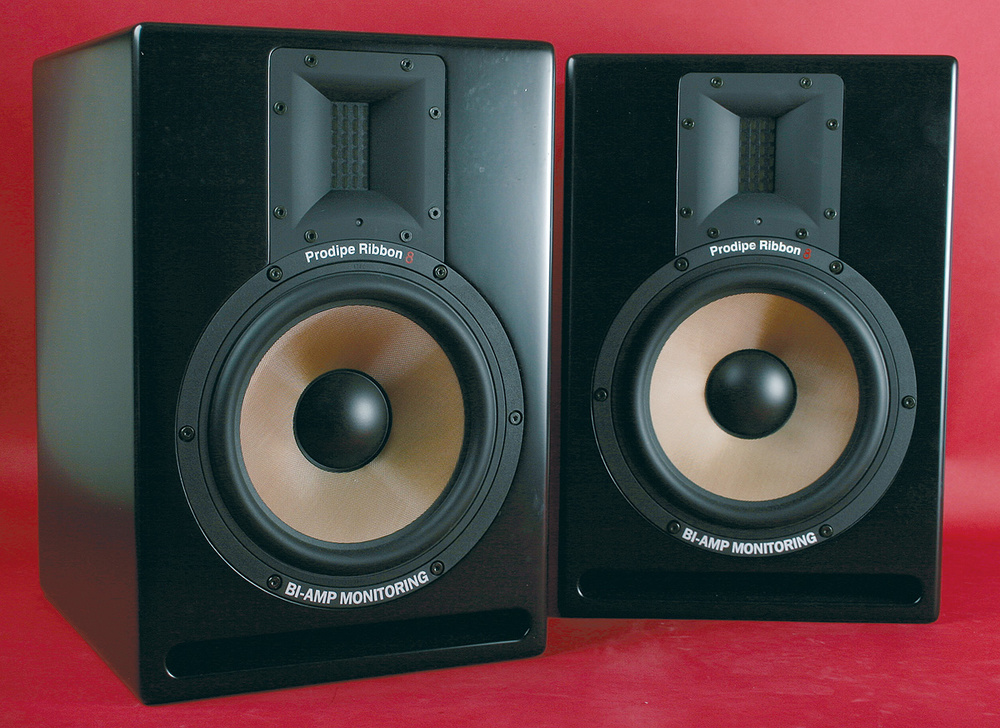
We've already looked at some of the microphones from French manufacturer Prodipe, but now the company have expanded their range to include a new line of active monitor speakers using ribbon tweeters (flat ribbons, not to be confused with the folded‑ribbon type used by Adam).
Overview
Like Prodipe's mics, their monitors are built in China, which helps to keep the cost down. The Pro Ribbon 5 and the Pro Ribbon 8 are both active, two‑way, front-ported designs, and, as the names suggest, they have five‑inch and eight‑inch drivers respectively. They both employ the same rectangular ribbon tweeter, and thus benefit from the usual ribbon characteristic of low mass — which equates to a good ability to follow high‑frequency transients.
We had the larger Pro Ribbon 8 in for review, a model whose amplifier gives 140W of power to the two drivers via a 24dB/octave active crossover operating at 2.4kHz. A frequency response of 45Hz to 30kHz is specified, and a steep 35Hz low‑cut filter reduces subsonic content that would otherwise eat up headroom unnecessarily.
The general look of these speakers reminds me of the Samson Rubicons (another budget monitor with a visually similar ribbon HF unit), but I've no way of telling if these tweeters come from the same source. Physically, the cabinets are quite conventional. They measure 381 x 265 x 316mm, and the tweeter is recessed in a rectangular waveguide. The port takes the form of a slot beneath the bass driver, which has a distinctive dull-gold colouring to its glass/Aramid cone, and the power LED is of the now‑familiar bright‑blue variety. Cosmetically, the speakers look purposeful but not over‑ornate. Moulded baffles around the drivers and plain, satin‑black cabinetwork with rounded corners help to break up their otherwise utilitarian lines. The cabinet material is almost certainly MDF, and it seems very rigid, with no obvious resonances when tapped. Each speaker weighs 13kg, but there's no figure given for maximum SPL — not that this model seems in any way shy in that department.
As is now standard for such speakers, the rear panel plays host to all the necessary connectors, and also provides a mounting point for the active electronic circuitry within. The panel layout is fairly straightforward, with a range of analogue connection options, as well as the expected power switch and IEC mains inlet. A slide switch allows operation at 230V or 110V. Unbalanced inputs are catered for via an RCA phono socket, with balanced inputs on both a TRS jack and a conventionally wired XLR. Of course, either of these may also be used unbalanced, as long as the correct cable is used. A volume control offers a ‑30dB to +6dB range, and to allow the user to customise the high-frequency end to their own room and listening preferences, there's a rotary 'HF Level' control that can be used to cut or boost the output of the amplifier that feeds the tweeter. You can choose between settings of ‑2dB, ‑1dB, flat and +1dB. There are no low‑end tweaks to allow for varying speaker placement, as you find on some active speakers, and these may be missed by some users — but this also means that there's less for the inexperienced user to mess up.
Testing
 The rear panel includes balanced and unbalanced analogue audio connections, switchable-voltage power inlet, and volume and HF controls.
The Pro Ribbon 8s' current retail price should make them a very attractive proposition — providing, of course, that they deliver in the sound‑quality stakes. I tested the Pro Ribbon 8s on a recording and editing session, as well as using them to listen to some commercial material that I know very well, and was generally impressed, given the price bracket within which these speakers fall. They were mounted on the upper shelf of my mixing desk, sitting on Primacoustic speaker pads to decouple speaker vibrations from the desk itself.
The ribbon delivers a welcome degree of high‑end detail without sounding aggressive, while the eight‑inch woofer provides plenty of depth to the sound. The overall tonality has a warm and easy‑going character, and a solid low end, but with the all‑important transient details coming across clearly. There's more than enough level when working close to the speakers, as would normally be the case, and although a more costly monitor might sound a touch better focused in the mid‑range, I enjoyed working with these speakers and never felt that they were misleading me.
All speakers have their own tonal signature, and when I switched to my Mackie HR624 Mk2s or Adam A7s there was a noticeable difference, particularly in the mid‑range (which actually made my own speakers sound a touch hard), but they all get the job done and I felt that I could work all day on the Pro Ribbon 8s without fatigue. And the more I used them, the more I liked them!
Respectable Ribbons?
When I first unpacked these speakers, I didn't know what to expect, but after having worked with them for a few days, I have to say that I'm pretty happy with their sound and tonal balance. They work well for tracking and mixing, and they're especially impressive for speakers in this lower-mid price category. I particularly appreciate the fact that the sound isn't over‑hyped or aggressive, as so many monitors seem to be these days.
As always, you can buy better, but in this case you may find that you have to spend a fair bit more to do so. If you're in the market for new active monitors that can handle the full audio spectrum in a smooth and capable manner, but you can't afford — or don't want — to spend more than you have to, then the Pro Ribbon 8s should go on your 'must‑audition' list.
Alternatives
At this price point, the obvious competitors are the Samson Rubicons, the Fostex PM series and the mid‑priced KRKs. The Alesis Monitor One Mk IIs are still in the running too, as are Mackie's MR8s.
Pros
- Good performance for a sensible price.
- Well-balanced, non‑aggressive sound.
Cons
- I have no complaints, bearing in mind the cost of these speakers.
Summary
The Pro Ribbon 8s make very effective project studio monitors at an attractive price and without skimping on bass response. They have a smooth, comfortable sound yet you can still hear the high-frequency detail.
information
Etcetera Distribution +44 (0)1706 285 650.