

CAD continue their M series with an affordable new valve mic.
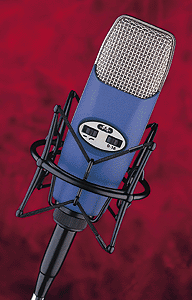 The new M9 valve mic from CAD is supplied in a large flightcase, well padded to protect the microphone, power supply, shockmount and cables (an IEC mains cable and 10m-long PSU-to-mic cable are included). The power supply is a neat little metal box carrying a mains inlet, voltage selector and fuse holder on the rear panel, with an illuminated power switch and a pair of XLRs on the front. The PSU will necessarily have to be located in the studio with the mic, but the supplied cable should be long enough to allow it to be positioned safely next to a wall where nobody is likely to trip over it.
Two kinds of stand adaptor are provided with the mic, but neither came with a 3/8-inch thread converter for European mic stands. The most basic adaptor is a simple knuckle-jointed fitting which clamps to the base of the microphone with a threaded collar ring. The second device is a full shockmount with elasticated suspension between inner and outer cradles. The microphone fits securely to the inner cradle using the same threaded base ring arrangement, and the whole assembly looks very professional.
Design & Construction
The M9 shares a strong family resemblance with the other members of the M series (I reviewed the M177 and M179 in SOS October 2001), featuring a blue body and silvered wire-mesh grille. It weighs a touch over 500g without stand adaptors, and measures roughly 175 x 55 x 50mm. An oval name plate carries a pair of thumb switches to introduce a high-pass filter (-3dB from 100Hz) and a 16dB pad. The mic's serial number is given on a sticky label (instead of being etched or milled) and fixed to the bottom of the XLR connector. The rear of the mic has a ventilation grille through which can be seen the double-triode valve — a Russian Sovtek 7025. This was also marked as a 12AX7WA, which is an ECC83 in old British nomenclature.
The internal preamp is a hybrid design in which the valve is employed to impedance-convert and buffer the 1.1-inch gold-sputtered single-diaphragm capsule. A generic dual op amp is used to drive the balanced output directly — the design is entirely transformerless.
The valve should exhibit a long and stable life, but will eventually require replacement. Fortunately, this is very easy to do, and the microphone doesn't have to be returned to the dealer. All that is needed is a crosshead screwdriver and a replacement valve (which CAD recommend obtaining from their dealers to ensure compliance with the original specs). With the standmount adaptor removed from the base of the mic, undoing four screws in the case releases the two side panels and exposes the internal electronics. The valve can then be withdrawn easily from its holder and the new one installed — two minutes work at the most, with nothing to trim or set up afterwards!
Technical Specifications
The technical specifications of the M9 are similar to those for CAD's more expensive VSM1. The output level is typical for a condenser mic at about 16mV/Pa, while it has a dynamic range of 118dB and a noise floor of 15dBSPL (A weighted). With the pad switched in, the M9 can tolerate signal peaks of 154dBSPL — sufficient to accommodate closely miked brass and percussion — and harmonic distortion is quoted as below 0.2 percent for signals under 138dBSPL (with the pad switched out).
The M9's frequency response exhibits a similar set of high-frequency ripples to the VSM1, with a small 1.5dB peak at 5kHz and another larger one (+3dB) at about 12kHz. The quality control response trace issued with the review unit also showed a broad mid-range dip in the response which reached as much as -3.5dB at 1kHz. However, rather than hearing this as a mid-range suck-out, it is perceived more as a slightly peaky top and warm bass. As this is a cardioid microphone, the precise amount of bass lift is obviously dependent on the proximity of the sound source, but it generally adds a useful warmth and richness to the sound.
The polar response is virtually identical to that of the VSM1 — although this might be expected, given that the capsule is of the same size and construction. Like all large-diaphragm mics, the polar response narrows appreciably above 5kHz, with the -3dB point coming in from about 60 degrees off axis at all frequencies below 1kHz, to nearer 45 degrees at 10kHz, and 25 degrees by 15kHz. At these higher frequencies it also becomes distinctly hypercardioid in character, growing a rear tail with the front-back rejection consequently falling from over 25dB for frequencies below 1kHz, to only 10dB above 10kHz.
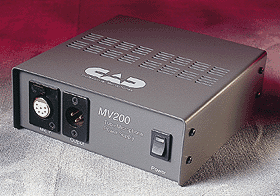 CAD MV200 power supply unit.
These changes in polar pattern with frequency are quite typical of the genre, but mean that care is required in placing the mic relative to the source and also in positioning it to minimise spill. For example, if a vocalist moves a couple of inches off-axis the tonal quality will change quite noticeably, particularly when working at close range (a suitable pop filter is essential). On a more positive note, though, deliberately aiming the mic at a specific part of an instrument to take advantage of its non-uniform polar response can help to balance the tonal qualities of the instrument very well. This is a particularly effective technique with acoustic guitars, pianos and some woodwind and brass instruments — any instrument where the sound is emitted over a large surface area — such that careful positioning and angling of the mic allows the tonal balance to be fine-tuned.
The rear pickup tail, which appears at high frequencies, would not normally cause a problem, but I would not recommend using the M9 for close miking tom-toms in a drum kit, for example. Although the mic has a characteristic which suits individual percussion, in the case of tom-toms the rear tail will offer less rejection of the overhead cymbals than would other, more uniformly and precisely patterned microphones.
In Use
The only operational oddity I found was that switching the microphone's pad in and out caused a brief buzz and hiss which died away over a couple of seconds. Instead of a simple attenuator on the input, it seems the gain structure of the preamp is changed by this switch, and the circuitry takes a short period to settle down afterwards. This should not cause any problems in practice, although it is disconcerting the first time you hear it.
Comparing the M9 with my various reference mics, principally Sennheiser MKH models and Neumann KM and TLM designs, I found it performed extraordinarily well, particularly since it cost typically half as much as the models I was comparing it to! The background noise level was on a par, the tonality (while hardly neutral) was complementary and usable, and the accuracy of polar response was very predictable, which made aiming the mic very straightforward — changing its angle slightly always delivered the expected results. The warmth at the bottom end, even when used for relatively distant placement, was characteristically 'valve-like' and very flattering to the majority of sources, especially acoustic guitars and other stringed instruments, and most voices.
The mic is slightly cleaner sounding than many all-valve mics, possibly because of the hybrid nature of the circuitry, but it is also warmer than 'ultra-accurate' mics such as the DPAs and some Sennheisers, which can sound rather clinical at times. This 'middle-ground' sound character actually works very nicely in most situations, and the M9 could quickly become a favourite and widely used mic.
The peaks at the top end of the M9's response tended to come over as a crispness to instruments and voices alike, giving the impression of detail with an open airiness and sparkle. On the few occasions where this attribute became intrusive I found it could easily be tamed by repositioning the mic slightly, using the duller off-axis response to artistic advantage.
I was very pleased to see CAD were supplying a proper shockmount cradle with the M9 — something I wished they had done with the M177 and M179 (although suitable cradles are available as optional accessories for these mics). The very nature of the M9 means that it is inherently susceptible to mechanical vibration — both the cardioid capsule and the valve in the head amplifier — but microphony of this kind was kept well under control when the shockmount was used. Having said that, some care was needed not to 'short-circuit' the cradle's isolation through careless dressing of the relatively stiff cable. This is a common problem with valve mics that require inflexible multicore cables, as these tend to convey mechanical vibration to the microphone body. Careful positioning and fixing of the cable, avoiding any tension between stand and suspension, helps considerably.
Overall, I am pleased to say that the M9 package worked very well indeed and I have been extremely impressed by it. Despite its sub-£500 UK price, it seems to perform equally as well as the more expensive VSM1, which I also liked a lot. The fact that the M9 compares quite well against 'big name' mics costing twice as much also makes it an absolute steal at the asking price. I'm not saying this new CAD is better than some of the established greats — you still get what you pay for, by and large — but the sonic differential is substantially less than the money would suggest. A classic sign of technological progress!
The M9 also comfortably undercuts its nearest competitors — the Rode NTK and NTV, and the AKG Solidtube, for example. I believe it is fractionally quieter and cleaner than the AKG, while sharing a sound quality similar to the two Rode mics. So, if you happen to be thinking about a general purpose, large-diaphragm condenser mic, and you want a subtly warm and characterful valve sound too, the M9 has to be high on your shortlist.
Pros
- Stereotypical large-diaphragm and valve sonic characteristics.
- Usable, defined polar pattern and wide frequency response.
- Good technical specifications.
- Shockingly low price for the fine performance.
- Well packaged and equipped.
Cons
- Peaky on-axis frequency response may not suit all instruments.
- Hypercardioid tail at high frequencies could be troublesome.
- The stiff cable can negate the effect of the shockmount if not dressed carefully.
- Makes the CAD VSM1 look very expensive!
Summary
The M9 provides the sound characteristics you would expect of a large-diaphragm valve mic, and backs it up with a fine technical performance at a very attractive price.