

Recorded on eight-track cassette, cLOUDDEAD's extraordinary debut album is an object lesson in lo-fi production and the creative use of budget equipment.
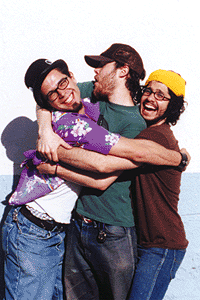
 cLOUDDEAD: (from left) Odd Nosdam, Why? and Dose One.Anyone who keeps an eye on the wider UK music press couldn't have failed to miss the name cLOUDDEAD over the last year. Consisting of vocalists Why? and Dose One alongside producer Odd Nosdam, all members of the nonconformist avant garde hip-hop collective Anticon, cLOUDDEAD have impressed and confused reviewers in equal measure with their self-titled debut CD. Originally released by US label Mush as six limited-press 10-inch records, the whole set has been collected and released on one CD by Ninja Tune's hip-hop off-shoot Big Dada. A lo-fi mixture of hiss, orchestral drones and decidedly grimy beats coupled with twisting, complex vocals which owe more to free-form poetry than rapping, cLOUDEAD's music is not easily slotted into a convenient genre. Jumping between the darkly humorous, poignant, and downright baffling, and described in the press as a cross between Radiohead's Kid A, Cypress Hill and the Beta Band, cLOUDDEAD may well have been the most startlingly original CD of 2001 — a feat made more impressive by the fact that the whole collection was almost entirely written and recorded on a shoestring kit list in various bedrooms from Cincinnati to California between January '99 and March 2000.
Although Dose One has already been to the UK to promote the CD, I wanted to get to the bottom of the cLOUDDEAD sound. So I caught up with a friendly and relaxed Odd Nosdam (or David Madson to his mum) via a transatlantic phone line from rainy Suffolk to sunny California and asked him how he started out making music. "I grew up with hip-hop, that was the music that really clicked for me when I was younger, but once I got out of high school I wasn't really listening to hip-hop any more. I found that by around '95/'96 the kind of hip-hop that was being put out wasn't what I wanted to hear. So when I started making beats, I figured maybe I could make something that I would like to hear. That's what it was all about, I kind of found a style that I really liked doing."
After producing a couple of beat tapes, it was a chance encounter in his home town of Cincinnati with an old school friend that brought all three members of the group together: "It's kind of interesting. I was best friends with Why?'s big brother all through school, but once we got out of high school we lost touch and I never really saw that much of him. Then I ran into him at a store one day and he was like 'You should come over and check out this band I've got going with my brother.' Dose One was already involved with the group and I just went over one day in early '98 and met them and ended up giving them a tape of some beats I'd made and we just kind of hooked up. It was a total accident really."
cLOUDDEAD's break came when they played the first couple of songs they had written to fellow Cincinnati resident Robert Curcio, who runs Mush records. David takes up the story: "Mush at that time were putting out trip-hop and dance stuff, really nice, clean house music and all of a sudden we came along with this weird ambient shit and we were like 'He might hate this stuff!' Thankfully, though, Robert is very open-minded and he totally got what we were doing, he was like 'This is pretty cool, go ahead and do some more stuff and I'll put out a little series of 10-inches.' It really inspired me 'cause I was in art school at the time and I didn't really like where my life was going; I was living at home with my parents and working bullshit jobs. It was Robert who gave us the freedom to do what we did and believed in it and pushed it."
Less Is More
A quick scan down the list of kit the trio used to make the tracks on the CD reveals an ultra-sparse setup based around a Tascam eight-track cassette multitracker, with a humble Boss SP202 Dr Sample being the main sound source. I asked David about the problems involved in using such a basic sampler. "The Dr Sample normally has around 20 seconds of sample time, and a couple of cheap effects like a delay and a ring mod. I had a little expansion card for it, but it doesn't have a fully featured sequencer, so all I was able to do was loop stuff."
So how did David go about constructing a track within such tight hardware constrictions? "First I'd have a drum break looped and then I'd find samples that were around the same tempo as the drums. I would lay the drums on track one of the eight-track and I'd find some sampled drones or whatever and put those on tracks two, three and four, and something else on five and six. I was just filling the eight-track up with samples, then mixing it all down to DAT." He chuckles: "That's the thing about the Dr Sample, it's not like using an Akai MPC, it's just me pushing a button and telling it to loop, there's nothing complex about the sequencing."
Did he use any other tricks? "A lot of sample layering. Sometimes if I had just one tone I would layer that on top of another loop to thicken it up a bit. I also used a lot of 'poor man's delay' where you have the same sample recorded twice with the second sample a couple of milliseconds (or whatever) off, and you get this stereo effect that's almost phased. I used that on the fat droney sounds."
Whilst on the subject of samples I asked David where he found the source material that he used for cLOUDDEAD. "A lot of those samples are from records that I've bought from thrift stores. There are so many thrift stores where I'm from in Cincinnati, full of terrible records. I just love the idea of going to one of these thrift stores and coming home with a stack of dirty old LPs that somebody else didn't want any more. Then going through this stack of bad records and taking sounds that nobody would ever hear because there was never a hit on this record and it ended up at a thrift store. Taking an LP that nobody ever cared about and making something out of it that you can just love, you know? I buy lots of old 1940s and '50s easy listening — things like Reader's Digest boxed sets, 10 records of easy listening music, I'll just dig through those and find tones and put 'em together with other stuff. I'm also a big sampler of bad '80s cheesy pop music. I love sampling that stuff, really bad keyboard samples."
As well as using old vinyl for finding samples, cLOUDDEAD made use of all manner of household objects to create unusual textures and samples. Chairs, wine glasses and telephone conversations were all put to good use, but perhaps the most bizarre instrument on the CD can be found at the end of track two, where Why? plays a solo on a miked-up blender "set to liquefy". Mad but ingenious stuff.
Films also provided inspiration: "I got a lot of stuff from weird movies too. By the time I was doing the cLOUDDEAD stuff I had a DAT machine that I had hooked up to my VCR and if I heard something I'd just record it."
So is there anything that David wouldn't use? "I learned a lot about sampling making the cLOUDDEAD stuff. I try to really think about what I'm sampling and why I'm doing it, and I'm more specific about what I sample than ever before. I do try to avoid anything that is totally recognisable and I don't like to sample really good music. If it's a really good song it's like 'Why would I want to sample that?'"
The exception that proves this rule is the cheeky (but effective) use of a loop from The Moody Blues' classic 'Nights In White Satin'. "That was kind of a joke, that's why I only used it for 16 bars. I had all these obscure samples on that beat and I had always wanted to sample that song, so I just said fk it and threw it on there. You know, just to be like 'I sampled "Nights In White Satin", sue me!'"
Mic Controllers
David's atmospheric sample collages and beats are only half the story when it comes to the distinctive cLOUDDEAD sound. Dose One and Why?'s fast poetry and often unorthodox vocal styles fade in and out of the tracks, sometimes upfront and at others barely audible. David explained how he went about recording the vocals. "I would make all the beats on the Tascam eight-track tape player. I'd then mix the beats down onto DAT and bounce the beats back onto the eight-track, leaving six tracks open. Then I'd give the eight-track to Dose and Why? and they'd write to the music or they'd have something written and they fit their vocals to the music.
 "We were using a 20-dollar mic plugged straight in to the eight-track. Dose and Why? would do their vocals and we'd mix 'em down and that'd be that. I think a few of the vocals were recorded on a really good mic at Robert Curcio's home studio. He had a really nice condenser, but the setup was the same — mic plugged straight into the eight-track. We just used whatever we could find, I wasn't really too conscious of the fact that we had bad equipment. We were just doing our thing."
The mixing process was also an intuitive affair: "Once the beats and vocals were done, me and Why? would get together and do the final mix. The vocal sound quality sometimes wasn't so good, so we had to compensate by making the vocals a little quieter than we'd have liked 'em. I was used to hearing records where you barely hear the vocals, so that they really just become another part of the music. In many cases that's what we were going for, it was more about the final sound, rather than just vocals over the top of a beat."
Peel Session
To mark the release of the CD, cLOUDDEAD were asked to record a session for John Peel's BBC Radio One show. David recalls how they went about reproducing the cLOUDDEAD sound live. "We had a friend who was house-sitting at this really nice house that happened to have a studio in it. The studio had some live instruments and some really good mics, so we just went up there with two Roland VS880s. We just tried to reinterpret some of the cLOUDDEAD stuff in a live way. For example, we did a version of 'Bike' for the session with an upright bass player and Why? playing grand piano. It was all very spontaneous."
Of course the cLOUDDEAD DIY sampling ethic got a look in: "On one track we made the beat by banging away on our guitars, the piano and the mic stands. On another track the vocals were done in the cemetery near our house and recorded with a dictaphone. It was kind of exciting and actually quite fun redoing some of the old stuff and I think it turned out pretty cool."
Mush Records must think so too, as the session is due to be released as a 10-inch single.
Dish The Dirt
In these days of 24-bit mastering and sparkling clean production technique, a lot has been made in the press about the hiss and dirt included in cLOUDDEAD's recordings. Rather than detracting from the quality of the songs, I found the resulting grit added even more atmosphere and a sense of honesty to cLOUDDEAD's work. I asked David about the dirty feel of the production. He laughed: "That's what happens when you use cassette!" So none of the noise and grime was intentional? "Sometimes it was. If I had found a certain kind of sample that I wanted to use but it didn't sound quite the way I wanted, I'd take it off the Dr Sample, put it onto the eight-track, EQ it weirdly or slow parts of it down. For example, say I'd have a four-bar sample, like a two-chord loop: I'd put it on the eight-track, play it back and change the pitch as I was resampling it. Then I'd dub it down to make it really hissy and dirty, then sample it on the Dr Sample's lo-fi [8-bit sampling] option — that gets it really dirty. The fact a lot of it was on cassette tape didn't help the grittiness, it just totally added to it.
"I was inspired by the lo-fi sound of the groups I was listening to, and because my equipment was already pretty lo-fi, the times when I tried to make stuff that sounded hi-fi and polished didn't really work out. I wouldn't say I purposely try and make something that dirty, it just kind of happens that way."
Cloudy Horizons
Since recording the cLOUDDEAD album David, Dose and Why? have moved on to new projects, both together and individually. I asked David if he'd upgraded his setup following the cLOUDDEAD releases. "I've got an Akai MPC2000 with eight outputs now, but that's all I've added to my Dr Sample and eight-track setup. I bought the MPC2000 because it's the hip-hop sampler/sequencer, and I'm totally diggin' it. Now I can sequence properly it's opened up a whole new world for me!" He laughs: "It makes me lazy though. Like I don't have to work so hard any more trying to get one drum loop to match another for more than a minute. I like choppin' shit too, it's definitely a cool machine."
Has the MPC changed his style of production? "We just go through phases in our lives and cLOUDDEAD was our lives at that time. The music that I did last year and the stuff I'm doing now is not like cLOUDDEAD. Me and Why? have finished a record called Reaching Quiet. That's what we did all last year, right after we finished cLOUDDEAD. It was done on the MPC and the sound quality is one hundred percent better. I'm not saying that makes it a better record, it's just that things that could be a problem to people on the cLOUDDEAD stuff will not be an issue on Reaching Quiet."
So what is the future of cLOUDDEAD? "Well, we're all living together here in California and we're buying cars, eating out in fine restaurants and having sex with beautiful women," David laughs. "We've another limited-edition cLOUDDEAD 10-inch coming out on Mush. It was written last year using the MPC, way after all the other cLOUDDEAD stuff was all finished. It sounds really different and I'm curious to see what people think." And after that? "It's possible that we'll do some stuff together again but I don't know man, we're just kind of living."
cLOUDDEAD Kit List (1999-2000)
- Boss SP202 Dr Sample sampler.
- Tascam cassette eight-track.
- Sony portable Minidisc recorder.
- Tascam DAT recorder.
- Alesis ADAT digital multitrack.
- Roland VS880 digital eight-track.
- Yamaha cassette four-track.
- Pearl drum kit.
- Two acoustic guitars recovered from the garbage.
- Radio Shack microphone.
- Dictaphones.
- Bad record players.
- Speakerphone.
- Blender.