

As someone who's been hugely successful both in his native Britain and his adopted home of the USA, Peter Collins has a uniquely international perspective on record production.
 "The demise of British bands has been very apparent to me in the last decade," says Peter Collins, sadly. "There have been very few British bands coming through by comparison. As I look at the British charts now, Limp Bizkit and other American bands are dominating them — of course, there have been successful British bands in the last decade, but comparatively few. From what I can gather from my British friends, a lot has to do with the British taste for dance music, the demise of the pub scene, venues for bands to play in. Kids haven't grown up on bands so much — they've grown up on Kylie and Jason — whereas in America the live scene for bands is much more fertile."
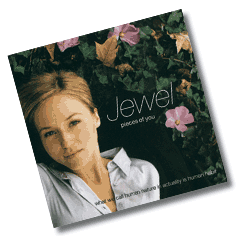
If anyone should know about the differences between American and British pop music, it's Peter Collins. Collins has been a top-flight producer both in this country, where he had massive '80s hits with Nik Kershaw, Musical Youth, Tracey Ullman, Alvin Stardust and Gary Moore, and in the USA. Since moving across the Atlantic in 1985, he's produced some of the biggest names in rock, including Rush, Queensryche, Bon Jovi and Alice Cooper, and has also worked extensively with more acoustic-based acts such as Nanci Griffith, Jewel, Shawn Mullins and the Indigo Girls. The number of Collins-produced albums sold, and the amount of repeat work he gets, suggest that he's struck a chord with both the public and the artists he's produced, whether in Neasden or Nashville.
Organic Production
 It's clear that although he's no technophobe, Collins much prefers the organic, human experience of working with a well-drilled live band to production jobs that are entirely based around sequencers, samplers, and endless computer editing — and that America is the place to go if you want to work in this way. "The British are very good at using the machinery to get it right," he says, "but unless it's a techno-type band, I much prefer having the band play than piecing it all together in the studio, by far."
Ironically, perhaps, his early career saw him partnered with a producer who, in many eyes, would come to epitomise the artificial, manufactured approach to pop production: "I started out as a fledgling producer in the '70s and had my first hit in 1979 with Matchbox, who were a rockabilly band. Then I met Pete Waterman, who was working in Rocket Records at the time. He'd signed a band called the Lambrettas, who were a mod band, and he asked me to produce them, and I subsequently had hits with them. Pete Waterman and I joined forces in the early '80s — he managed me — and I had a string of hits.
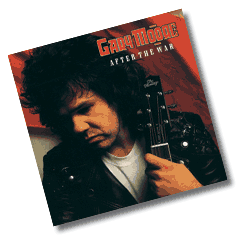 "One of the reasons we parted company in the mid-'80s was that I was getting more into rock music, more sort of album-orientated music, and he was into the dance-pop that he does extremely well. Iconcentrated on my area, and he concentrated on his. And he became one of the richest men in England! My wife's from Mississippi, and my career happened to take off in America about the same time as we moved here. I produced a track for Gary Moore, who was opening up for Rush in 1984-85, and as a result of that I got a gig with Rush. I did the Power Windows album, and I've done three more since then. I've been in the States 14 years, and in Nashville for eight years [see 'Nashville Skyline' box].
"I found that America was far less microscopic than England. I'd come from the '80s, where the techno age was born, with Frankie Goes To Hollywood and Trevor Horn-style production, where all the digital reverbs and drum machines were coming in, the PPG Wave, the Fairlights and Synclaviers. All that was coming in and we were using it in England, a lot. But when I got to America, that stuff wasn't being used as much, and I found here there's a much greater love for analogue and valve technology. Americans are particularly into analogue warmth, although with the preponderance of Pro Tools, a lot of that is changing. The analogue sound is being somewhat compromised by the ease of use of Pro Tools. I use it when it's going to be useful to me. If I can have the budget to run
Pro Tools and analogue at the same time, then if I need to go into Pro Tools to move something around, I can do it immediately, and then resend it to analogue there and then, or have the engineer do it immediately after the session, so that we're always caught up — then, I think, it can be a very useful tool. I use a lot of plug-ins, like Auto-Tune and Amp Farm, that sort of thing."
Bass In Different Places
"I found when I came to America that the American sense of bottom end is very different to the English perception of bottom end," says Peter Collins. "The English perception is much tighter, doesn't go as low, not as warm or as fat: it's crunchier, it approaches the mid-range. I think that's pretty much always been the case in British pop and rock music, a different sensibility to bottom end. I've noticed time and time again that British records seem very light to me at the bottom — it's a sweeping generalisation, but Americans notice it as well, and that's why they have so much British stuff remastered in America.
"One reason for the British perception of bottom end may have been Radio One. Because they have so much compression on Radio One, if you've got too much bottom end, that compression would make your record sound quieter over the radio when the record hits their compressors — I'm going back now, because I think Radio One is much more hi-fi than it used to be. In my day, in the early '80s, Radio One was everything — if you weren't on Radio One you could forget it. British stuff, traditionally, has always been very heavily compressed. Americans, until recently, have been a little bit more judicious with the compression."
Pellow Talk
 Clearly, Collins is in his element in the USA. More recently, however, was working in England producing two tracks for Smile, the debut solo album by former Wet Wet Wet singer Marti Pellow. "I was kind of aware of Wet Wet Wet's success, but I was in America at the time," says Collins. "I was sent the stuff and I thought 'He's a great singer, and he's got really good material.' I've moved out of rock recently, into contemporary acoustic music — Jewel, the Indigo Girls, Nanci Griffith — I'm very much into both genres, and both of them came together with Marti. He wants to sound contemporary but does love real players, it's very organic. As a result, we used real players, and for the most part we didn't use a click track — we had guys who could just go out there and play. We try to get it in a band performance, with Marti doing live vocals, some of which we kept.
"Since coming to America I've found it much easier to work that way. In 1979, when I was working with Matchbox, I created a drum loop for them to play to. I was very much into the click-track element then, but I was fortunate enough when I came to America to work with such great players that it wasn't necessary. Sometimes there's a great band that requires absolute precision, like Rush or Queensryche: then, a click track is extremely helpful, because you want it to be absolutely tight, but where the music needs to be looser or more fluid, then the click track can be dispensed with.
"I used Phil Brown, who's a veteran engineer from Basing Street Studios, who worked with Led Zeppelin — his recording technique and miking technique is superb, and is equivalent to any of the veteran Americans. We worked at Chris Difford's studio, down in Rye. It's a very nice studio, I think Elvis Costello owns it, or they have a partnership, and it's a lovely environment. I could have used one of the big commercial studios in town, but I knew Marti would be comfortable there, he's done a lot of work there, it's an informal atmosphere, very relaxed, and the studio works! They have the maintenance people from Ridge Farm, so the maintenance was good. Phil Brown was happy to work there, so it seemed to make sense.
"The Marti Pellow material was recorded purely analogue. We tried out some ideas on Pro Tools, worked out the string arrangements in Pro Tools, but basically it was analogue with analogue slaves. Pro Tools was just used as a rehearsal medium. They actually recorded on a couple of vintage Ampex machines which were so old that the head gap between the record and erase heads was so huge that dropping in was a nightmare! But the high fidelity was very good, I was very pleased with what we were getting on tape."
The Metal Zone
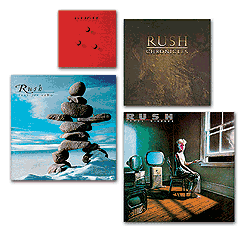
 Although he's had considerable success with singer-songwriters such as Pellow, Griffith and Jewel, Peter Collins' track record is such that he is perhaps most in demand as a producer of rock music. His American career was built on the highly technical, sophisticated prog-rock nouveau of Rush and Queensryche, and despite his enthusiasm for working with 'real musicians', it was for his expertise in the technological side of production that Rush picked him: "When I first worked with them, they wanted to be involved with the technological breakthroughs that were happening in England at the time, the Trevor Horn sound that he'd achieved with Yes and Frankie and those sort of bands. So I was able to help them move into that area, and be a foil, a sounding-board for Neil Peart on the drums and push him into different areas. When I first got involved, Alex Lifeson had this horrible mismatched guitar pedalboard, which needed a lot of work — or, rather, lot of work had been done to it, and that was the problem. It was just a question of coming in fresh, and getting them to change some things they'd always done. If there's somebody to say to them 'Guys, I think that section could be better, it could be more exciting, or it could be more laid-back,' or whatever, they like that. They like to be challenged.
"In the case of Rush, they strive to be better with every record, they strive to progress with every record. AC/DC strive to sound exactly as they did on their first record on their 14th record, and that's their strength, but Rush want to be different on every record and to progress. As human beings, that's the way they are, they're very interesting people, and they need continual intellectual and musical stimulation."
Since then, Collins has also guided glam metal acts like Alice Cooper and Bon Jovi to new hits, and the current explosion of new 'punk', sports metal, skatecore and rap/metal crossover bands is keeping him busier than ever: "This past year I've been working with a band called Ultraspank, from Santa Barbara, California, who are kind of in the Limp Bizkit area, and a band called Mayfield Four from Washington — both those acts are on Epic — and Systematic, who are signed to Lars Ulrich's [Metallica's drummer] label."
 Modern metal bands represent a stiff challenge for the producer and engineer. The impact of this kind of music is very dependent on freshness and energetic performance combined with heavily distorted guitars, but also relies a great deal on precision and technical accuracy. "Those bands are very concerned about how their records sound sonically," remarks Collins. "They're very much into the way the drums and the bass sound, and in the case of Systematic, they wanted to use Pro Tools just as a tool to give a certain unreal quality to the decays of guitars. A guitar has a natural decay, and in Pro Tools you can sometimes chop that decay to quite an exciting effect. But generally speaking they try to avoid Pro Tools unless they have to use it to achieve what they perceive to be a contemporary sound. A lot of that is really tightening things up, making sure that the kick drum is absolutely on it.
"For the Limp Bizkit type of stuff, a kick drum with a lot of click in it is quite desirable, a lot of attack. Of course, all the Korn-type bands detune at least a tone down, so the guitars are flapping away in the bass area anyway — it's got to be really carefully planned sonically. They usually have a guitar tech on hand all the time. The tuning is always very difficult. You spend a lot of time in rehearsal getting the arrangements agreed and played in, so that when they go in the studio they can play it very quickly. Also, good headphone balances are very important. I always have eight-channel mixers for each musician, so that he can get his own headphone balance. If they're well-rehearsed, if everything works in the studio, and they can get their headphones the way they want them, they can usually nail it within three or four takes at most."
Nashville Skyline
Although his work is mainly in rock music and contemporary AOR, Peter Collins is based in America's country music capital, Nashville. "I'm not actually involved in country music, I'm outside that circle, I just use the facilities here," he explains. "The whole setup here is to support the country music industry. But, that being so, there are a lot of people here from Los Angeles, people here from the rock world, who are taking advantage of all the facilities that are here in Nashville. There are excellent studios, excellent rental equipment — I mean, if you're working in Atlanta, for example, they have to bring in equipment from Nashville, if you're working in Memphis they've got to bring in equipment from Nashville, so it's a great recording centre. And of course you've got superb musicians here, and everywhere you go there's a songwriter. In LA, every waitress is an aspiring actress — well, every waitress here is an aspiring songwriter. For a producer, it's a wonderful environment."
Agent Of Freedom
Whether he's working with an ultra-heavy thrash metal outfit or a sensitive singer-songwriter, Collins' approach to production seems to be based above all around respecting the artists and treating them as intelligent professionals. He's not in the business of trying to shoehorn an artist's talents into his own preconceived production masterplan, or of remixing and remodelling their songs beyond recognition; nor does he set out to create ready-made backing tracks for manufactured pop stars.
"My job is to get what they want onto tape, and to best represent what they do," he concludes. "I'm sort of an agent provocateur: if I hear weaknesses or things I think could be better, I'll try to provoke them to come up with some ideas which I think would be satisfactory. My job is to try to identify what their vision is, and help them achieve it."