

 Cool: "We cut the samples up a lot and flip them around and make it sound crazy."
Miami is now a hip-hop centre to rival New York and LA, and Cool & Dre are two of its most active beatmakers, songwriters and producers.
High school has been the starting point for countless bands over the last 50 years, as it was for Marcello 'Cool' Valenzano and Andre 'Dre' Lyon, who met when they sang together in the honours chorus at North Miami Senior High a decade or so ago. "You know when you meet somebody you just know, y'know?" says Cool, in a verbal shorthand that explains the chemistry between he and Dre. This is a chemistry that has resulted in huge hits for Fat Joe and Ja Rule, and beats, songs and tracks for artists including Diddy, Trick Daddy, Trina, Buju Banton, Juvenile and Killer Mike. They have also had soundtrack cuts in Chasing Papi, All About The Benjamins and Bad Boys II, and their own custom label deal with Jive Records, dubbed Epidemic Records, which is launching Miami rappers Dirtbag and Fat Joe Terror Squad alumnus Tony Sunshine.
Miami is rap's Third Coast, where the explicit rawness of Trick & Trina records mingles with Latino silkiness. In the legendary wars between New York's and LA's Urban gangstas, Miami came on quietly and then exploded. Rappers and producers including Timbaland have moved there en masse in the last few years and Cool & Dre, natives to Miami, have watched the migration with satisfaction. "Miami is the place you go to kick back while you work — go in the ocean, go to the clubs, go to the studio — all the same vibe," says Dre, a New Yorker of Jamaican descent who moved to Miami when he was six.
"We work a lot outside of Miami — New York, LA and Atlanta — but we do most of it right here," says Cool, originally from Venezuela. "It's the vibe, it's the weather. Even with the damn hurricanes, it's paradise. People feel creative. We go to Circle House [Studios] and you got a pool and a cabana. Hit Factory/Criteria is more corporate but incredibly professional. You want the A&R guys there. Shit gets done there. I don't think there really is a 'Miami way' of producing records, but it brings out creativity in different people in different ways. It's a place to hang out and bang out records."
Getting Out There
"Bang out" is right. Like the other production teams in hip-hop, including the Neptunes, with whom C&D have often been compared, they are prolific, as the number of artists they've worked with attests to. However, tracks have a funny way of getting around, especially the one that gave the duo their first big hit. Ja Rule's 'New York' typifies C&D's sound, says Cool. "That beat was our sound, but what really made it different was that no one had put together those synths into a hip-hop track before," he says. The synths in question included Korg Trinity and Yamaha Motif ES7 keyboards and Novation Supernova and Roland JV880 and XV5080 sound modules, controlled from a Kurzweil PC88. "The sound worked in the street and in the clubs. It's a big sound, not just a beat.
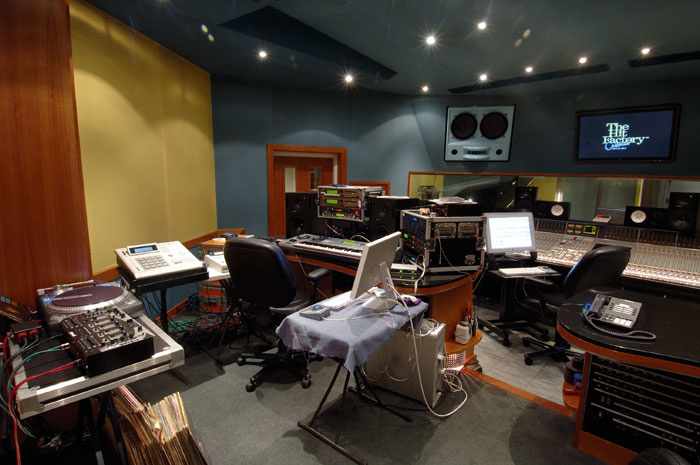 A writing area set up in Studio E at the Hit Factory for Cool & Dre, with turntables, MPC2000 and their favourite synths."We were working with Jadakiss and Fat Joe was in the studios and heard it and said 'I got to have that beat.' So we said Jada, we love you, but Joe needs this record. But Joe takes forever to record. Finally we get into the album and Joe's like 'I'm not feeling this any more,' and we're like 'Damn, you made us take that from Jada.' So then Ja [Rule] hollers at us and we've got this beat still and Ja hears it and loves it. But it's still a beat; we've got the hook but not the song yet. Irv Gotti hears it and says the same thing. And I start singing '100 guns, 100 clips...' and Irv and Ja go crazy for it. The funny thing is, when we made the record, it ended up having Fat Joe and Jadakiss singing on it as guests. So everyone was all over that beat."
The hook in 'New York' hook is a faceful of synth pads, which overturned rap orthodoxy like electric guitars did in the late 1990s: an instrument at the time considered so off-genre that it was poised to make an impact the moment someone added them in a certain way. "The record came on people like 'What the hell was that?'" says Cool. "But that combination of hook and beat is the way we produce — no set formula, experiment with sounds and beats, and see what works with the song."
Keeping Notes
Both producers have home studios, with the one in the guest room at Dre's house being the more sophisticated of the two. It's equipped with a Pro Tools HD system, though Cool says they also like Propellerhead's Reason and Apple's Logic 7, even Garageband. And as much as they enjoy messing with synth sounds, they prefer the virtual instrument route to collecting vintage keys. "I prefer that because then it's all there in front of you," says Cool, though he has a soft spot for their introduction to synthesis. "The Ensoniq ASR19 was our first synth. We were down at Ace Music and the guy pressed one button and the whole song played and that really set us off. We knew we had to learn to produce records."
Early production attempts taught them about the components of sounds. "One day we went to a studio to mix some stuff and the engineer said 'Those drums sound real weak. You can't just take the sounds as they are — you have to create them.'" They've been ardent samplers ever since, building their library into a 20GB mass using mostly the classic Akai MPC2000. "We cut the samples up a lot and flip them around and make it sound crazy," says Cool, who has been known to sample directly from his iPod. "It's noisy, but sometimes noise is a big part of a sound, like on a kick drum. We'll stack several kick drums together to create one big kick, but still keep it distinct from other elements in the low end. We put every sound in there for a reason." Sometimes they'll stack entire tracks: the groove on The Game and 50 Cent's 'Hate It Or Love It' used five separate samples from the Fabulous Tramps' 'Rubberband Man' that they had chopped and rearranged. (And properly cleared; hip-hop records now have more paperwork than the military.)
That huge sample library is kept on their Pro Tools drive, readily accessible for songwriting. "We used to use an Iomega Zip drive to store stuff, but now we'll dump beats right to Pro Tools and get rid of it on the drum machine. The ideas are all there at our fingertips." Cool & Dre are meticulous note-takers, naming each beat and logging it by date, then backing up to CD-R and cataloguing them by month. "We do a lot of original music, but our big hits have a lot of samples so it makes it seem as if we rely on samples," says Dre.
One thing that sets Cool & Dre apart from other hip-hop producers is an affinity for live musicians. "That's a big part of our sound," says Cool. "We have a group of musicians in Miami who are like family and we use them all the time in the studio. We work with a guitar player and do 30 takes and we'll keep all of them and then turn them into samples." However, live drums tend to be overdubs, adjunct to sequenced samples. "We'll have the drummer come in and do a fill over the tracks, or just play an open hi-hat, which is the hardest drum sound to get good as a sample. We'll have them play the whole track through and take the best four bars and loop them. Live players give a track that good dirt."
Robert Brisbane, a friend of the producers for the last eight years and their main recording engineer for the last five, says he counts on players like guitarist Dave Cabrera to walk into the studio with much of their sound ready-made with stomp boxes, and also likes to tap a DI through an Avalon mic pre and into the console. But he'll also experiment with microphones on amps. "One of the ways I get good results is to put a Shure SM7 close in on the speaker to capture the attack, and then put a U87 somewhere in the back of an open cabinet to get the amp's own ambience."
Keeping Track Of The Tracks
As well as looking after their beats and archives, Cool & Dre are scrupulous about keeping track of where their tracks are in the studio. The 'leaked' mix is becoming either a problem or a guerilla marketing tool; C&D prefer that it remain the latter, particularly since they are now label moguls themselves. "The whole download game has to do with control of the material, and to control it you have to keep track of it," says Cool. "Usually, you don't want leaks on a high-profile artist, though sometimes it can also be a good thing, if you're in control of it. A download about a week before the album release date can be a good time to do it on purpose. 'New York' got leaked and it was at a thousand spins before the album came out. But when we're in the studio, we try not to give copies of anything to anyone, including the artist. Sometimes the clients are the ones who leak it the worst, leaving it in a car or someone's house or through a 'friend'. At the end of each session, we back up to DVD and clean off the hard drive before we leave. You gotta control the track."
Mic Picks & Vocals
Just as C&D tend to stick with technical platforms that they are familiar with, like drum machines, their microphones tend to be drawn from a short list of favourites. "We stick to the standards — the [Neumann] U87, the [AKG] C12, and the Sony C800," says Cool. "The 800 has a nice high end to it, so it's good for female vocals and on a lot of R&B singers, like Remy Martin and Christina Milian, and helps the vocal ride above the track. The U87 has a lot of thickness — we used that on Trina's vocals and it sounds great."
Brisbane says he likes to use a Neve 1073 or an Avalon VT737 mic pre, and gently touch up the vocal chain into a Urei LA2A, Neve or UA 1176 compressor. "If those aren't available, I'll go through an SSL channel and use those dynamics and EQ," he says. "But I'd prefer to start out with what gives me a great sound and not have to add EQ or other processing until later, if at all. The more you add, the more noise you add." Noise also comes in the form of vocals recorded by the artists themselves and emailed on MP3 files. "Then you have to use EQ to undo what they do to the tracks, which is annoying," he adds. Brisbane will often combine outboard effects with plug-ins, such as using an 1176 and a Bomb Factory BF2A compressor. "I love the convenience of pulling up a plug-in on a screen," he says, "but analogue compression gives a track some life when you're recording digitally." And like C&D, Brisbane tends to keep a limited selection of processors set to go in preconfigured ways when recording, ready to capture what's happening, and adds any processing later on. "Hip-hop sessions are impulsive," he says. "Not like a rock record where you spend a lot of time on the sounds before you hit Record."
Vocal sessions are straightforward affairs, and one of the aspects of record-making that Cool & Dre are very hands-on about (mixes tend to go to some of the heavyweights, including Serban Ghenea and Manny Marroquin). "We usually know which mic is going to work best, but sometimes we'll set up a few, and decide as the artists does a few passes to warm up," says Cool. But while they do like to have a complete vocal performance on a track, they're not at all averse to flying in the best bits of the repeating lines such as choruses. "This is the fly-in capital of the world," he laughs. "It's rare when you can find someone who can nail all six or seven harmony parts. Even when we were working on a DA88 in the beginning, after a certain point we just sampled it and flew the part in and then stacked them up."
 Cool & Dre with Christina Milian.
Talking Perfection
Dre tends to be psychologist half of C&D; it's he who sets the mood for vocal sessions. "I'm an artist, too, and I know how it feels to be trapped in a vocal booth for two hours," he says. "Pro Tools has made the process of vocals very clinical, and vocals are the last really human part of the production process, especially in hip-hop, which is so machine-driven. I don't look for perfection — Pro Tools can give me that later. I try to get the feel of the song from the vocalist. I try to make the singer forget he or she is in the studio, because it's too easy to forget we're making music, not just a product. One of the things I do is tell the singer to talk some of the lines at certain points. When Alicia Keys sings 'You Don't Know My Name' there's a line in there that she talks — 'Let me call that boy' — and it's at that moment that you hear Alicia the person, not Alicia the singer. Michael Jackson used to talk a lot of his lines. It really gets the feel across on a song."
The essence of a producer isn't so much a matter of technical chops as it is an ability to relate to an artist. Cool & Dre have a touch when it comes to that. Tony Sunshine, one of Epidemic's first signings, says in a published interview of his production team: "Cool & Dre are like my brothers... I was signed to Loud Records, and when they folded, it was hard for me to get signed to another label because of politics and being Hispanic. Cool & Dre seen my struggle, and they've always been there for me. They had their own situation going on at Jive, and they felt that they had to come back and get the kid. They helped put me on the right track. When they got their little thing going, they... came back for me when no one else believed that I could do it."
Cool is appreciative of the sentiment, but says that it's what a producer should do. "A life story is important and we take that into consideration. You do a lot of records and often you don't get a chance to learn about people. But you figure out pretty quick when the chemistry is there. We did a couple of tracks with Sunshine and that turned into the whole album."
If the technical end of hip-hop sometimes seems less than complex, the politics can make up for it. They are generous in crediting influences including Sleepy Brown of Outkast and Goodie Mob producers Organized Noize, whose falsetto Dre can emulate precisely, and Cool cites Pharrell Williams of the Neptunes as another vocalist/producer who can cross hip-hop and R&B well. But the critics' comparisons of the two producer teams might have raised some hackles. "We dealt with that one night at a club where we ran into the Neptunes," Cool recalls. "We told them that that wasn't us saying that we were the 'new Neptunes', that we were the new duo in town. It was the magazines. We told them we were big fans of theirs. We said 'We respect y'all.' Without that, there would have been some tension. The Neptunes, they had a huge run. Most producers never get more than two, three hit records if they're lucky. But that's why we admire the Neptunes: they stay up there. That's what we plan to do."