

 The drums were received as a stereo file, with reverb already added, so there was little room for manoeuvre. However, Noveltech's Character plug-in was able to impart a little extra punch.
When you're aiming for an in-your-face rock-epic, the last thing you want is a muddy mix! Krys Baxter's Afterglow gets the Mix Rescue treatment...
Krys Baxter is currently studying sound production at Stow College in Glasgow, and he recorded 'Afterglow' during his first year there, using Cubase and some fairly basic hardware. He told us that he'd encountered a lot of problems with hiss and also had trouble balancing the mix, so was open to any advice we could offer.
On listening, I felt that he'd managed to invest his original mix with a lot of energy. However, the end result was also very congested, especially in the lower-mid range.
Starting Point
Although I had no trouble importing the audio WAV files that Krys sent me, some of these had been bounced down at a very low level. In fact, in some cases the level was so low that the waveform display looked empty until I normalised the files! As luck would have it, the most extreme normalisation was necessary on tracks that sat fairly well back in the mix, so quality loss wasn't such a serious issue as it might have been.
Where possible, Krys had provided the tracks 'dry' (that is, without any processing), although his DI'd acoustic guitar track sounded compressed to my ears, so I suspect he had compressed this as he recorded it.
The drum part sounded as though it was generated using very nice sampled drums, but it came ready-mixed as a single stereo track and it also had reverb added, which limited my mixing options. The drums later turned out to be Pro Sessions files that had been cut and pasted to fit the arrangement; the room ambience is recorded along with the kits and so couldn't be removed.
With the exception of the acoustic guitar, which had been both miked and DI'd, the remaining guitars and bass guitar were DI'd clean — even the heavy rock solo parts — so some amp modelling was needed to create the necessary sounds. Of course, if you can't get the right sound using plug-ins, re-amping is also an option: all you need is an audio interface with a spare input and output so that you can route the guitar track to a mic'd-up guitar amplifier, then record what the mic picks up to a new track.
Other than guitars and drums, there was a single lead vocal part, an organ track with rotary speaker effect already applied, and a very dense, choir-like synth pad. In all, there were 14 tracks, which included both the DI'd and miked version of the acoustic guitar part, the three different lead guitar parts playing throughout the solo towards the end of the song, and a few electric guitar chordal and picked parts.
Problems I identified right away included noise on the bass guitar track (that may, in part, have been a result of the normalisation process) and some audible noise on other guitar parts. The lead vocal also sounded quite rough in isolation, not because of the singing, but because it sounded very much as though it had been recorded using a hand-held dynamic mic that was on the verge of popping most of the time. Krys later emailed me and said that that was exactly how he'd recorded the vocals, using his SM58. Looking at the waveform display, it initially seemed that the louder sections of the vocal had already been compressed or limited quite extensively, but closer examination revealed this to be clipping, which was probably due to overcooking the recording levels. In isolation this was clearly audible, but I hoped that by the time I'd balanced the mic it would be less obvious.
Drums & Bass
Because this track had originally sounded very congested in Krys' mix, I decided to build it up from scratch to identify the problem, and where better to start than the bass and drums? The drum sound was already very good and I couldn't alter the reverb that had already been added, so I used Noveltech's Character plug-in on the Powercore platform to give it a little more punch and definition, which it did beautifully.
 The DI'd bass was run through IK Multimedia's Ampeg SVT bass modelling plug-in, to give an old-school rock bass sound with both depth and definition.I initially tried Character on the bass guitar part too, but it didn't hide the DI'd nature of the sound. It also enhanced the already excessive background noise, so I decided instead to use the IK Multimedia Ampeg SVT bass modelling plug-in, as the amp would add realism and depth to the sound, while the speaker emulator would filter out some of the high-end noise. This actually worked very well, though I had to make significant adjustments to the controls once the rest of the mix was added, because what sounded great in isolation didn't sit quite so comfortably with the other instruments. What I ended up with was pretty much an old-school rock bass sound, with both depth and definition.
Acoustic Guitar
I decided that, before adding the vocals, the other important foundation part was the acoustic guitar as this played throughout the song and formed a key part of the rhythmic element. After auditioning both the mic'd and DI'd versions, it became clear that neither was ideal, but the mic'd version turned out to be the least useful, as it sounded somewhat phasey and disembodied. I later found out that Krys had recorded this using his SM58, pointing in the general direction of the soundhole, which explains why it didn't sound too hot — normally you'd use a capacitor mic and point it so as to avoid the soundhole. As expected, the DI'd version had more clarity, but it sounded a bit scratchy. Adding the two together just sounded awful, so I ditched the mic'd version and worked on the DI track alone. As the acoustic guitar part was part of the overall rhythm track and not a solo performance, I ended up filtering out quite a lot of low end, using a low-cut EQ. I also added some high 'air' EQ boost, so that, when mixed at an appropriate level, the acoustic guitar part blended nicely with the hi-hat, adding a chordal structure but without taking up too much spectrum space. I was able to sit the vocal over this basic backing track and get an acceptable sound, so now all I had to do was fit in the other parts without producing sonic soup.
Noise-free Mixes
Krys told me that he was concerned about the amount of noise he was experiencing when recording. The best way to tackle this is to optimise the gain structure at every point in the signal chain, and to record at healthy levels while at the same time avoiding clipping. Peaks of between -12 and -6dB are fine, but you also need be aware of noise in the source sound, especially when recording electric guitars. These can pick up all kinds of hum and interference, especially if you are using a model with single-coil pickups. Playing guitars close to CRT-type computer monitors can also introduce interference, but fortunately we don't see many of these used in studios any more. Adding gain to create overdrive effects tends to bring up the noise, and though some background noise during heavy guitar sections is generally accepted as part of the 'rock' sound, you should try to keep it as low as you can. Avoid lighting dimmers and move away from gear containing transformers, as these tend to radiate hum.
When mixing, all ostensibly silent sections of tracks should be cut out or muted, to stop noise or spill contributing to the clutter. Where there are pauses between notes or chords, gating can be used to keep the spaces silent. I trimmed most of the tracks in Chris' mix to achieve this. If using a gate, you should always place the gate before reverb or delay in the chain — otherwise you'll lose the decay tail of the effect, which will sound unpleasant. To avoid vocal popping, a mesh pop-shield should ideally always be used between the singer and the microphone, even if you're using a stage-type dynamic model. Modern recording equipment is so quiet and has such a wide dynamic range that avoiding noise is child's play compared to doing the same with analogue tape!
Lead Guitar
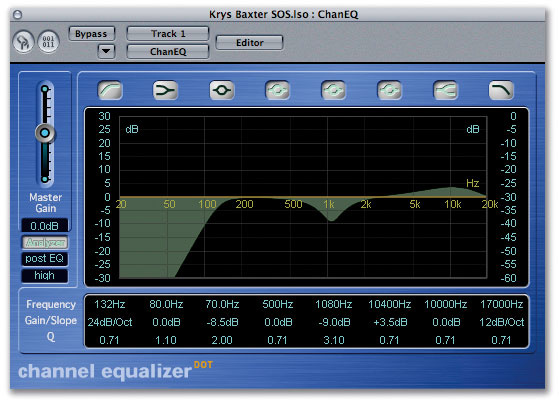 The low frequencies were filtered out of the electro-acoustic guitar's DI signal and slight tweaks were made further up the spectrum, to make it sit more comfortably in the mix.Fortunately, the lead guitar part comes in briefly at the introduction to the song and then stays out of the way until the solo, a little past halfway through. Listening to Krys' mix showed that he envisioned this as a big rock part. He'd already comped up what he felt were the best phrases, so I took the cleanly recorded DI'd guitar and fed it through the Line 6 Gearbox plug-in, choosing a fairly modern British overdrive amplifier and inserting a Tube Screamer emulation stomp box before it. Some tape-style echo, courtesy of Logic 's own plug-ins, completed the 'stadium rock' effect. For this, I used two mono tape delays with different delay times and panned them left and right. I set the delay times to approximately 400 and 600ms and rolled off the delays above 3kHz to soften them. Full-bandwidth delays can really get in the way of the original so, by rolling off some high end from the delays, you can use more without running into balance problems. I did notice some spill from a rhythm acoustic guitar part that seemed to swell into existence during pauses in the solo, so I'm guessing Krys had also applied some compression here. Where the lead vocal comes in again during the guitar solo, I simply used level automation to drop the solo by a few dBs, to make more room for the vocal.
Vocals
 A UAD Plate 140 reverb and two tape delays (one panned left, one right) were set up as send effects.
 Line 6 are famous for their guitar modelling gadgets, and the Gearbox plug-in was used on the guitars. With EQ and optical compressor models, the plug-in even worked nicely on the vocals.The lead vocal was pitched fairly well, though further improvement was possible. I decided to work on this using Melodyne, which confirmed that the vocal did drift a little from the intended pitch centre, but it was easy enough to correct. To make the performance feel more controlled, I used Melodyne 's manual facilities to reduce some of the pitch modulation. There was nothing I could do about the bumping noises caused by handling noise, or near-popping due to breath but, once mixed into the track, these became less noticeable. There were also a few odd clicks and glitches but, again, these were largely hidden by the backing track. As Krys was after a stadium rock effect, I took the opportunity to try out a vocal preamp in the Gearbox plug-in. I applied relatively little EQ but drove the UK 'Vintage model' EQ quite hard to soften the sound, and used it to add a bit of air at the top end too. I also engaged a 100ms delay, set to around 30 percent wet, to give a slight double-tracked feel. I treated the vocals to a little compression (courtesy of the Gearbox optical compressor emulation), to tame the louder sections, but I also used mix automation to bring up some of the quieter sections, so that I didn't have to be too heavy-handed with the compression. Universal Audio's Plate 140 reverb plate plug-in provided the necessary sense of space, but I also fed a little of the vocals to the two mellow-sounding tape delays I had set up for the guitar solo.
Other Guitars
I then turned my attention to the other guitar parts. For the two remaining solo parts, I used Logic 's Guitar Amp Pro plug-in to produce a suitably overdriven sound, and added more of the tape echo to these parts before panning them hard left and right. By reducing their level, so that they formed a distant background for the main lead part, rather than trying to compete with it, I managed at the same time to keep the exciting sound and reduce the muddiness.
 Getting levels right is what mixing is all about, and using level automation to bring different parts up or down in the mix will help you make space to let the key elements stand out.That left several more rhythmic guitar parts to deal with, the first of which was labelled 'crunch guitar,' though, again, it had been recorded clean, leaving me with plenty of processing options. This was a simple E-G-A chordal part that occurred four times throughout the song. It soon became apparent that there were some tuning issues, as well as some audible noise, so I began by gating the part to try to eliminate the noise during the pauses. I also tried the Guitar Amp Pro plug-in to create a British rock sound, but I then decided to replace the part — the tuning problem was still very audible to me, and the level of noise limited the amount of overdrive I could add.
The replacement part was done very quickly. I used my daughter's Telecaster for this (both because it was to hand and because I'd put new strings on it only a couple of days previously), plugged into my little Vox AD30VT modelling guitar amp, with a sound designed to emulate an overdriven Marshall amplifier. I put the nearest available dynamic mic a few inches from the amp's speaker grille and recorded with the track playing loudly over the monitors. As the mic was so close to the grille, the amount of spill picked up from the studio monitors was relatively small. Once the track was playing back in the song, I used Guitar Amp Pro, both to dirty it up a little more, and to adjust the tonal balance. Other than the tuning issues, I think that a large part of Krys' problem was that, although he'd played the part correctly, he didn't really dig into the guitar — and no matter how much amp emulation I applied afterwards, the part didn't come over as aggressive enough. When I replaced the part, I used partial chords, sometimes containing as few as two notes. When you're layering multiple guitar parts, this is an effective way of stopping the whole thing from sounding too messy. Another tactic is to play rhythmically with spaces between the chords, which, to his credit, Krys had done throughout the song.
 Logic's Guitar Amp Pro was used extensively in this mix, noticeably on the guitars, synths and the B3 Hammond organ part. It's great for adding the sort of grit and dirt you need in a powerful rock track.A second chordal guitar part, occurring just three times throughout the song, played a much more important supporting role. I treated this with Guitar Amp Pro (to give it a warm British '70s rock sound) and added a little reverb, via the Plate 140 that I'd set up on aux send 1. The part I added sat very much behind this and blended well with the organ sound.
In parts of the song where these guitar tracks weren't playing, Krys had added a further two guitar parts, entitled 'Phased Pick' and 'Phased Strum,' again provided clean for me to reprocess. The pick part was a simple arpeggio in the style of 'House of the Rising Sun,' so I simply rolled off a lot of the low end, to thin it out, and added a slow phaser plug-in. For the strummed part, I used a slow rotary speaker plug-in, to give a more watery phase effect, and panned these two parts left and right to create some width. I kept these parts fairly low in the mix, as they otherwise tended to get in the way.
That just left the keyboard parts. I found that the choral pad part sat far more comfortably if I applied a fairly heavy roll-off below 500Hz (430Hz, 24dB/octave). Though this might sound pretty severe, it meant that it took up far less space in the mix. With everything else added back in, it sounded just right , leaving a sense of breathy vocals but without all that mid-range mud below it. I then used level automation to bring this part up beneath the chorus sections, and to drop it to a relatively low level during verses. I also thinned out the low end of the organ part, after roughening it up a bit. First I tried using Logic 's Overdrive plug-in, as the original version sounded rather too polite for rock, but I got a more convincing sound by feeding it through another instance of the Guitar Amp Pro plug-in, with a bit of dirt dialled in via the gain control.
Tidying Up
The very end of the song sounded rather messy and unplanned, so I did a little editing to create a more positive last chord on which the song could end more conclusively, and I shortened the pad keyboard parts to match.
After a little careful balancing, the track sounded pretty strong, well-balanced, and far less messy. Though the quality of some of the original recorded parts (and, consequently, the amount of normalisation needed to get some tracks up to the right level) set limits on what could be achieved, the general feel of a song is far more important than basic technical quality. For all its limitations, I felt the track now sounded something much closer to Krys' original intentions. It just remained to use PSP's Vintage Warmer to add a little more density to the finished mix. This also handled the limiting — which was used sparingly, so as not to squash the life out of the mix.
Remix Reactions: What Krys Said
"I recorded the whole song into my laptop using Cubase SX3. The only mic I used was an SM57, which I used for the vocals as well. I couldn't find my pop shield and always meant to go back and re-record the vocals — and I'm afraid to say I did just hold the mic in my hand (sorry!). I also used the SM57 for recording the acoustic guitar, tending to put it on the dining room table along with everything else, and then move the soundhole as close as I could get comfortably!
"My soundcard is an M-Audio Fastrack, which has been really good so far for me. This whole song was recorded when I was doing my first year, and I think I got a little plug-in crazy. I was trying to create a massive stadium rock song, which was the reason for the big guitar solo. I have to admit that, at the time, I was very proud of the automation I had applied, but I always felt that this big part of the song, that was supposed to set it apart from the usual run-of-the mill rock song, actually let it down. I felt like I'd overcrowded the song and over-compressed it. My EQ'ing was very crude as well, but every time I went back to try to fix it I seemed to get a mental block. I had lost all the original power of the song, yet I also felt that all the parts were necessary. Listening to it now, I can see that I had tried to push too many parts together, when really I should have been allowing each part its place in the song.
"I recorded the guitarist doing the solo on a loop and then just used the pieces I thought worked best. In all, there were originally around 20 tracks of guitar solo, which I cut down to just three or four. The Hammond organ sound was a big part of creating a large sound and I played around with sounds on the Native Instruments B4 plug-in for days, eventually settling for one of the presets ('Small Faces', I think). Over a period of months I added more guitar parts, some flanged and some picked, just trying to lift it a little, but all I succeeded in doing was bogging it down more and more, which is why I wanted to see if it could be rescued.
"I just listened to your final mix and I'm absolutely gobsmacked at the quality you've injected into the vocals. The whole thing has a life of its own now. At first, I thought the effect on the vocal might have been too strong, but as the rest of the song starts to move it really lifts the vocals out. I like the subtle melodic changes resulting from the pitch-fixing, which moves things away from the formulaic melody I had, and I'll be applying this to the live version. The acoustic guitar has more definition. I was listening to the vocals when I suddenly realised I could hear the guitar clearly, where previously I seemed to lose it where the song starts to kick up a gear. It is only in retrospect that I realise the importance of good-quality recordings. Thank you very much for taking the time to work on this song for me. I look forward to poring over all the details in the article."
Hear The Difference
It's all very well reading about the changes Paul made to the mix, but there's no substitute for listening! You can hear MP3 'before and after' clips of the various tracks and the full mix on the SOS web site at www.soundonsound.com/sos/mar07/mixrescue/.

Send Us Your Tracks!
If you're interested in having your track rescued, send an email with an MP3 of your mix to mixrescue@soundonsound.com. Although we can't guarantee to rescue every mix we get sent (there's only so much space in the magazine!), we'll listen to each one. When sending in files for us to remix, you'll always retain the highest quality if the individual tracks are recorded so that they peak between -12dB and 0dB. At the same time be careful to avoid clipping at all costs. It is also preferable to start a mix without any processing on any of the tracks — we can always add processing, but it is virtually impossible to remove it!