

 Karlheinz Stockhausen lectures on Kontakte, one of his most significant works, at the well–known summer school in Darmstadt, Germany, 1961.
Few individuals have influenced the development of electronic music as much as Karlheinz Stockhausen, who died last December. We look back at his life and celebrate his many achievements.
As you glance over Peter Blake’s iconic cover artwork for Sergeant Pepper’s Lonely Hearts Club Band, take a closer look at the face fifth from the left on the top row. It is the face of Karlheinz Stockhausen, the German composer of over 350 pieces of classical music, in his mid–30s in this photo, who died on December 5th at the age of 79.
For over 50 years, Stockhausen was a giant of the classical music world: iconoclastic, innovative, and often controversial. He was renowned for his refusal to accept conventional forms and boundaries, and his music was often conceived in outlandishly large terms — his seven–day–long opera Licht, 26 years in the making, will finally receive its first performance in 2008. But his influence and admirers extend far beyond the frontiers of classical music, and artists as diverse as Björk, the Beatles, Kraftwerk, Pink Floyd, Brian Eno, Frank Zappa, David Bowie and Miles Davis have all noted or paid tribute to Stockhausen’s influence on their work.
Post–African Repetitions
At first, this might seem strange; after all, Stockhausen was a fastidious critic of popular music, complaining of its reliance on repetition and consequent predictability. In a memorable exchange published in The Wire in 1995, he recommended that Aphex Twin (aka Richard James) listen to more of his music “because he would then immediately stop with all these post–African repetitions”. Richard James retorted that Stockhausen should listen to more Aphex Twin; “then he’d stop making abstract random patterns you can’t dance to”.
So how did Stockhausen, whose own music could ostensibly not be further from most popular music in its sensibility and scope, end up being admired by popular musicians around the globe — not to mention having a spot on the Sergeant Pepper album cover alongside such pop culture icons as Marilyn Monroe, Marlon Brando and Bob Dylan?
 The answer lies in his prodigious output of electronic music. Throughout the course of his 50–year composing career, Stockhausen produced over 140 works employing electronics in some capacity, and many of those works (particularly those from the ’50s and ’60s) played a pivotal role in anticipating and helping to form what might be described as the grammar of electronic music. He was among the first to employ techniques such as sampling, directional sound, the blending of live and electronic performance, the complex analysis of acoustic sounds and the mimicking of their characteristics in electronic music, and much else besides. In the days when electronic music was largely uncharted territory, Stockhausen was one of its boldest and most influential pioneers.
The Art Of The State
To understand his impact, a little context might be helpful. Although popular music has largely led the way in producing innovative electronic music techniques and developments over the last 30 years or so, it wasn’t always this way. Before the advent of commercial synthesizers, the expense of the equipment required for creating electronic music (not to mention the space needed to accommodate it) was so prohibitive that it largely confined experimentation to universities and state broadcasters — institutions which tended to patronise classical composers. At that stage, the union of electronic music, then based on tape recording techniques, and popular music, then based very much around live performance, seemed to be a far–fetched idea.
Therefore, in the postwar period, Europe’s most technically advanced facilities were often run by state broadcasters: the WDR Electronic Studio in Germany, built in 1951, hosted many of Europe’s electronic composers in the ’50s and ’60s. Later, the BBC’s Radiophonic Workshop, established in London in 1958, would lead the way in British electronic music. In the US, meanwhile, the world’s first programmable electronic music synthesizer — the room–sized RCA Mark II — was built at Columbia University in New York in 1957, funded by a massive grant from the Rockefeller Foundation. Suffice to say, in its infancy, electronic music creation was a serious and expensive business, beyond the reach, and probably the interest, of most pop musicians.
It was onto this landscape that Stockhausen emerged as a young classical composer in the ’50s. Born in the village of Moedrath, near Cologne, in 1928, he became a student of musicology, philosophy and German literature at the University of Cologne in his late teens. Following the completion of his degree, he studied in Paris for a short time, before taking up a position at the then newly established WDR music studio in Cologne. He dabbled, as did most electronic composers at that time, in musique concrète — the art of creating musical pieces from recorded sounds and manipulating them via tape techniques. But the limitations of this approach soon became apparent to Stockhausen, and he began to seek to expand the creative horizons of electronic music.
His first important electronic pieces — Studie I and II of 1952 and 1953 respectively — are sonic explorations using pure sine waves, sometimes reverberated, cut off or reversed. Although the pieces are fascinating artifacts of early electronic music, Stockhausen later admitted that they were constrained by both his command of the technology and the limitations of the technology itself. But they are undoubtedly milestones of a sort, in that they are among the first pieces composed by a musician using electronic sounds created from raw waveforms. The task of creating music in this way was complex enough that up to that time few musicians had attempted it, musique concrète being the preferred medium.
Making Contact
 Stockhausen at work on the electronic elements of Hymnen in the WDR Electronic Studio, Cologne, where much of his most important work was completed.Stockhausen’s first electronic masterpiece arrived in 1956 with Gesang der Junglinge (Song of the Youths) — apparently, Paul McCartney’s favourite piece of his. Created at the WDR studios, it is a 13–minute work of beguiling complexity. It is built around 11 basic electronic elements (mainly sine waves, filtered and modulated in different ways, and electronic clicks) interacting with recordings of the voice of a boy singing (hence the title), producing some highly intricate and fresh–sounding musical effects. Significantly, it was the first piece that combined synthesized sounds with musique concrète, setting the purity and sterility of one against the familiarity of the other, a dramatic contrast then quite new in electronic music.
The piece also represented one of the first musical experiments with spatial effects: creating the piece for five–channel tape, with each channel played back through a different loudspeaker, allowed Stockhausen to begin exploring the directionality of sound in performance, adding another dimension to electronic music performance, which he would develop further in subsequent works.
In 1960, Stockhausen completed Kontakte (Contacts), which would soon be regarded as a key work in the evolution of electronic music. It was among the first to combine electronics and live performance, employing a four–channel tape recording along with live percussion instruments and piano.
The piece’s innovations are numerous. For example, Stockhausen wanted to be able to imitate the live percussion with his electronic sounds. To do this, he engaged in an incredibly detailed spectral analysis of the acoustic sound sources — drums, bells and the like — using their characteristics to shape the electronic sounds. The result doesn’t attempt to mimic the sounds precisely, but uses their characteristics to come up with electronic doppelgangers for them. His distillation of the character of these timbres of metal, skin, and wood into electronic sounds remains incredibly impressive considering the means at his disposal, and anticipates the sound–shaping techniques that would help form much of the electronic sound palette before the advent of sampling.
Kontakte also further explored the directionality of recorded sound, this time combined with live performers. A four–channel tape with four loudspeakers allowed Stockhausen to pass his sounds around and across the audience in an elaborate and dramatic use of acoustic space that might be seen as an early precursor to surround sound.
 The WDR Electronic Studio also housed an EMS Synthi 100 modular synthesizer; this photo shows the composer during the production of his piece Sirius. Today, to hear Kontakte, even if only in its stereo reduction, is to marvel at its sonic complexity. The detail and intricacy of its sound world is stunning, even to ears accustomed to the limitless possibilities of modern sampling and synthesis. Try to imagine how the piece might have sounded to young musicians of the late ’50s or early ’60s, and you get some understanding of why Stockhausen began to attract attention from across the wider musical world.
His 1967 work Hymnen (Anthems) was particularly significant in this respect. A nearly two hour–long work for tape, Hymnen begins with scattered fragments of short–wave radio public broadcasts, which are gradually joined by recordings of various national anthems from around the world, as well as synthesized electronic sounds. The piece slowly evolves in to a sort of hallucinatory collage, with the radio broadcasts, national anthems and electronic sounds weaving in and out of one another. With its trance–like sound world and leftish political overtones, Hymnen cast its spell far outside classical music circles — in fact, of all Stockhausen’s electronic works, it seemed to become the one pop musicians became most often enamoured of. Indeed, by the mid–’60s, many of the innovative popular musicians of the era were beginning to take note of the possibilities that Stockhausen’s work seemed to unveil. And among his admirers were the most popular pop musicians of all: Paul McCartney and John Lennon.
A Growing Influence
It was perhaps fitting that the Beatles chose Stockhausen as one of the few musical figures to make the cover of Sergeant Pepper’s Lonely Hearts Club Band in 1967, since it was the album that decisively shifted the artistic emphasis for bands out of the concert stadium and into the recording studio. ‘Strawberry Fields Forever’, with its abundance of overdubbing, tape delays and Mellotron flutes, is often quoted as showing Stockhausen’s influence, and Stockhausen has said that John Lennon and he spoke often on the phone during that period. Despite the composer’s oft–stated antipathy for popular music, he would go on to describe Lennon as “the most important mediator between popular and serious music of this century”.
In Germany, meanwhile, so–called ‘Krautrock’ was beginning to make an appearance, typified by bands such as Kraftwerk and Tangerine Dream. Their music was formed from an eclectic fusion of British/US rock music and the influence of works by electronic music pioneers, principally Stockhausen himself. Indeed, Irmin Schmidt and Holger Czukay of the Krautrock group Can were in fact students of Stockhausen at university in the mid–’60s.
His influence was also felt in the world of progressive jazz. Miles Davis, whose later albums make extensive use of studio techniques, paid homage to Stockhausen’s influence in his works. In his autobiography, he wrote that “I had always written in a circular way and through Stockhausen I could see that I didn’t want to ever play again from eight bars to eight bars, because I never end songs: they just keep going on. Through Stockhausen I understood music as a process of elimination and addition.” The collage–like quality of music from the ‘Electric Miles’ period was said to stem directly from his reaction to Hymnen and several of Stockhausen’s non–electronic pieces.
Throughout the ’70s, a string of artists including Brian Eno, Pink Floyd and Frank Zappa would acknowledge Stockhausen’s influence on their increasingly innovative work. By this time, of course, the liberation of electronic music was well under way; the increasing availability of commercial synthesizers and advanced recording equipment helped to deliver electronic musical creativity to a much wider constituency — who wasted no time in taking it in more readily accessible directions.
More Helicopter!
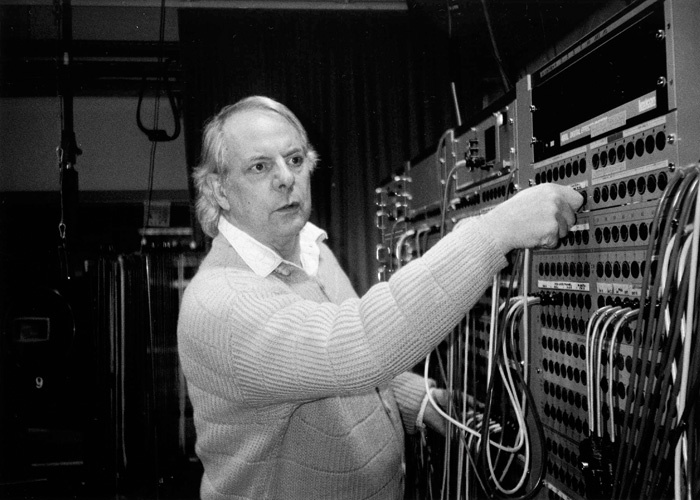 Stockhausen retained his interest in electronic composition throughout his life. This photo, again taken in WDR, dates from 1996.Stockhausen continued composing with electronics throughout his life, and in his later years he could often be found at electronic music festivals across Europe, attending performances of his own pieces or overseeing new works. His passion for pushing the envelope never seemed to dim; perhaps the most striking work of his later years is the Helicopter String Quartet of the mid–’90s, a piece which called for four helicopters, a string quartet, and swathes of loudspeakers, televisions and audio processing equipment. Electronically blending the music of the string quartet with the rotor noise of the helicopters, the piece seemed conceived to prove Stockhausen’s theory that “any sound can become music if it is related to other sounds”.
It’s unlikely, of course, that the sampled beats of hip–hop or the studio experiments of rock musicians, or indeed the “post–African repetitions” of Aphex Twin, were what he had in mind in saying this. But whether he intended it or not, his was the path that helped lead the way.
Further Investigation
If you want to find out more about the life, work and opinions of Karlheinz Stockhausen, a good starting point would be a visit to his web site (www.stockhausen.org). This offers a range of resources, including an on–line shop selling CDs, scores, books and videos.